
Global Shipping Halts in Strait of Hormuz as U.S. and Iran Open High-Stakes Peace Talks
Iran has declared the Strait of Hormuz closed in response to regional strikes, stalling international shipping just as U.S. and Iranian officials meet in Switzerland to negotiate a fragile peace framework.
By Factlen Editorial Team
- U.S. Administration
- Seeks to leverage both diplomatic negotiations and maximum military deterrence to reopen the strait and secure a broader regional agreement.
- Iranian Leadership
- Views the closure as a legitimate defensive measure and a critical point of leverage to force the release of frozen assets and halt regional strikes.
- Global Energy Markets
- Focused entirely on the immediate resumption of commercial transit to mitigate catastrophic price spikes and supply chain failures.
- Regional Security Analysts
- Warns of the extreme risk of accidental military escalation in the strait and the limitations of asymmetric naval warfare.
What's not represented
- · Commercial Maritime Insurers
- · European Energy Importers
- · Oman Port Authorities
Why this matters
The Strait of Hormuz is the world's most critical oil chokepoint, handling roughly 20% of global petroleum consumption. A prolonged closure threatens to spike global energy prices, disrupt supply chains, and escalate military conflict in the Middle East.
Key points
- Iran has declared the Strait of Hormuz closed to international shipping, citing ongoing regional military strikes.
- The closure immediately halted commercial transit and caused a significant spike in global crude oil prices.
- The crisis coincides with high-level U.S.-Iran diplomatic talks currently underway in Switzerland.
- Negotiators are attempting to resolve a major dispute over billions of dollars in frozen Iranian assets.
- President Trump has threatened military action if the strait remains closed, contrasting with VP Vance's diplomatic efforts.
- Alternative pipeline routes lack the capacity to replace the 21 million barrels of oil that pass through the strait daily.
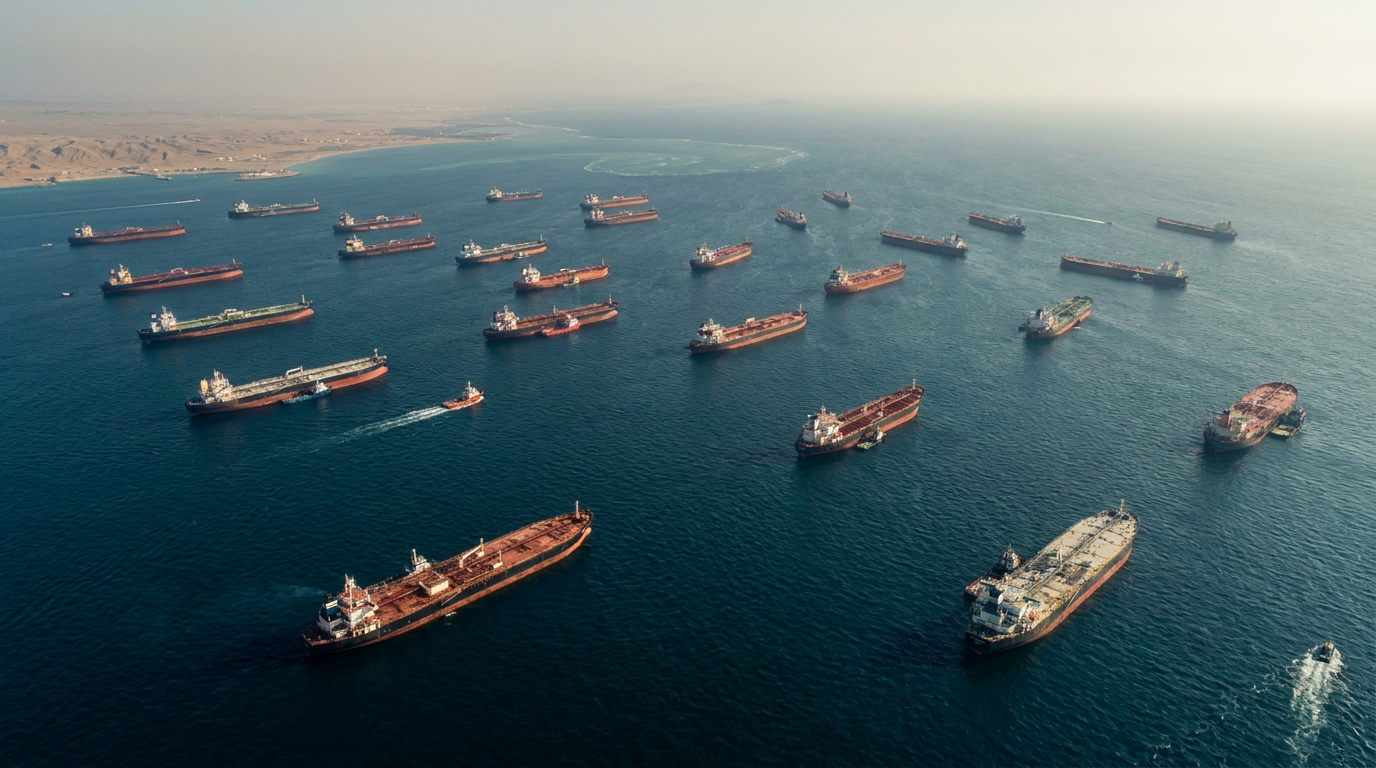
The physical reality of the crisis materialized overnight as ship tracking data revealed a sudden and near-total halt of commercial transits through the Strait of Hormuz. Tankers and cargo vessels have begun idling in the Gulf of Oman and the Persian Gulf, creating a massive maritime traffic jam at the world's most vital energy chokepoint. The disruption follows a formal declaration from Tehran that the key waterway is now shut to international shipping, a move that immediately sent shockwaves through global supply chains and maritime insurance markets.[2][5]
The catalyst for the shutdown is deeply tied to the broader regional conflict. Tehran explicitly linked the closure of the strait to ongoing Israeli military operations in southern Lebanon, framing the blockade as a necessary countermeasure against what it describes as unchecked regional aggression. By leveraging its geographic control over the strait, Iran is attempting to force the international community to intervene in the escalating violence in the Levant, utilizing horizontal escalation to maximize its geopolitical leverage.[1][6]
The macroeconomic shock was instantaneous. Brent crude prices surged dramatically on the news, reflecting the extreme vulnerability of global energy markets to any disruption in the region. Approximately 21 million barrels of oil—roughly one-fifth of global petroleum consumption—pass through the Strait of Hormuz every day. Energy analysts warn that if the closure persists beyond a few days, the resulting price spikes will cascade through the global economy, driving up inflation and threatening to tip fragile economies into recession.[4][7]

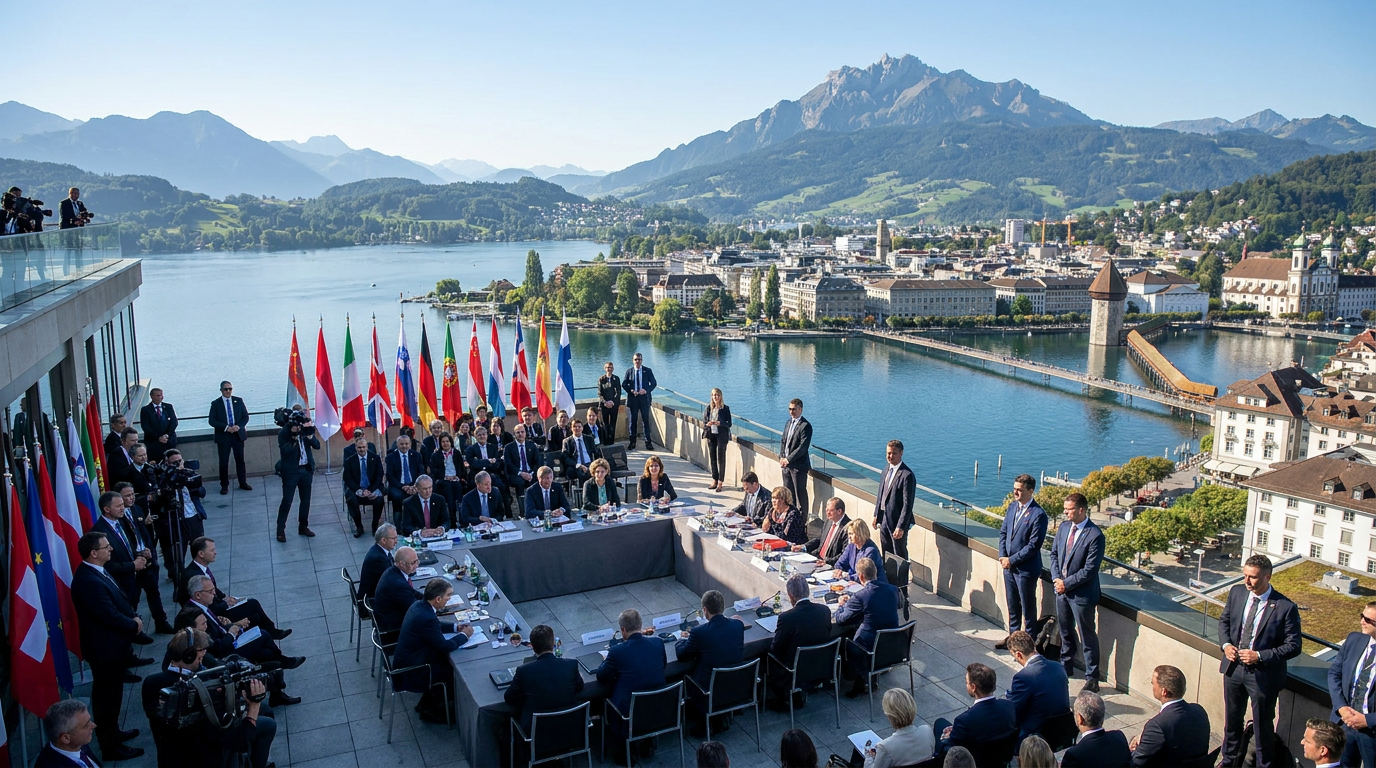
The crisis is unfolding in a deeply paradoxical diplomatic context. The physical closure of the strait coincides precisely with the commencement of high-level negotiations at the Bürgenstock resort in Switzerland. Vice President JD Vance is leading the U.S. delegation, publicly stating a desire to turn over a "new leaf" with Tehran and establish a comprehensive peace framework. The juxtaposition of a severe military-economic escalation and high-stakes diplomacy highlights the complex, multi-track nature of the current U.S.-Iran relationship.[1][8]
At the negotiating table in Switzerland, the core friction point extends beyond the immediate maritime crisis to a long-standing financial dispute. The talks are heavily focused on the fate of billions of dollars in frozen Iranian assets. These funds, sequestered under various international sanctions regimes, represent a critical lifeline for Iran's struggling economy. Experts note that resolving the status of these assets is the primary test of the new diplomatic framework, with both sides demanding significant concessions before agreeing to a release mechanism.[3][7]
The mechanics of unfreezing these funds are notoriously complex. It is not a simple matter of authorizing a wire transfer; it requires navigating a labyrinth of international banking compliance, secondary sanctions, and domestic political optics in the United States. Analysts point out that any agreement to release the funds will likely require strict oversight mechanisms to ensure the money is used for humanitarian purposes, a condition that Tehran has historically resisted as an infringement on its sovereignty.[3]

Complicating the diplomatic efforts in Switzerland is the contrasting messaging emanating from Washington. President Donald Trump has adopted a posture of maximum deterrence, publicly threatening to resume military strikes against Iran. In stark contrast to the conciliatory tone struck by his vice president, Trump warned that Iran "won't have a country" if the waterway remains closed, injecting a highly volatile element of brinkmanship into the ongoing crisis.[1]
Complicating the diplomatic efforts in Switzerland is the contrasting messaging emanating from Washington.
This strategic ambiguity has sparked intense debate among foreign policy analysts. Some view the divergent rhetoric between the President and the Vice President as a coordinated "good cop, bad cop" strategy designed to extract maximum concessions at the negotiating table. Others suggest it reflects a genuine fracture within the administration regarding the best approach to handling Tehran, raising questions about the U.S. delegation's ultimate authority to finalize a binding agreement in Switzerland.[1][7]
Iran's legal and rhetorical framing of the closure relies heavily on interpretations of international maritime law. State media and official spokespeople assert that restricting access to the strait is a sovereign right and a legitimate defensive measure in the face of regional threats. This claim is fiercely contested by Western capitals and international legal bodies, which maintain that the Strait of Hormuz is an international strait subject to the right of transit passage, making any unilateral closure a violation of international law.[6][8]
Understanding the gravity of the crisis requires examining the geography of the chokepoint itself. The Strait of Hormuz is only 21 miles wide at its narrowest point, but the actual navigable shipping lanes are restricted to just two miles in each direction, separated by a two-mile buffer zone. This extreme bottleneck makes the waterway highly susceptible to asymmetric disruption, where even a small-scale deployment of force can effectively halt massive commercial vessels.[7]

In the 21st century, a naval blockade does not require a physical wall of warships. The mere threat of asymmetric warfare—such as the deployment of fast-attack craft by the Islamic Revolutionary Guard Corps (IRGC), the laying of sea mines, or the positioning of coastal anti-ship missile batteries—is enough to send maritime insurance premiums to prohibitive levels. Once insurers refuse to cover vessels transiting the area, commercial traffic effectively ceases, achieving the goals of a blockade without firing a shot.[2][5]
Alternative routes for exporting Gulf oil are severely limited. While pipelines exist—such as the East-West Pipeline across Saudi Arabia to the Red Sea, and the Habshan-Fujairah pipeline in the United Arab Emirates—their combined spare capacity can only offset a fraction of the 21 million barrels lost by a Hormuz closure. The vast majority of the region's energy exports remain entirely dependent on safe passage through the strait, leaving global markets fundamentally exposed.[4][7]
The current diplomatic window is exceptionally fragile. Negotiators in Switzerland are racing against the clock, acutely aware that a prolonged economic shock will harden political positions in both Washington and Tehran. If the economic pain of the closure begins to severely impact Western economies, the pressure on the U.S. administration to abandon talks and resort to military intervention to reopen the strait will increase exponentially.[3][8]

The risk of tactical miscalculation in the Gulf remains the most immediate threat. With U.S. naval assets operating in close proximity to IRGC patrols in a highly charged environment, the margin for error is virtually nonexistent. A misread signal, an accidental collision, or a rogue action by a local commander could easily ignite a broader kinetic conflict, derailing the Switzerland talks entirely and plunging the region into war.[2][7]
The coming days will test the limits of both diplomacy and deterrence. The international community is watching to see whether the promise of sanctions relief and the unfreezing of billions in assets can outweigh the immense geopolitical leverage Iran currently wields by holding the global economy's most vital artery at risk. Until the tankers begin moving again, the global economy remains in a precarious state of suspended animation.[1][3][6]
How we got here
Mid-2026
Escalating Israeli military operations in southern Lebanon prompt threats of retaliation from Tehran.
June 20, 2026
U.S. Vice President JD Vance and Iranian officials arrive in Switzerland to begin negotiations on a peace framework.
June 21, 2026
Iran officially declares the Strait of Hormuz closed to international shipping, citing regional aggression.
June 22, 2026
Global oil prices spike as commercial transit through the strait comes to a complete halt.
Viewpoints in depth
U.S. Administration's Strategy
Washington is attempting a complex dual-track approach of high-level diplomacy paired with maximum military deterrence.
The U.S. approach is characterized by a stark division of labor. Vice President JD Vance is leading the diplomatic charge in Switzerland, attempting to construct a comprehensive peace framework that addresses both the immediate maritime crisis and the long-standing issue of frozen assets. This track relies on the premise that economic relief is the most effective lever to change Tehran's behavior. Simultaneously, President Trump is maintaining a posture of maximum pressure from Washington, issuing severe military threats to ensure Iran understands the catastrophic consequences of a prolonged blockade. Analysts debate whether this is a coordinated strategy or a sign of internal policy friction, but the immediate goal remains clear: force the reopening of the strait without triggering a full-scale regional war.
Tehran's Strategic Calculus
Iran views the closure of the strait as its most potent asymmetric weapon to force international intervention and secure economic relief.
For Iranian leadership, the Strait of Hormuz is the ultimate geopolitical trump card. By halting 20% of the world's oil supply, Tehran ensures that its regional security concerns—specifically the ongoing strikes in Lebanon—cannot be ignored by the international community. Furthermore, the timing of the closure, coinciding with the Switzerland talks, is a calculated move to maximize leverage over the billions in frozen assets. Iranian officials argue that the closure is a legitimate defensive measure under international law, framing it as a necessary response to Western-backed aggression. The strategy relies on the assumption that the West's fear of a global economic recession will ultimately outweigh its reluctance to unfreeze the disputed funds.
Energy Markets' Vulnerability
Commodity traders and supply chain analysts are bracing for catastrophic economic impacts if the chokepoint remains closed.
From the perspective of global energy markets, the political justifications for the closure are secondary to the immediate physical reality: the world's most important energy artery has been severed. Analysts point out that the global economy operates on a just-in-time supply chain model, meaning that even a brief disruption in the 21 million barrels per day flowing through Hormuz can cause immediate, cascading price shocks. While alternative pipelines exist across the Arabian Peninsula, their spare capacity is vastly insufficient to cover the shortfall. Market experts warn that if maritime insurers permanently revoke coverage for the region, the resulting energy crisis could rival the oil shocks of the 1970s, driving up global inflation and severely damaging industrial output.
What we don't know
- Whether the divergent messaging between President Trump and Vice President Vance is a coordinated negotiating tactic or a genuine policy dispute.
- The exact threshold of economic damage that would prompt the U.S. military to attempt a forced reopening of the strait.
- How long global energy markets can absorb the loss of Hormuz transit before triggering a severe recession.
- The specific oversight mechanisms being proposed in Switzerland for the release of Iran's frozen assets.
Key terms
- Strait of Hormuz
- A narrow waterway between the Persian Gulf and the Gulf of Oman, serving as the only sea passage from the Persian Gulf to the open ocean.
- Horizontal Escalation
- A military strategy where a country responds to an attack in one location by initiating conflict in a different, geographically separate theater to stretch the adversary's resources.
- Asymmetric Warfare
- Conflict between opposing forces which differ greatly in military power, typically involving unconventional tactics like fast-attack boats or sea mines to counter a larger conventional navy.
- Brent Crude
- A major trading classification of sweet light crude oil that serves as a benchmark price for purchases of oil worldwide.
Frequently asked
Can the U.S. Navy force the Strait of Hormuz open?
While the U.S. Navy possesses overwhelming conventional firepower, clearing the strait of asymmetric threats like sea mines and fast-attack craft is a slow, dangerous process that cannot immediately restore commercial shipping confidence.
How much of the world's oil goes through the strait?
Approximately 21 million barrels of oil per day pass through the Strait of Hormuz, which accounts for roughly 20% of total global petroleum consumption.
Why are Iranian assets frozen?
Billions of dollars in Iranian assets are held in foreign banks, frozen by international and U.S. sanctions designed to restrict Tehran's funding of its nuclear program and regional proxy groups.
Are there alternative routes for the oil?
Yes, pipelines exist across Saudi Arabia and the UAE to bypass the strait, but their combined spare capacity is only a few million barrels per day, far short of what is needed to replace the Hormuz route.
Sources
Source coverage
8 outlets
4 viewpoints surfaced








[1]The GuardianU.S. Administration
Trump news at a glance: President threatens to restart attacks on Iran even as Vance cites progress in talks
Read on The Guardian →[2]Al JazeeraRegional Security Analysts
Shipping stalls in Strait of Hormuz after Iran declares key waterway shut
Read on Al Jazeera →[3]Fox NewsU.S. Administration
Major dispute to threaten Trump's Iran deal over billions in frozen Tehran funds: expert
Read on Fox News →[4]ReutersGlobal Energy Markets
Brent crude spikes as Strait of Hormuz transit halts amid US-Iran talks
Read on Reuters →[5]BloombergGlobal Energy Markets
Global supply chains brace for impact as Hormuz closure traps tankers
Read on Bloomberg →[6]IRNAIranian Leadership
Tehran asserts sovereign right over Hormuz amid regional aggression
Read on IRNA →[7]Middle East InstituteRegional Security Analysts
The Strategic Calculus of Iran's 2026 Hormuz Closure
Read on Middle East Institute →[8]U.S. Department of StateU.S. Administration
Press Briefing on Switzerland Talks
Read on U.S. Department of State →
More in news politics
See all 6 stories →US-Iran Talks
US and Iran Agree to 60-Day Roadmap for Final Deal After Tense Opening in Switzerland
8 sources

Colombia Election
Right-Wing Outsider Abelardo de la Espriella Claims Victory in Historic Colombian Election
8 sources

Strait of Hormuz
US and Iran Open Direct Peace Talks in Switzerland Amid Renewed Strait of Hormuz Blockade
7 sources
Public Health Guidelines
Fact Check: Do 'Weekend Warrior' Workouts Actually Provide the Same Benefits as Daily Exercise?
7 sources

Every angle. Every day.
Get news politics stories with full source coverage and perspective breakdowns delivered to your inbox.