
How Small Language Models Are Moving AI From the Cloud to Your Pocket
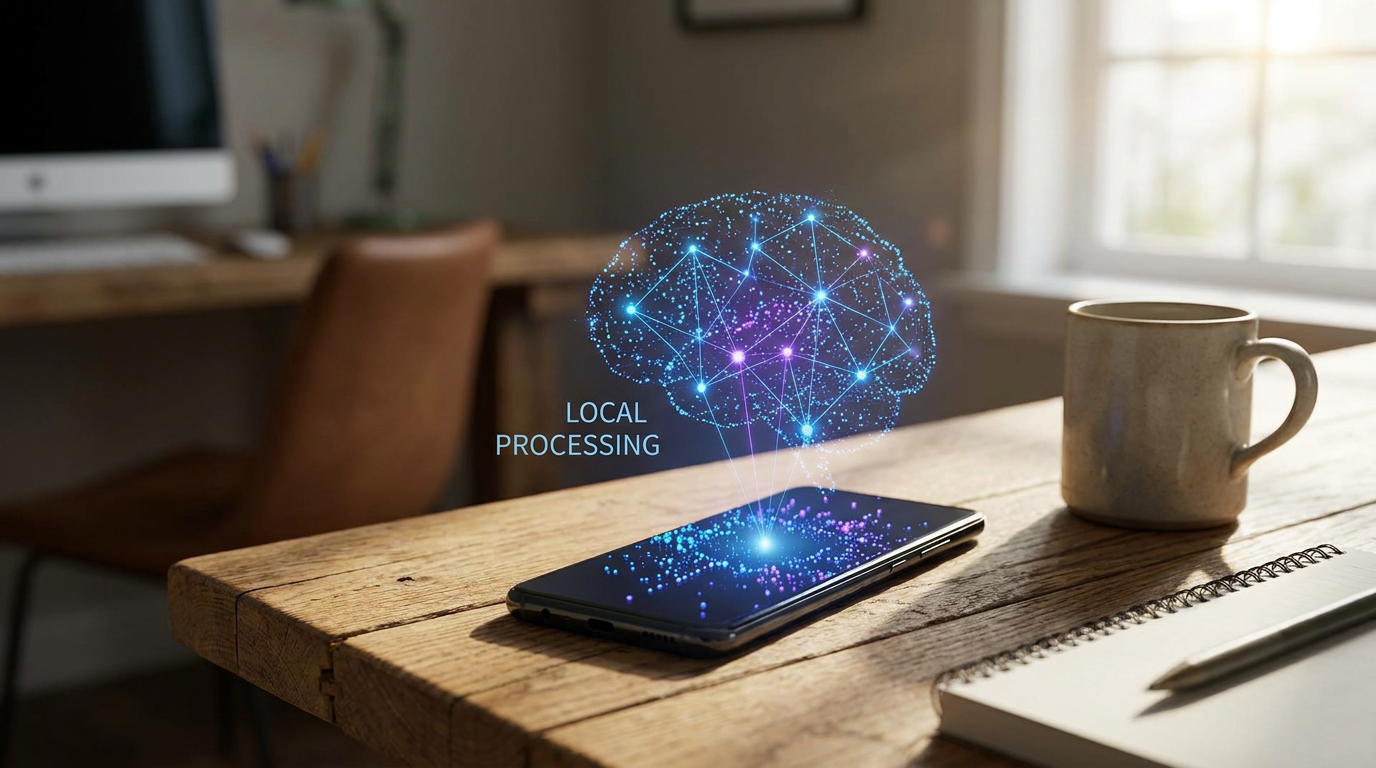
Massive cloud-based AI models are making room for a new paradigm: highly efficient, privacy-first Small Language Models that run entirely on consumer hardware.
By Factlen Editorial Team
- Privacy & Security Advocates
- Argue that local AI is the only viable path for handling sensitive personal and corporate data.
- Open-Source Developers
- Value SLMs for democratizing AI access and eliminating recurring API costs.
- Enterprise Strategists
- Focus on the economic efficiency of hybrid routing architectures.
What's not represented
- · Cloud Infrastructure Providers
- · Hardware Manufacturers
Why this matters
By processing data directly on your device rather than sending it to a remote server, Small Language Models guarantee absolute privacy, eliminate subscription costs, and allow powerful AI tools to work seamlessly offline.
Key points
- Small Language Models (SLMs) run entirely on local devices like smartphones and laptops.
- Local execution guarantees data privacy by keeping sensitive information off cloud servers.
- Techniques like quantization compress models to fit within standard consumer RAM limits.
- SLMs eliminate recurring API costs and network latency for developers.
- Enterprises are adopting hybrid routing, using local models for routine tasks and cloud models for complex queries.
For the past three years, the artificial intelligence narrative has been entirely dominated by scale. Technology giants raced to build massive data centers, training Large Language Models (LLMs) with hundreds of billions of parameters that required supercomputers just to answer a simple question. But in 2026, the most significant AI revolution is happening quietly in the palm of your hand, shifting power away from centralized servers and directly into consumer hardware.[8]
This shift is being driven by the rapid maturation of Small Language Models (SLMs). While there is no strict industry boundary, SLMs are generally defined as neural networks containing between 1 billion and 14 billion parameters. Unlike their massive cloud-based counterparts, these compact models are engineered specifically to run locally on the hardware you already own—smartphones, laptops, and embedded edge devices—without requiring an internet connection.[2][5]
What makes the current generation of SLMs remarkable is their performance parity. Models released in early 2026, such as Microsoft's Phi-4 (14B), Google's Gemma 3 (4B), and Meta's Llama 3.2 (3B), are achieving benchmark scores that rival the massive, trillion-parameter cloud models of just a year ago. They are proving that when it comes to everyday tasks like summarizing text, writing code, or managing schedules, raw size is no longer a prerequisite for high-quality reasoning.[4]

How do researchers make a model small but smart? The first breakthrough is a technique called "knowledge distillation." Instead of training an SLM from scratch on trillions of words of raw, unfiltered internet data, engineers use a massive "teacher" model to generate highly curated, high-quality reasoning patterns. The smaller "student" model then learns directly from these refined examples, absorbing the logic and capabilities of the larger model without inheriting its bloated memory footprint.[5]
The second, and arguably more crucial, mechanism is quantization. Neural network weights are typically stored as large 16-bit or 32-bit floating-point numbers, which demand massive amounts of memory. Quantization mathematically compresses these weights down to 4-bit integers (INT4). This aggressive compression drastically reduces the model's physical footprint, allowing a highly capable 4-billion parameter AI to fit comfortably within just 3 gigabytes of standard device RAM.[4][5]

This hardware-software synergy was firmly cemented at Apple's WWDC 2026. Apple Intelligence now relies heavily on a roughly 3-billion parameter on-device Foundation Model woven directly into the operating system. It processes text, understands images, and executes complex app intents entirely locally. Responses are generated in under a second, all without sending a single packet of personal data to a remote cloud server.[1][6]
This hardware-software synergy was firmly cemented at Apple's WWDC 2026.
For consumers and regulated industries alike, this local execution solves the biggest hurdle to AI adoption: data sovereignty. Because inference happens entirely on the edge device, sensitive information—whether it is a private text message, a patient's medical record, or proprietary corporate financial data—never traverses the public internet. This physical isolation inherently neutralizes the risk of cloud data breaches.[1][2]
Beyond privacy, SLMs offer a massive economic and functional advantage. Cloud LLMs incur per-token API costs and suffer from inevitable network latency. SLMs, by contrast, offer zero-latency inference and eliminate recurring API fees entirely. Developers are now building autonomous agents that can run continuously in the background of a mobile app, processing data for free without racking up thousands of dollars in server bills.[4][7]

Enterprises are rapidly adopting a "hybrid routing" architecture to capitalize on these economics. In this setup, a local SLM acts as the first line of defense, handling 80% to 95% of routine daily queries locally. Only when a user asks a highly complex question that exceeds the local model's capability is the request seamlessly escalated to a larger, more expensive cloud model.[5]
The open-source community has been instrumental in democratizing this technology. Projects like `llama.cpp` were designed specifically to run AI efficiently on standard consumer CPUs, rather than requiring expensive, dedicated graphics cards. This single architectural decision made local AI accessible to millions of developers, powering popular desktop tools that allow anyone to run private AI entirely offline.[3]
The impact of SLMs extends far beyond laptops and phones into industrial edge computing. Autonomous drones, smart factory sensors, and modern vehicles are deploying local vision-language models to process environmental data in real-time. In these scenarios, waiting for a cloud server to respond—or losing internet connectivity altogether—could be catastrophic. Local models ensure continuous, safe operation.[1][7]

Despite their rapid advancement, SLMs are not a universal replacement for frontier models. Due to their reduced parameter count, they lack the vast, encyclopedic world knowledge of massive cloud models. They can also struggle with highly nuanced, multi-step logical reasoning outside of their specific training domains, making them specialists rather than true generalists.[5]
Ultimately, the future of artificial intelligence is not just about building bigger data centers; it is about making AI smaller, faster, and more personal. By moving intelligence from distant server farms directly onto our devices, Small Language Models are democratizing access to machine learning, guaranteeing user privacy, and embedding capable AI into the very fabric of our daily hardware.[8]
Viewpoints in depth
Privacy & Security Advocates
Argue that local AI is the only viable path for handling sensitive personal and corporate data.
For healthcare providers, financial institutions, and privacy-conscious consumers, sending data to a third-party cloud server is a non-starter. Privacy advocates champion SLMs because they guarantee data sovereignty—inference happens entirely on the device, meaning personal messages, medical records, and proprietary code never traverse the internet. This physical isolation inherently neutralizes the risk of cloud data breaches and unauthorized model training.
Open-Source Developers
Value SLMs for democratizing AI access and eliminating recurring API costs.
The open-source community views SLMs as a liberation from the 'API tollbooths' of major tech giants. By optimizing models to run on standard consumer hardware—often using CPU-first engines like llama.cpp—developers can build and deploy autonomous agents, coding assistants, and offline tools without paying per-token fees. This camp prioritizes efficiency and accessibility, ensuring that AI innovation isn't restricted to organizations with massive cloud budgets.
Enterprise Strategists
Focus on the economic efficiency of hybrid routing architectures.
Corporate IT leaders are less concerned with ideology and more focused on unit economics. Running every employee query through a frontier cloud model is prohibitively expensive. Enterprise strategists advocate for 'hybrid routing,' where a cheap, fast local SLM handles 90% of routine tasks—like summarizing emails or formatting data—and only escalates complex reasoning requests to a premium cloud model. This drastically reduces operational expenditures while maintaining high performance.
What we don't know
- How quickly hardware manufacturers will scale up on-device memory to support even larger local models.
- Whether the performance gap between SLMs and frontier cloud models will eventually plateau or continue to close.
Key terms
- Parameter
- The internal variables or 'weights' a neural network uses to make decisions; a proxy for the model's size and complexity.
- Quantization
- A compression technique that reduces the precision of a model's weights (e.g., from 16-bit to 4-bit) to save memory and speed up processing.
- Knowledge Distillation
- A training method where a smaller 'student' model learns to mimic the outputs and reasoning patterns of a massive 'teacher' model.
- Edge Computing
- Processing data locally on the device where it is generated (like a phone or sensor), rather than sending it to a centralized cloud server.
- Inference
- The process of running live data through a trained AI model to generate a response or prediction.
Frequently asked
Can I run a Small Language Model on my current phone?
Yes. Modern smartphones equipped with dedicated Neural Processing Units (NPUs), such as recent iPhones and Google Pixels, can comfortably run 3-to-4 billion parameter models locally.
Do Small Language Models hallucinate less than large ones?
Because they are often fine-tuned on highly specific, curated datasets for narrow tasks, SLMs can be less prone to broad hallucinations than general-purpose cloud models, though they are not immune to errors.
Will SLMs replace massive cloud models like GPT-4?
No. Cloud models will remain essential for complex reasoning, vast knowledge retrieval, and heavy computational tasks. SLMs are designed to handle routine, everyday tasks efficiently at the edge.
Sources
Source coverage
8 outlets
3 viewpoints surfaced






[1]IBMPrivacy & Security Advocates
Why small language models are the next big thing in AI
Read on IBM →[2]OraclePrivacy & Security Advocates
What is a Small Language Model (SLM)?
Read on Oracle →[3]Red HatOpen-Source Developers
Benchmarking llama.cpp vs. vLLM for local AI inference
Read on Red Hat →[4]Local AI MasterOpen-Source Developers
Best Small Language Models 2026: Top Picks for Local AI
Read on Local AI Master →[5]CogitxEnterprise Strategists
Small Language Models (SLMs): Comprehensive Guide 2026
Read on Cogitx →[6]MindStudioEnterprise Strategists
What WWDC 2026 Signals for AI Builders: On-Device LLMs
Read on MindStudio →[7]deepsense.aiEnterprise Strategists
Developing a Complete RAG Pipeline with SLMs on a Mobile Phone
Read on deepsense.ai →[8]Factlen Editorial TeamEnterprise Strategists
Synthesis by Factlen editorial team
Read on Factlen Editorial Team →

More in ai
See all 5 stories →


Every angle. Every day.
Get ai stories with full source coverage and perspective breakdowns delivered to your inbox.