
How AI is Decoding the Carbonized Scrolls of Herculaneum
Two millennia after Mount Vesuvius turned an ancient Roman library into lumps of charcoal, machine learning is finally allowing scholars to read the lost texts without opening them.
By Factlen Editorial Team
- Classical Papyrologists
- Scholars focused on translating and interpreting the newly revealed Greek and Roman texts.
- Computer Vision Researchers
- Technologists and engineers focused on refining the machine learning pipeline and 3D segmentation tools.
- Archaeological Preservationists
- Experts focused on the physical conservation of the artifacts and the ethics of future excavations.
What's not represented
- · Italian cultural heritage regulators managing the physical artifacts
Why this matters
This breakthrough represents the largest influx of new classical literature since the Renaissance. By proving that carbonized, unopenable scrolls can be read digitally, researchers have unlocked a technology that could recover thousands of lost ancient texts, fundamentally altering our understanding of human history.
Key points
- The Herculaneum papyri are the only intact library surviving from classical antiquity, carbonized by the eruption of Mount Vesuvius in 79 AD.
- Physical attempts to unroll the scrolls over the past 270 years resulted in the destruction of the fragile artifacts.
- Researchers are now using high-resolution 3D X-ray scans from particle accelerators to map the internal layers of the crushed scrolls.
- Through the Vesuvius Challenge, crowdsourced machine learning models successfully detected the invisible carbon ink, allowing the scrolls to be read virtually.
For more than two centuries, one of the greatest literary treasures of the ancient world has sat in plain sight, completely unreadable. The Herculaneum papyri represent the only large-scale library from classical antiquity that has survived to the present day in its entirety. Yet, until recently, the hundreds of scrolls housed in museum vaults were little more than tantalizing mysteries—fragile lumps of carbonized ash that guarded the lost philosophies, histories, and poetry of the Greco-Roman world. Now, an unprecedented convergence of particle physics, computer vision, and crowdsourced machine learning is finally unlocking the invisible library. Without ever physically opening the delicate artifacts, researchers are peering deep inside their crushed layers to read words that have not been seen by human eyes in nearly two millennia.[7]
The story of the scrolls begins with a cataclysm. In 79 AD, the catastrophic eruption of Mount Vesuvius obliterated the Roman towns of Pompeii and Herculaneum. While Pompeii was famously buried under a steady rain of pumice and ash, Herculaneum was hit by a blistering pyroclastic flow—a superheated avalanche of gas and volcanic debris. This intense, oxygen-deprived heat instantly carbonized the organic materials in the town. Inside a sprawling luxury estate known today as the Villa of the Papyri, thought to have belonged to Julius Caesar's father-in-law, a vast collection of papyrus scrolls was flash-fried into compact, coal-like briquettes. Preserved beneath twenty feet of volcanic rock, the library slept undisturbed for centuries.[2][6]
The modern saga of the Herculaneum library began in 1752, when workmen digging a well for the Bourbon royal family accidentally struck the buried villa. As excavators tunneled through the hardened volcanic mud, they unearthed stunning bronze statues, intricate frescoes, and hundreds of blackened, cylindrical objects. Initially, many of these artifacts were thrown away, mistaken for lumps of charcoal or petrified tree branches. It was only when someone noticed faint traces of lettering on a broken fragment that the excavators realized they had stumbled upon a massive ancient library, containing upwards of 1,800 individual scrolls.[2][4]
Discovering the library was a triumph; attempting to read it was a disaster. For generations, scholars and antiquarians tried desperately to unroll the carbonized papyri. Early methods were brutal, involving slicing the scrolls in half with butcher knives or dousing them in harsh chemicals. Even the most delicate mechanical attempts, such as a specialized machine invented by a Vatican monk that used silk threads to slowly pull the papyrus apart, resulted in the scrolls crumbling into flakes of black dust. While some fragmented texts were recovered, the physical unrolling process invariably destroyed the very artifacts it sought to preserve.[2][4]

By the late 20th century, physical unrolling was entirely abandoned. The remaining collection—more than 300 completely intact, sealed scrolls—was placed in protective storage, mostly at the National Library of Naples and the Bodleian Libraries in Oxford. Scholars resigned themselves to the bitter reality that the technology required to read the scrolls simply did not exist. The invisible library became a symbol of lost knowledge, containing works by classical authors that had otherwise vanished from history, locked away in a format that was too fragile to touch.[4][6]
The paradigm shifted with the pioneering work of Dr. Brent Seales, a computer scientist at the University of Kentucky. Seales envisioned a process called "virtual unwrapping," which would use high-resolution medical imaging to see inside an object without opening it. In 2015, Seales and his team achieved a monumental proof-of-concept when they successfully read the En-Gedi scroll, a charred parchment from the Dead Sea region. By tracing the layers of the scroll in a 3D scan and digitally flattening them, they revealed the text of the Book of Leviticus. It was a watershed moment for digital archaeology, but Herculaneum presented a vastly more difficult challenge.[3][6]
The En-Gedi scroll was written with a metal-based ink, which showed up brightly on an X-ray against the carbonized parchment. The ancient Romans at Herculaneum, however, used a carbon-based ink made from soot and water. Because the papyrus itself had been turned into carbon by the volcano, the ink and the paper had the exact same radiodensity. On a standard X-ray or CT scan, the ink was completely invisible. The scrolls appeared as a dense, chaotic maze of crushed carbon, with no discernible lettering to guide the virtual unwrapping process.[1][3]
The En-Gedi scroll was written with a metal-based ink, which showed up brightly on an X-ray against the carbonized parchment.
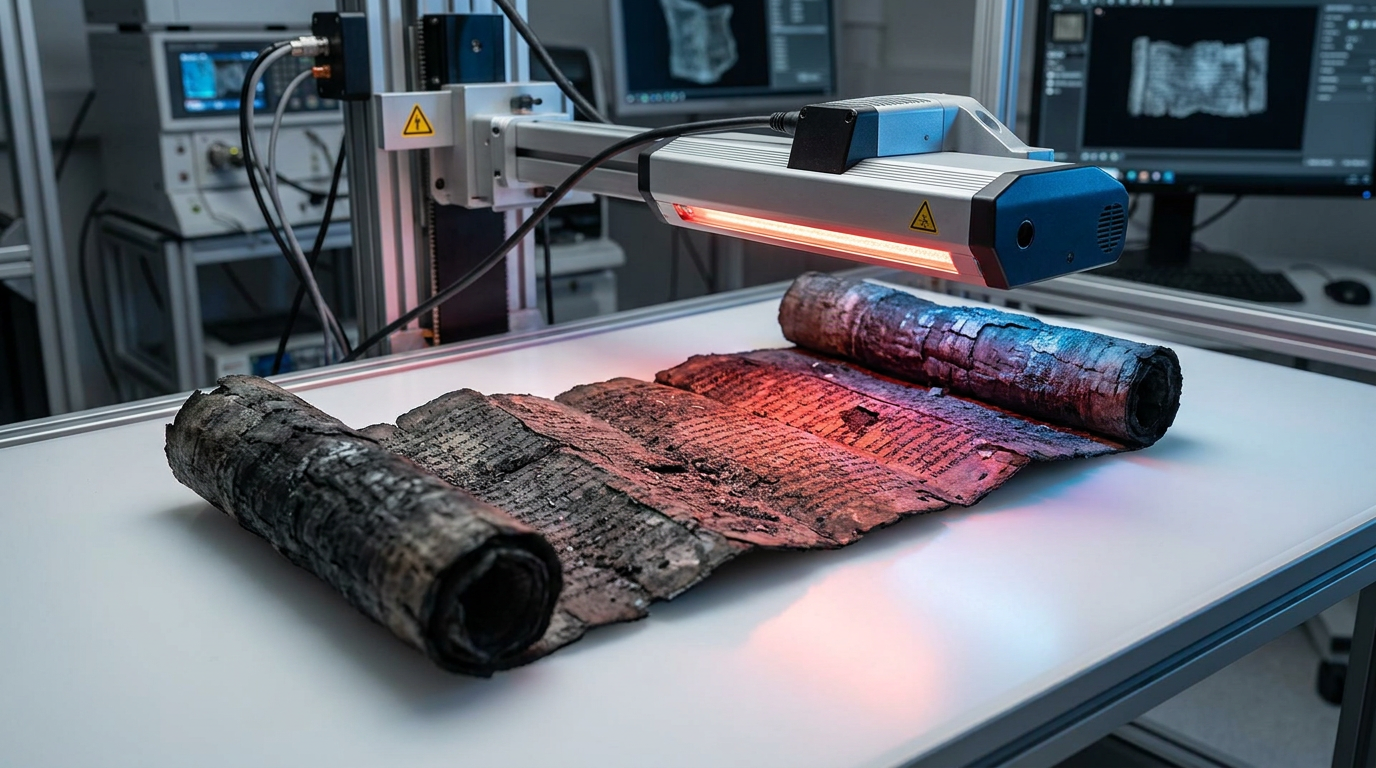
To find the invisible ink, researchers needed unprecedented resolution. They took the delicate scrolls to national synchrotron facilities—massive particle accelerators like the Diamond Light Source in the UK and the European Synchrotron Radiation Facility (ESRF) in France. These facilities produce X-ray beams billions of times brighter than the sun, capable of capturing 3D scans at a microscopic resolution of just a few micrometers. The resulting datasets were massive, providing a highly detailed topological map of the crushed papyrus layers, but the carbon ink still refused to show itself clearly to the naked eye.[1][5]

Realizing that the sheer scale of the data required a global effort, Seales partnered with Silicon Valley entrepreneurs Nat Friedman and Daniel Gross to launch the Vesuvius Challenge in March 2023. The project released thousands of 3D X-ray scans and open-source software tools to the public, offering over $1 million in prize money to anyone who could successfully decode the text. The competition galvanized a worldwide community of computer vision experts, machine learning engineers, and student researchers, turning a niche archaeological puzzle into a high-stakes technological race.[1][4]
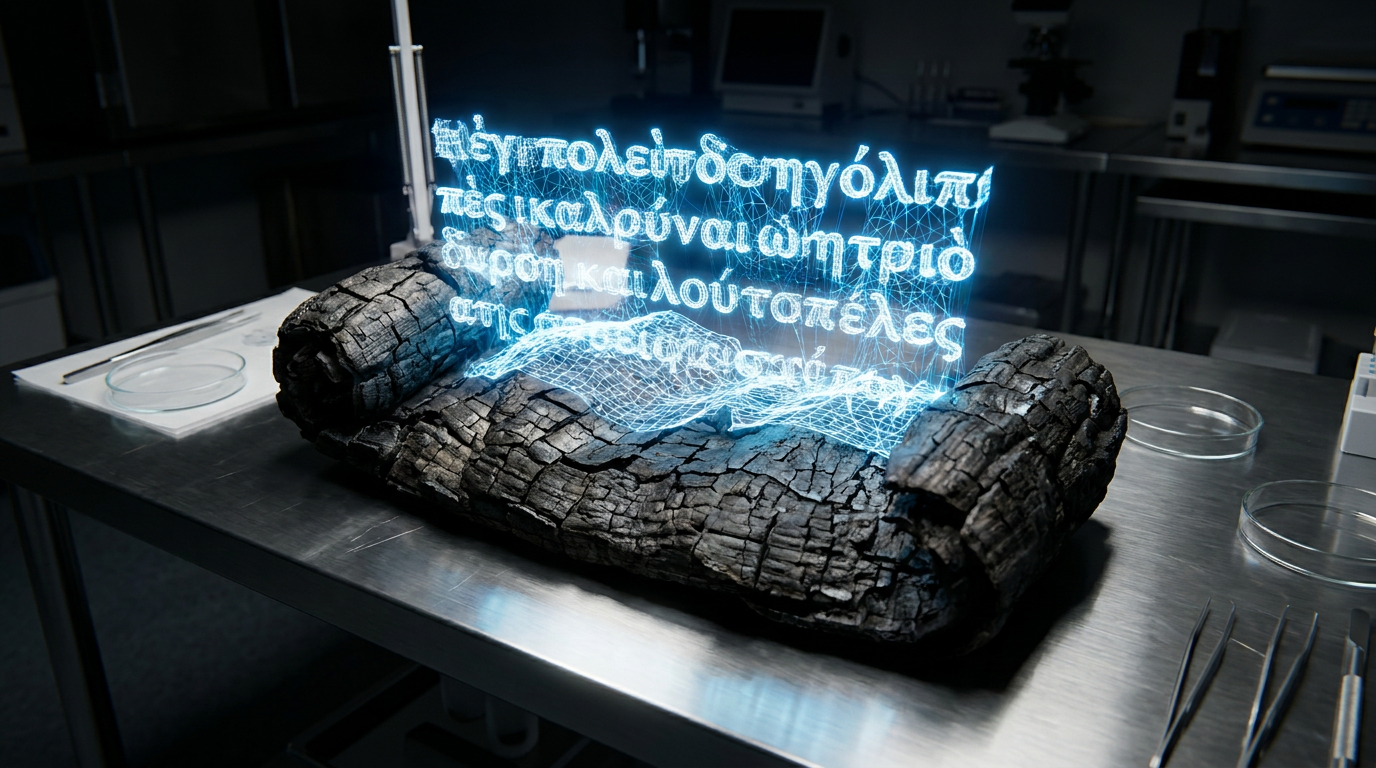
The breakthrough came from an unexpected realization about the physical properties of the ink. While the carbon ink didn't show up as a bright spot on an X-ray, it did subtly alter the surface texture of the papyrus. When the water-based ink dried, it caused the plant fibers to warp slightly, creating a microscopic "crackle" pattern. Contestants began training deep learning models to recognize these minute topological variations. By treating the 3D scans like video frames and feeding them through neural networks, the AI learned to detect the exact locations where ink had been applied, even when it was invisible to human researchers.[3][4]
In late 2023, the world witnessed the first fruits of this labor. Two students—Luke Farritor, a SpaceX intern, and Youssef Nader, a biorobotics graduate student in Berlin—independently trained machine learning models that revealed the first complete word from inside a sealed Herculaneum scroll. The word was "porphyras," the ancient Greek term for purple dye. The discovery sent shockwaves through the academic community, proving definitively that the carbonized ink could be detected and that the invisible library could, in fact, be read.[3][6]
The momentum accelerated rapidly. In early 2024, a team of students claimed the Vesuvius Challenge Grand Prize by decoding over 2,000 characters across 15 columns of text from a single scroll. Papyrologists translated the newly revealed Greek text, identifying it as a previously unknown philosophical work by Philodemus of Gadara, an Epicurean philosopher who lived in Herculaneum. The text discussed the nature of pleasure, specifically analyzing how the scarcity or abundance of food and music affects human enjoyment. For the first time in two millennia, a lost voice from antiquity was speaking again.[1][6]

The technological pipeline continued to yield astonishing results into 2025. Researchers turned their attention to a scroll known as PHerc. 172, housed at Oxford. By refining their segmentation and ink-detection algorithms, they managed to read the colophon—the final section of the scroll where the author and title are typically recorded. Without ever unrolling the papyrus, they identified the work as "On Vices," another text by Philodemus. It marked the first time the title of a still-rolled Herculaneum scroll had ever been recovered non-invasively, providing scholars with a direct map of the library's contents.[2][5]
As the project moves through 2026, the focus has shifted from proving the concept to scaling the operation. The Vesuvius Challenge community is currently working to fully automate the virtual unwrapping pipeline, minimizing the need for painstaking manual segmentation of the 3D meshes. Armed with faster scanning protocols developed at the ESRF, the team aims to image and read the remaining 300 intact scrolls over the next few years. What began as a painstaking, decades-long quest by a single laboratory has blossomed into a highly efficient, open-source factory for recovering ancient literature.[4][7]
The implications of this technology extend far beyond the scrolls currently sitting in museum vaults. The Villa of the Papyri has only been partially excavated, and archaeologists believe that the main library—potentially containing thousands of additional scrolls, including lost Latin masterpieces—still lies buried beneath the volcanic rock of Herculaneum. For centuries, the high cost of excavation and the inability to read the carbonized papyri kept the shovels at bay. Now, with the digital key to the library finally in hand, the push to unearth the rest of the villa has gained unprecedented urgency, promising a new Renaissance of classical knowledge.[4][7]
How we got here
79 AD
Mount Vesuvius erupts, burying Herculaneum and carbonizing the library at the Villa of the Papyri.
1752
Workmen digging a well accidentally discover the buried villa and its blackened scrolls.
2015
Dr. Brent Seales pioneers virtual unwrapping, successfully reading the En-Gedi scroll from Israel.
March 2023
The Vesuvius Challenge launches, crowdsourcing AI models to detect ink in the Herculaneum CT scans.
October 2023
The first word, 'porphyras' (purple), is successfully read from an unopened scroll.
2024
A team of students wins the Grand Prize for decoding over 2,000 characters of a lost philosophical text.
2025
Researchers successfully recover the title of a still-rolled scroll, 'On Vices,' without unrolling it.
Viewpoints in depth
Classical Papyrologists
Scholars focused on translating and interpreting the newly revealed Greek and Roman texts.
For classicists, the Vesuvius Challenge represents the holy grail of their field. The vast majority of literature from antiquity has been lost to time, with modern scholars relying on a narrow canon of texts that were copied by medieval monks. The Herculaneum library offers a direct, unedited window into the intellectual life of the 1st century BC. Papyrologists are particularly excited about the heavy presence of Epicurean philosophy in the recovered texts, hoping that further decoding will reveal lost works by major figures like Sophocles, Epicurus, or even early Roman histories that could rewrite our understanding of the ancient world.
Computer Vision Researchers
Technologists and engineers focused on refining the machine learning pipeline and 3D segmentation tools.
From a computer science perspective, the scrolls present one of the most complex geometric and pattern-recognition challenges ever attempted. The papyrus layers are crushed, warped, and fused together, requiring advanced 3D mesh segmentation just to trace a single page. Researchers in this camp view the project as a triumph of open-source collaboration. By releasing the massive CT datasets and offering bounty prizes, the Vesuvius Challenge bypassed traditional academic silos, allowing independent developers and students to rapidly iterate on neural networks. The ink-detection models developed here are already pushing the boundaries of what AI can extract from noisy, low-contrast medical imaging.
Archaeological Preservationists
Experts focused on the physical conservation of the artifacts and the ethics of future excavations.
Preservationists celebrate virtual unwrapping as the ultimate non-invasive conservation tool. For centuries, the desire to read the scrolls resulted in their physical destruction. The new digital pipeline ensures that the remaining 300 scrolls will survive intact for future generations. However, this camp is also looking ahead to the unexcavated portions of the Villa of the Papyri. While the ability to read the scrolls strengthens the argument for new digs, preservationists caution that any future excavation must be meticulously planned. Removing artifacts from the stable, oxygen-deprived volcanic mud exposes them to rapid degradation, meaning the scanning technology must be ready to process new discoveries immediately upon extraction.
What we don't know
- Whether the unexcavated lower levels of the Villa of the Papyri contain the main Latin library, which could hold lost works by major Roman authors.
- How quickly the fully automated segmentation pipeline can be perfected to read the remaining 300 scrolls without manual human tracing.
- Whether the machine learning models trained on Herculaneum ink can be adapted to read other damaged or faded manuscripts from different historical periods.
Key terms
- Virtual unwrapping
- A non-invasive digital technique that uses 3D X-ray tomography and computer vision to flatten and read the internal layers of a rolled object.
- Synchrotron
- A large particle accelerator that produces extremely bright X-rays, used to scan the dense carbonized scrolls at microscopic resolution.
- Epicureanism
- An ancient Greek system of philosophy founded by Epicurus, which taught that the pursuit of modest, sustainable pleasure and freedom from fear is the greatest good.
- Segmentation
- The computational process of tracing the complex, crumpled 3D layers of papyrus within a CT scan so they can be digitally flattened.
Frequently asked
Why can't archaeologists just unroll the scrolls?
The scrolls were carbonized by the extreme heat of the volcano. They are incredibly brittle, and physical attempts to unroll them cause them to crumble into dust.
Why didn't standard X-rays work?
The ancient Romans used a carbon-based ink made of soot and water. Because the papyrus was also turned into carbon by the volcano, the ink and the paper look identical on a standard X-ray.
What have they found in the scrolls so far?
Researchers have discovered lost philosophical texts by the Epicurean philosopher Philodemus, including writings on music, food, pleasure, and a newly identified scroll titled 'On Vices.'
Sources
Source coverage
7 outlets
3 viewpoints surfaced







[1]The GuardianClassical Papyrologists
AI helps scholars read scroll buried when Vesuvius erupted in AD79
Read on The Guardian →[2]Smithsonian MagazineClassical Papyrologists
Using A.I., Researchers Peer Inside a 2,000-Year-Old Scroll Charred by Mount Vesuvius' Eruption
Read on Smithsonian Magazine →[3]University of KentuckyComputer Vision Researchers
UnLost: Uncovering Lost Knowledge from the Ancient Library of Herculaneum
Read on University of Kentucky →[4]Vesuvius ChallengeComputer Vision Researchers
Master Plan and 2025 Updates
Read on Vesuvius Challenge →[5]ForbesArchaeological Preservationists
Scientists Peered Inside A 2,000-Year-Old Roman Scroll—And They’re Thrilled
Read on Forbes →[6]National Endowment for the HumanitiesComputer Vision Researchers
NEH-Supported Artificial Intelligence Project Decodes 2,000-Year-Old Herculaneum Scrolls
Read on National Endowment for the Humanities →[7]Factlen Editorial TeamArchaeological Preservationists
Synthesis by Factlen editorial team
Read on Factlen Editorial Team →
Every angle. Every day.
Get culture stories with full source coverage and perspective breakdowns delivered to your inbox.