
How AI and Next-Gen Sensors are Eliminating 'Clear Air Turbulence' Surprises
Airlines are deploying artificial intelligence, crowdsourced sensor networks, and airborne lasers to detect and avoid invisible turbulence, making flights smoother and safer.
By Factlen Editorial Team
- Aviation Safety Regulators
- Focuses on reducing in-flight injuries to passengers and crew through standardized data sharing and early warning systems.
- Airline Operations
- Prioritizes fuel efficiency, reducing aircraft structural wear, and avoiding overly cautious detours by using precise AI routing.
- Aerospace Engineers
- Focuses on the technical challenge of measuring molecular backscatter and integrating LIDAR sensors into commercial airframes.
What's not represented
- · Passengers with severe flight anxiety
- · Cabin crew unions
Why this matters
Clear air turbulence is the leading cause of in-flight injuries and a major source of passenger anxiety. By making the invisible visible, these new technologies protect travelers, reduce flight delays, and cut the carbon emissions associated with overly cautious detours.
Key points
- Clear air turbulence is invisible to traditional radar because it lacks moisture.
- IATA's Turbulence Aware platform crowdsources real-time sensor data from thousands of flights.
- New AI models can predict turbulence zones with 86% accuracy before a flight departs.
- Airborne LIDAR uses lasers to detect air density fluctuations up to 15 kilometers ahead.
- LIDAR gives pilots 60 to 90 seconds to adjust the aircraft and secure the cabin.
The sudden jolt of clear air turbulence is a universal travel anxiety. One moment, the flight is perfectly smooth; the next, the aircraft drops sharply, sending unsecured items flying and triggering a chorus of gasps. There are no storm clouds, no lightning, and seemingly no warning.[8]
The stakes go far beyond spilled coffee. Clear air turbulence (CAT) is the leading cause of in-flight injuries for passengers and cabin crew. It costs the global aviation industry hundreds of millions of dollars annually in medical claims, mandatory aircraft structural inspections, and the heavy fuel burn required to navigate around suspected rough patches.[4][5]
This challenge is becoming more urgent. Meteorological studies indicate that CAT is growing more frequent and severe as climate change alters the temperature gradients within the Earth's jet streams, increasing atmospheric wind shear.[2][7]
The core problem has always been a technological blind spot: pilots simply cannot see it. Traditional airborne weather radar relies on bouncing radio waves off water droplets or ice crystals to paint a picture of the sky ahead.[4]
Because CAT occurs in entirely cloudless skies, there is no moisture to reflect the radar waves. To a standard cockpit display, the violently swirling air looks perfectly clear, leaving flight crews unaware until the aircraft physically hits the invisible wake.[4]

The first major breakthrough in solving this problem relies on crowdsourcing. Through the International Air Transport Association's (IATA) Turbulence Aware platform, modern aircraft are being transformed into a global network of flying weather stations.[1]
Instead of relying on subjective radio reports from pilots—such as calling out "light chop at 35,000 feet"—aircraft sensors now automatically calculate the Eddy Dissipation Rate (EDR). EDR is an objective, mathematical measurement of the atmosphere's turbulent state, derived from how the airframe is buffeted.[1]
This precise EDR data is instantly beamed to ground servers, anonymized, and broadcast back up to other aircraft in the vicinity via Wi-Fi and satellite links, painting a real-time map of atmospheric conditions.[1][3]
The scale of this network is expanding rapidly. In 2024, participating airlines generated 51.8 million automated turbulence reports—a 35% increase from the previous year—giving dispatchers an unprecedented view of where rough air is actively occurring.[7]

But knowing where turbulence is right now is only half the battle; knowing where it will be hours from now is the holy grail. To achieve this, the aviation industry is turning to artificial intelligence.[8]
But knowing where turbulence is right now is only half the battle; knowing where it will be hours from now is the holy grail.
All Nippon Airways (ANA) recently became the first airline to fully implement an AI-driven turbulence prediction service across its fleet. Developed in collaboration with BlueWX and Keio University, the deep learning model analyzes a decade of historical flight data alongside complex meteorological patterns.[2][5]
The AI model has achieved an impressive 86% accuracy rate. By forecasting turbulent zones before a plane even leaves the tarmac, dispatchers can optimize flight paths to avoid the worst areas entirely.[5]

Other major carriers are following suit. Delta Air Lines has deployed AI systems that fuse real-time aircraft sensor data with weather forecasts. This allows the airline to pinpoint turbulence zones in advance, saving thousands of tons of jet fuel that would otherwise be wasted on unnecessary detours.[6]
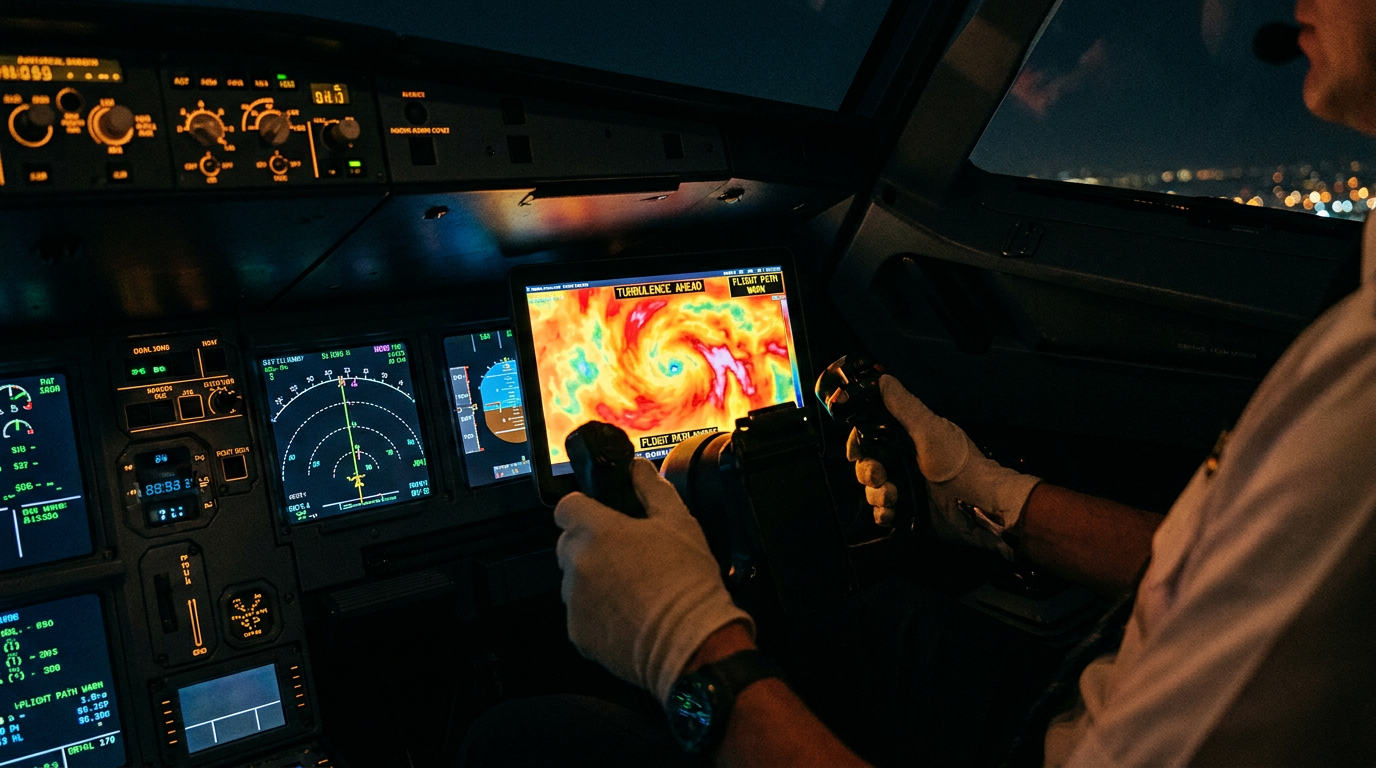
While AI predicts and crowdsourcing shares, the ultimate frontier is allowing an individual aircraft to "see" invisible turbulence directly ahead of its nose. This is being achieved through Airborne LIDAR (Light Detection and Ranging).[4]
Unlike traditional radar, a LIDAR system emits short-wave ultraviolet or visible laser pulses forward along the aircraft's flight path.[3][4]
Instead of needing water droplets to bounce off, these highly calibrated lasers reflect off the air molecules themselves. By measuring this "molecular backscatter," the system can detect the minute air density fluctuations that characterize clear air turbulence.[3][4]
Recent engineering breakthroughs by the German Aerospace Center (DLR) and independent researchers have demonstrated that both UV and 532-nanometer visible-light LIDAR can detect moderate turbulence 10 to 15 kilometers ahead of the aircraft.[3][4]

At typical cruising speeds, a 15-kilometer detection range gives pilots roughly 60 to 90 seconds of advance warning before the aircraft enters the turbulent zone.[4][8]
While a minute may seem brief, it is a game-changer. It provides enough time for the autopilot to adjust the aircraft's angle of attack to smooth the ride, and for the crew to secure service carts and instruct passengers to buckle up.[4][8]
The era of the unexpected plunge is coming to an end. Through a combination of AI forecasting, global sensor networks, and laser-based detection, aviation is systematically stripping the surprise out of clear air turbulence, ensuring that the skies remain safe and comfortable.[8]
How we got here
2018
IATA launches the Turbulence Aware platform to begin crowdsourcing flight data.
2021
All Nippon Airways (ANA) and Keio University begin operational trials of an AI-based turbulence prediction model.
2024
IATA's platform processes a record 51.8 million automated turbulence reports from participating airlines.
August 2025
ANA becomes the first airline to fully implement AI turbulence prediction across its fleet, achieving 86% accuracy.
2026
Advancements in visible-light and UV LIDAR demonstrate the ability to detect clear air turbulence up to 15 kilometers ahead of an aircraft.
Viewpoints in depth
Aviation Safety Regulators
Focuses on reducing in-flight injuries to passengers and crew through standardized data sharing and early warning systems.
For regulatory bodies and industry associations like IATA, the primary concern is human safety. Clear air turbulence remains the leading cause of non-fatal aviation accidents, disproportionately affecting unbuckled passengers and working cabin crew. Regulators view the standardization of Eddy Dissipation Rate (EDR) data as a critical milestone. By moving away from subjective pilot reports and toward objective, automated sensor data, the industry can create a unified, global safety net that warns every aircraft in the sky, regardless of the airline.
Airline Operations
Prioritizes fuel efficiency, reducing aircraft structural wear, and avoiding overly cautious detours by using precise AI routing.
From an operational standpoint, turbulence is incredibly expensive. When pilots lack precise data, they take wide, conservative detours around suspected rough air, burning thousands of tons of excess jet fuel and increasing carbon emissions. Furthermore, severe turbulence encounters require mandatory, time-consuming structural inspections of the airframe, leading to flight cancellations. Operations managers champion AI prediction and LIDAR because these tools allow for surgical precision—avoiding the actual turbulence without wasting fuel on phantom threats.
Aerospace Engineers
Focuses on the technical challenge of measuring molecular backscatter and integrating LIDAR sensors into commercial airframes.
Engineers and researchers view clear air turbulence as a complex physics problem. Traditional radar is useless without water droplets, so the challenge has been developing lasers powerful enough to measure the density of the air itself (molecular backscatter) without blinding other aircraft or requiring massive power supplies. Researchers at institutions like the German Aerospace Center (DLR) are focused on miniaturizing these UV and visible-light LIDAR systems so they can be seamlessly integrated into the aerodynamic noses of commercial jetliners without adding prohibitive weight.
What we don't know
- How quickly LIDAR systems can be miniaturized and retrofitted onto older, existing commercial aircraft fleets.
- Whether AI prediction models will maintain their 86% accuracy as climate change rapidly alters historical jet stream patterns.
Key terms
- Clear Air Turbulence (CAT)
- Severe atmospheric turbulence occurring in cloudless regions, making it invisible to traditional weather radar.
- Eddy Dissipation Rate (EDR)
- An objective, mathematical metric used by aircraft sensors to measure the intensity of turbulence in the atmosphere.
- LIDAR (Light Detection and Ranging)
- A remote sensing method that uses pulsed lasers to measure distances and detect invisible atmospheric changes.
- Molecular Backscatter
- The reflection of laser light off air molecules, which allows LIDAR systems to detect the density fluctuations that cause turbulence.
Frequently asked
Will clear air turbulence crash a modern airplane?
No. Modern commercial aircraft are engineered to withstand forces far exceeding even the most severe turbulence. The primary risk is internal injury to unbuckled passengers and crew.
Why is clear air turbulence becoming more common?
Climate change is altering global temperature gradients, which increases wind shear within the jet streams and generates more frequent and intense clear air turbulence.
How does AI predict turbulence before takeoff?
AI models analyze decades of historical flight data, real-time meteorological conditions, and global wind patterns to forecast turbulent zones with up to 86% accuracy.
Can pilots see clear air turbulence out the window?
No. Because it occurs in cloudless air without moisture, it is completely invisible to the naked eye and to traditional weather radar.
Sources
Source coverage
8 outlets
3 viewpoints surfaced








[1]IATAAviation Safety Regulators
Turbulence Aware Platform
Read on IATA →[2]Aerospace Global NewsAirline Operations
ANA is the first airline to adopt AI-driven turbulence prediction
Read on Aerospace Global News →[3]MDPIAerospace Engineers
A Clear Air Turbulence Detection Method Using a 532 nm Visible Light Airborne LiDAR System
Read on MDPI →[4]DLRAerospace Engineers
Airborne remote detection of Clear Air Turbulence with LIDAR
Read on DLR →[5]Mexico Business NewsAirline Operations
ANA First to Use AI Turbulence Prediction at 86% Accuracy
Read on Mexico Business News →[6]TravieAirline Operations
Aviation AI Market and Delta Air Lines Turbulence Prediction
Read on Travie →[7]EVA AirAirline Operations
EVA Air Joins IATA's Turbulence Aware Platform
Read on EVA Air →[8]Factlen Editorial TeamAviation Safety Regulators
Synthesis by Factlen editorial team
Read on Factlen Editorial Team →
Every angle. Every day.
Get travel stories with full source coverage and perspective breakdowns delivered to your inbox.