
Global Markets Surge and Oil Plunges Following U.S.-Iran Peace Framework
Stock indices across Asia and Wall Street rallied sharply as Brent crude fell below $84 a barrel following an interim agreement to reopen the Strait of Hormuz.
By Factlen Editorial Team
- Global Equity Investors
- Focused on the risk-on rally and easing inflation pressures.
- Energy Importers & Shippers
- Focused on the unblocking of the Strait of Hormuz and immediate supply relief.
- Geopolitical Skeptics
- Focused on the fragility of the 60-day interim framework and unresolved issues.
What's not represented
- · Domestic U.S. political reactions
- · OPEC+ member state reactions
Why this matters
The reopening of the world's most critical energy chokepoint instantly lowers fuel costs for consumers and businesses globally. For investors, the removal of this massive geopolitical overhang clears the way for a sustained market rally and reduces the pressure on central banks to keep interest rates high.
Key points
- The U.S. and Iran have agreed to an interim peace framework, ending a 107-day conflict.
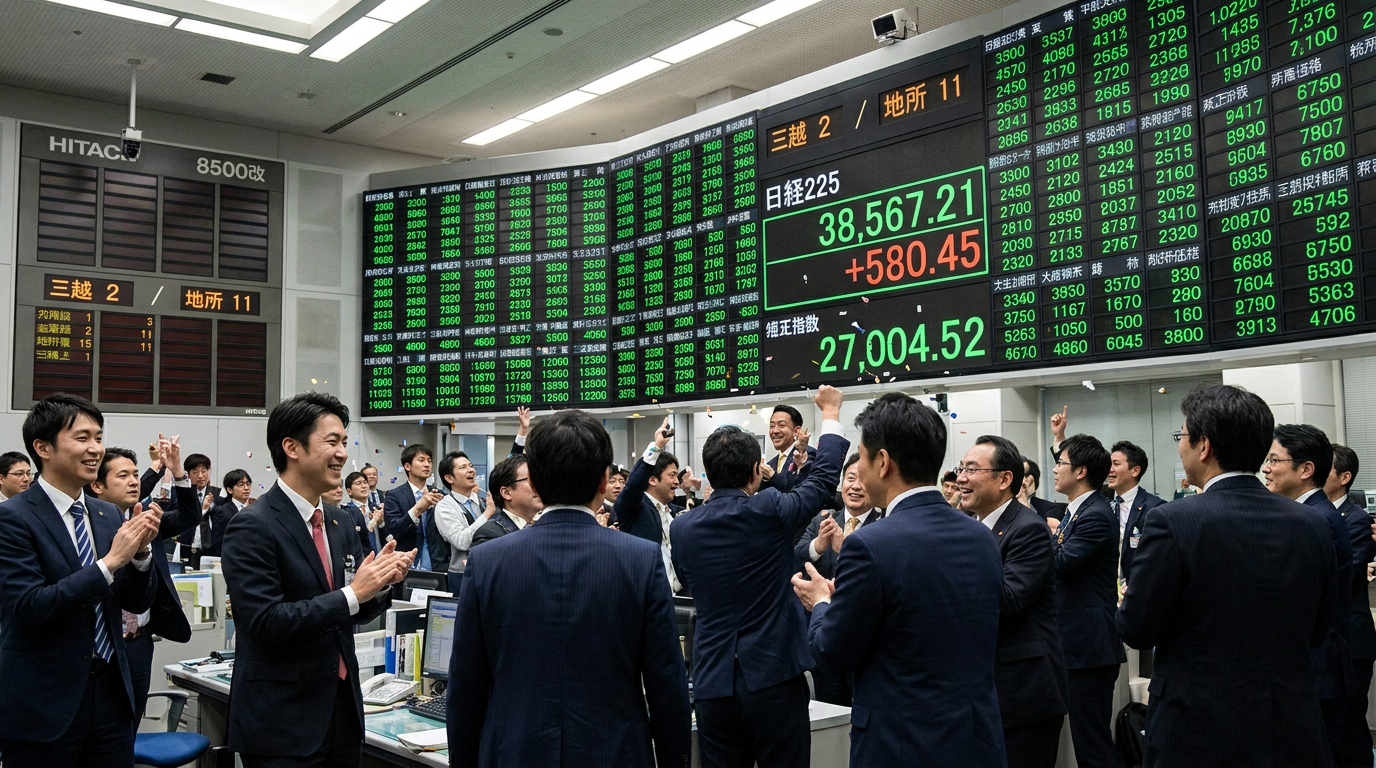
- Global equity markets surged on the news, with Japan's Nikkei 225 jumping 5.5%.
- Brent crude oil prices tumbled roughly 5% to below $83.50 a barrel.
- The agreement paves the way for reopening the Strait of Hormuz, a vital global energy chokepoint.
- A 60-day negotiating window will follow to finalize details on sanctions and frozen assets.
Global equity markets surged and oil prices plummeted on Monday following the announcement of a framework peace agreement between the United States and Iran, signaling an end to a 107-day conflict that had choked global energy supplies. The breakthrough agreement, which includes an immediate cessation of hostilities and the lifting of a U.S. naval blockade, has instantly removed the largest geopolitical overhang facing the global economy in 2026. Financial centers from Tokyo to New York reacted with immediate exuberance, pricing in a rapid return to normalized trade and lower energy costs.[1][4]
Asian markets led the relief rally, acting as the first major financial hubs to open after the weekend announcement. Japan's Nikkei 225 benchmark index soared 5.5% in morning trading, while South Korea's Kospi jumped over 5.7%, reflecting deep relief in economies heavily reliant on imported energy. U.S. stock futures quickly followed suit, with contracts tied to the Dow Jones Industrial Average and the tech-heavy Nasdaq 100 pointing to a robust open on Wall Street. Investors breathed a collective sigh of relief over the de-escalation, shifting capital aggressively back into risk-on assets.[1][2][4]
The most immediate and dramatic impact was felt in the energy sector, where the conflict had previously driven prices to multi-year highs. Brent crude, the primary global benchmark, tumbled roughly 5% to below $83.50 a barrel, erasing months of war-driven premiums that had threatened to tip the global economy into a recession. U.S. West Texas Intermediate crude experienced a similar plunge, dropping nearly 6% as traders rapidly unwound speculative positions built on the assumption of a prolonged Middle Eastern conflict.[1][2][3][6]

The market euphoria stems directly from the interim agreement's promise to reopen the Strait of Hormuz, the world's most vital maritime chokepoint. President Donald Trump took to social media to declare the maritime route open, proclaiming to the shipping industry, "Let the oil flow!" and authorizing the immediate removal of the U.S. naval blockade. The decisive rhetoric provided the exact signal energy markets had been waiting for, confirming that the physical barriers to global oil transit were finally being dismantled.[3]
The Strait of Hormuz is a critical artery for the global economy, normally handling roughly a fifth of the world's oil and liquefied natural gas. Its closure over the past three months had stranded dozens of commercial vessels, disrupted complex global supply chains, and forced the International Energy Agency to release record levels of emergency reserves—up to 2.5 million barrels a day—just to stabilize prices. The unblocking of this strait is viewed by economists as the single most important factor in preventing a sustained global energy crisis.[2][3]

The Strait of Hormuz is a critical artery for the global economy, normally handling roughly a fifth of the world's oil and liquefied natural gas.
For the broader economy, the sudden drop in energy costs eases a major inflationary pressure that had been troubling central banks worldwide. This shift comes at a highly critical moment for the U.S. Federal Reserve, as newly appointed Chair Kevin Warsh prepares for his first policy meeting this week. With the threat of war-fueled energy inflation suddenly subsiding, markets are rapidly reassessing the trajectory of interest rates, betting that the Fed may now have the breathing room to hold rates steady rather than being forced into defensive hikes.[2][4]
The risk-on sentiment rippled across other asset classes throughout the trading day, fundamentally reshaping currency and commodity valuations. The U.S. dollar slipped to a 10-day low against major peers as investors confidently moved capital away from safe-haven cash positions and into higher-yielding equities. Paradoxically, spot gold saw a 2% bump, hitting its highest level since early June, as the broader easing of inflation fears and the prospect of a more dovish Federal Reserve made the non-yielding metal more attractive to institutional buyers.[4][5]
Energy-dependent emerging markets are particularly poised to benefit from the diplomatic breakthrough. Analysts in India noted that the deal promises immediate and profound relief from high import costs, easing severe pressure on the rupee and mitigating local inflation risks that had intensified during the 107-day conflict. For these economies, the peace framework is not just a geopolitical victory, but a vital economic lifeline that prevents further currency devaluation and protects domestic consumers from skyrocketing fuel and food prices.[4]
Despite the widespread market exuberance, the framework remains an interim step with several complex logistical and diplomatic hurdles remaining. Iranian authorities outlined a 60-day negotiating window to finalize the granular details of the pact, which reportedly include the release of $24 billion in frozen Iranian assets and the formal suspension of broader economic sanctions. Geopolitical analysts caution that this two-month window will be highly sensitive, requiring strict adherence from both sides to prevent the fragile truce from collapsing before a permanent treaty is signed.[1][3]

On the operational front, major shipping associations are advising caution, waiting for concrete maritime details and comprehensive mine-clearing operations before moving their stranded vessels through the previously contested waters. The Japanese Shipowners' Association, which currently has 38 linked vessels stranded in the channel, stated they are waiting for "more concrete information" before resuming transit. However, for forward-looking financial markets, the mere prospect of normalized global trade has been more than enough to ignite one of the strongest and most broad-based cross-asset rallies of the year.[1][2][3]
How we got here
Late Feb 2026
Conflict breaks out, leading to a U.S. naval blockade and the closure of the Strait of Hormuz.
March 2026
Global oil prices spike as energy markets panic over the severed supply lines.
June 12, 2026
Oil prices begin to slide from $93 a barrel amid rumors of an impending diplomatic breakthrough.
June 15, 2026
The U.S. and Iran officially announce an interim peace framework, triggering a massive global market rally.
Viewpoints in depth
Global Equity Investors
Focused on the removal of a massive economic headwind.
For equity markets, the peace framework removes the single largest tail risk of 2026. Investors had been bracing for prolonged inflation and depressed corporate margins due to soaring energy costs. The sudden resolution has triggered a massive "risk-on" rotation, sending capital out of safe havens like the U.S. dollar and into growth stocks and emerging markets.
Energy Importers
Relieved by the restoration of critical supply lines.
Nations heavily dependent on imported energy, particularly in Asia, view the deal as an economic lifeline. The reopening of the Strait of Hormuz prevents a catastrophic supply shock that was already straining national reserves and currency valuations in countries like India, Japan, and South Korea.
Geopolitical Analysts
Cautious about the fragility of the 60-day interim framework.
While markets are pricing in a complete resolution, geopolitical experts emphasize that this is only a preliminary framework. The upcoming 60-day negotiating window must resolve complex issues, including the unfreezing of $24 billion in Iranian assets and the permanent lifting of sanctions, leaving room for potential setbacks before oil flows fully normalize.
What we don't know
- The exact timeline for when commercial shipping will fully resume through the Strait of Hormuz.
- Whether the 60-day negotiating window will successfully resolve remaining disputes over sanctions and frozen assets.
- How the sudden drop in energy-driven inflation will impact the Federal Reserve's upcoming interest rate decisions.
Key terms
- Brent Crude
- The primary benchmark price for global oil purchases, used to price two-thirds of the world's internationally traded crude oil.
- Risk-on Asset
- Investments like stocks or emerging market currencies that carry higher risk but offer higher returns, which investors favor when economic confidence is high.
- Safe-haven Asset
- Investments like the U.S. dollar or gold that are expected to retain or increase in value during times of market turbulence.
- Strait of Hormuz
- A narrow waterway connecting the Persian Gulf to the open ocean, serving as the world's most important oil transit chokepoint.
Frequently asked
Why did the stock market surge today?
Global markets rallied because the U.S. and Iran announced a framework for a peace deal, ending a 107-day conflict that had threatened global energy supplies and economic stability.
How much did oil prices drop?
Brent crude, the global oil benchmark, fell roughly 5% to below $83.50 a barrel following the announcement.
What is the Strait of Hormuz?
It is a critical maritime chokepoint between the Persian Gulf and the Gulf of Oman, through which roughly 20% of the world's oil and liquefied natural gas normally passes.
Is the peace deal finalized?
Not entirely. The current agreement is an interim framework, with a 60-day negotiating period planned to finalize details regarding sanctions and frozen assets.
Sources
Source coverage
6 outlets
3 viewpoints surfaced






[1]Al JazeeraGeopolitical Skeptics
Stock markets soar, oil falls as US and Iran announce framework to end war
Read on Al Jazeera →[2]Investing.comGlobal Equity Investors
U.S. stock futures climb after the U.S. and Iran announce an interim peace agreement
Read on Investing.com →[3]The GuardianEnergy Importers & Shippers
Donald Trump posts 'Let the oil flow' as US-Iran peace deal sparks immediate drop for Brent crude
Read on The Guardian →[4]The HinduEnergy Importers & Shippers
Stock markets surge tracking global rally, drop in oil prices as U.S., Iran reach peace deal
Read on The Hindu →[5]The StarEnergy Importers & Shippers
Dollar hits 10-day low as US, Iran reach peace deal
Read on The Star →[6]MarketWatchGlobal Equity Investors
Oil prices decline after U.S.-Iran agree to framework of peace deal
Read on MarketWatch →

Every angle. Every day.
Get finance stories with full source coverage and perspective breakdowns delivered to your inbox.