
G7 Leaders Push for Ukraine Peace Deal as Trump Signals Return of Russian Oil Sanctions
Following a ceasefire in Iran, U.S. President Donald Trump used the G7 summit to urge Russia to negotiate an end to the war in Ukraine, signaling that Washington may soon reimpose suspended oil sanctions on Moscow.
By Factlen Editorial Team
- Kyiv & European Allies
- Advocating for maximum pressure on Moscow and viewing U.S. mediation as the key to forcing a settlement.
- The U.S. Administration
- Focused on leveraging the end of the Middle East conflict to broker a legacy-defining peace deal in Eastern Europe.
- Global Economic Observers
- Monitoring the fallout of renewed sanctions on global energy markets and the effectiveness of targeting Russia's shadow fleet.
What's not represented
- · The Kremlin / Russian Government
- · Iranian Leadership
Why this matters
The potential reimposition of U.S. sanctions on Russian oil could significantly impact global energy prices, while a U.S.-brokered peace summit may represent the most viable path to ending the four-year war in Ukraine.
Key points
- U.S. President Donald Trump urged Russia to make a deal to end the war in Ukraine during the G7 summit in France.
- Trump signaled the U.S. may reimpose sanctions on Russian oil that were temporarily lifted during the recent Iran conflict.
- Ukrainian President Volodymyr Zelenskyy presented Trump with photos of a Russian strike on a historic Kyiv monastery, drawing strong condemnation.
- European leaders are actively urging Trump to host a trilateral peace summit in the U.S. between himself, Zelenskyy, and Putin.
- Ukraine is seeking licenses to manufacture U.S.-designed anti-ballistic missile systems domestically to secure its long-term air defense.
- The UK and Canada announced new sanctions targeting the 'shadow fleet' Russia uses to export oil and evade Western price caps.
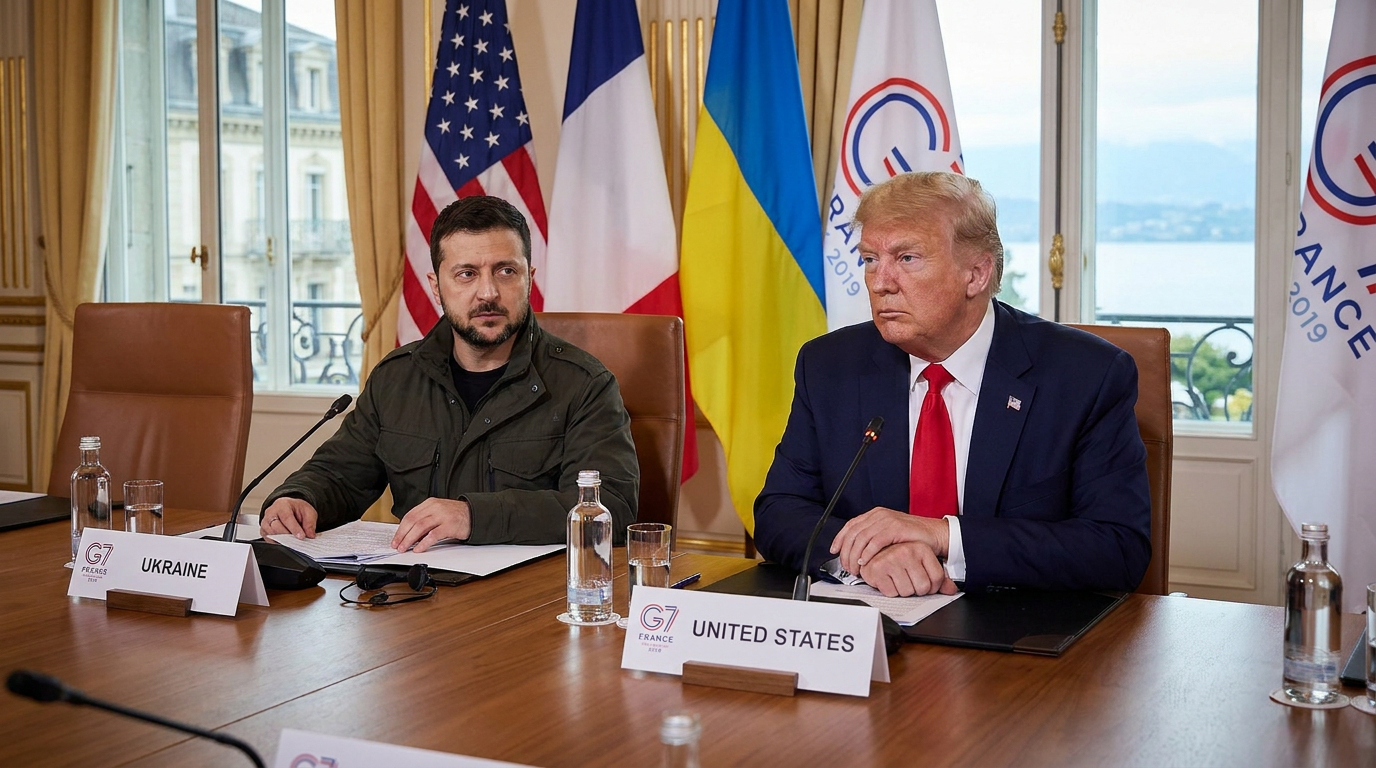
As world leaders convened on the shores of Lake Geneva for the Group of Seven summit in Evian-les-Bains, France, the geopolitical spotlight abruptly pivoted from the Middle East back to Eastern Europe. U.S. President Donald Trump arrived at the gathering fresh off brokering a 60-day ceasefire in the brief but disruptive U.S.-Iran conflict. With the immediate threat of a broader Middle Eastern war paused, the American administration signaled its intent to refocus diplomatic and economic pressure on resolving Russia's four-year-old full-scale invasion of Ukraine. The shift in attention provided a critical opening for Ukrainian President Volodymyr Zelenskyy, who attended the summit at the invitation of French President Emmanuel Macron to rally Western allies and re-engage Washington.[1][3][6]
The centerpiece of the summit's first full day was a blunt directive from the U.S. President aimed squarely at Moscow. Speaking to reporters after a joint working session, Trump declared that "Russia should make a deal," acknowledging that the prolonged conflict had resulted in a tremendous loss of life for both nations. While Trump had previously claimed he could end the war within 24 hours of taking office, he conceded that the deep antipathy between the Ukrainian and Russian leadership had made a settlement far more difficult than anticipated. Nevertheless, his public commitment to do "whatever I can" to force an end to the fighting marked a rhetorical escalation that European allies had spent months hoping to secure.[2][3][7]
The primary mechanism for this renewed American pressure lies in the global energy markets. During the height of the recent conflict with Iran, the United States had quietly eased certain sanctions on Russian oil shipments. This temporary waiver was designed as a macroeconomic shock absorber, ensuring that global oil prices remained stable while commercial transit through the critical Strait of Hormuz was threatened. The policy effectively allowed Moscow a brief financial reprieve, enabling Russian crude to flow more freely to international buyers and bolstering the Kremlin's war chest at a time when its military was facing stiff Ukrainian resistance.[1][3]
Now, with the Iran ceasefire in place and commercial shipping resuming its normal pace through the Gulf, that financial leniency appears to be ending. Trump explicitly tied the reopening of the Strait of Hormuz to a shift in U.S. policy toward Moscow, stating that Washington is now in a position to snap the suspended sanctions back into place. By threatening to choke off Russia's renewed oil revenues, the U.S. administration is attempting to manufacture the economic leverage necessary to drag Russian President Vladimir Putin to the negotiating table. European diplomats view this threat as the most potent tool in the Western arsenal, provided Washington actually follows through on the enforcement.[1][3][7]

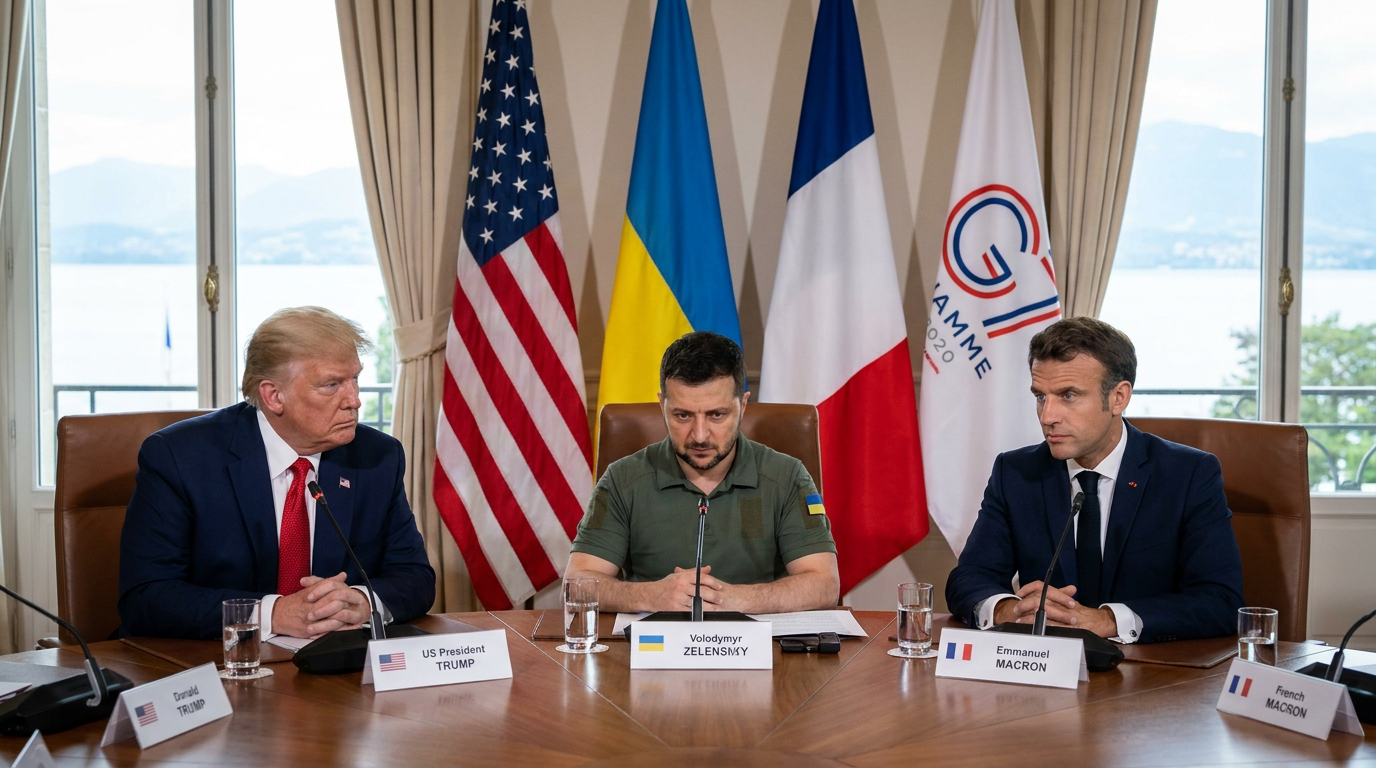
The diplomatic maneuvering at the summit was anchored by a highly anticipated bilateral meeting between Trump and Zelenskyy. The 30-minute encounter marked the first face-to-face discussion between the two leaders in over four months, a period during which Kyiv had grown increasingly anxious about Washington's distraction in the Middle East. Unlike their tense Oval Office meeting the previous year, where Zelenskyy was reportedly told he lacked leverage, the atmosphere in Evian-les-Bains was described by European observers as highly constructive. The Ukrainian delegation arrived armed with evidence that their battlefield fortunes had stabilized, pointing to successful drone incursions deep into Russian territory as proof that Kyiv was negotiating from a position of resilience.[5][6][8]
The emotional turning point of the bilateral meeting centered on the physical toll of the Russian offensive. During the discussion, Zelenskyy presented Trump with photographs detailing the aftermath of a recent Russian missile strike on the Kyiv Pechersk Lavra, an 11th-century Orthodox monastery and one of Ukraine's most revered historic landmarks. The strike was part of a broader barrage that hit Ukraine's largest cities just hours before the summit began, killing at least eleven civilians. By showcasing the destruction of a deeply significant religious site, Zelenskyy aimed to bypass abstract geopolitical arguments and appeal directly to the U.S. President's sensibilities regarding cultural and religious preservation.[1][5][6]
The presentation of the photographs proved to be a highly effective diplomatic tactic. According to sources familiar with the closed-door meeting, Trump was visibly disappointed by the destruction of the monastery and appeared genuinely moved by the images. European diplomats later characterized the move as psychologically astute, noting that it succeeded in eliciting a strong condemnation of the strike from the American leader. While expressions of sympathy do not automatically translate into policy shifts, the moment helped thaw the previously frosty dynamic between the two presidents and set a collaborative tone for the broader G7 discussions that followed.[5][6]

The presentation of the photographs proved to be a highly effective diplomatic tactic.
The ripple effects of the Trump-Zelenskyy meeting were immediately felt among the European delegations. French President Emmanuel Macron and German Chancellor Friedrich Merz, both of whom had previously clashed with Trump over his unilateral handling of the Iran crisis, expressed a renewed sense of optimism regarding the transatlantic alliance's posture on Ukraine. Merz noted that he found the U.S. President to be highly cooperative and attentive, a stark contrast to the simmering tensions that had characterized recent NATO interactions. The European consensus emerging from the summit was that Washington finally recognized that Russia's strategic position was weakening, creating a viable window for a coordinated diplomatic offensive.[3][5]
Behind closed doors, the G7 leaders reached a unanimous assessment of the military reality: Russia is not winning the war of attrition. Despite holding significant territory in eastern Ukraine, Moscow's forces have suffered catastrophic casualty rates and have failed to seize the strategic initiative. Zelenskyy relayed this consensus to the press, emphasizing that the Kremlin's inability to secure a decisive victory means it must eventually seek an agreement. The challenge for the Western alliance is how to translate this battlefield stalemate into a binding diplomatic framework before the onset of another grueling winter, which would heavily tax Ukraine's battered energy infrastructure.[3][5]
To sustain Ukraine's position while diplomacy advances, the G7 leaders committed to significantly upgrading Kyiv's defensive capabilities. The primary focus of these discussions was the urgent need for advanced air defense systems to protect Ukrainian cities and power grids from relentless Russian ballistic missile attacks. While France and other European allies have become the largest providers of military aid during the U.S. pivot to the Middle East, the sophisticated Patriot missile batteries required to intercept hypersonic threats remain largely dependent on American supply chains and export approvals.[1][6]
Zelenskyy used the summit to push for a more sustainable, long-term solution to Ukraine's air defense deficit. Rather than relying solely on donated batteries, the Ukrainian president formally requested that Washington grant Kyiv the necessary licenses to manufacture U.S.-designed anti-ballistic systems and interceptor missiles domestically. This technology transfer would allow Ukraine to scale up its own defense industrial base, reducing its reliance on the unpredictable political cycles of its Western partners. According to the Ukrainian delegation, Trump appeared to view the licensing proposal positively, though formal agreements have yet to be finalized by the Pentagon.[6]

With military support theoretically secured, the diplomatic focus shifted to the mechanics of a potential peace process. European leaders, led by Macron, actively urged Trump to leverage his self-proclaimed deal-making prowess by hosting a trilateral summit in the United States. The proposed format would bring Zelenskyy and Putin to the same table under American mediation, a high-stakes gamble designed to break the current deadlock. Macron publicly argued that the only viable negotiation is one where Ukraine and Russia face each other directly, but with European and American guarantors present to ensure compliance and enforce terms.[3]
For his part, Zelenskyy has publicly embraced the idea of U.S.-mediated talks, arguing that Donald Trump is likely the only global leader with enough leverage to force Vladimir Putin into genuine negotiations. The Ukrainian president has long maintained that lower-level diplomatic backchannels are useless, as only Putin possesses the absolute authority to halt the Russian war machine. By explicitly tying the peace process to Trump's involvement, Kyiv is attempting to flatter the U.S. President's desire for a legacy-defining diplomatic triumph, hoping that Washington's ego will guarantee its continued engagement in Eastern Europe.[6]
The primary obstacle to this grand diplomatic design remains the Kremlin itself. While Trump claimed to have held productive phone calls with both Putin and Zelenskyy prior to arriving in France, Moscow has shown little genuine appetite for concessions. Russian officials have previously dismissed the idea of a U.S.-hosted summit, demanding instead that any direct talks require Zelenskyy to travel to Moscow—a non-starter for Kyiv. Furthermore, Putin's strategy has consistently relied on outlasting Western patience, betting that political fatigue in Washington and European capitals will eventually force Ukraine to accept a ceasefire on Russian terms.[2]
To counter this Russian strategy of attrition, the G7 allies are moving to tighten the economic noose beyond the reimposition of U.S. oil sanctions. The United Kingdom and Canada used the Evian-les-Bains summit to announce a new wave of targeted penalties aimed squarely at Russia's "shadow fleet"—the clandestine network of aging, uninsured tankers that Moscow uses to export crude oil outside of the Western price cap mechanism. By sanctioning the financial networks, insurance providers, and shell companies that facilitate this illicit trade, the allies hope to severely curtail the energy revenues funding the Russian defense-industrial sector.[1][4]

Despite the unified rhetoric and the flurry of proposed sanctions, a degree of uncertainty continues to cloud the Western strategy. Several European diplomats privately noted that while Trump was enthusiastic about the concept of a peace deal, he remained frustratingly noncommittal on the exact timeline for snapping the U.S. oil sanctions back into place. The fear among some allied delegations is that Washington might use the threat of sanctions as a bargaining chip with Moscow, rather than deploying them immediately to maximize economic pain. Until the U.S. Treasury formally acts, the financial pressure on the Kremlin remains theoretical.[3][5]
As the G7 summit concludes, the trajectory of the Ukraine war hangs in a delicate balance. The next 60 days—mirroring the duration of the U.S.-Iran ceasefire—will serve as a critical test of whether the renewed Western focus can actually alter the calculus in Moscow. If the United States follows through on its economic threats and successfully coordinates a diplomatic summit, the conflict could finally shift from the bloody trenches of the Donbas to the negotiating table. If the momentum stalls, however, Ukraine faces the grim prospect of entering a fifth year of total war against an adversary determined to grind it into submission.[1][3]
How we got here
Feb 2022
Russia launches its full-scale invasion of Ukraine.
Early 2026
The U.S. temporarily eases sanctions on Russian oil to stabilize global markets during a conflict with Iran.
June 15, 2026
The U.S. and Iran agree to a 60-day ceasefire, reopening the Strait of Hormuz to commercial shipping.
June 16, 2026
President Trump meets with President Zelenskyy at the G7 summit in France, signaling a renewed focus on Ukraine.
Viewpoints in depth
Kyiv & European Allies
Advocating for maximum pressure on Moscow and viewing U.S. mediation as the key to forcing a settlement.
European leaders and the Ukrainian delegation believe that Russia's military is suffering unsustainable losses and losing the strategic initiative. They argue that the only way to translate this battlefield reality into a lasting peace is through overwhelming economic pressure and guaranteed security arrangements. By urging Donald Trump to host a trilateral summit and supporting Ukraine's domestic defense manufacturing, this camp seeks to lock Washington into a long-term commitment that Vladimir Putin cannot simply outlast.
The U.S. Administration
Focused on leveraging the end of the Middle East conflict to broker a legacy-defining peace deal in Eastern Europe.
Fresh off negotiating a 60-day ceasefire with Iran, the U.S. administration is pivoting its deal-making focus back to Ukraine. The American strategy relies heavily on macroeconomic leverage, specifically the threat of snapping back suspended sanctions on Russian oil now that global energy markets have stabilized. While President Trump has expressed a strong desire to end the bloodshed, his approach is highly transactional, balancing the need to pressure Moscow with a reluctance to permanently entangle the U.S. in European security guarantees.
Global Economic Observers
Monitoring the fallout of renewed sanctions on global energy markets and the effectiveness of targeting Russia's shadow fleet.
For international markets and non-aligned nations, the primary concern is the economic ripple effect of the G7's diplomatic maneuvers. Analysts are closely watching how the reimposition of U.S. oil sanctions and new British and Canadian penalties on Russia's clandestine shipping networks will impact global crude prices. There is skepticism regarding how quickly these measures can drain the Kremlin's war chest, as Moscow has spent years building alternative financial infrastructure to bypass Western price caps.
What we don't know
- Whether the U.S. Treasury will immediately reimpose the suspended sanctions on Russian oil or use them as a prolonged bargaining chip.
- If Vladimir Putin will agree to attend a U.S.-hosted trilateral peace summit, given his previous demands that talks occur in Moscow.
- Whether the Pentagon will formally approve the licenses required for Ukraine to manufacture U.S. anti-ballistic systems domestically.
Key terms
- Strait of Hormuz
- A critical maritime chokepoint between the Persian Gulf and the Gulf of Oman, through which a significant portion of the world's oil supply passes.
- Shadow Fleet
- A clandestine network of aging, often uninsured oil tankers used by Russia to export petroleum while evading Western financial sanctions and price caps.
- Kyiv Pechersk Lavra
- An 11th-century historic Orthodox Christian monastery in Ukraine's capital, recently damaged by a Russian missile strike.
- Group of Seven (G7)
- An intergovernmental political and economic forum consisting of seven major industrialized democracies, including the US, UK, France, Germany, Italy, Canada, and Japan.
Frequently asked
Why were U.S. sanctions on Russian oil temporarily lifted?
The U.S. eased certain sanctions to stabilize global oil prices and ensure steady supply during the recent conflict with Iran, which threatened shipping in the Middle East.
What did Zelenskyy show Trump during their meeting?
Zelenskyy presented photographs of the destruction caused by a recent Russian missile strike on the Kyiv Pechersk Lavra, a historic 11th-century monastery.
What is Ukraine asking for regarding air defense?
Beyond donated Patriot missile batteries, Ukraine is requesting licenses to manufacture U.S.-designed anti-ballistic systems and interceptors domestically.
Will Putin and Zelenskyy hold direct peace talks?
European leaders are urging Trump to host a trilateral summit in the U.S., but the Kremlin has previously demanded that Zelenskyy travel to Moscow, making immediate talks uncertain.
Sources
Source coverage
8 outlets
3 viewpoints surfaced







[1]PBSThe U.S. Administration
Trump signals he may reimpose sanctions on Russian oil as G7 refocuses on Ukraine
Read on PBS →[2]Courthouse NewsThe U.S. Administration
U.S. President Donald Trump is in Europe for a Group of Seven meeting
Read on Courthouse News →[3]The GuardianKyiv & European Allies
Hopeful mood on war among European leaders at G7 summit
Read on The Guardian →[4]The HinduGlobal Economic Observers
G7 Summit 2026 begins in Évian: Key leaders, dates, and venue details
Read on The Hindu →[5]Channel News AsiaKyiv & European Allies
G7 leaders express optimism for peace after Trump's 'very good' Zelenskyy meeting
Read on Channel News Asia →[6]Kyiv IndependentKyiv & European Allies
Zelensky meets Trump, Macron at G7 summit
Read on Kyiv Independent →[7]InquirerGlobal Economic Observers
G7 leaders rally around Ukraine, Trump urges Russia to make deal
Read on Inquirer →[8]Jerusalem PostGlobal Economic Observers
G7 leaders express optimism for peace after Trump's 'very good' Zelensky meeting
Read on Jerusalem Post →
More in news politics
See all 12 stories →G7 Summit
G7 Leaders Push for Ukraine Peace Deal as Trump Shifts Focus from Iran
7 sources
G7 Summit
Trump Urges Russia to 'Make a Deal' on Ukraine as G7 Leaders Push for Peace Talks
6 sources
D.C. Autonomy
Trump Threatens Federal Takeover of Washington D.C. as Progressive Leads Mayoral Primary
6 sources
Ukraine War
Trump Urges Russia to 'Make a Deal' at G7 Summit, Weighs Reinstating Oil Sanctions
7 sources
Every angle. Every day.
Get news politics stories with full source coverage and perspective breakdowns delivered to your inbox.