
Agentic AI: How Large Action Models Are Automating Digital Chores
Artificial intelligence is evolving from chatbots that answer questions to autonomous agents that can plan and execute multi-step tasks across software applications.
By Factlen Editorial Team
- Automation Advocates
- Argue that AI agents will drastically improve productivity by eliminating repetitive digital chores.
- Enterprise Strategists
- Focus on how organizations must redesign workflows to integrate human-agent collaboration effectively.
- Technical Architects
- Emphasize the underlying mechanics of LAMs and the importance of robust security guardrails for autonomous systems.
What's not represented
- · Entry-level administrative workers facing role transitions
- · Software interface designers adapting to AI-first navigation
Why this matters
As AI moves from generating text to taking action, it promises to eliminate hours of repetitive digital administrative work, allowing professionals and everyday users to focus on creative and strategic tasks.
Key points
- AI is shifting from conversational chatbots to autonomous agents that execute tasks.
- Large Action Models (LAMs) allow AI to interact with software interfaces and APIs.
- Agents operate in a loop of perceiving, reasoning, acting, and learning from errors.
- Multi-agent systems enable specialized AI programs to collaborate on complex projects.
- Human oversight remains critical for sensitive actions and major decisions.
If the defining technology of the early 2020s was the chatbot, 2026 has officially become the era of the autonomous digital worker. Across industries, organizations and individuals are moving beyond systems that simply answer questions, adopting intelligent software that can independently complete complex, multi-step tasks.[7]
For years, generative AI was largely confined to a conversational box. You typed a prompt, and the system generated text, code, or an image. But if you wanted to actually do something with that output—book a flight, update a spreadsheet, or deploy a piece of software—you had to do the clicking, copying, and typing yourself.[2]
That paradigm is shifting rapidly with the rise of "agentic AI." Unlike traditional models that merely react to prompts, agentic systems are designed to plan, decide, and execute workflows with minimal human intervention. They do not just generate content; they work toward defined goals.[4]
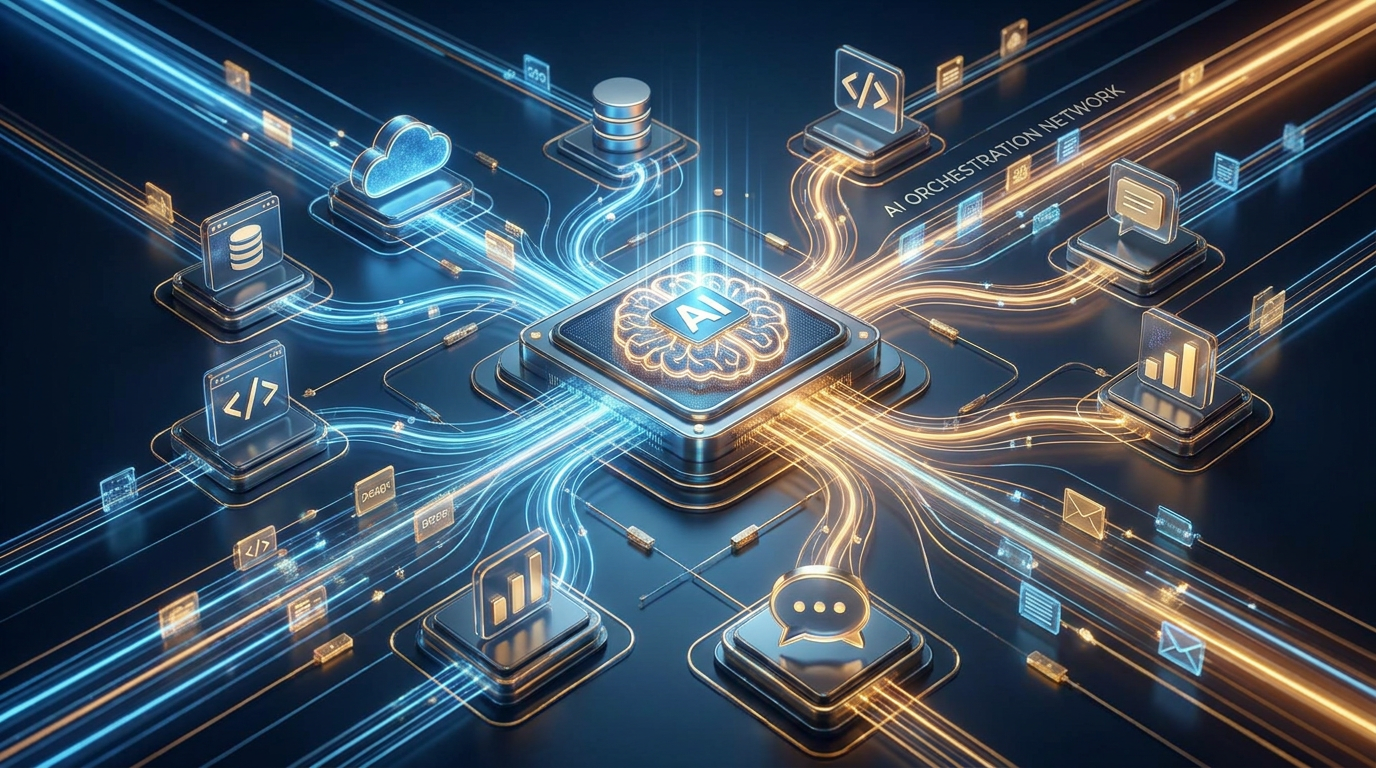
The engine driving this shift is the Large Action Model (LAM). While Large Language Models (LLMs) are trained to predict the next word in a sequence, LAMs are trained to predict and execute the next logical action in a digital environment. They bridge the gap between understanding human intent and interacting with software.[1][3]

The operational process of an AI agent begins with perception. A LAM can "see" a user interface, read an application's documentation, or interpret an API (Application Programming Interface), understanding the digital environment much like a human would look at a screen to see what buttons are available.[3]
Once the agent understands its environment and the user's goal, it moves to the reasoning phase. It breaks down a complex request—such as "research three competitors, summarize their pricing, and build a presentation"—into a sequence of manageable, logical steps.[6]
Once the agent understands its environment and the user's goal, it moves to the reasoning phase.
Then comes the defining feature: action. The agent interacts with external tools, clicking buttons, filling out forms, or sending data across different software platforms to execute its plan. It navigates the digital world on behalf of the user.[5]
Crucially, modern AI agents operate in a continuous feedback loop. If an action fails—perhaps a website's layout changed or a login expired—the agent does not simply crash. It evaluates the error, adjusts its plan, and tries a different approach, demonstrating a level of adaptability previously unseen in automation.[4]

For everyday users, this technology is manifesting as highly capable personal assistants. Instead of just drafting an email, an agent can read an incoming message, check your calendar, negotiate a meeting time with the sender, and send the calendar invite—all autonomously in the background.[7]
In the enterprise sector, the impact is even more profound. Companies are deploying agents to handle end-to-end customer support, where the AI doesn't just suggest a refund policy to a human representative, but actually navigates the billing system to process the refund itself.[2]

We are also seeing the emergence of multi-agent systems. In these setups, specialized agents collaborate to complete a project. A "research agent" might gather data, hand it off to an "analysis agent" for processing, which then passes the insights to a "formatting agent" to build a final report.[4]
Under the hood, these systems rely on a sophisticated architecture. They combine a foundational language model for reasoning with persistent memory to track past interactions, and a "tool-use" framework that grants them secure access to external software and databases.[5]
Of course, granting autonomous systems the ability to take action introduces new security considerations. Developers are implementing strict guardrails, ensuring agents operate within defined permissions and often requiring human approval before executing sensitive actions like moving money or deleting files.[6]
How we got here
2022–2023
The Chatbot Era begins as Large Language Models gain mainstream adoption for text generation.
2024
Early tool use emerges, allowing models to access web search and basic plugins.
2025
Researchers develop Large Action Models specifically trained to navigate user interfaces and APIs.
2026
Agentic workflows become mainstream, with enterprises deploying autonomous agents for end-to-end task execution.
Viewpoints in depth
Automation Advocates
This camp believes AI agents are the ultimate productivity multiplier.
Proponents of rapid agent adoption argue that the technology will free human workers from the drudgery of data entry, scheduling, and cross-platform copying and pasting. By delegating these digital chores to autonomous systems that can operate 24/7 without fatigue, they believe organizations can unlock unprecedented levels of efficiency and allow employees to focus entirely on creative and strategic endeavors.
Enterprise Strategists
This group focuses on the organizational redesign required to support AI agents.
Business leaders and management researchers emphasize that simply plugging an AI agent into an existing workflow is not enough. They argue that companies must completely rethink how work is structured, moving toward a model of "human-agent collaboration." This requires upskilling employees to act as managers of digital workers, ensuring they know how to properly prompt, monitor, and correct autonomous systems.
Technical Architects
This perspective highlights the engineering challenges and security risks of autonomous AI.
Software engineers and security professionals caution that while LAMs are powerful, giving an AI the ability to take action introduces significant risk. If an agent hallucinates a step or misinterprets a command, it could accidentally delete data, send incorrect emails, or trigger costly API calls. This camp advocates for strict "human-in-the-loop" protocols and robust digital guardrails to prevent agents from executing sensitive tasks without explicit approval.
What we don't know
- How quickly traditional software interfaces will evolve to cater specifically to AI agents rather than human users.
- The long-term impact of agentic automation on entry-level administrative and data-entry jobs.
Key terms
- Large Action Model (LAM)
- An AI model trained to execute tasks across software interfaces rather than just generating text.
- Agentic Workflow
- A process where an AI system autonomously plans and executes a multi-step task to achieve a goal.
- Multi-Agent System
- A setup where several specialized AI agents collaborate, passing information back and forth to complete a complex project.
- API (Application Programming Interface)
- A software intermediary that allows two applications to talk to each other, frequently used by AI agents to take action.
Frequently asked
What is the difference between an LLM and a LAM?
An LLM (Large Language Model) is designed to understand and generate text. A LAM (Large Action Model) is designed to understand a goal and execute the digital actions needed to achieve it.
Can AI agents control my computer?
Yes, some advanced agents can navigate desktop environments by "seeing" the screen and simulating mouse clicks and keystrokes, though they require explicit user permission to do so.
Do I need to know how to code to use AI agents?
No. Many platforms in 2026 offer no-code, drag-and-drop interfaces that allow anyone to build and deploy custom AI agents using natural language instructions.
Are AI agents safe to use for sensitive tasks?
While agents are highly capable, developers recommend keeping a "human in the loop" for sensitive actions, requiring manual approval before the agent finalizes a major decision or financial transaction.
Sources
Source coverage
7 outlets
3 viewpoints surfaced







[1]DigitalOceanTechnical Architects
What are large action models?
Read on DigitalOcean →[2]MIT SloanEnterprise Strategists
Agentic AI, explained
Read on MIT Sloan →[3]AIMultipleTechnical Architects
What is a large action model (LAM)?
Read on AIMultiple →[4]TaskadeAutomation Advocates
What Are AI Agents? The Future of Autonomous Work
Read on Taskade →[5]ActivepiecesAutomation Advocates
6 Best AI Agent Software Tools in 2026
Read on Activepieces →[6]MediumEnterprise Strategists
Best Agentic AI Models in 2026
Read on Medium →[7]Factlen Editorial Team
Synthesis by Factlen editorial team
Read on Factlen Editorial Team →
More in ai
See all 7 stories →Local AI
The 2026 Guide to Running AI Locally: How Consumer Hardware Caught Up to the Cloud
8 sources

On-Device AI
How Small Language Models Brought AI to Your Phone Without the Cloud
6 sources
Animal Cognition
AI Decodes Sperm Whale 'Phonetic Alphabet,' Revealing Complex Language Parallels
8 sources

Edge AI
How On-Device AI and Quantization Are Moving LLMs Out of the Cloud
6 sources

Every angle. Every day.
Get ai stories with full source coverage and perspective breakdowns delivered to your inbox.