
2026 Rivian R2 vs. Tesla Model Y: The Ultimate Mid-Size EV Trade-Off Analysis
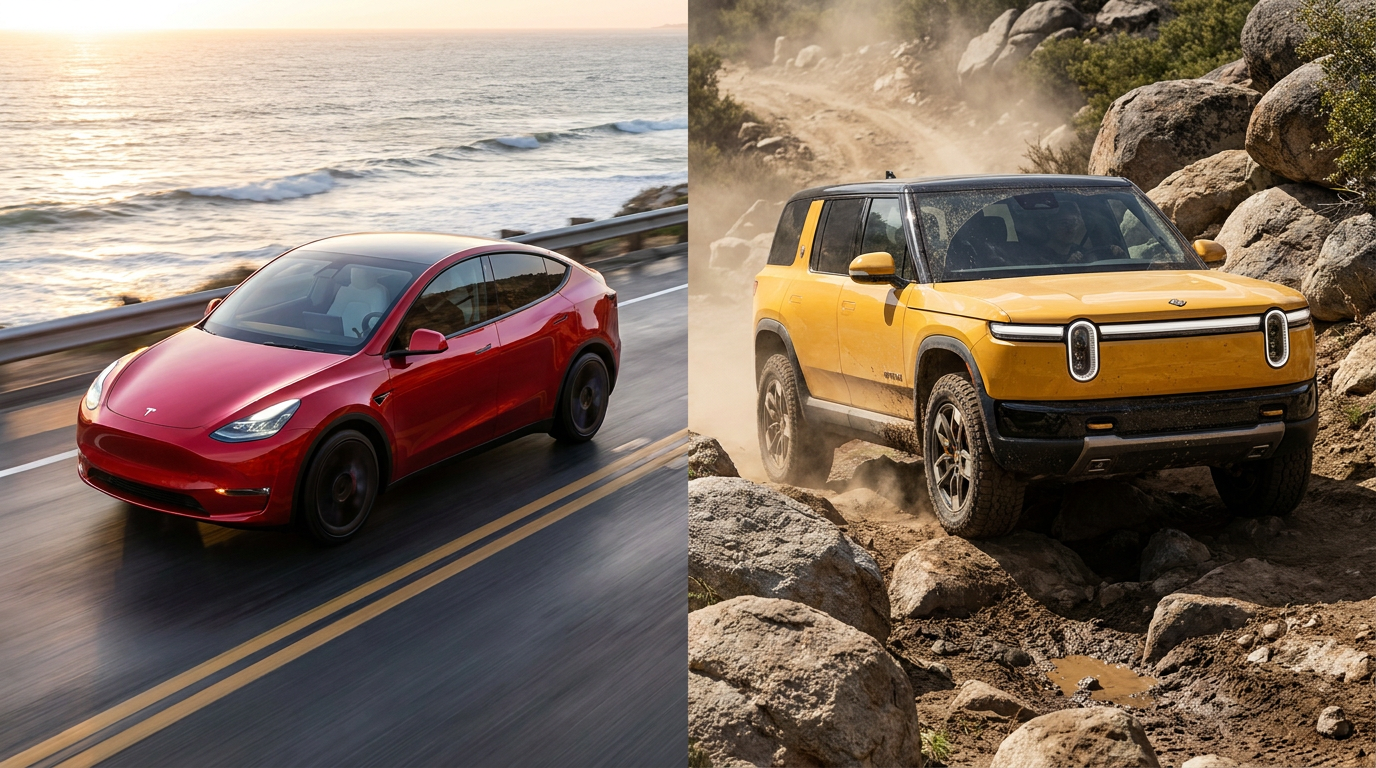
The newly refreshed 2026 Tesla Model Y faces its first true philosophical rival in the Rivian R2. We break down the exact trade-offs between Tesla's aerodynamic street performance and Rivian's boxy, off-road utility.
By Factlen Editorial Team
- Street-Performance Advocates
- Prioritize on-road handling, charging infrastructure, and sporty driving dynamics.
- Outdoor Utility Seekers
- Value ground clearance, cargo capacity, and off-road capability for weekend adventures.
- Everyday Owners
- Focus on daily livability, interior comfort, and real-world software performance.
What's not represented
- · Traditional legacy automakers whose mid-size EVs are competing against both Tesla and Rivian.
- · Budget-conscious buyers who are priced out of the $45,000+ market entirely.
Why this matters
For the first time in the EV era, buyers looking for a mid-size electric SUV do not have to settle for a one-size-fits-all compromise. Understanding the stark engineering differences between the street-focused Tesla Model Y and the rugged Rivian R2 ensures you invest $50,000 in a vehicle that actually matches your daily life and weekend ambitions.
Key points
- The 2026 Tesla Model Y Premium AWD starts at $48,990, undercutting the Rivian R2 Premium AWD by $5,000.
- The Model Y excels in on-road handling, aerodynamic efficiency, and advanced highway autonomy.
- The Rivian R2 offers vastly superior off-road capability with 9.6 inches of ground clearance.
- The R2 provides 90.1 cubic feet of total cargo space, easily beating the Model Y's 76 cubic feet.
- Rivian's native NACS port allows the R2 to use Tesla Superchargers without an adapter.
- Tesla's minimalist screen-only interior contrasts sharply with Rivian's inclusion of a driver display and physical stalks.
For years, the Tesla Model Y has been the undisputed default choice for anyone seeking a mid-size electric SUV. But in 2026, the EV landscape is shifting from early-adopter compromises to highly specialized choices. The arrival of the Rivian R2 introduces a genuine, rugged alternative to Tesla’s sleek, street-focused dominance. With both vehicles priced in the $45,000 to $60,000 range, buyers are no longer forced into a single aerodynamic crossover shape. Instead, they face a distinct choice between two radically different engineering philosophies: the track-capable urban commuter versus the boxy, high-clearance adventure vehicle.[1][2][3]
The baseline comparison starts with the price and trim structures, where Tesla maintains a distinct affordability advantage. The 2026 Tesla Model Y Premium All-Wheel Drive starts at $48,990, offering 327 miles of range and a 0-60 mph time of 4.6 seconds. In contrast, the equivalent Rivian R2 Premium AWD commands a $5,000 premium, starting at $53,990 for a nearly identical 330 miles of range and matching acceleration. At the top end, the gap narrows: the 510-horsepower Model Y Performance costs $57,490, while the 650-horsepower R2 Performance Launch Edition sits just slightly higher at $59,485. For buyers strictly comparing spec sheets, Tesla offers a lower barrier to entry, but Rivian argues its higher price bakes in physical hardware that Tesla simply does not offer.[4][5]
The case for the Tesla Model Y is built entirely around street performance, aerodynamic efficiency, and software maturity. Evidence supporting the Model Y includes its sports-car-like handling, a low center of gravity, and a firm suspension that makes it genuinely fun on a twisty canyon road. The 2026 refresh brings improved sound insulation, a redesigned dashboard, and a 16-inch high-definition screen that controls nearly every vehicle function. Furthermore, Tesla’s integration with the Supercharger network remains the industry gold standard for seamless road-tripping, and its Full Self-Driving suite offers advanced highway autonomy that competitors are still working to match.[1][6]

However, the arguments against the Model Y center on its limitations as a true utility vehicle. The evidence is clear in its geometry: with just 6.6 inches of ground clearance and a sloping fastback roofline, the Model Y is essentially a lifted sedan. It cannot tackle serious off-road trails, and its cargo capacity maxes out around 76 cubic feet. Additionally, the minimalist interior—which lacks physical buttons, a dedicated driver display, and a physical gear stalk—continues to alienate drivers who prefer tactile controls. The ride quality, while improved for 2026, remains noticeably stiffer than traditional luxury SUVs, transmitting more road imperfections into the cabin.[3][5][7]
Conversely, the case for the Rivian R2 rests on its massive utility, rugged geometry, and thoughtful interior packaging. The primary evidence for the R2 is its physical footprint: it boasts 9.6 inches of ground clearance, short overhangs for a 25-degree approach angle, and a boxy silhouette that yields a cavernous 90.1 cubic feet of total storage, including a spacious front trunk. Inside, Rivian provides a dedicated digital instrument cluster behind the steering wheel, physical stalks for wipers and gears, and a power-sliding rear window that allows for carrying long items like surfboards. It is a vehicle explicitly designed to get dirty, featuring a suspension tuned for compliance over rocks, gravel, and rutted trails.[2][3][5]
Conversely, the case for the Rivian R2 rests on its massive utility, rugged geometry, and thoughtful interior packaging.
The arguments against the Rivian R2 highlight its aerodynamic penalties and charging speeds. Because it is shaped like a traditional SUV, it requires a larger, heavier battery pack to achieve the same 330-mile range as the sleeker Tesla. Evidence of this inefficiency shows up at the charging station: the R2 peaks at a 210-kW charge rate, which lags behind the 250-kW maximum of the Model Y and the 350-kW rates seen in some competitors. Furthermore, while the R2 is astonishingly quick in a straight line—hitting 60 mph in 3.6 seconds in its Performance trim—its heavier steering and softer, semi-active dampers mean it will never carve a mountain road with the same precision as the Tesla.[2][4]

When evaluating the daily driving experience, the two vehicles offer starkly different atmospheres. The 2026 Model Y features a stark, ultra-modern cabin with ventilated sport seats, ambient lighting that reacts to music, and a heavy reliance on screen-based controls. It feels like a piece of consumer electronics. The Rivian R2, meanwhile, feels like a premium piece of outdoor gear. Its cabin is flooded with light from a massive panoramic roof, utilizes real wood accents, and prioritizes durable, easy-to-clean materials. Crucially, Rivian has adopted the North American Charging Standard (NACS) port natively for the R2, meaning it can access Tesla Superchargers without an adapter, neutralizing one of Tesla's biggest historical advantages.[1][2][7]
Ultimately, the Tesla Model Y fits perfectly when a buyer prioritizes on-road driving dynamics, maximum energy efficiency, and access to the most advanced driver-assistance software on the market. It is the ideal choice for urban commuters who want a sports sedan experience with the added practicality of a hatchback. It does not fit well for buyers who frequently venture off pavement, those who need to haul bulky, square-shaped cargo, or drivers who strongly prefer physical buttons and a traditional instrument cluster over a centralized touchscreen interface.[5][6]

The Rivian R2 fits exceptionally well when a buyer wants a true sport utility vehicle capable of handling active outdoor lifestyles, rough terrain, and massive gear hauls. It is the right choice for those who appreciate a softer, more compliant ride and a cabin design that balances digital interfaces with tactile physical controls. It does not fit well for buyers looking for the absolute lowest purchase price, those who prioritize canyon-carving handling, or drivers who want the absolute fastest DC fast-charging speeds available for cross-country highway sprints.[2][3][5]
The 2026 mid-size EV market has matured to the point where consumers no longer have to compromise their lifestyle to drive electric. The Tesla Model Y and the Rivian R2 are both engineering triumphs, but they are built for entirely different personas. Whether you want a track-capable spaceship or a battery-powered basecamp, the choice now comes down to where you actually plan to drive.[3][5]
How we got here
2020
Tesla launches the Model Y, which quickly becomes the best-selling electric vehicle in the world.
Early 2024
Rivian officially unveils the R2 mid-size SUV, promising a more affordable entry point to its rugged brand.
Late 2025
Tesla introduces a major styling and interior refresh for the Model Y, known internally as Project Juniper.
Spring 2026
The first Rivian R2 Performance Launch Edition models begin arriving in customer driveways, sparking direct comparisons with the updated Model Y.
Viewpoints in depth
Street-Performance Advocates
Drivers and reviewers who prioritize on-road handling, efficiency, and software.
This camp argues that the vast majority of SUV owners never take their vehicles off-road, making the Tesla Model Y's street-biased engineering the most logical choice. They point to the Model Y's lower center of gravity, stiffer suspension, and superior aerodynamic efficiency as evidence that it is the better daily driver. For these buyers, the seamless integration of Tesla's Supercharger network and the advanced capabilities of Full Self-Driving outweigh the need for high ground clearance or a boxy cargo area.
Outdoor Utility Seekers
Enthusiasts who demand true off-road capability and maximum cargo volume.
This perspective champions the Rivian R2 for returning the 'utility' to the SUV segment. They argue that the Model Y is essentially a lifted hatchback, whereas the R2's 9.6 inches of ground clearance, flat roofline, and massive 90.1 cubic feet of storage make it a genuine adventure vehicle. Evidence cited by this camp includes the R2's ability to tackle 25-degree approach angles and its compliant, semi-active suspension that absorbs rutted trails. They are willing to accept a slight aerodynamic penalty in exchange for a vehicle that can confidently reach remote campsites.
What we don't know
- How Rivian's point-to-point hands-free driving software will perform in the real world compared to Tesla's mature Full Self-Driving suite.
- Whether Tesla will adjust Model Y pricing further downward once the Rivian R2 reaches full mass-market production volume.
Key terms
- NACS (North American Charging Standard)
- The charging plug design originally developed by Tesla, which has now been adopted by most major automakers, including Rivian, for seamless access to the Supercharger network.
- Torque Vectoring
- A system that actively controls the amount of power sent to each individual wheel, improving handling on twisty roads and maximizing grip on slippery off-road trails.
- Approach Angle
- The maximum angle of a ramp or obstacle a vehicle can climb from a flat surface without the front bumper hitting the ground.
- Frunk
- A portmanteau of 'front trunk,' referring to the enclosed storage space located under the hood of an electric vehicle where an engine would traditionally sit.
Frequently asked
Does the Rivian R2 use the Tesla Supercharger network?
Yes. The 2026 Rivian R2 comes natively equipped with the North American Charging Standard (NACS) port, allowing it to plug directly into Tesla Superchargers without needing an adapter.
Which vehicle is faster from 0 to 60 mph?
In their top-tier Performance trims, the Tesla Model Y is slightly faster, hitting 60 mph in 3.3 seconds, compared to the Rivian R2 Performance's 3.6 seconds.
Do both SUVs offer a third row of seating?
No. The Tesla Model Y offers an optional, albeit cramped, third row for seven-passenger capacity. The Rivian R2 is strictly a two-row, five-passenger vehicle.
Which car has more cargo space?
The Rivian R2 offers significantly more cargo space, with 90.1 cubic feet of total storage (including the front trunk), compared to the Model Y's maximum of roughly 76 cubic feet.
Sources
Source coverage
7 outlets
3 viewpoints surfaced






[1]Car and DriverStreet-Performance Advocates
2026 Tesla Model Y: What We Know So Far
Read on Car and Driver →[2]EdmundsOutdoor Utility Seekers
2027 Rivian R2 First Drive: The Heart of the EV Market
Read on Edmunds →[3]The AutopianOutdoor Utility Seekers
The Rivian R2 Is A Masterclass In Intelligent Compromise
Read on The Autopian →[4]CarwowStreet-Performance Advocates
Rivian R2 vs Tesla Model Y: which is better?
Read on Carwow →[5]Car ConfectionsOutdoor Utility Seekers
2027 Rivian R2 vs. 2026 Tesla Model Y: Which EV SUV is Best?
Read on Car Confections →[6]The Straight PipesStreet-Performance Advocates
2026 Tesla Model Y Performance Review
Read on The Straight Pipes →[7]Reddit (r/Rivian)Everyday Owners
Rivian R2 Test Drive Review Coming From a 2026 Model Y Owner
Read on Reddit (r/Rivian) →
Every angle. Every day.
Get automotive stories with full source coverage and perspective breakdowns delivered to your inbox.