
The Shift to Local AI: How Smart Homes Are Cutting the Cloud to Protect Privacy and Speed Up Response Times
A new generation of smart home hubs is moving processing power from remote servers directly into your living room. By utilizing edge computing and local AI, these systems offer instant response times, function during internet outages, and keep sensitive household data strictly private.
By Lila Morgan

- Privacy Advocates
- Argue that smart homes must process data locally to prevent corporate surveillance and data harvesting.
- Open-Source Community
- Value local control to avoid vendor lock-in and ensure devices continue working even if a manufacturer goes out of business.
- Commercial Manufacturers
- Balance the consumer demand for speed and privacy against the higher hardware costs of edge computing and the loss of recurring cloud revenue.
Perspectives this story doesn't cover
- Internet Service Providers
- Cloud Infrastructure Providers
What’s at stake
For years, consumers have accepted that smart home convenience requires sacrificing data privacy and relying on external internet connections. The shift to local edge computing fundamentally changes this equation, allowing users to build automated, intelligent homes that are entirely private, instantly responsive, and immune to internet outages.
For the past decade, the "smart" in smart home has largely lived hundreds of miles away in a corporate data center. When a user asks a voice assistant to turn on the living room lights, that audio snippet is recorded, compressed, and transmitted over the internet to a cloud server. The server processes the speech, translates it into a machine command, and sends a signal back to the home router, which finally tells the smart bulb to illuminate.
This cloud-first architecture enabled the rapid proliferation of cheap smart devices, as manufacturers could offload expensive computing power to remote servers. But it also introduced three persistent frustrations for consumers: noticeable latency, complete failure during internet outages, and deep privacy concerns about audio recordings leaving the home.
Now, a fundamental architectural shift is rewriting the rules of home automation. Driven by dramatic reductions in the cost of neural processing units (NPUs) and the development of highly efficient Small Language Models (SLMs), the industry is moving toward "edge computing"—processing data locally on devices inside the home rather than in the cloud.[1][2]
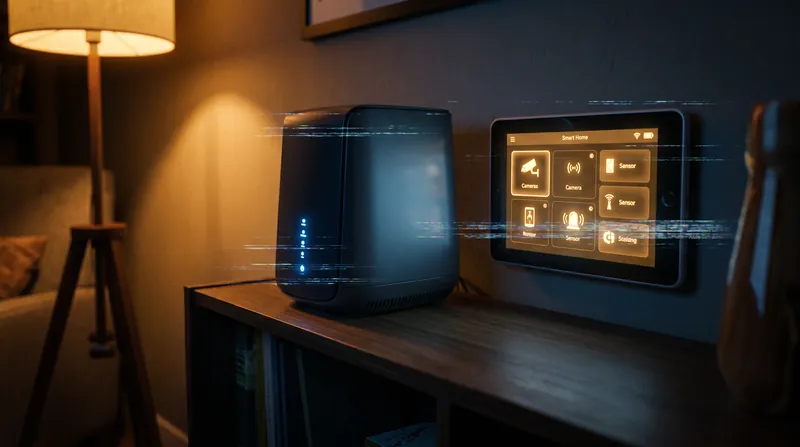
This transition to local AI means that smart home hubs, smart speakers, and even individual appliances are becoming self-contained computing environments. Instead of acting as dumb relays that simply pass information to a server, these devices are now capable of understanding natural language, recognizing faces, and executing complex automation routines entirely on their own silicon.
The most immediate benefit of local processing is speed. Cloud-based commands typically suffer from a 500- to 1,500-millisecond delay—a lag that feels unnatural when performing a task as simple as flipping a light switch. By eliminating the round trip to a remote server, edge-processed commands execute in under 100 milliseconds, making voice control feel as instantaneous as a physical button press.
Reliability is the second major driver of this shift. In a cloud-dependent setup, an internet service provider outage or a server crash at the manufacturer's end renders the entire smart home paralyzed. Local control ensures that as long as the home's internal Wi-Fi or Zigbee network is functioning, automations continue to run, alarms continue to arm, and lights continue to respond.
In a cloud-dependent setup, an internet service provider outage or a server crash at the manufacturer's end renders the entire smart home paralyzed.
The Connectivity Standards Alliance (CSA) has codified this local-first approach into the foundation of the Matter protocol. Matter requires that devices be able to communicate directly with one another over the local network—using Thread or Wi-Fi—without requiring an active internet connection to function. This standard is forcing manufacturers to build devices that don't rely on proprietary cloud APIs for basic operations.
Privacy advocates have championed edge computing as the only viable solution to the surveillance concerns inherent in smart homes. When audio processing and computer vision happen locally, sensitive data never leaves the physical boundaries of the house. A security camera can use local AI to distinguish between a family member, a dog, and an intruder, sending only a text alert to the user's phone rather than streaming a 24/7 video feed to a corporate server.[2]
Open-source platforms have been at the vanguard of this movement. Home Assistant, the wildly popular open-source home automation platform, successfully demonstrated that users can run fully local, privacy-respecting voice assistants on inexpensive hardware like a Raspberry Pi. This proved that local AI is not just a theoretical concept, but a deployable reality for hobbyists and power users.
Major tech companies are now following suit. Apple has increasingly shifted Siri's speech recognition and natural language processing directly onto the iPhone and HomePod hardware, utilizing the company's custom neural engines to keep audio data on-device. This approach not only enhances privacy but significantly reduces the server costs associated with processing billions of daily voice queries.
The hardware enabling this shift is advancing rapidly. Small Language Models—AI models trained on highly specific datasets rather than the entire internet—require a fraction of the memory and processing power of massive models like GPT-4. These SLMs can be optimized to understand home automation commands with near-perfect accuracy, running efficiently on the low-power chips embedded in modern smart home hubs.[1]
Despite the clear advantages, the transition to edge computing is not without challenges. Local processing requires more capable, and therefore slightly more expensive, hardware inside the home. Manufacturers who have built their business models around harvesting user data or charging monthly cloud subscription fees may be reluctant to embrace a paradigm that cuts them out of the loop.
Furthermore, maintaining and updating local AI models presents a logistical hurdle. While cloud models can be updated centrally and instantly for all users, local models must be pushed to individual devices via firmware updates, requiring robust over-the-air update mechanisms and careful management of device storage.[2]
Nevertheless, the trajectory of the smart home industry is clear. As consumers increasingly demand faster response times, rock-solid reliability, and uncompromising privacy, the era of the cloud-dependent smart home is drawing to a close. The future of home automation is local, intelligent, and entirely contained within the four walls of the house.[1]
Key takeaways
- Smart home processing is moving from remote cloud servers to local hubs inside the home.
- Edge computing reduces command latency from over a second to under 100 milliseconds.
- Local AI ensures smart homes continue to function during internet outages.
- Processing audio and video on-device prevents sensitive data from being sent to corporate servers.
- The Matter protocol mandates local network control, accelerating the shift away from cloud reliance.
Terms in play
- Edge Computing
- The practice of processing data near the edge of your network, where the data is being generated (like on a smart home hub), rather than in a centralized data-processing warehouse.
- Neural Processing Unit (NPU)
- A specialized microchip designed specifically to accelerate artificial intelligence and machine learning tasks, making local AI processing fast and energy-efficient.
- Small Language Model (SLM)
- A compact version of an AI language model that is trained on specific tasks (like home automation commands) so it can run on low-power devices without needing massive server farms.
- Matter Protocol
- A universal smart home industry standard that ensures devices from different brands can communicate with each other securely and locally, without relying on cloud connections.
Sources
Source coverage
2 outlets
3 viewpoints surfaced


- [1]Factlen Editorial Team
Synthesis by Factlen editorial team
Read on Factlen Editorial Team → - [2]IEEE Internet of Things JournalPrivacy Advocates
Edge Intelligence in Smart Home Environments: Architecture and Privacy
Read on IEEE Internet of Things Journal →
Comments

More in Technology
See all →Spectrum Regulation
Why Bluetooth Jammers Are Illegal: The Mechanics of 2.4 GHz Interference
4 sources
Lithography Physics
The Rayleigh Criterion: How Wavelength and Numerical Aperture Actually Constrain Chip Scaling
8 sources

Smart TV Privacy
LG Smart TVs Caught Logging Audio and Scanning Local Networks in Standby
4 sources
LMR Battery Tech
LG Energy Solution and Seoul National University Resolve Gas Buildup in Cobalt-Free LMR Batteries
5 sources

Every angle. Every day.
Get Technology stories with full source coverage and perspective breakdowns delivered to your inbox.