
Sports Analytics Market Projected to Nearly Triple to $9.64 Billion by 2030
Fueled by rapid advancements in artificial intelligence and wearable sensors, the global sports analytics sector is experiencing explosive financial growth.
By Xia Wu

Share this story
The era of gut-feeling coaching and instinct-driven management is officially giving way to the algorithmic front office. The global sports analytics market is on a trajectory to nearly triple in size, reaching a projected $9.64 billion by 2030.[1][2][4]
This surge, building upon an estimated $3.86 billion valuation at the end of 2026, represents a staggering compound annual growth rate of 25.7%. The driving forces behind this financial explosion are the rapid proliferation of artificial intelligence-enabled statistics, sophisticated wearable sensors, and expansive cloud-based analytics platforms.[1][2][4]
The integration of these advanced tools has transitioned from a luxury to an absolute prerequisite for elite sporting entities. Franchises across the globe are recognizing that maintaining a competitive advantage in an increasingly data-rich environment requires enterprise-level technological infrastructure.[2][8]
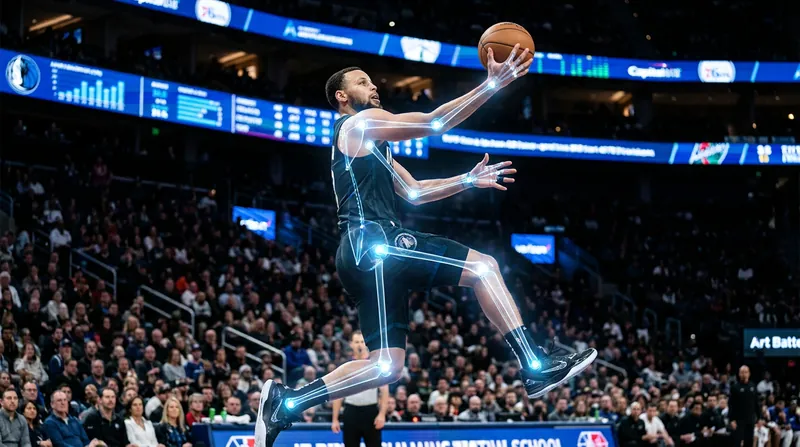
The mechanism powering this revolution relies on the seamless fusion of hardware data collection and software analysis. Wearable devices, equipped with miniaturized inertial measurement units, GPS chips, and biometric sensors, collect granular physiological data from athletes in real time.[5][7]
This raw biometric data is instantly transmitted to cloud-based machine learning models capable of processing vast volumes of information without latency. By the end of the decade, advanced AI systems are expected to process and analyze over 100,000 distinct data points per second, allowing coaching staffs to adapt strategies with unprecedented precision.[3][5]
The most immediate and financially impactful application of this technology is injury prevention and load management. Player downtime costs professional leagues hundreds of millions of dollars annually, making predictive health analytics a critical investment for protecting human assets.[6][8]
By analyzing physiological load, movement asymmetries, and subtle fatigue indices, AI models can flag injury risks before a catastrophic muscle tear or ligament sprain occurs. The integration of smart wearable technology in training regimens has already contributed to a reported reduction in injury rates by up to 15% across several elite athletic programs.[5][6][8]
Beyond health and career longevity, on-field tactical adjustments are being fundamentally reengineered by computer vision. Video analytics platforms capture high-definition broadcast footage and automatically tag specific events, quantifying player effectiveness and spatial dynamics in real time.[5]
Basketball and soccer clubs are increasingly utilizing these optical tracking systems to conduct live tactical adjustments during matches. Some franchises using advanced video-based feedback and AI-driven tactical models have reported improvements in player efficiency metrics by 10% to 15%.[5]
The commercial side of the sports industry serves as an equally massive demand driver for analytics infrastructure. Fan engagement initiatives and the global expansion of sports betting require real-time, highly accurate data feeds to function effectively.[3][8]
Artificial intelligence engines are now routinely deployed to curate personalized video highlights, generate predictive insights for fan behavior, and power complex, in-play betting markets. This structural demand tailwind from the sports betting sector alone is expected to generate incremental annual market revenue of approximately $800 million to $1.2 billion by 2030.[3][8][9]
To fuel this technological expansion, investment capital is flooding the sports technology sector at record levels. The sports wearables market has attracted significant venture backing, highlighted by biometric-tracking company Whoop, which recently raised $575 million at a $10.1 billion valuation.[2]
Similarly, smart ring manufacturer Oura secured $900 million at an $11 billion valuation, underscoring the broad confidence institutional investors have in the commercial viability and mainstream adoption of sports-tech integration.[2]
However, the explosion of biometric tracking and AI analytics introduces significant friction regarding data ownership and athlete privacy. Player associations and labor unions are increasingly scrutinizing who controls an athlete's physiological data and ensuring it cannot be weaponized during contract negotiations.[2][3]
Furthermore, the high cost of comprehensive AI rollouts—which demand high-speed cameras, proprietary sensors, expansive cloud capacity, and skilled data science teams—threatens to widen the competitive gap in global sports. Wealthy franchises can afford bespoke analytics departments, while smaller-market clubs may struggle to keep pace with the technological arms race.[6]
Ultimately, the sports analytics market is reshaping the very fabric of athletic competition and sports entertainment. As artificial intelligence and wearable technologies become deeply embedded in daily operations, the margin between winning and losing will increasingly be defined by which organization can best interpret the invisible data at its disposal.[1][2][8]
The essentials
- The global sports analytics market is projected to reach $9.64 billion by 2030, growing at a 25.7% CAGR.
- Growth is driven by AI-enabled statistics, wearable sensors, and cloud-based analytics platforms.
- Predictive health analytics using biometric data has reduced injury rates by up to 15% in some elite programs.
- The global expansion of sports betting is expected to generate over $800 million in incremental annual revenue for the sector.
- Massive venture capital is flowing into the space, highlighted by Whoop's recent $10.1 billion valuation.
Timeline
2020-2023
Early adoption of GPS vests and basic biometric tracking becomes standard in elite soccer and rugby.
2025
Global sports analytics market surpasses $3 billion as cloud computing enables real-time video analysis.
March 2026
Wearable giant Whoop raises $575 million at a $10.1 billion valuation, signaling massive investor confidence.
July 2026
Industry reports project the analytics market will nearly triple to $9.64 billion by the end of the decade.
2030 (Projected)
AI systems are expected to process over 100,000 data points per second for live tactical adjustments.
- Performance & Coaching Advocates
- Focus on how AI and wearables optimize human performance and elevate tactical sophistication.
- Commercial & Market Analysts
- View the analytics boom primarily as a massive revenue engine driven by fan engagement and sports betting.
- Data Infrastructure Providers
- Emphasize the critical need for robust cloud computing and seamless hardware-software integration.
Perspectives this story doesn't cover
- Labor union representatives negotiating biometric data rights
- Smaller market clubs priced out of enterprise AI systems
Sources
Source coverage
9 outlets
3 viewpoints surfaced









- [1]Sports Business JournalPerformance & Coaching Advocates
Sports analytics market to hit $9.64B by 2030
- [2]Ministry of SportPerformance & Coaching Advocates
Global sports analytics market to nearly triple to $9.64 billion by 2030
- [3]BarchartCommercial & Market Analysts
Major Highlights of the Sports Analytics Market
- [4]Research and MarketsCommercial & Market Analysts
Sports Analytics Market - Global Forecast 2026-2030
- [5]Fortune Business InsightsCommercial & Market Analysts
Sports Analytics Market Size and Future Outlook
- [6]Mordor IntelligenceData Infrastructure Providers
Artificial Intelligence Market In Sports
- [7]Precision ReportsPerformance & Coaching Advocates
Wearable Devices in Sports Market Overview
- [8]Market.usData Infrastructure Providers
Global AI Sports Analytics Market
- [9]DataInteloData Infrastructure Providers
Sports Analytics Market

More in Sports
See all →Sports Data Tech
Genius Sports Q2 Revenue Hits $196M, Fueled by 28% Surge in Betting Data Tech
6 sources

Special Teams
NFL Finalizes 2026 Rule Changes: Anytime Onside Kicks and Alignment Overhauls Reshape Special Teams
8 sources

Salary Cap
NBA Free Agency Spending Tiers Revealed as New CBA Rules Reshape Offseason Flexibility
3 sources

Sports Biomechanics
How AI and Markerless Motion Capture Are Engineering Injuries Out of Sports
3 sources
Comments
Every angle. Every day.
Get Sports stories with full source coverage and perspective breakdowns, free every day.