
FIFA Mandates 10-Second Substitutions and 5-Second Restarts to Combat Time-Wasting at 2026 World Cup
In a sweeping effort to accelerate match tempo and eliminate time-wasting, FIFA has implemented strict new countdown clocks for substitutions and restarts at the 2026 World Cup.
By Ryder James

Share this story
The 2026 FIFA World Cup in North America is breaking records for attendance and format size, but its most profound legacy on the sport might be the eradication of soccer's most frustrating tactic: time-wasting.[1][6]
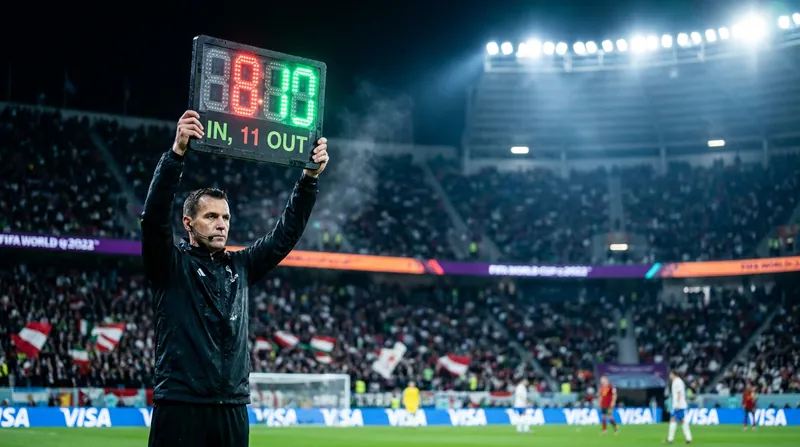
Under sweeping new regulations approved by the International Football Association Board (IFAB) earlier this year, the tournament has introduced strict countdown clocks to govern match restarts and substitutions. The most visible change requires any substituted player to exit the pitch at the nearest boundary line within exactly 10 seconds.[1][5][7]
The penalty for violating this substitution countdown is severe and immediate. If a departing player dawdles or attempts to slowly walk across the field to kill the clock, their incoming replacement is barred from entering the match for one full minute of running game time. This effectively forces the penalized team to defend with a man down, a risk no manager is willing to take during a tight knockout match.[2][5]
Referees have also been empowered to accelerate dead-ball situations. Match officials can now initiate a visual five-second countdown for throw-ins and goal kicks if they suspect a team is deliberately delaying the restart. If the team fails to put the ball back into play before the timer expires, possession is instantly turned over to the opposition—resulting in a lost throw-in or a corner kick awarded to the other team.[1][3][5]
To combat the infamous "flop"—where players feign cramps or minor injuries to halt the opposing team's momentum—FIFA instituted a mandatory sideline wait. Any player who requires on-field medical assessment must now leave the pitch and wait a full 60 seconds before being allowed to return to the action.[3][4]
For decades, fans, broadcasters, and purists have lamented the dramatic drop in effective playing time during major international tournaments. The final 15 minutes of closely contested matches often devolved into a series of strategic delays, with the ball spending more time out of bounds than at the players' feet.[1][4][7]
The implementation of these rules coincides perfectly with the tournament's arrival in the United States, Canada, and Mexico. Newer soccer audiences in North America have historically cited constant stoppages, time-wasting, and simulation as their primary barriers to enjoying the sport. By addressing these complaints head-on, FIFA has tailored the 2026 World Cup to a demographic that demands continuous action.[4][6]
The early results from the group stages have been overwhelmingly positive. The new rules have yielded a faster, more fluid tournament with a marked decrease in late-game stalling. This sustained tempo has contributed to an average of nearly three goals per game—the highest scoring rate the World Cup has seen in over 50 years.[2][4][6]
Beyond the countdown clocks, the 2026 tournament has introduced other measures to clean up player conduct. The newly dubbed "Prestianni Rule" mandates a red card for any player who covers their mouth with a hand or shirt while confronting an opponent, a move designed to curb hidden insults. Additionally, the Video Assistant Referee (VAR) system has been expanded to review mistaken second yellow cards and incorrectly awarded corners.[5][7]
As the expanded 48-team tournament progresses deep into the knockout rounds, the true test of these regulations will come during high-stakes, one-goal matches. However, the overwhelming consensus among fans and officials is that the countdown clocks have successfully modernized the beautiful game, ensuring that the final whistle is decided by skill rather than stalling.[1][4][6]
Key points
- Substituted players must exit the pitch within 10 seconds or their team plays a man down for one minute.
- Referees can initiate a 5-second countdown for throw-ins and goal kicks to prevent stalling.
- Players receiving on-field medical treatment must wait 60 seconds on the sideline before returning.
- The new rules have contributed to a faster tournament pace and the highest goal average in 50 years.
How we got here
Feb 2026
IFAB approves a package of measures to enhance match tempo at its 140th Annual General Meeting in Wales.
June 11, 2026
The new time-wasting rules officially debut as the expanded 48-team World Cup kicks off in North America.
July 2026
The group stages conclude with a noticeable increase in effective playing time and the highest goal average in 50 years.
- Fans and Broadcasters
- Thrilled by the increased tempo and the elimination of cynical late-game stalling, noting it makes the sport far more entertaining.
- Match Officials and Administrators
- Argues that strict time limits protect the integrity of the sport and ensure fans get the full 90 minutes of effective playing time they expect.
- Players and Managers
- Acknowledges the necessity of the rules but expresses frustration that the 60-second medical wait can occasionally penalize genuinely injured players.
Perspectives this story doesn't cover
- Medical Staff and Team Doctors
- Goalkeepers
Sources
Source coverage
7 outlets
3 viewpoints surfaced







- [1]FIFAMatch Officials and Administrators
Tougher measures to address discriminatory behaviour and time-wasting developed in advance of the FIFA World Cup 2026
Read on FIFA → - [2]Fox SportsFans and Broadcasters
So, What Exactly Changed To Enhance The Speed And Flow Of The Matches?
Read on Fox Sports → - [3]The MirrorPlayers and Managers
FIFA has applied various new rules during World Cup 2026 to prevent time-wasting
Read on The Mirror → - [4]ReasonFans and Broadcasters
FIFA Fixed Soccer and Americans Love It
Read on Reason → - [5]Live Soccer TVMatch Officials and Administrators
10-Second Substitutions and 5-Second Restarts to Curb Time-Wasting
Read on Live Soccer TV → - [6]BBC SportFans and Broadcasters
World Cup 2026: How new rules are changing the tournament
Read on BBC Sport → - [7]ESPNPlayers and Managers
How FIFA's new time-wasting rules are impacting the 2026 World Cup

More in Sports
See all →Contenders
The 48-Team Crucible: Analyzing the Early Contenders for the 2026 World Cup
3 sources
History
The Pursuit of Immortality: How the World Cup Golden Boot Evolved Across a Century of Football
4 sources

Looking back
The Qatar Crucible: How the 2022 World Cup Redefined Football's Global Hierarchy
4 sources
History
The Bench Revolution: How Substitutions Transformed from a World Cup Afterthought to the Ultimate Tactical Weapon
4 sources
Comments
Every angle. Every day.
Get Sports stories with full source coverage and perspective breakdowns, free every day.