
Record Gravitational Wave Signal Allows First-Ever Measurement of Black Hole Event Horizon Properties
Astrophysicists have isolated a faint 'direct wave' from the loudest black hole collision ever recorded, extracting the first direct measurements of an event horizon's rotation and surface gravity.
By Mateo Ramos

- Observational Astrophysicists
- View the direct wave as a confirmed, revolutionary new tool for probing black holes.
- Theoretical Skeptics
- Argue the signal's alignment with the event horizon might be a mathematical coincidence.
- Quantum Gravity Researchers
- Hope this new observational window will eventually break classical physics.
Perspectives this story doesn't cover
- Instrument engineers building next-gen detectors
The event horizon of a black hole is the universe's ultimate one-way street. By definition, nothing that crosses this boundary—not even light—can ever escape or send information back out. For decades, astrophysicists have been forced to study these mysterious borders indirectly, observing how their extreme gravity affects surrounding stars and gas. But a new analysis of the loudest gravitational wave ever recorded has shattered that limitation, giving scientists their first direct observational data from the very edge of a newly formed black hole.[3]
The breakthrough centers on a gravitational wave signal cataloged as GW250114. Originally detected in January 2025 by the Laser Interferometer Gravitational-Wave Observatory (LIGO) in the United States, alongside the Virgo and KAGRA detectors, the signal was generated by the violent collision of two massive black holes more than a billion light-years away. The impact was so powerful that it sent ripples through the fabric of spacetime, washing over Earth with a signal-to-noise ratio roughly three times stronger than the historic first gravitational wave detection a decade earlier.
Because of its unprecedented clarity, GW250114 offered researchers a pristine laboratory to test the limits of Albert Einstein's general theory of relativity. A massive international team, led by scientists at the Australian National University's ARC Centre of Excellence for Gravitational Wave Discovery (OzGrav) and Canada's Perimeter Institute, combed through the data looking for a subtle, previously theoretical signature. Their findings, published in the journal Nature, confirm the existence of a 'direct wave'—a faint gravitational echo emitted directly from the immediate vicinity of the new black hole's event horizon.[1]
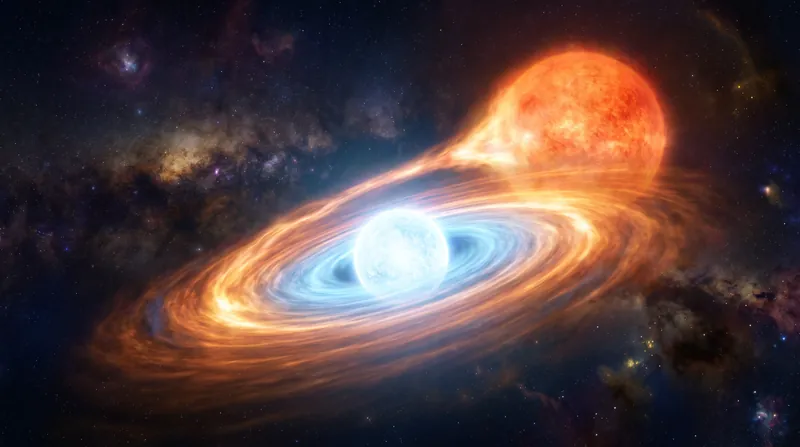
To understand the significance of the direct wave, it helps to break down the anatomy of a black hole collision. When two black holes spiral toward each other, they emit a rising pitch of gravitational waves known as an inspiral. As they finally crash together and merge into a single, larger black hole, the spacetime around them undergoes violent contortions. The newly formed remnant then settles into a stable state by vibrating, much like a struck bell ringing out its final notes.[2]
Astrophysicists call this final vibrating phase the 'ringdown.' For years, scientists have used the fading tones of the ringdown, known as quasinormal modes, to calculate the mass and overall spin of the resulting black hole. However, these quasinormal modes are primarily generated by the 'light ring'—a turbulent region of trapped photons orbiting just outside the black hole—rather than the event horizon itself. The event horizon remained frustratingly out of reach, hidden beneath the dominant ringing of the surrounding spacetime.[2][3]
Theoretical physicists had long suspected that a secondary, much fainter signal should be buried within the complex frequencies of the ringdown. As the two original black holes finish merging, the extreme gravity of the newborn black hole literally drags the surrounding fabric of spacetime along with its rotation, a well-documented phenomenon known as frame dragging. This violent, localized twisting of space right at the absolute boundary of the event horizon should emit a distinct, rapidly fading pulse of energy: the direct wave.
Finding this direct wave in real observational data was considered a monumental, perhaps impossible, challenge. Because the black hole's gravity is so unimaginably intense, any signal emitted near the horizon is severely redshifted and suppressed, fading away almost instantly as it struggles to escape the gravity well. It required a collision as exceptionally loud, clean, and perfectly oriented as GW250114 for the fragile direct wave to stand out against the background noise of the universe and the much louder quasinormal modes dominating the detector.[2]
Finding this direct wave in real observational data was considered a monumental, perhaps impossible, challenge.
By successfully isolating this elusive wave using advanced data filtering techniques, the research team achieved a historic first in astrophysics: they directly measured two fundamental properties of the event horizon itself. The first critical property extracted from the data is the horizon's rotation frequency. The direct wave was found to oscillate at approximately twice the frequency at which the event horizon is physically spinning, providing scientists with a precise, direct speedometer for the black hole's absolute boundary for the very first time.[1]
The second fundamental property extracted from the direct wave is the horizon's surface gravity. This metric dictates exactly how quickly the direct wave decays and fades into nothingness as it radiates outward. Together, these two unprecedented measurements perfectly match the theoretical predictions laid out by Albert Einstein's equations for a rotating black hole, known in astrophysics as a Kerr black hole. The fact that the raw observational data aligns so cleanly with century-old mathematical models is a resounding, triumphant victory for classical physics.[1][3]
The broader implications of this measurement extend far beyond simply confirming old theories. Black holes sit at the exact, highly contested intersection where general relativity—the physics of the unimaginably massive—collides with quantum mechanics—the physics of the unimaginably small. Because these two frameworks famously refuse to work together, theorists have spent decades proposing exotic alternatives to standard black holes, such as 'gravastars' or objects with modified, fuzzy horizons, to resolve the mathematical paradoxes that arise when these two realms meet at the singularity.[3]
By providing a brand new observational tool to probe the event horizon directly, the direct wave gives physicists a concrete way to test these exotic theories using real data rather than just theoretical chalkboards. If future, highly sensitive gravitational wave detections reveal direct waves that deviate even slightly from Einstein's classical predictions, it could provide the very first tangible signature of quantum gravity or entirely new physics operating at the extreme boundary of a black hole.
Despite the widespread excitement surrounding the Nature publication, the broader scientific community is maintaining a healthy dose of skepticism, as is standard for any breakthrough astrophysical claim. The sheer complexity of gravitational wave data means that teasing out a signal as incredibly faint as the direct wave carries an inherent risk of false positives. The mathematical filtering required to separate the delicate direct wave from the much louder ringdown is incredibly intricate, leaving some room for debate over how the data is interpreted.[2][3]
In fact, a separate team of researchers has already circulated a paper directly challenging the horizon interpretation. By running extensive, highly detailed numerical simulations of various black hole mergers, they found that the frequency of the direct wave does not always correlate neatly with the horizon's rotation across different types of collisions. Instead, they argue that the frequencies only happen to align when the final black hole has a specific dimensionless spin rate—around 0.68—which coincidentally perfectly matches the remnant produced by the GW250114 event.[3]
This rigorous counter-argument raises the uncomfortable possibility that the apparent detection of the event horizon's properties might be a mathematical coincidence unique to this specific collision, rather than a universal, reliable tool for probing all black holes. The original research team openly acknowledges this ongoing debate, noting that the true, definitive test will only come as gravitational wave observatories detect more high-quality, high-fidelity mergers in the coming years to see if the pattern holds up across different masses and spins.[2][3]
Fortunately, as international facilities like LIGO, Virgo, and KAGRA undergo continuous quantum-precision upgrades, their sensitivity is reaching truly astonishing levels. They can now reliably register spacetime distortions on scales ten thousand trillion times smaller than a human hair. With this radically enhanced precision, astrophysicists fully expect to capture even louder and clearer signals than GW250114 in the near future, providing the necessary volume of data to confirm whether the direct wave is indeed a reliable messenger from the edge of the abyss.
Regardless of exactly how the academic debate over this specific signal ultimately settles, the groundbreaking analysis of GW250114 marks a profound, irreversible shift in observational astronomy. The sheer idea that humanity can reach across more than a billion light-years of empty space and measure the exact rotational speed of an invisible boundary where time and space fundamentally break down is a staggering testament to the power of modern astrophysics. The event horizon is no longer just a theoretical concept confined to chalkboards; it is rapidly becoming a tangible, measurable destination.
- GW250114
- Gravitational wave signal
- 3x
- Stronger than first detection
- 0.68
- Dimensionless spin of remnant
- 62.7
- Solar masses of final black hole
What we don’t know
- Whether the 'direct wave' signature is a universal feature of all black hole mergers or a mathematical coincidence unique to the specific spin of GW250114.
- How the event horizon behaves at the microscopic level where quantum mechanics and general relativity intersect.
- Whether future, even louder gravitational wave detections will reveal deviations from Einstein's predictions, hinting at new physics.
Key points
- Astrophysicists have isolated a new component of gravitational waves, called a 'direct wave,' from the loudest black hole collision ever recorded (GW250114).
- This direct wave provides the first observational measurements of an event horizon's rotation frequency and surface gravity.
- The measurements perfectly match the predictions of Albert Einstein's general theory of relativity for a rotating black hole.
- The discovery opens a new window to test exotic theories of quantum gravity at the extreme edges of the universe.
- Some researchers caution that the signal's alignment with the horizon's properties might be a mathematical coincidence related to this specific black hole's spin rate.
Key terms
- Event horizon
- The boundary around a black hole beyond which the escape velocity exceeds the speed of light, making it a point of no return.
- Gravitational wave
- Ripples in the fabric of spacetime caused by the acceleration of massive objects, such as colliding black holes.
- Ringdown
- The final phase of a black hole merger where the newly formed, distorted black hole vibrates and settles into a stable state, emitting fading gravitational waves.
- Frame dragging
- A phenomenon predicted by general relativity where a massive, rotating object literally drags the surrounding fabric of spacetime along with it.
- Direct wave
- A specific, faint component of a gravitational wave signal emitted from the immediate vicinity of the event horizon during the final stages of a merger.
- Quasinormal modes
- The specific frequencies at which a newly formed black hole vibrates during the ringdown phase, typically associated with the light ring outside the horizon.
Sources
Source coverage
3 outlets
3 viewpoints surfaced



- [1]NatureObservational Astrophysicists
GW250114 reveals signatures of post-merger black-hole horizon
Read on Nature → - [2]ScienceAlertTheoretical Skeptics
Scientists May Have Detected The First Signature of a Black Hole's Event Horizon
Read on ScienceAlert → - [3]Factlen Editorial TeamTheoretical Skeptics
Synthesis by Factlen editorial team
Read on Factlen Editorial Team →
Comments
More in Science
See all →Medical Physics
How Larmor Precession and T1/T2 Relaxation Times Generate Tissue Contrast in Magnetic Resonance Imaging
9 sources
Arctic Permafrost
Permafrost Thaw Amplifies Earthquake Impacts in the Arctic, Triggering Massive Rock Avalanches
5 sources

Clinical Trials
Phase I, II, III, and IV: The Four Metrics That Define Drug Safety, Efficacy, and Approval
7 sources

Climate Forcing
The -0.7 W/m² Radiative Forcing: Why Aerosols Currently Mask a Quarter of Greenhouse Gas Warming
7 sources

Every angle. Every day.
Get Science stories with full source coverage and perspective breakdowns delivered to your inbox.