
The Science of Umami Synergy: How to Multiply Flavor in Home Cooking
Combining glutamate-rich foods with specific nucleotides doesn't just add flavor—it multiplies it up to fifteen-fold. Understanding the science of "umami synergy" allows home cooks to elevate everyday recipes and reduce salt intake without sacrificing taste.
By Factlen Editorial Team
- Culinary Scientists
- Focuses on the molecular interactions and receptor biology that dictate flavor perception.
- Plant-Based Chefs
- Focuses on using umami synergy to replicate the deep savory satisfaction of meat in vegan cooking.
- Public Health Advocates
- Focuses on umami's potential for sodium reduction and improved satiety in daily diets.
- Traditional Gastronomes
- Focuses on how ancient culinary traditions intuitively mastered these pairings long before science explained them.
What's not represented
- · Industrial Food Manufacturers
- · Flavor Chemists
Why this matters
Mastering umami synergy allows home cooks to multiply the savory depth of their meals up to fifteen-fold without relying on excess salt or fat. This scientific approach to flavor pairing is especially transformative for elevating plant-based recipes and supporting healthier, lower-sodium diets.
Key points
- Umami is the fifth basic taste, driven primarily by the amino acid glutamate.
- Umami synergy occurs when glutamate is paired with nucleotides like inosinate or guanylate.
- This chemical combination can multiply the intensity of savory flavors by up to fifteen times.
- Traditional pairings like cheese and beef, or kombu and bonito flakes, intuitively rely on this science.
- Plant-based cooks can use dried mushrooms and tomatoes to replicate meat's savory depth.
- Utilizing umami synergy allows home cooks to reduce sodium by up to 30% without losing flavor.
Beyond the familiar sensations of sweet, sour, bitter, and salty lies a fifth dimension of taste that dictates the deeply satisfying, mouth-filling quality of our favorite foods. Known as umami—a Japanese portmanteau translating roughly to "pleasant savory taste"—this culinary holy grail is the invisible architecture behind a rich beef stew, a perfectly aged parmesan, and a robust mushroom broth. While home cooks have long chased this elusive depth through trial and error, modern food science has decoded the exact molecular mechanics of deliciousness.[5][6]
The foundation of umami lies in a single, naturally abundant amino acid: glutamate. Found in everything from ripe tomatoes and cured meats to human breast milk, glutamate serves as a fundamental biological signal to our brains that we are consuming vital, energy-yielding proteins. When glutamate hits the palate, it triggers a baseline savory sensation that makes food taste inherently richer and more complex.[6][7]
But simply adding glutamate to a recipe is only the beginning. The true secret to achieving restaurant-quality depth in home cooking involves unlocking a biological phenomenon known as "umami synergy." This chemical reaction occurs when glutamate is intentionally paired with specific ribonucleotides, transforming a flat dish into a multi-dimensional culinary experience.[1][8]
Umami synergy is triggered when glutamate is combined with either inosinate or guanylate. When these compounds meet on the tongue, they do not merely add their flavors together in a linear fashion; instead, they multiply the intensity of the savory sensation by up to fifteen times. This exponential leap in flavor is the difference between a good soup and an unforgettable one.[4][7]

The science behind this flavor explosion comes down to the microscopic architecture of the human tongue. In 2002, researchers identified the primary umami receptor, a protein structure known as T1R1 + T1R3. When a molecule of glutamate enters the mouth, it binds to this receptor, sending a standard savory signal to the brain's gustatory cortex.[4][6]
However, when a nucleotide like inosinate or guanylate is also present in the bite, it acts as an allosteric modulator. The nucleotide essentially acts as a molecular padlock, clamping the glutamate into the receptor for a significantly longer period. This prolonged binding amplifies the neural signal, creating a sustained, mouth-filling sensation that lingers beautifully long after the food is swallowed.[4][7]
Long before molecular gastronomy could explain this receptor mechanism, traditional food cultures around the world intuitively built their foundational recipes on the mathematics of umami synergy. Cooks across continents discovered that pairing certain ingredients yielded a magical deliciousness that neither ingredient possessed on its own.[5][6]
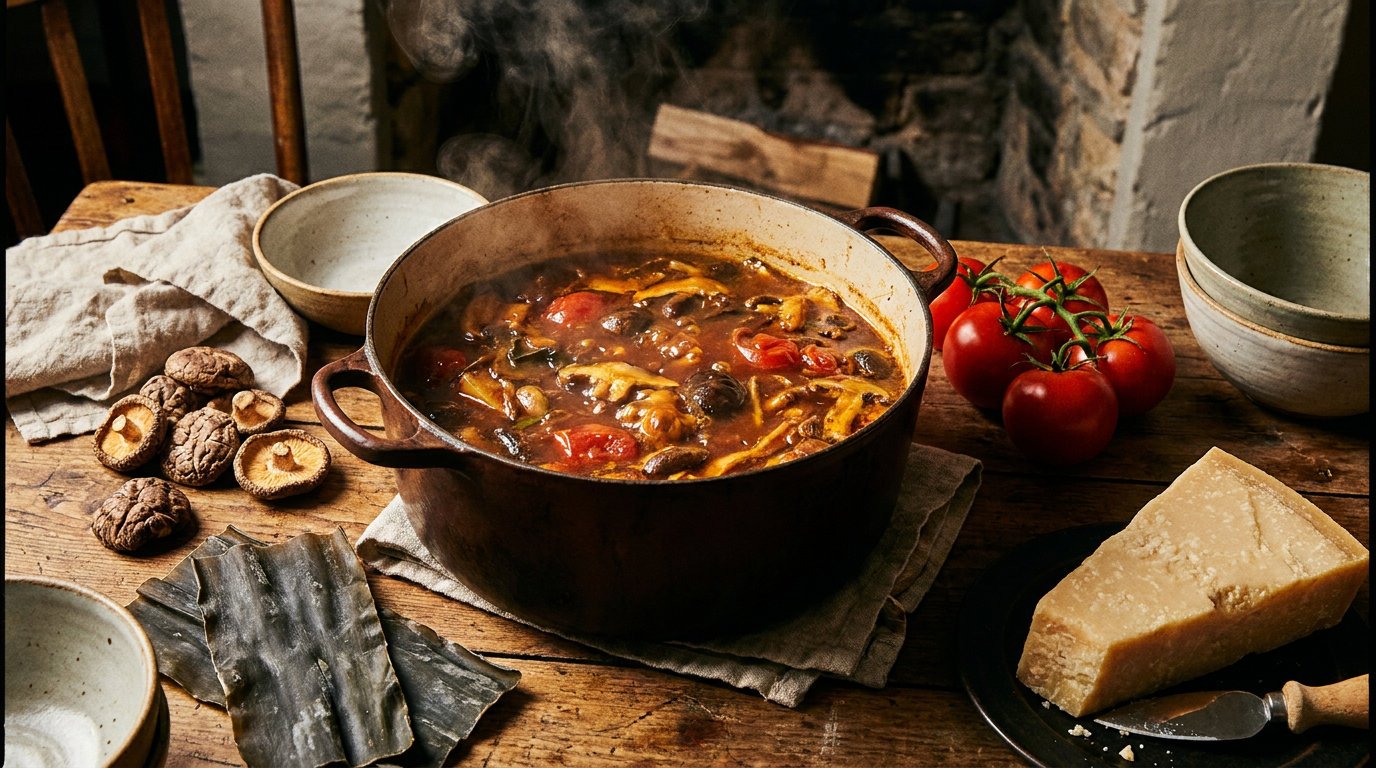
The most famous historical example is Japanese dashi, the bedrock broth of the nation's cuisine. By simmering kombu kelp—which is densely packed with glutamate—alongside katsuobushi, or dried bonito flakes, which are rich in inosinate, cooks created a liquid with an exponentially more powerful savory profile. Scientific analysis later revealed that the optimal ratio of glutamate to inosinate for maximum synergy is exactly 1:1, a balance traditional dashi masters achieved purely through taste.[6][7]

Western culinary traditions rely heavily on the exact same chemical equation. A classic American cheeseburger intuitively pairs the high glutamate content of aged cheddar cheese with the rich inosinate content of ground beef. Similarly, a traditional Caesar salad dressing achieves its aggressive savory punch by combining parmesan cheese (glutamate) with anchovies (inosinate).[7][8]
Western culinary traditions rely heavily on the exact same chemical equation.
Even the luxurious pairing of oysters and champagne has been scientifically proven to rely on this exact biological mechanism. Researchers recently discovered that the umami synergy between the two delicacies stems from combining the nucleotides found in the mollusc's muscles with the glutamate released by the champagne's dead yeast cells during the fermentation process.[3][7]
For modern home cooks, understanding this equation—Glutamate plus Nucleotides equals Flavor Multiplication—opens up an unprecedented level of control in the kitchen. Rather than relying on heavy fats or excessive salt to make a dish taste good, cooks can engineer deep satisfaction by strategically combining the right ingredients.[1][8]
To harness this power, cooks must first identify their molecular sources. Glutamate is highly concentrated in tomatoes, soy sauce, miso paste, kombu, and aged cheeses. Inosinate, on the other hand, is primarily found in animal proteins, including beef, pork, poultry, and fish. Combining an ingredient from the first list with an ingredient from the second guarantees a synergistic reaction.[5][6]
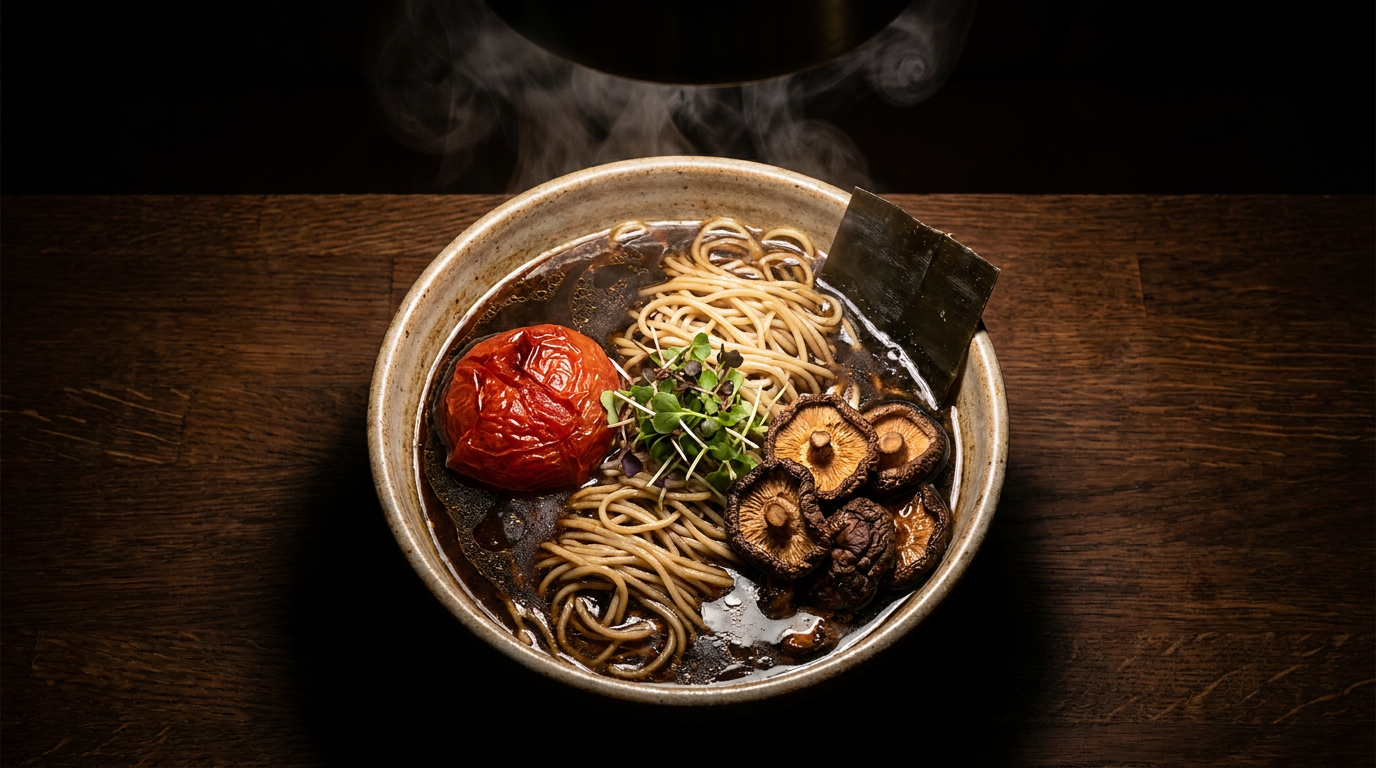
Guanylate, the third piece of the umami puzzle, is almost exclusively found in dried mushrooms, particularly dried shiitake and porcini. The drying process is crucial; as the mushroom dehydrates, its cellular structure breaks down, converting its RNA into guanylate and turning the humble fungus into a potent, concentrated flavor enhancer.[2][6]

This makes guanylate an invaluable tool for plant-based and vegan cooking. Vegetarian dishes often lack the inosinate provided by meat, which can sometimes make them feel less savory, less grounding, or less satisfying to the palate than their omnivorous counterparts.[2][8]
By intentionally pairing a strong glutamate source, such as tomato paste or soy sauce, with a guanylate source, like a deeply steeped dried mushroom broth, plant-based chefs can trigger the exact same umami synergy that makes a traditional beef stew so comforting. This technique allows vegetables to stand at the center of the plate without compromise.[2][5]
Beyond elevating flavor, mastering umami synergy has significant implications for public health and daily nutrition, particularly regarding sodium reduction. Because umami provides such a profound sense of satisfaction and mouthfeel, it can effectively trick the brain into not missing salt.[4][6]
Clinical trials and culinary studies have demonstrated that incorporating umami-rich ingredients allows cooks to reduce the sodium content of a dish by up to 30 percent without any perceived loss of palatability. This makes umami synergy a critical technique for anyone managing hypertension or looking to cook healthier meals without eating bland food.[4][8]

Furthermore, the presence of umami compounds actively stimulates the sustained secretion of viscous saliva. This biological response not only aids in the physical mechanics of swallowing but also initiates the smooth, efficient digestion of complex proteins in the stomach.[6][8]
The conversation around umami inevitably leads to monosodium glutamate (MSG), the isolated salt of glutamic acid. Despite decades of outdated stigma, the global scientific and medical consensus is clear: the human body processes the glutamate in a pinch of MSG exactly the same way it processes the naturally occurring glutamate in a ripe heirloom tomato.[2][4]
How we got here
1908
Japanese chemist Kikunae Ikeda discovers glutamate as the source of umami in kombu kelp.
1913
Shintaro Kodama discovers the nucleotide inosinate in dried bonito flakes.
1957
Akira Kuninaka identifies guanylate in shiitake mushrooms and discovers the principle of umami synergy.
1985
Umami is officially recognized as the fifth basic taste by the global scientific community.
2002
Scientists identify the specific T1R1 + T1R3 taste receptors on the human tongue responsible for sensing umami.
Viewpoints in depth
The Molecular Biology View
Flavor is not just an abstract art, but a quantifiable chemical reaction on the tongue.
From a biological perspective, umami synergy is a masterclass in receptor mechanics. The discovery of allosteric modulation—where nucleotides act as a molecular padlock to lock glutamate into the T1R1 + T1R3 taste receptor—explains why certain ingredient pairings have dominated global cuisines for centuries. It proves that our culinary preferences are deeply encoded in our evolutionary biology, driving us toward nutrient-dense, protein-rich foods.
The Plant-Based Kitchen
Umami synergy is the key to replicating the deep satisfaction of meat without animal products.
Vegan and vegetarian cooking historically struggled to replicate the deep, grounding satisfaction of meat because plant-based diets naturally lack inosinate. By understanding the science of umami synergy, plant-based chefs can leverage guanylate from dried mushrooms and pair it with glutamates from tomatoes and fermented soy. This allows them to engineer the exact same neurological satisfaction and mouthfeel as a beef stew, entirely through plants.
The Public Health Angle
Umami synergy offers a highly effective, flavor-forward strategy for dietary sodium reduction.
With hypertension standing as a leading global health issue, reducing dietary salt intake is paramount. Public health advocates highlight that umami synergy allows for up to a 30% reduction in sodium without compromising taste. Because umami provides a profound sense of satiety and mouthfeel, it offers a rare dietary intervention that doesn't feel like a sacrifice, making lower-sodium diets far easier for the general public to maintain.
What we don't know
- Whether individual genetic variations in the T1R1 + T1R3 receptor significantly alter how different people experience umami synergy.
- The full extent of how umami compounds interact with the gut microbiome once digested.
Key terms
- Umami
- The fifth basic taste, characterized by a deep, pleasant, and lingering savory flavor.
- Glutamate
- An abundant amino acid responsible for the baseline sensation of umami, found in tomatoes, cheese, and soy sauce.
- Inosinate
- A nucleotide found primarily in animal proteins like meat and fish that multiplies the umami effect of glutamate.
- Guanylate
- A nucleotide found almost exclusively in dried mushrooms that triggers umami synergy when paired with glutamate.
- Umami Synergy
- The biological phenomenon where combining glutamate with inosinate or guanylate multiplies the intensity of savory flavor by up to fifteen times.
- Allosteric Modulator
- A substance that binds to a receptor to change its response to a stimulus; in this case, nucleotides locking glutamate into taste receptors.
Frequently asked
What is the difference between MSG and natural umami?
There is no chemical difference. The human body processes the glutamate in Monosodium Glutamate (MSG) exactly the same way it processes the naturally occurring glutamate found in tomatoes or cheese.
Why do dried mushrooms have more umami than fresh ones?
The drying process breaks down the mushroom's cellular structure, converting its RNA into guanylate, a powerful nucleotide that triggers umami synergy.
How does umami help reduce salt intake?
Umami provides a profound sense of mouthfeel and satisfaction that tricks the brain into not missing salt, allowing cooks to reduce sodium by up to 30% without the food tasting bland.
What is the T1R1 + T1R3 receptor?
It is the specific protein structure on the human tongue responsible for detecting umami. Nucleotides lock glutamate into this receptor, amplifying the savory signal sent to the brain.
Sources
Source coverage
8 outlets
4 viewpoints surfaced







[1]ChefsquirePlant-Based Chefs
Tiger Prawn Extraction & Umami Synergy: Elevating Flavor Through Science
Read on Chefsquire →[2]Delish KnowledgePlant-Based Chefs
Plant-Based Umami: The Secret to Creating Delicious, Vegan Food
Read on Delish Knowledge →[3]Nature Scientific ReportsCulinary Scientists
Umami synergy: The timeless, complimentary taste of oysters and champagne explained by science
Read on Nature Scientific Reports →[4]ResearchGateCulinary Scientists
Science of umami taste: adaptation to gastronomic culture
Read on ResearchGate →[5]Culinary ScienceTraditional Gastronomes
Exploring the Fifth Taste: The Synergy of Umami
Read on Culinary Science →[6]Umami Information CenterTraditional Gastronomes
What is Umami
Read on Umami Information Center →[7]Ramen ChemistryCulinary Scientists
Umami Science Part III - Umami Synergy
Read on Ramen Chemistry →[8]Factlen Editorial TeamPublic Health Advocates
Synthesis by Factlen editorial team
Read on Factlen Editorial Team →
More in food drink
See all 37 stories →Sustainable Viticulture
The Rise of PIWI Grapes: How Fungus-Resistant Vines Are Reshaping Sustainable Wine
6 sources

Flavor Science
The Science of Umami: How to Engineer Deep Savory Flavor in Plant-Based Cooking
6 sources

Cocktail Science
The Science of Clarified Milk Punch: How Curdled Milk Makes Crystal-Clear Cocktails
6 sources

Tea Chemistry
The Chemistry of Tea: How Processing and L-Theanine Alter the Health and Cognitive Effects of Camellia Sinensis
7 sources
Every angle. Every day.
Get food drink stories with full source coverage and perspective breakdowns delivered to your inbox.