
The Science of the Maillard Reaction: How Heat Transforms Food
The Maillard reaction is the complex chemical process responsible for the browning and deep savory flavors in everything from seared steak to toasted bread.
By Factlen Editorial Team
- Professional Chefs
- Focus on practical techniques to control heat and moisture for optimal browning.
- Culinary Scientists
- Focus on mapping the precise chemical pathways and isolating specific flavor compounds.
- Public Health Researchers
- Focus on mitigating the formation of harmful byproducts like acrylamide during high-heat cooking.
What's not represented
- · Commercial flavor manufacturers
Why this matters
Understanding the Maillard reaction allows home cooks to intentionally manipulate heat, moisture, and time to unlock restaurant-quality flavor in their own kitchens.
Key points
- The Maillard reaction is a chemical interaction between amino acids and reducing sugars under high heat.
- It produces hundreds of distinct flavor compounds and the brown pigments known as melanoidins.
- The reaction typically requires temperatures above 285°F (140°C) to proceed rapidly.
- Moisture inhibits the reaction by capping the surface temperature at the boiling point of water.
- Alkaline environments accelerate the browning process, a technique commonly used in baking pretzels.
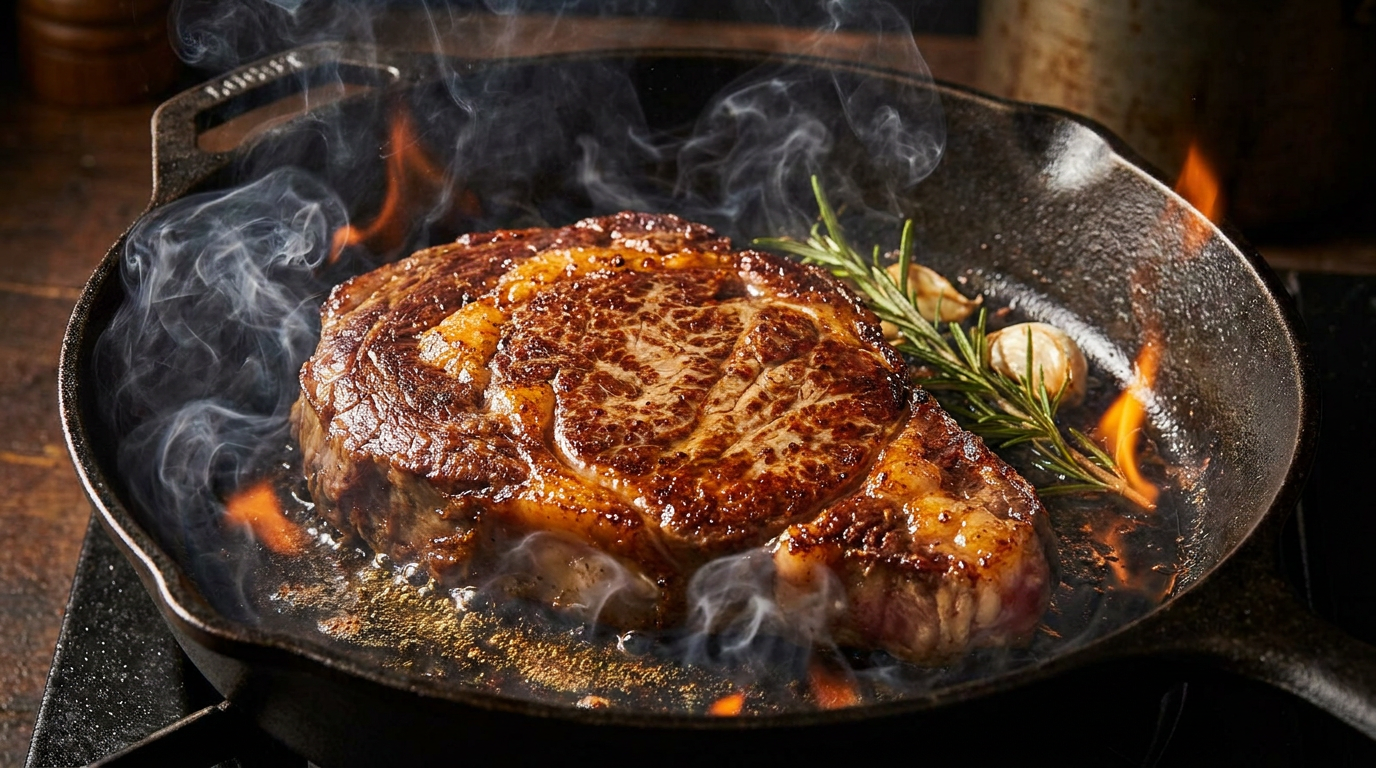
There is a universal, almost primal appeal to the aroma of a steak searing in a hot cast-iron skillet, the scent of a fresh loaf of bread emerging from the oven, or the rich fragrance of coffee beans roasting. These distinct culinary experiences, which span cultures and cuisines, share a single, unifying chemical secret. It is a transformation that elevates raw, often bland ingredients into complex, savory masterpieces. In the culinary world, this process is frequently referred to simply as "browning," but that shorthand vastly understates its profound importance to the way we experience food. The true engine behind these mouthwatering aromas and deep flavors is a complex cascade of chemical interactions known as the Maillard reaction. Without it, our diets would be remarkably dull, lacking the savory depth and roasted notes that define so many of our favorite meals.[4][5]
The reaction is named after Louis-Camille Maillard, a French chemist who first described the phenomenon in 1912. At the time, Maillard was not attempting to revolutionize the culinary arts; rather, he was investigating biological protein synthesis and how amino acids link together to form proteins. During his experiments, he observed that when he heated a solution containing both amino acids and sugars, the mixture unexpectedly turned brown. This serendipitous discovery laid the groundwork for what chemistry Nobel laureate Jean-Marie Lehn would later describe as the most widely practiced chemical reaction in the world. Today, the Maillard reaction is recognized as a cornerstone of food science, essential not only in home kitchens and high-end restaurants but also across the global food manufacturing industry.[2][3]
At its core, the Maillard reaction is a form of non-enzymatic browning, distinguishing it from the enzymatic browning that causes a sliced apple or avocado to turn brown when exposed to air. The process requires two primary reactants: amino acids, which are the fundamental building blocks of proteins, and reducing sugars, such as glucose, fructose, or lactose. When these components are subjected to heat, a complex and highly dynamic chemical dance begins. The heat acts as a necessary catalyst, providing the energy required to initiate the reaction between the nucleophilic amino group of the amino acid and the reactive carbonyl group of the reducing sugar. This initial interaction sets off a chain reaction that fundamentally alters the molecular structure of the food.[1][2][3]

The initial stage of the Maillard reaction results in the formation of an unstable intermediate compound known as a glycosylamine. Because this molecule is inherently unstable, it rapidly undergoes a chemical rearrangement—specifically known as the Amadori rearrangement—to form more stable compounds called ketosamines. This step is crucial because it acts as the gateway to the reaction's immense complexity. Depending on the specific amino acids and sugars present in the food, these ketosamines can break down and recombine in myriad ways, branching off into numerous distinct chemical pathways. It is at this stage that the reaction begins to generate the vast array of volatile aroma compounds that we perceive as the smell of cooking food.[2][4]
As the reaction cascades forward, it produces literally hundreds of different flavor and aroma compounds. The specific profile of these compounds is highly dependent on the exact chemical constituents of the raw food. For instance, the amino acids present in beef will react with sugars to produce a completely different set of flavor molecules than the amino acids found in wheat flour or coffee beans. This explains why a baking loaf of bread smells entirely different from a roasting chicken or frying fish, even though the underlying chemical mechanism—the Maillard reaction—is exactly the same in all three scenarios. These newly formed compounds can also break down further, reacting with one another to create even more complex flavor profiles.[1][3][5]
As the reaction cascades forward, it produces literally hundreds of different flavor and aroma compounds.
The final stages of the Maillard reaction are responsible for the characteristic visual changes in cooked food. As the smaller flavor compounds continue to react and polymerize, they form large, complex, nitrogen-containing polymers known as melanoidins. These melanoidins are the brown pigments that give a seared steak its dark crust, a French fry its golden hue, and a dark beer its rich color. Unlike the volatile aroma compounds that drift into the air and stimulate our olfactory senses, melanoidins remain in the food, contributing to its visual appeal and providing a subtle, earthy bitterness that balances the savory and sweet notes generated earlier in the reaction.[2][3]
Temperature is arguably the most critical variable in controlling the Maillard reaction. While the reaction can technically occur at lower temperatures over very long periods—such as the slow browning of aging champagne or the preservation of ancient bog bodies—in a culinary context, it requires high heat to proceed rapidly. The reaction typically begins to accelerate significantly at temperatures between 285°F and 330°F (140°C to 165°C). This specific temperature threshold is why cooking methods that rely on water, such as boiling, poaching, or steaming, fail to produce the rich flavors and brown crusts associated with roasting or frying. Because water boils at 212°F (100°C), the surface temperature of wet food cannot exceed this point until all the moisture has evaporated.[1][3][5]

Consequently, moisture is the primary enemy of the Maillard reaction in the kitchen. When a cook places a wet piece of meat into a hot pan, the thermal energy is initially expended on evaporating the surface water rather than initiating the browning process. This creates a localized steaming effect, which keeps the temperature well below the 285°F threshold required for the Maillard reaction to thrive. To overcome this, professional chefs employ various techniques to ensure a dry surface before cooking. Thoroughly patting meat dry with paper towels, leaving it uncovered in the refrigerator to air-dry, or applying salt in advance to draw out and subsequently evaporate moisture are all scientifically grounded methods designed to jump-start the Maillard reaction the moment the food hits the pan.[1][5][6]
Beyond temperature and moisture, the pH level of the cooking environment also exerts a profound influence on the rate and extent of the Maillard reaction. The chemical process accelerates significantly in alkaline (basic) conditions. This occurs because an alkaline environment deprotonates the amino groups, thereby increasing their nucleophilicity and making them more reactive toward the sugars. Bakers have exploited this chemical quirk for centuries, most notably in the production of traditional pretzels and bagels. By briefly boiling the dough in a solution of lye or baking soda before baking, they artificially raise the surface pH, supercharging the Maillard reaction to produce a deeply browned, glossy crust and a distinct, alkaline-tinged flavor profile.[1][3]

While the Maillard reaction is universally celebrated for its culinary benefits, it also presents certain health and safety considerations that food scientists continue to study. When foods—particularly those rich in carbohydrates and the amino acid asparagine, such as potatoes and wheat—are subjected to excessively high temperatures, the Maillard reaction can produce a byproduct called acrylamide. The World Health Organization has classified acrylamide as a probable human carcinogen based on animal studies, though the actual risk posed by the levels typically found in a standard human diet remains a subject of ongoing scientific debate and investigation.[3][4]
To mitigate the formation of acrylamide, food manufacturers and home cooks can employ several strategies. Cooking foods at slightly lower temperatures, avoiding excessive charring or burning (which transitions the food from the Maillard reaction into pyrolysis), and soaking starchy foods like potatoes in water before frying to remove excess surface sugars can all significantly reduce acrylamide levels. Interestingly, the Maillard reaction is not entirely detrimental from a health perspective; the process also generates various antioxidant compounds, which can help neutralize harmful free radicals in the body, suggesting a complex and nuanced relationship between browned foods and human health.[2][4]

Ultimately, mastering the art of cooking is largely about mastering the Maillard reaction. By understanding the underlying chemistry—the delicate interplay of amino acids and sugars, the strict temperature thresholds, the inhibitory effect of moisture, and the accelerating power of alkalinity—home cooks can intentionally manipulate these variables to unlock restaurant-quality flavors in their own kitchens. Whether it is achieving the perfect sear on a scallop, baking a deeply golden loaf of sourdough, or simply roasting vegetables to coax out their savory depth, the Maillard reaction remains the most powerful tool in the culinary arsenal, a daily miracle of chemistry that transforms the mundane into the extraordinary.[6]
How we got here
1912
French chemist Louis-Camille Maillard first describes the reaction while studying protein synthesis.
1953
Chemist John E. Hodge publishes a definitive paper outlining the complex mechanism of the Maillard reaction.
2002
Researchers discover that acrylamide, a probable carcinogen, can form during the Maillard reaction in starchy foods.
Viewpoints in depth
Culinary Scientists
Focus on the precise chemical pathways and molecular transformations.
Food chemists view the Maillard reaction as a complex matrix of hundreds of simultaneous equations. They study the specific Amadori rearrangements and the resulting ketosamines to map exactly which amino acids yield which flavor profiles. For instance, they know that reacting cysteine with sugar produces meaty, savory notes, while proline yields the aroma of baked bread. Their goal is often to isolate these pathways to synthesize natural flavorings for the commercial food industry.
Professional Chefs
Focus on practical application, temperature control, and moisture management.
For culinary professionals, the Maillard reaction is a daily tool rather than a theoretical concept. Chefs prioritize techniques that guarantee optimal browning: resting meat uncovered in refrigerators to desiccate the surface, utilizing heavy cast-iron pans that retain thermal mass, and strictly avoiding pan-overcrowding to prevent steaming. Their perspective is entirely pragmatic—manipulating the physical environment to ensure the chemical reaction occurs flawlessly every time.
Public Health Researchers
Focus on the byproducts of high-heat cooking and long-term health impacts.
Health researchers approach the Maillard reaction with a degree of caution, primarily due to the formation of acrylamide when starchy foods are cooked at high temperatures. While acknowledging the culinary benefits, this camp advocates for moderation and modified cooking techniques—such as soaking potatoes before frying or aiming for a golden-yellow color rather than dark brown—to minimize exposure to potential carcinogens without entirely sacrificing flavor.
What we don't know
- The exact health risks of dietary acrylamide at typical consumption levels remain a subject of ongoing study.
- Scientists have yet to fully catalog every single volatile flavor compound produced during complex Maillard reactions.
Key terms
- Amino Acids
- Organic compounds that combine to form proteins, acting as one of the two primary reactants in the Maillard reaction.
- Reducing Sugars
- Simple sugars, such as glucose and fructose, that have a free aldehyde or ketone group capable of reacting with amino acids.
- Melanoidins
- Large, complex, brown-colored polymers formed in the final stages of the Maillard reaction that give cooked food its dark crust.
- Pyrolysis
- The chemical decomposition of organic materials at elevated temperatures, commonly known as burning or charring.
- Acrylamide
- A chemical byproduct that can form when starchy foods are cooked at very high temperatures.
Frequently asked
Is the Maillard reaction the same as caramelization?
No. While both require high heat and produce browning, caramelization involves only the breakdown of sugars, whereas the Maillard reaction requires both sugars and amino acids (proteins).
Why doesn't boiled food turn brown?
Boiling water cannot exceed 212°F (100°C). The Maillard reaction requires temperatures of at least 285°F (140°C) to occur rapidly, so wet cooking methods prevent browning.
How can I get a better sear on my steak?
Thoroughly pat the steak dry with paper towels before cooking to remove surface moisture, and ensure your pan is preheated to a high temperature.
Sources
Source coverage
6 outlets
3 viewpoints surfaced






[1]Science of CookingPublic Health Researchers
What is the Maillard Reaction
Read on Science of Cooking →[2]National Center for Biotechnology InformationCulinary Scientists
Maillard Reaction: Mechanism, Influencing Parameters, Advantages, Disadvantages, and Food Industrial Applications: A Review
Read on National Center for Biotechnology Information →[3]WikipediaPublic Health Researchers
Maillard reaction
Read on Wikipedia →[4]MasterClassProfessional Chefs
Maillard Reaction Explained: What Is the Maillard Reaction?
Read on MasterClass →[5]Modernist CuisineProfessional Chefs
The Maillard Reaction
Read on Modernist Cuisine →[6]Factlen Editorial TeamProfessional Chefs
Synthesis by Factlen editorial team
Read on Factlen Editorial Team →
More in lifestyle
See all 52 stories →Circular Dining
How Zero-Waste Restaurants Actually Work: The Mechanics of Circular Dining
8 sources
Flavor Chemistry
The Science of Synergistic Umami: How to Multiply Savory Flavors in Home Cooking
7 sources
Social Infrastructure
The New Third Place: How Gen Z and Millennials Are Rebuilding Real-World Community
7 sources

Digital Communication
The New Rules of Digital Etiquette: Voice Notes, AI, and the Death of the Cold Call
6 sources

Every angle. Every day.
Get lifestyle stories with full source coverage and perspective breakdowns delivered to your inbox.