
The Science of Synergistic Umami: How to Multiply Savory Flavors in Home Cooking
Understanding the chemical interaction between glutamates and nucleotides allows home cooks to amplify the savory depth of their meals by up to 15 times.
By Factlen Editorial Team
- Flavor Chemists
- Focuses on the molecular interactions, specifically how nucleotides act as allosteric modulators on the T1R1/T1R3 tongue receptors.
- Culinary Traditionalists
- Emphasizes how ancient cooking techniques intuitively solved complex flavor chemistry long before scientists could explain it.
- Public Health Advocates
- Highlights umami's clinical potential to reduce dietary sodium intake and assist patients suffering from taste loss.
What's not represented
- · Industrial food manufacturers relying on artificial flavorings
Why this matters
Mastering umami synergy transforms everyday cooking from guesswork into a precise science, allowing you to build restaurant-quality flavor profiles while simultaneously reducing your sodium intake.
Key points
- Umami is the fifth basic taste, signaling the presence of protein to the brain.
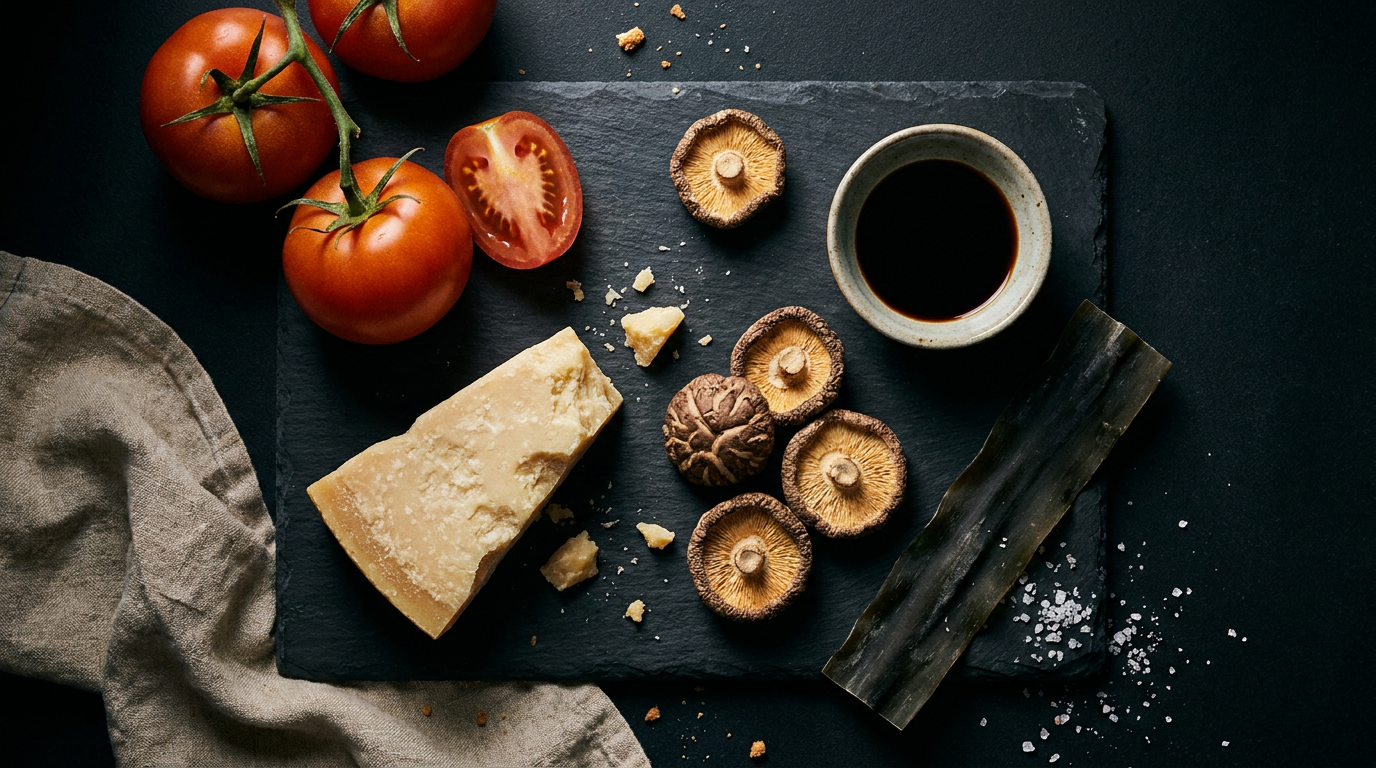
- Basal umami is created by free glutamates found in tomatoes, cheese, and fermented foods.
- Synergistic umami occurs when glutamates are combined with nucleotides from meat or mushrooms.
- This chemical combination amplifies the perceived savory flavor by up to 15 times.
- Traditional pairings like dashi, cheeseburgers, and bolognese intuitively rely on this synergy.
- Maximizing umami allows cooks to reduce sodium content by up to 30% without losing flavor.
Take a bite of a perfectly seared steak, a slice of aged parmesan, or a steaming bowl of miso soup, and you will experience a profound, mouth-filling savoriness that lingers on the palate. This sensation is not merely the result of salt or fat; it is umami, the universally recognized fifth basic taste. For decades, Western culinary traditions struggled to categorize this deep, brothy richness, often lumping it in with saltiness. But in the modern kitchen, understanding umami has evolved from a vague culinary concept into a precise science. By mastering the molecular interactions that create this flavor, home cooks can transform ordinary ingredients into extraordinary meals.[6]
The story of umami begins in 1908, when Japanese chemist Kikunae Ikeda sought to understand why the traditional dashi broth made by his wife tasted so uniquely delicious. By evaporating large quantities of kombu (kelp) broth, Ikeda successfully isolated glutamic acid, an amino acid that he identified as the source of the savory flavor. He named this taste "umami," a portmanteau of the Japanese words for "delicious" and "taste." Despite his groundbreaking work, it took nearly a century for the global scientific community to officially recognize umami alongside sweet, sour, salty, and bitter, finally identifying specific taste receptors on the human tongue dedicated to detecting it.[2][5]
To harness umami in home cooking, one must first understand the mechanics of "basal umami," which is driven entirely by glutamates. Glutamic acid is one of the most abundant amino acids in nature, found in both plant and animal proteins. However, when bound within a protein chain, it has absolutely no taste. It is only when these proteins are broken down into individual amino acids—a process achieved through cooking, aging, ripening, or fermenting—that the glutamate becomes "free." This free glutamate is what our taste buds recognize and crave.[1][5][6]
This biological mechanism explains why certain ingredients are universally beloved in kitchens around the world. A hard, aged parmesan cheese contains vastly more free glutamate than a glass of fresh milk, just as a sun-dried tomato packs a far more concentrated savory punch than a pale, unripe one. Fermented pantry staples like soy sauce, miso paste, and Worcestershire sauce are essentially liquid umami, created by utilizing enzymes and time to break down proteins into their most flavorful, free-floating components.[3][7]

But basal umami is only half of the flavor equation. The true secret to restaurant-quality depth lies in a phenomenon known as "synergistic umami." In 1913, Shintaro Kodama, a disciple of Ikeda, discovered that dried bonito flakes (katsuobushi) contained a different umami compound called inosinate. Decades later, in 1957, Akira Kuninaka identified guanylate in dried shiitake mushrooms. Both inosinate and guanylate belong to a family of molecules called nucleotides. On their own, these nucleotides provide very little flavor. But when combined with free glutamates, a profound chemical reaction occurs.[1][5]
Kuninaka discovered that mixing glutamates with nucleotides does not simply add their flavors together; it multiplies them exponentially. When a food rich in inosinate or guanylate is introduced to a food rich in glutamate, the perceived intensity of the savory flavor is amplified by up to fifteen times. This synergistic explosion is the holy grail of flavor chemistry, transforming a mildly savory dish into an intensely satisfying, mouth-watering experience that coats the tongue and lingers long after the bite is swallowed.[1][3][6]
The biological reason for this synergy is rooted in our evolutionary drive to seek out protein-dense, nutritious foods. The primary umami receptor on the human tongue is a complex structure known as the T1R1/T1R3 receptor. When free glutamate binds to this receptor, it sends a signal to the brain indicating the presence of protein. However, when nucleotides like inosinate or guanylate are also present, they act as "allosteric modulators." They physically alter the shape of the receptor, trapping the glutamate molecule inside for a significantly longer period. This prolonged binding sends a sustained, powerful signal of satisfaction to the brain's pleasure centers.[1][2][6]

The biological reason for this synergy is rooted in our evolutionary drive to seek out protein-dense, nutritious foods.
Long before scientists mapped the T1R1/T1R3 receptor, traditional cuisines around the world intuitively harnessed synergistic umami. The most elegant example is Japanese dashi, the foundational broth of the nation's cuisine. By simmering kombu (which is packed with glutamate) alongside dried bonito flakes (which are loaded with inosinate), Japanese cooks created a broth that perfectly optimized this 15x flavor multiplier. A vegan version of dashi achieves the exact same synergy by swapping the bonito flakes for dried shiitake mushrooms, which provide a massive dose of guanylate.[1][5][6]
Western culinary traditions are equally built on this unspoken chemical synergy. A classic Italian pasta Bolognese pairs slow-cooked tomatoes (glutamate) with ground beef (inosinate). A Caesar salad derives its addictive quality from the combination of aged parmesan cheese (glutamate) and cured anchovies (inosinate). Even the humble American cheeseburger is a masterpiece of synergistic umami, layering a slice of glutamate-rich cheese over an inosinate-heavy beef patty, often topped with glutamate-heavy ketchup.[3][6][7]
For the modern home cook, understanding this synergy turns recipe development from a guessing game into a precise science. If a soup or stew tastes "flat" or lacks depth, the solution is rarely just more salt. Instead, cooks should analyze the umami balance. If the dish already contains meat (inosinate), adding a splash of soy sauce or a spoonful of tomato paste (glutamate) will trigger the multiplier effect. Conversely, if a vegetarian dish relies on tomatoes or cheese (glutamate), adding dried mushrooms (guanylate) will instantly elevate the flavor profile.[6][7]

Cooking techniques also play a vital role in maximizing umami. Slow-roasting vegetables, braising tough cuts of meat, and utilizing fermented ingredients all serve the same chemical purpose: breaking down complex proteins to release more free glutamates and nucleotides. A quick-boiled chicken breast will always taste blander than a slow-simmered chicken thigh, simply because the extended cooking time allows the proteins to degrade into their most flavorful components.[3][6][7]
The purest, most direct way to add basal umami to a dish is through monosodium glutamate (MSG). Despite decades of debunked stigma, MSG is simply the isolated sodium salt of glutamic acid, biologically identical to the glutamate found naturally in tomatoes and cheese. While a pinch of MSG can dramatically improve the savory depth of a dish, culinary scientists note that it only provides basal umami. To achieve the coveted synergistic effect, MSG must still be paired with ingredients containing nucleotides, such as meat, fish, or mushrooms.[2][6][7]
Beyond pure culinary pleasure, the science of umami has significant implications for public health and nutrition. Because umami enhances the overall perception of flavor and satisfaction, it can be used to dramatically reduce the sodium content of a meal. Studies have shown that maximizing synergistic umami allows cooks to reduce added salt by up to 30% without any perceived loss of palatability. This makes umami an invaluable tool for dietitians and chefs designing heart-healthy menus.[3][6]

Furthermore, umami plays a crucial physiological role in digestion. The activation of umami receptors strongly stimulates the production of saliva, which is essential for breaking down food and swallowing. This property is currently being utilized by culinary researchers and healthcare professionals to help patients suffering from taste loss—such as those undergoing chemotherapy or the elderly—rediscover the joy of eating. By engineering "super umami" recipes, organizations are helping vulnerable populations maintain their appetite and nutritional intake.[4][6]
Ultimately, the science of umami proves that cooking is as much about chemistry as it is about art. The fifth taste is not a vague culinary buzzword; it is a fundamental biological reward system that has guided human diets for millennia. By consciously pairing glutamates with nucleotides, home cooks can unlock the full potential of their pantries, transforming everyday ingredients into deeply satisfying, scientifically optimized meals.[6]
How we got here
1908
Kikunae Ikeda isolates glutamic acid from kombu broth and coins the term 'umami'.
1913
Shintaro Kodama discovers inosinate in dried bonito flakes, identifying the first nucleotide umami compound.
1957
Akira Kuninaka identifies guanylate in shiitake mushrooms and discovers the 15x synergistic multiplier effect.
1985
The term 'umami' is officially recognized as the scientific term for the fifth basic taste at the first Umami International Symposium.
2002
Scientists definitively identify the T1R1/T1R3 taste receptors on the human tongue, proving umami is a distinct biological sense.
Viewpoints in depth
Flavor Chemists
Focuses on the molecular interactions and receptor biology of taste.
For flavor chemists, umami is a fascinating study in receptor biology. The discovery of the T1R1/T1R3 receptor complex proved that umami is not a subjective culinary concept, but a hardwired evolutionary mechanism designed to detect protein. Chemists are particularly interested in how nucleotides act as allosteric modulators—literally changing the physical shape of the taste receptor to trap glutamate molecules for longer periods, which explains the lingering, mouth-coating sensation of synergistic umami.
Culinary Traditionalists
Emphasizes how ancient cooking techniques intuitively solved complex flavor chemistry.
Culinary historians and traditional chefs point out that long before scientists could isolate glutamic acid, human intuition had already perfected synergistic umami. The development of Japanese dashi, the aging of Italian parmesan, and the fermentation of Chinese soy sauce were all empirical triumphs. Traditionalists argue that understanding the science simply validates the wisdom of these ancient practices, proving that the slow, methodical breakdown of proteins through traditional cooking methods is chemically superior to taking shortcuts.
Public Health Advocates
Highlights umami's clinical potential to improve diets and assist patients.
In the realm of public health, umami is viewed as a powerful tool for dietary intervention. Because synergistic umami drastically increases the palatability of food, dietitians use it to help patients reduce their sodium intake without feeling deprived. Furthermore, clinical researchers are utilizing umami's ability to stimulate saliva production to help patients with compromised taste—such as those undergoing chemotherapy—regain their appetite and maintain crucial nutritional intake during treatment.
What we don't know
- The exact evolutionary timeline of when humans developed specific T1R1/T1R3 receptors.
- How individual genetic variations affect the perceived intensity of synergistic umami.
Key terms
- Basal Umami
- The foundational savory taste provided by free glutamates, found abundantly in tomatoes, aged cheese, and soy sauce.
- Synergistic Umami
- The exponential amplification of flavor that occurs when glutamates are combined with nucleotides.
- Free Glutamate
- Glutamic acid that has been broken off from a protein chain through cooking, aging, or fermentation, allowing it to interact with taste receptors.
- Nucleotides
- Compounds like inosinate and guanylate that provide little flavor on their own but act as massive flavor multipliers when paired with glutamates.
- Allosteric Modulator
- A substance that physically changes the shape of a biological receptor; in cooking, nucleotides change taste receptors to trap glutamate longer.
Frequently asked
What is the difference between umami and saltiness?
Saltiness is triggered by sodium ions and provides a sharp, immediate taste. Umami is triggered by amino acids (glutamates) and provides a deep, lingering, mouth-coating savoriness.
Is MSG safe to use in home cooking?
Yes. Monosodium glutamate is simply the isolated sodium salt of naturally occurring glutamic acid, and decades of scientific consensus have debunked the health myths surrounding its use.
How can vegetarians achieve synergistic umami without meat?
Vegetarians can pair glutamate-rich foods (like tomatoes, cheese, or soy sauce) with guanylate-rich foods (like dried shiitake mushrooms or nutritional yeast) to achieve the exact same 15x flavor multiplier.
Sources
Source coverage
7 outlets
3 viewpoints surfaced







[1]NatureFlavor Chemists
Umami synergy as the scientific principle behind food pairing
Read on Nature →[2]Chemical SensesFlavor Chemists
Glutamate: from discovery as a food flavor to role as a basic taste
Read on Chemical Senses →[3]Popular SciencePublic Health Advocates
The Science of Umami and Synergistic Flavor
Read on Popular Science →[4]Life KitchenPublic Health Advocates
The Science of Taste: How Umami Amplifies Flavor
Read on Life Kitchen →[5]Umami Information CenterFlavor Chemists
What is Umami? The Fifth Basic Taste
Read on Umami Information Center →[6]Factlen Editorial TeamCulinary Traditionalists
Synthesis by Factlen editorial team
Read on Factlen Editorial Team →[7]AjinomotoCulinary Traditionalists
How to Add Umami to Your Cooking
Read on Ajinomoto →

More in lifestyle
See all 54 stories →Biotech Skincare
The Rise of Biotech Beauty: How Lab-Grown Ingredients Are Reshaping Skincare
8 sources
Skincare Science
The Science of Skin Barrier Repair: How Ceramides and Microbiome Care Replaced Harsh Exfoliants
8 sources

Circular Dining
How Zero-Waste Restaurants Actually Work: The Mechanics of Circular Dining
8 sources

Social Infrastructure
The New Third Place: How Gen Z and Millennials Are Rebuilding Real-World Community
7 sources

Every angle. Every day.
Get lifestyle stories with full source coverage and perspective breakdowns delivered to your inbox.