
The Science of the 'Fifth Stroke': How AI and Biomechanics Are Pushing Swimming's Underwater Limits
The fastest part of a swimming race happens entirely underwater. Now, cutting-edge fluid dynamics and AI pose estimation are helping athletes perfect the elusive dolphin kick.
By Factlen Editorial Team
- Biomechanics Researchers
- Focus on fluid dynamics, vortex recycling, and the physical limits of human propulsion in water.
- Sports Technologists
- Focus on democratizing elite training through AI pose estimation, markerless motion capture, and wearable sensors.
- Competitive Coaches
- Focus on the practical application of the dolphin kick, core strength development, and maximizing the 15-meter rule.
- Factlen Analysis
- Synthesizing the intersection of marine biology, physics, and AI to explain the evolution of the sport.
What's not represented
- · Recreational swimmers who lack access to advanced coaching
- · Regulatory bodies managing the evolution of swimming rules
Why this matters
As wearable tech and AI computer vision become accessible to local pools, the highly technical biomechanics once reserved for Olympic laboratories are now available to amateur athletes, democratizing elite sports science.
Key points
- The fastest segment of a competitive swimming race occurs entirely underwater using the dolphin kick, often called the 'fifth stroke.'
- By staying submerged, swimmers bypass surface wave drag, reaching speeds up to 2.2 meters per second.
- World Aquatics strictly limits underwater kicking to 15 meters per length to maintain the integrity of surface strokes.
- New AI pose estimation tools can track underwater biomechanics using standard cameras, eliminating the need for expensive lab equipment.
- Wearable smart textiles and inertial sensors are providing coaches with real-time data on stroke symmetry and core undulation.
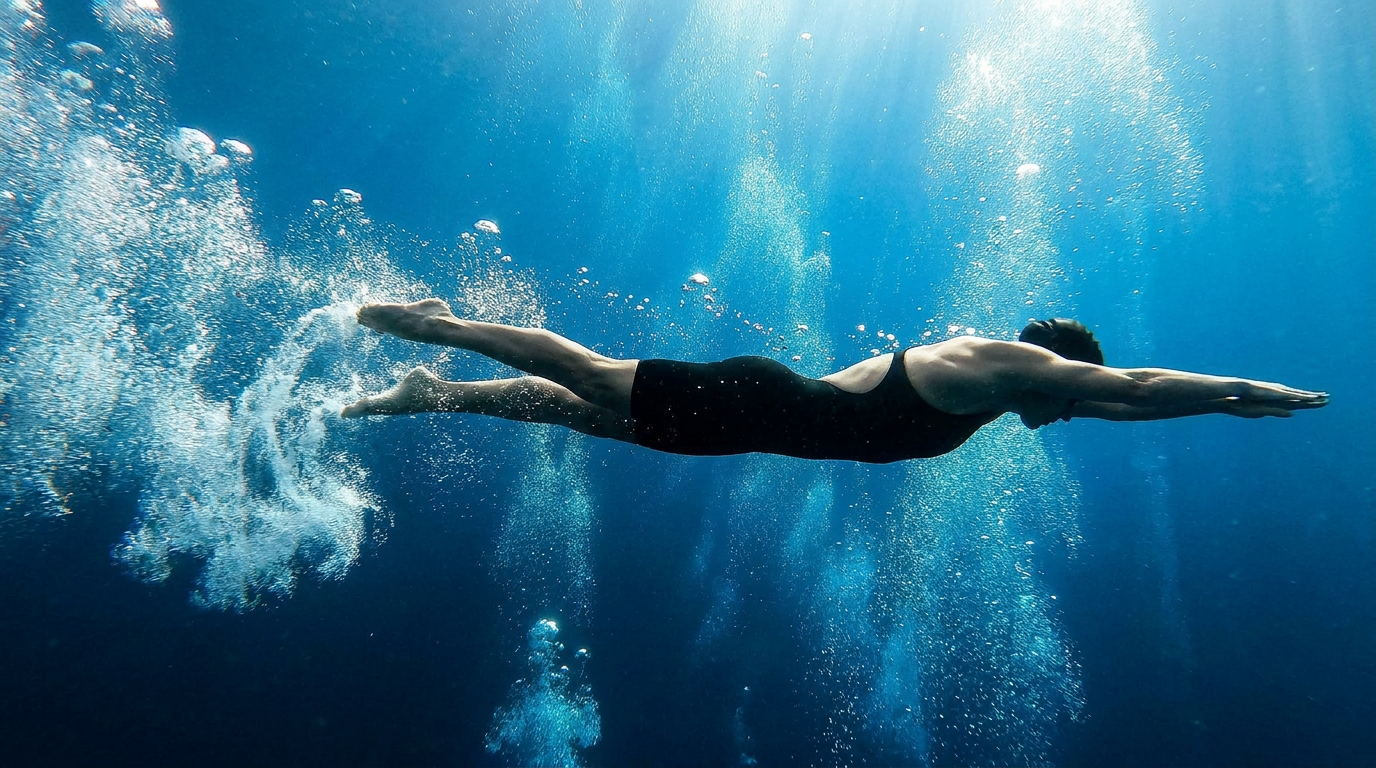
When the world's elite swimmers dive off the blocks, the fastest segment of their race does not involve the traditional strokes they are famous for. Instead, the most explosive speeds are achieved entirely beneath the surface, utilizing a technique that has fundamentally reshaped competitive aquatics. Known colloquially as the "fifth stroke," the underwater dolphin kick allows athletes to slice through the water with marine-like efficiency.[2][3]
For decades, swimming was defined by the four official surface strokes: freestyle, backstroke, breaststroke, and butterfly. But as sports scientists and athletes began looking to nature for inspiration, they realized that human surface swimming was inherently limited. The dolphin kick, initially just a component of the butterfly stroke, was adapted into a continuous, streamlined underwater weapon used off every start and turn.[2][3]
The secret to the fifth stroke's blistering speed lies in the physics of the water's surface. When a swimmer moves along the top of the water, they create a "bow wave" in front of them, similar to a boat. This wave generates significant resistance, known as wave drag, which acts as a hard physical limit on how fast a human can propel themselves.[2]
By staying fully submerged, swimmers bypass this surface turbulence entirely. In a tight, streamlined position, an elite swimmer executing a flawless underwater dolphin kick can reach speeds of up to 2.2 meters per second—significantly faster than the peak velocity of the standard freestyle stroke. The deeper the swimmer goes, within reason, the less wave drag they encounter, allowing them to glide with remarkable efficiency.[3]

Executing the dolphin kick correctly, however, is notoriously difficult and counterintuitive to terrestrial human movement. It is not simply a matter of kicking the legs up and down. True power in the fifth stroke originates from the core. The swimmer must hinge at the shoulders, ribs, and hips, creating a fluid, undulating wave that travels down the body and snaps like a whip through the toes.[2][3]
This full-body undulation closely mimics the propulsion mechanics of cetaceans, such as dolphins and whales. While fish like tuna generate thrust by sweeping their tails horizontally, marine mammals and human swimmers utilize a vertical, 90-degree undulation. When adapted to the human form, this requires immense abdominal strength, ankle flexibility, and precise rhythm to ensure the body remains perfectly streamlined while generating maximum thrust.[2][6]
The complex fluid dynamics of this motion are only now being fully understood. Researchers at the University of Tsukuba recently utilized particle image velocimetry—a technique that uses lasers and high-speed cameras to track microscopic particles in a fluid—to visualize the exact water-flow patterns generated by the dolphin kick. Their findings revealed a hidden world of aquatic mechanics.[1]
The complex fluid dynamics of this motion are only now being fully understood.
The Tsukuba study demonstrated that the powerful downward snap of the legs generates a massive, concentrated vortex in the water. More importantly, as the swimmer transitions into the upward kick phase, they actually recycle the flow generated by the previous downward movement. This vortex recycling acts as a fluid springboard, compounding the propulsive force and allowing the swimmer to maximize their momentum with every undulation.[1]

Because the underwater dolphin kick is so overwhelmingly effective, the international governing body for aquatic sports, World Aquatics, had to step in to prevent swimming from devolving into a purely underwater breath-holding contest. The rules now strictly limit swimmers to 15 meters of underwater kicking off the start and after every turn. Once a swimmer's head passes the 15-meter mark, it must break the surface.[3]
Maximizing those 15 meters has become the defining obsession of modern competitive swimming. Coaches dedicate massive portions of their training regimens to core conditioning and breath control specifically for the underwater phase. Comprehensive guides, such as The Dolphin Kick Manual, have emerged to break down the highly technical nuances of kick amplitude, frequency, and the dryland mobility required to perfect the movement.[6]
Yet, despite its importance, the fifth stroke has historically been the hardest part of swimming to analyze. Water distorts light, bubbles obscure the camera's view, and traditional biomechanical sensors are often too bulky or fragile to survive the pool environment. For years, elite underwater analysis was restricted to million-dollar aquatic flumes and specialized research laboratories.[4][5]
That barrier is rapidly dissolving thanks to the integration of artificial intelligence and computer vision. Initiatives like Project DIVE (Data-driven Intelligent Video Evaluation) are pioneering markerless motion capture for the pool. Using standard, commercially available waterproof cameras, researchers are training AI models to perform granular pose estimation on submerged swimmers.[5]
These AI systems can automatically segment a swimmer's underwater trajectory, tracking the precise alignment of the head, the angle of the hips, and the amplitude of the kick. By mapping a digital skeleton over the swimmer's video feed, the software can instantly flag biomechanical inefficiencies—such as a drop in underwater distance per kick or a misalignment in the core—with an accuracy rate of 87 to 92 percent compared to traditional lab equipment.[4][5]

Simultaneously, the hardware itself is evolving. The latest generation of wearable sports technology includes smart textiles embedded with graphene-printed strain sensors and miniaturized inertial measurement units (IMUs). Worn seamlessly under a swimsuit or cap, these devices capture high-resolution data on acceleration, rotational velocity, and stroke symmetry without impeding the athlete's natural movement.[4]
When this wearable data is fused with AI-driven video analysis, coaches receive a comprehensive, real-time dashboard of a swimmer's internal exertion and external biomechanics. It represents a massive democratization of sports science. Local clubs and amateur athletes can now access the kind of granular, data-driven feedback that was once the exclusive domain of Olympic training centers.[4][5][7]
The evolution of the fifth stroke is a testament to human ingenuity in the water. By looking to the ancient evolutionary mechanics of marine life and pairing them with the bleeding edge of artificial intelligence, swimmers are continuing to find new ways to cheat drag and push the boundaries of human speed. The fastest frontier in the pool is no longer on the surface—it is in the data-rich, undulating depths below.[2][5][7]
How we got here
1952
The butterfly stroke is recognized as the fourth official competitive stroke, introducing the dolphin kick to competition.
1998
World Aquatics extends the 15-meter underwater limit to all individual strokes to prevent excessive underwater dominance.
2000
Misty Hyman wins Olympic gold utilizing a specialized horizontal 'fish kick' underwater.
2024
University of Tsukuba publishes groundbreaking particle image velocimetry research visualizing the vortexes of the dolphin kick.
2025
Projects like DIVE and SWIM-360 begin deploying AI pose estimation and smart wearables to democratize underwater biomechanical analysis.
Viewpoints in depth
Biomechanics Researchers
Argue that true breakthroughs in aquatic speed come from understanding fluid dynamics.
Researchers emphasize that human surface swimming is fundamentally limited by wave drag. They argue that the future of the sport lies in understanding how the body can generate and ride vortexes underwater, much like cetaceans. By utilizing advanced fluid dynamics tools like particle image velocimetry, they are mapping the exact physical limits of human propulsion in water.
Sports Technologists
Believe the next era of swimming records will be driven by accessible data.
Technologists argue that bringing AI pose estimation and smart textiles out of the lab and into everyday pools will revolutionize the sport. By providing granular biomechanical feedback through standard cameras and wearable IMUs, they believe elite-level analysis will become accessible to athletes at all levels, democratizing performance optimization.
Competitive Coaches
View the underwater dolphin kick as the ultimate test of core strength and discipline.
For coaches, the focus is on the practical reality of racing: maximizing the strict 15-meter underwater limit. They prioritize rigorous dryland training, core conditioning, and breath control to help swimmers gain crucial fractions of a second, viewing the 'fifth stroke' as the most critical differentiator in modern competition.
What we don't know
- Whether the proliferation of AI training tools will prompt World Aquatics to further regulate wearable technology in competition.
- How much faster human beings can theoretically swim before reaching the absolute biomechanical limits of the dolphin kick.
Key terms
- Dolphin kick
- An undulating, wave-like leg and core motion that simulates the tail propulsion of marine mammals.
- Wave drag
- The hydrodynamic resistance caused by the creation of surface waves when an object or swimmer moves along the top of the water.
- Particle image velocimetry
- A fluid dynamics technique that uses lasers and cameras to track microscopic particles, visualizing the flow of water around a swimmer.
- Pose estimation
- An AI computer vision technique that detects and tracks the position of human joints and limbs in video footage.
- Inertial measurement unit (IMU)
- A tiny electronic device containing accelerometers and gyroscopes used in wearables to track an athlete's movement and rotation.
Frequently asked
What is the 'fifth stroke' in swimming?
The fifth stroke refers to the underwater dolphin kick, a full-body undulating motion used by swimmers off starts and turns to maximize speed while fully submerged.
Why is swimming underwater faster than on the surface?
Swimming underwater allows athletes to bypass 'wave drag'—the hydrodynamic resistance caused by the bow wave created when moving along the water's surface.
What is the 15-meter rule?
World Aquatics rules state that a swimmer must break the surface of the water by the 15-meter mark after every start and turn, preventing races from becoming pure breath-holding contests.
How is AI changing swimming training?
AI-powered computer vision and pose estimation can now track a swimmer's underwater biomechanics using standard cameras, instantly flagging inefficiencies in technique without needing a specialized lab.
Sources
Source coverage
7 outlets
4 viewpoints surfaced







[1]University of TsukubaBiomechanics Researchers
Dolphin-Kick Swimming Maximizes Water-Flow Utilization with Increasing Speed
Read on University of Tsukuba →[2]InverseBiomechanics Researchers
Swimming's Big Secret: The Mysterious Fifth Stroke
Read on Inverse →[3]GrokipediaCompetitive Coaches
Dolphin kick
Read on Grokipedia →[4]PMCSports Technologists
Artificial Intelligence in Sports Biomechanics: A Scoping Review on Wearable Technology
Read on PMC →[5]MediumSports Technologists
DIVE into Smarter Swimming: Why AI and Open Data Could Revolutionise the Pool
Read on Medium →[6]Endurance SportswireCompetitive Coaches
The Dolphin Kick Manual Hits the Shelves, Giving Swimmers a New Edge Underwater
Read on Endurance Sportswire →[7]Factlen Editorial TeamFactlen Analysis
Synthesis by Factlen editorial team
Read on Factlen Editorial Team →

More in sports
See all 12 stories →Women's Soccer Boom
The Unprecedented Boom of U.S. Women's Soccer in 2026
0 sources

Centaur Chess
The Post-Engine Era: How AI Transformed Modern Chess Strategy
0 sources

Injury
Nebojsa Simić's Triumphant Return Highlights Handball's Grueling Injury Landscape
0 sources

Sports Business
Women's Soccer Enters the Billion-Dollar Era as Franchise Valuations Skyrocket in 2026
0 sources

Every angle. Every day.
Get sports stories with full source coverage and perspective breakdowns delivered to your inbox.