
The Science of Clinical Pilates: Why Targeted Movement is Rewriting Back Pain Rehab
Physiotherapist-led Clinical Pilates is replacing generic core exercises for chronic lower back pain. Clinical data reveals how targeted motor control training rebuilds the deep core and helps patients overcome the fear of movement.
By Factlen Editorial Team
- Clinical Physiotherapists
- Argue that Pilates must be individualized and pathology-specific to be safe and effective for rehabilitation.
- Pain Science Researchers
- Emphasize that the primary benefit of Pilates is overcoming the fear of movement and building consistent exercise habits.
- Evidence-Based Synthesis
- Views clinical Pilates as a highly effective, safe entry point for rehab that eventually transitions into general strength training.
What's not represented
- · Insurance Providers
- · Traditional Pilates Instructors
Why this matters
Chronic lower back pain is a leading cause of global disability, often worsened by generic fitness advice. Understanding the difference between traditional and Clinical Pilates allows patients to safely rehabilitate injuries without risking further flare-ups.
Key points
- Clinical Pilates differs from traditional studio classes by offering individualized, physiotherapist-led interventions tailored to specific spinal pathologies.
- The practice targets the deep core cylinder—including the transversus abdominis and multifidus—to restore subconscious spinal stabilization.
- Clinical trials show significant short-term improvements in pain and functional ability compared to minimal intervention.
- A major benefit of the practice is reducing kinesiophobia, allowing patients to rebuild confidence in their body's ability to move safely.
- Long-term data suggests Clinical Pilates is equally as effective as other forms of targeted strength training once foundational control is restored.
For decades, the standard advice given to anyone suffering from chronic lower back pain has been a vague directive to "strengthen your core." This well-meaning prescription often sends patients straight into the nearest group fitness class, where they attempt to crunch, twist, and plank their way back to health. Yet, for many individuals dealing with specific spinal pathologies, a generic workout can actually exacerbate their symptoms, leading to a frustrating cycle of flare-ups and setbacks. The missing link in this approach is specificity. Building strength is undeniably crucial for spinal health, but how that strength is built matters immensely.[6]
This gap between general fitness and targeted rehabilitation has given rise to the widespread adoption of Clinical Pilates. Unlike traditional Pilates—which is primarily a generalized movement system designed for overall conditioning—Clinical Pilates is a highly specialized, physiotherapist-led intervention. It strips away the one-size-fits-all choreography of a standard studio class and replaces it with a pathology-specific prescription. By treating movement as a precise medical intervention, clinicians are using this adapted method to rewire how patients with chronic pain recruit their muscles, stabilize their joints, and ultimately regain their quality of life.[6]

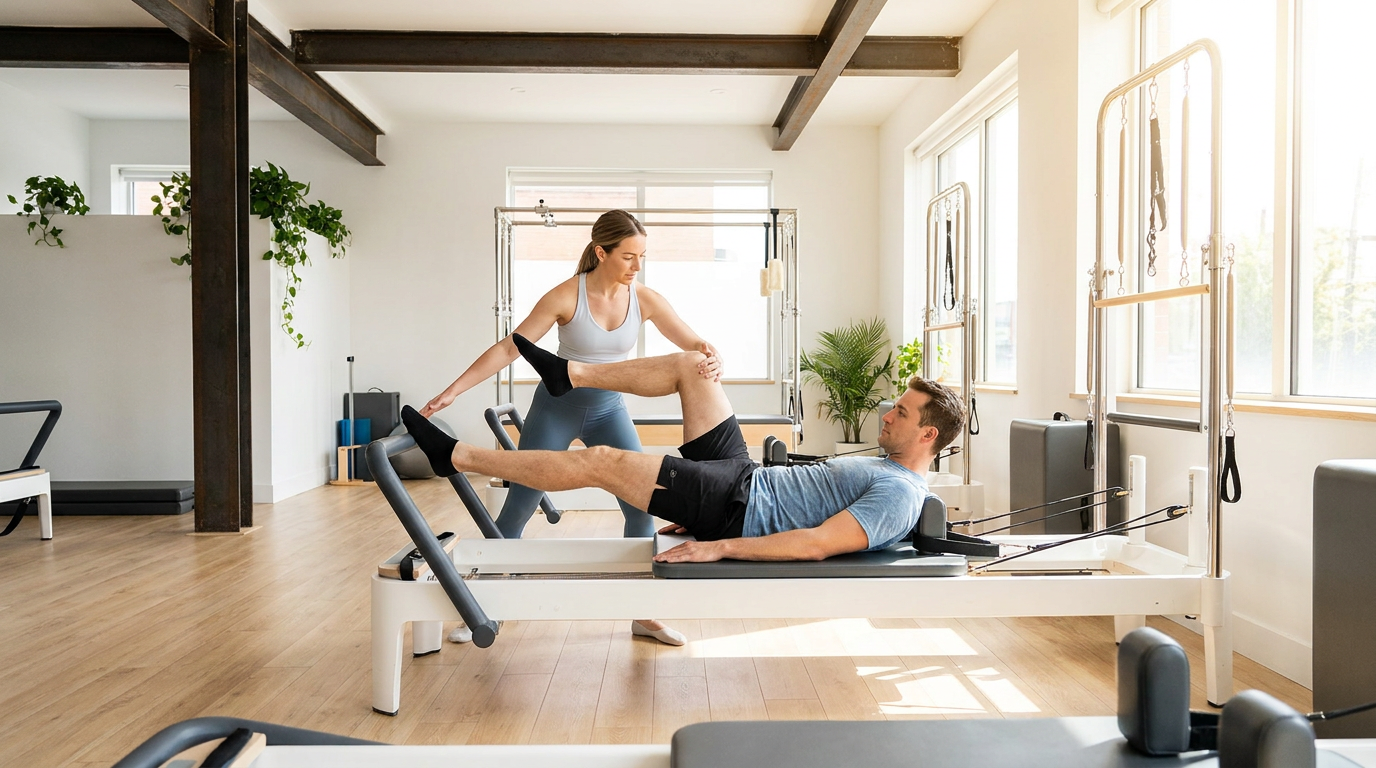
The distinction begins with the assessment. Before a patient ever touches a reformer machine or a mat, a physiotherapist conducts a comprehensive evaluation to identify the exact mechanical deficits driving the pain. They look for muscular imbalances, altered movement patterns, and specific directional preferences—meaning the specific angles and postures that either relieve or provoke the patient's symptoms. Based on this clinical picture, the physiotherapist designs a bespoke program. If a patient has a disc injury that worsens with forward bending, their Clinical Pilates routine will strictly avoid spinal flexion, focusing instead on extension and neutral-spine stabilization.[1]
To understand why this works, it is necessary to look beyond the "mirror muscles"—the superficial abdominals like the rectus abdominis that create the appearance of a six-pack. While these muscles are excellent for producing forceful movements, they are not designed for endurance or subtle joint stabilization. Clinical Pilates targets the deep core cylinder: the transversus abdominis wrapping around the waist, the multifidus muscles running along the spine, the diaphragm at the top, and the pelvic floor at the bottom. Together, these structures act as a biological corset, anticipating movement and bracing the spine before the limbs even begin to move.[4]
In a healthy body, this deep stabilization system operates subconsciously. Milliseconds before you reach for a heavy box or step off a curb, the transversus abdominis and multifidus contract to lock the lumbar spine in a safe, stable position. However, research shows that in individuals with chronic lower back pain, this anticipatory firing mechanism is often delayed or completely "switched off." The brain, altered by the presence of pain, alters its motor control strategy. The superficial muscles try to take over the stabilizing job, leading to muscle spasms, fatigue, and further joint compression.[4]

In a healthy body, this deep stabilization system operates subconsciously.
Clinical Pilates is fundamentally a practice of neurological retraining. The slow, deliberate movements, often performed on spring-loaded equipment like the reformer or the Cadillac, provide proprioceptive feedback that helps the brain "find" and recruit these dormant deep muscles again. The springs offer variable resistance, supporting the limb through the movement while demanding precise control from the core. Patients are taught to isolate the transversus abdominis and integrate it with their breathing, slowly rebuilding the subconscious motor patterns required for pain-free daily living.[1][4]
The clinical evidence supporting this targeted approach is robust. Systematic reviews analyzing dozens of randomized controlled trials have consistently demonstrated that Pilates-based exercise provides statistically significant improvements in pain and functional ability for patients with chronic lower back pain, particularly in the short term. Compared to minimal intervention or standard medical care, patients engaged in Clinical Pilates report faster reductions in disability and a quicker return to their normal activities. Recent clinical data even shows measurable increases in the physical thickness of the transversus abdominis and multifidus muscles after just eight weeks of consistent practice.[2][5]
However, the scientific literature also offers an important dose of perspective. While Clinical Pilates is highly effective, it is not necessarily a unique magic bullet when compared to other forms of high-quality, targeted exercise. Rigorous trials have shown that over a longer time horizon—such as 24 weeks—the outcomes of Clinical Pilates are often equivalent to those achieved through general, well-structured strength and conditioning programs. The ultimate goal of rehabilitation is to build tissue capacity, and the body responds to progressive overload regardless of whether it comes from a Pilates spring or a traditional dumbbell.[3][5]

If the long-term physiological outcomes are similar, why do physiotherapists rely so heavily on Clinical Pilates? The answer lies in safety, adherence, and psychology. Chronic pain is rarely just a mechanical issue; it is deeply intertwined with the nervous system. Many patients with long-standing back pain develop kinesiophobia—a profound fear of movement. They have learned that moving hurts, so they guard their bodies, stiffen their spines, and avoid physical activity. Handing these patients a barbell or sending them for a run is a recipe for failure, as their nervous systems are already on high alert.[2][6]
Clinical Pilates provides a uniquely safe and supportive environment to break this cycle of fear. Because the exercises are performed lying down or fully supported by the equipment, the gravitational load on the spine is minimized. The patient can experience movement without the immediate threat of pain. As they successfully execute controlled, pain-free repetitions, their brain begins to decouple movement from tissue damage. This psychological victory is often the turning point in rehabilitation, restoring the patient's confidence in their own body and paving the way for more intense physical activity down the line.[3][6]

The individualized nature of the practice also ensures a much higher rate of patient compliance. Rehabilitation exercises are notoriously tedious, and patients frequently abandon their home exercise programs out of boredom or frustration. Clinical Pilates, with its dynamic equipment, constant variation, and one-on-one supervision, keeps patients engaged. The tactile feedback from the physiotherapist and the immediate physical sensation of the springs working provide a rewarding, mindful experience that feels less like clinical homework and more like an empowering movement practice.[1][6]
Ultimately, Clinical Pilates is best viewed as a highly effective bridge. It takes patients from a state of acute vulnerability and pain, rebuilds their foundational motor control, and restores their confidence in movement. Once that lumbopelvic stability is re-established, the patient is no longer fragile. They can safely graduate from the clinical setting and transition into traditional Pilates classes, heavy strength training, or whatever physical activities bring them joy. By treating the specific pathology first, Clinical Pilates ensures that when the patient finally returns to the gym, their core is actually ready to do the work.[6]
Viewpoints in depth
Clinical Physiotherapists
Argue that Pilates must be individualized and pathology-specific to be safe and effective for rehabilitation.
From a clinical perspective, pain is a highly specific mechanical and neurological issue. Physiotherapists emphasize that a generic exercise program cannot account for the nuances of a herniated disc versus a facet joint sprain. They advocate for Clinical Pilates because it allows them to apply the principles of 'directional preference'—avoiding movements that provoke symptoms while loading the tissues that need strengthening. To this camp, the value of Pilates lies entirely in the clinical reasoning applied by the instructor, not just the exercises themselves.
Pain Science Researchers
Emphasize that the primary benefit of Pilates is overcoming the fear of movement and building consistent exercise habits.
Researchers studying the biopsychosocial model of pain point out that long-term clinical trials often show Pilates is no more effective than other forms of general exercise at the 24-week mark. However, they highlight that Clinical Pilates excels at reducing 'kinesiophobia'—the fear of movement. Because the exercises are performed in a highly controlled, supported environment, patients learn that they can move without causing tissue damage. For this camp, Pilates is a powerful psychological tool that rebuilds a patient's confidence, ensuring they actually adhere to their rehabilitation program.
What we don't know
- Whether specific subgroups of chronic pain patients (e.g., those with nerve impingement vs. muscular strain) benefit more from Pilates than others.
- The exact dosage—frequency and duration—required to maintain the neurological motor control adaptations long-term after the initial rehab phase ends.
Key terms
- Clinical Pilates
- A modified, physiotherapist-led version of Pilates designed specifically for injury rehabilitation and pathology management.
- Lumbopelvic Stability
- The ability to control the joints of the lower back and pelvis during movement, primarily using deep core muscles.
- Transversus Abdominis
- The deepest layer of abdominal muscle that acts like a corset to stabilize the spine before movement occurs.
- Kinesiophobia
- The fear of movement or physical activity due to a belief that it will cause further pain or injury.
- Directional Preference
- A clinical assessment concept where specific directions of movement (e.g., bending backward) alleviate a patient's pain while others aggravate it.
Frequently asked
Can I just go to a regular Pilates class for my back pain?
While traditional Pilates is excellent for general fitness, generic classes may aggravate specific injuries. Clinical Pilates is tailored to your exact pathology by a physiotherapist.
Do I need a reformer machine for Clinical Pilates?
Not necessarily. While reformers provide useful spring-loaded feedback, Clinical Pilates can be effectively performed on a mat using specific, physiotherapist-prescribed movements.
How long does it take to see results?
Clinical trials suggest that patients typically experience significant improvements in pain and functional ability within 6 to 8 weeks of consistent practice.
Is Clinical Pilates better than weightlifting for back pain?
In the early stages of rehab, it is often safer and more targeted. However, long-term studies show that both approaches are equally effective once foundational core control is restored.
Sources
Source coverage
6 outlets
3 viewpoints surfaced






[1]Journal of Orthopaedic & Sports Physical TherapyClinical Physiotherapists
Pilates-Based Rehabilitation for Musculoskeletal Conditions
Read on Journal of Orthopaedic & Sports Physical Therapy →[2]PLOS OnePain Science Researchers
Effectiveness of Pilates Exercise in Treating People with Chronic Low Back Pain: A Systematic Review
Read on PLOS One →[3]Medicine & Science in Sports & ExercisePain Science Researchers
Clinical Pilates versus General Exercise for Chronic Low Back Pain: Randomized Trial
Read on Medicine & Science in Sports & Exercise →[4]Physical Therapy in SportClinical Physiotherapists
Motor Control and Core Stability in Pilates Rehabilitation
Read on Physical Therapy in Sport →[5]Cochrane Database of Systematic ReviewsPain Science Researchers
Pilates for low back pain
Read on Cochrane Database of Systematic Reviews →[6]Factlen Editorial TeamEvidence-Based Synthesis
Synthesis by Factlen editorial team
Read on Factlen Editorial Team →
Every angle. Every day.
Get fitness stories with full source coverage and perspective breakdowns delivered to your inbox.