
The Invisible Strategist: How AI and Machine Learning Are Calling the Shots on the Formula 1 Pit Wall
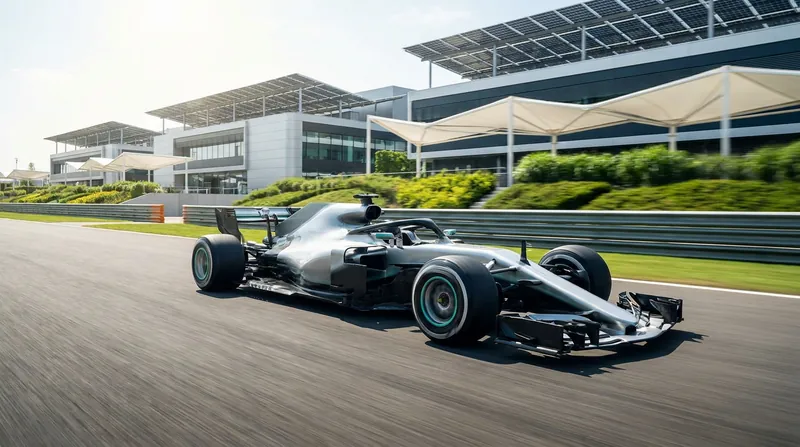
Modern Formula 1 teams run billions of cloud-based simulations per weekend, using advanced machine learning to predict tire degradation, model competitor behavior, and optimize pit stop strategies in real time.

Share this story
In modern Formula 1, the most consequential battles are no longer fought solely with aerodynamics and horsepower. They are fought with silicon, algorithms, and cloud infrastructure. At 370 kilometers per hour, human reaction time is a liability, and the sheer volume of variables changing every millisecond makes traditional intuition obsolete.
By 2026, artificial intelligence has become the invisible strategist sitting beside every race engineer on the pit wall, digesting millions of data points to offer strategic recommendations in the tightest of windows. Races that once hinged purely on a driver's instinct now depend on the seamless marriage of human judgment and machine-fast analysis.[2]
To understand why machine learning has become the lifeblood of motorsport, one must first understand the scale of the information being generated. A modern Formula 1 car is essentially a rolling supercomputer, fitted with between 300 and 600 onboard sensors. These instruments continuously monitor every conceivable system: engine temperature, brake pressure, fuel flow rate, aerodynamic load, steering angle, and the exact surface heat of the tires.[1]
The resulting data tsunami is staggering. Each car generates approximately 1.1 million telemetry data points every single second. Over the course of a full race weekend—spanning practice sessions, qualifying, and the Grand Prix itself—a single car produces over 1.5 terabytes of raw data. For decades, teams of engineers would manually review this telemetry between sessions, a laborious process that could take days. Today, machine learning models process it in real time, identifying degradation patterns and performance anomalies that no human analyst could detect at speed.[1]
The strategic war begins long before the cars touch the asphalt. Formula 1 teams now rely heavily on "digital twins"—highly detailed virtual clones of their physical cars. Using massive cloud computing infrastructure provided by tech giants like AWS and Oracle, teams run these digital twins through billions of simulated laps in the days leading up to a race.
These simulations account for historical performance trends, expected changes in track grip, and varying weather conditions, allowing engineers to know exactly how a specific aerodynamic setup will perform before a single physical part is manufactured.[1]
Once the race begins, the focus shifts to the most critical variable in motorsport: tire degradation. Tires dictate how long a driver can push, whether a specific stint is sustainable, and when a pit stop becomes mathematically unavoidable. To solve this, teams deploy advanced deep learning architectures, such as Bidirectional Long Short-Term Memory (Bi-LSTM) networks. These models track thousands of variables every lap, analyzing compound temperature deltas and track surface evolution to predict the exact lap a tire will lose its competitive edge.[1]
Crucially, these algorithms excel at modeling long-range temporal dependencies. They understand how a minor lock-up or an aggressive steering input made twenty laps ago will affect the rubber's structural integrity in the present moment. By comparing real-time telemetry against decades of historical track records, the AI helps strategists forecast optimal pit windows with an eerie level of precision, allowing them to plan stints with absolute confidence.[1]
But a race is not run in a vacuum, and teams do not just model their own cars. Artificial intelligence is now used to build complex behavioral profiles of the other nineteen drivers on the grid—a practice strategists refer to as "racing against ghosts." These competitor models analyze how aggressively rivals attack their out-laps, their historical tolerance for being undercut, and their typical stint lengths across different circuits. By running simulated races over and over, the AI anticipates what opponents will do before they even make a move.
Despite this immense computational power, teams face a fascinating physical constraint imposed by the sport's governing body. While a car might generate 100 gigabytes of data per lap during practice, FIA regulations strictly limit the amount of live telemetry that can be transmitted from the car to the pit wall during a race. Currently, that bandwidth is capped at roughly 60 megabytes per second.[1]
This bottleneck means that only about six percent of the total data collected by the car can actually be beamed back to the strategists in real time. To solve this, teams have deployed AI triage agents directly onto the car's onboard computers. These edge-computing algorithms act as gatekeepers, instantly evaluating the incoming sensor data and deciding which specific metrics are most critical to transmit back to the garage to inform the broader strategy.[1]
With the filtered data arriving on the pit wall, the AI compresses hours of manual analysis into mere seconds. Strategists are often forced to make race-defining decisions in a "third-of-a-lap window"—the brief moment before a driver reaches the pit lane entry. The AI presents the optimal mathematical choice, removing human blind spots and catching subtle trends in fuel use that might otherwise go unnoticed in the chaos of a Grand Prix.
Yet, for all its predictive power, the artificial intelligence does not have the final say. Formula 1 operates on a strict "human-in-the-loop" philosophy. The AI acts as an incredibly powerful advisor, but the race engineer retains the ultimate authority. This synergy is necessary because even the most sophisticated algorithms can underperform when their sociotechnical context is ignored or when unpredictable human elements enter the fray.
Algorithms thrive on historical data and predictable degradation curves, but racing is inherently chaotic. A sudden, unforecasted downpour, a bizarre safety car deployment, or a rival driver acting irrationally out of desperation are scenarios where historical data falls short. In these moments of high entropy, human intuition, experience, and the ability to read the emotional state of the driver over the radio remain irreplaceable.
This technological arms race is not entirely hidden from the public. Through partnerships with cloud providers, Formula 1 has integrated these machine learning insights directly into the global broadcast. Features like "Battle Forecast" use projected driver pace to predict exactly how many laps it will take for a chasing car to reach striking distance, while energy usage graphics show fans exactly how drivers are deploying their battery reserves.
The implications of this technology extend far beyond the checkered flag. The predictive maintenance models used to identify component failures on an F1 car are already being adapted for commercial aviation and industrial manufacturing. Similarly, the aerodynamic simulation tools and tire wear prediction algorithms developed for the track are being utilized to reduce drag on consumer electric vehicles and improve the safety of public highways.[1]
Ultimately, the integration of machine learning into Formula 1 represents the pinnacle of human-machine collaboration. It is a sport where the brightest engineering minds use the world's most advanced computational tools to extract fractions of a second from a physical machine. The invisible strategist may be calling the mathematical shots, but it is the human driver and the human engineer who must execute them at the absolute limit of physics.[2]
Key points
- Modern Formula 1 cars generate over 1.1 million telemetry data points per second from hundreds of onboard sensors.
- Teams use cloud computing to run billions of simulated laps with 'digital twins' before the race begins.
- Deep learning models predict exact tire degradation curves, allowing strategists to optimize pit stop windows.
- AI builds behavioral profiles of rival drivers to anticipate their strategies and undercut attempts.
- Strict FIA data limits force teams to use onboard AI to triage which telemetry gets transmitted to the pit wall.
- Despite the technology, teams maintain a 'human-in-the-loop' philosophy to handle unpredictable race chaos.
How we got here
2018
AWS partners with Formula 1 to introduce cloud-based analytics and broadcast insights.
2021
Top teams begin integrating deep learning models for real-time tire degradation prediction.
2024
The volume of pre-race cloud simulations reaches billions per weekend across the grid.
2026
AI triage agents become standard onboard cars to manage strict FIA telemetry transmission limits.
- Data Scientists & Cloud Providers
- Advocates for maximizing computational power to eliminate strategic blind spots.
- Race Engineers & Strategists
- Professionals who emphasize the necessity of human intuition in chaotic environments.
- Factlen Editorial Team
- Synthesizing the intersection of high-performance computing and human execution.
Perspectives this story doesn't cover
- Formula 1 Drivers
- The FIA (Regulatory Body)
Sources
Source coverage
2 outlets
3 viewpoints surfaced


- [1]MediumData Scientists & Cloud Providers
How Machine Learning is Transforming Formula 1
Read on Medium → - [2]Factlen Editorial TeamFactlen Editorial Team
Synthesis by Factlen editorial team
Read on Factlen Editorial Team →
More in Sports
See all →F1 Racecraft
The Physics of a Practice Incident: What the Sainz-Antonelli Spa Encounter Reveals About F1 Closing Speeds
2 sources
F1 Engineering
The Anatomy of an F1 Reset: How Red Bull is Rebuilding After the British Grand Prix
4 sources
F1 2026 Rules
The End of DRS: How F1's 2026 'Nimble Car' Rules Will Change Racing
2 sources
F1 Sustainability
How Formula 1 Cut Its Carbon Footprint by 35% While Expanding Its Global Calendar
3 sources
Comments
Every angle. Every day.
Get Sports stories with full source coverage and perspective breakdowns, free every day.