
The Science of Biophilic Design: How Architecture is Rewiring Our Brains for Calm
Biophilic design is moving beyond decorative houseplants to become a science-backed architectural standard. By integrating natural patterns, light, and materials, designers are measurably improving cognitive function and reducing stress in homes and workplaces.
By Factlen Editorial Team
- Environmental Psychologists
- Focuses on how natural stimuli reduce cognitive load, lower amygdala activation, and facilitate mental recovery.
- Architectural Designers
- Views biophilia as a structural framework for building performance, prioritizing spatial patterns and material integration over decorative additions.
- Corporate Wellness Advocates
- Emphasizes the measurable return on investment, noting that nature-connected employees show higher productivity and lower absenteeism.
What's not represented
- · Facility Maintenance Teams
- · Low-Income Housing Developers
Why this matters
Americans spend roughly 90% of their lives indoors, often in environments that actively drain cognitive energy. Understanding how to integrate natural elements into our spaces offers a proven, accessible way to lower daily stress, boost focus, and improve long-term mental health.
Key points
- Biophilic design integrates natural systems into architecture to support human health.
- fMRI studies show natural indoor elements reduce stress-related brain activity.
- Attention Restoration Theory explains how nature helps the brain recover from fatigue.
- The '14 Patterns' framework guides the integration of light, space, and materials.
- Biophilic offices see measurable boosts in employee productivity and wellbeing.
- The trend is shifting toward 'calibrated biophilia' rather than just maximizing greenery.
We spend roughly 90 percent of our lives indoors, navigating a modern landscape of drywall, fluorescent lighting, and synthetic carpets. For decades, the built environment has been engineered primarily for efficiency and cost, often at the expense of human comfort. These sterile, sensory-deprived spaces actively drain our energy, contributing to a modern epidemic of cognitive fatigue and chronic stress. But a profound shift is currently sweeping through the worlds of architecture and interior design. Driven by a deeper understanding of human biology, designers are fundamentally rethinking how our homes and workplaces should look and feel. They are moving away from the industrial boxes of the past and embracing a philosophy that reconnects our daily lives with the natural world. This movement is not merely an aesthetic trend; it is a science-backed revolution in how we inhabit space.[7]
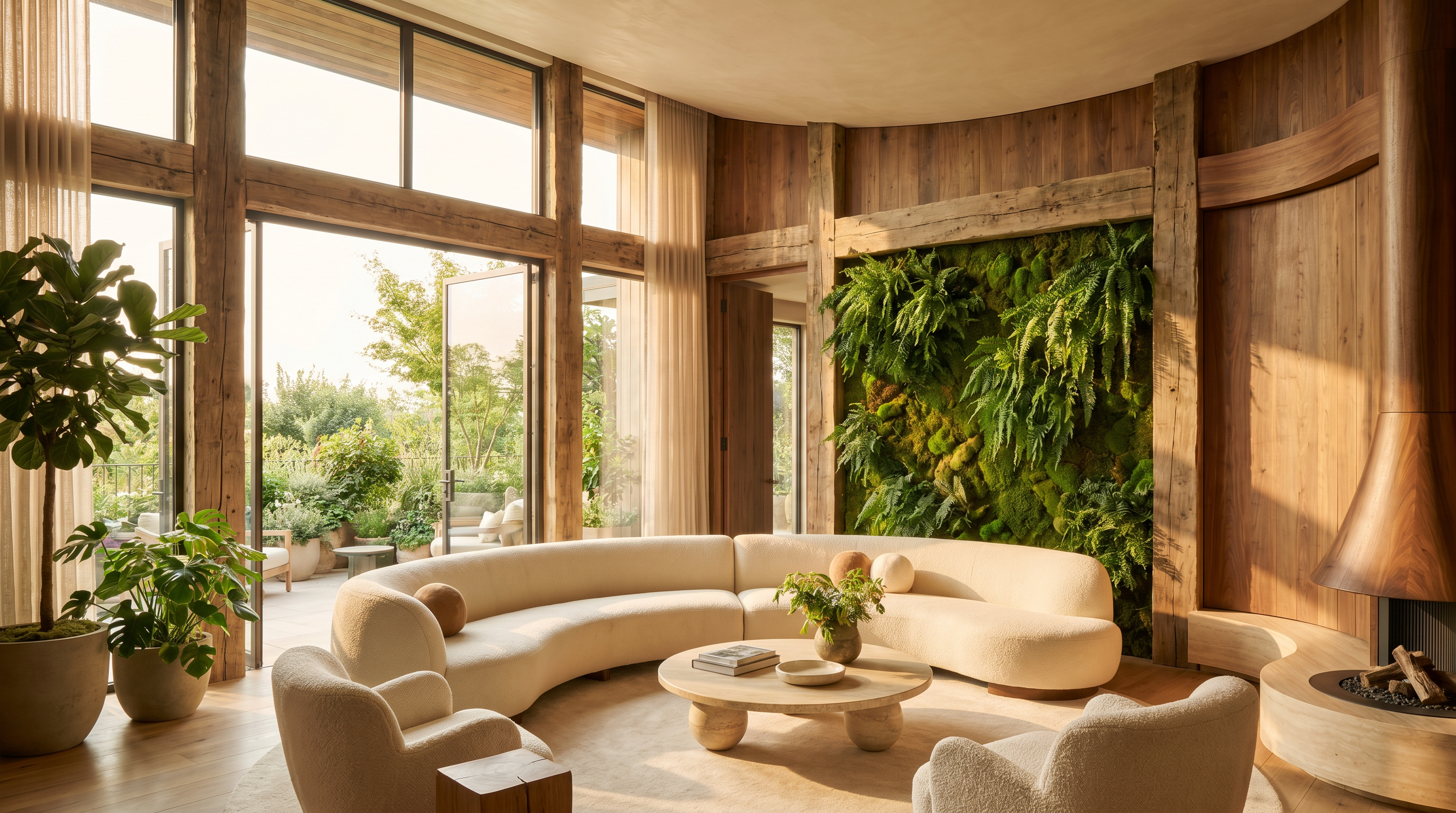
Enter biophilic design. Often misunderstood as simply scattering a few potted plants around a room, true biophilic design is a rigorous, evidence-informed approach to architecture and interiors. It draws heavily on the disciplines of environmental psychology, stress physiology, and building science to create spaces that actively support human health. The goal is to strengthen our connection to nature through the deliberate integration of daylight, natural materials, and nature-referencing spatial patterns. When executed correctly, these strategies do more than just make a room look beautiful; they support restorative experiences, enhance perceived wellbeing, and measurably improve user satisfaction. It is a holistic framework that treats nature not as an afterthought, but as a foundational element of human habitation.[3]
The core premise of this architectural movement rests on the "Biophilia Hypothesis." Popularized in the 1980s by the renowned biologist E.O. Wilson, the hypothesis suggests that humans possess an innate, evolutionary drive to affiliate with nature and other forms of life. Because our species evolved in the natural world over hundreds of thousands of years, our brains and nervous systems are biologically calibrated to respond positively to natural stimuli. We are hardwired to seek out sunlight, fresh air, and the presence of vegetation, as these elements historically signaled safety, sustenance, and survival. Biophilic design takes this evolutionary reality and applies it to the modern built environment, attempting to bridge the gap between our ancient biology and our contemporary indoor lifestyles.[1]
For a long time, the architectural industry treated nature as a decorative finishing touch—a green wall in a lobby or a ficus tree in a corner office. However, as we move through 2026, the industry is experiencing a paradigm shift toward "performance-driven interiorscapes." Architects and interior designers are no longer waiting until a building is finished to think about greenery. Instead, they are specifying plant systems, natural light channels, and organic materials alongside the core building infrastructure from the earliest stages of project planning. This evolution reflects a growing recognition that nature is a critical component of building performance, essential for creating environments that support focus, engagement, and long-term human health.[4]
The benefits of this integration are not merely anecdotal; they are deeply neurological. With the rise of environmental neuroscience, researchers are using advanced imaging techniques to understand exactly how physical spaces influence brain function. Studies utilizing functional magnetic resonance imaging (fMRI) have demonstrated that exposure to sterile, highly urbanized environments can increase activation in the amygdala—the brain's fear and stress processing center. Conversely, exposure to natural environments and biophilic interiors significantly reduces amygdala activity, inducing a state of psychological stability. By lowering cortisol levels and calming the nervous system, biophilic spaces act as a buffer against the chronic stress of modern life.[1]
This neurological calming effect is further explained by Attention Restoration Theory (ART). In our daily lives, we rely heavily on "directed attention"—the intense, energy-consuming focus required to read reports, stare at screens, and navigate busy streets. Directed attention is a finite resource, and when depleted, it leads to cognitive fatigue, irritability, and decreased productivity. Natural stimuli, however, engage a different type of attention known as "soft fascination." Watching leaves flutter in the breeze or observing the complex patterns of natural wood grain holds our attention effortlessly, allowing the brain's directed attention mechanisms to rest and recover. Biophilic design leverages this mechanism to create spaces that actively restore our cognitive resources.[2][3]
To translate these psychological theories into practical architectural applications, researchers at Terrapin Bright Green codified the "14 Patterns of Biophilic Design." This comprehensive framework connects evolutionary biology with building science, providing designers with a standardized toolkit for integrating ecological awareness into their projects. Rather than relying on vague notions of "bringing the outdoors in," the 14 patterns offer specific, measurable strategies that target cognitive, psychological, and physiological benefits. By breaking down the complex relationship between humans and nature into actionable design elements, the framework has become an essential guide for architects seeking to create truly restorative environments.[2]

These fourteen patterns are organized into three overarching categories. The first category, "Nature in the Space," involves the direct, physical, and ephemeral presence of nature within an interior. This goes far beyond static houseplants. It encompasses the strategic maximization of dynamic daylight that shifts in color and intensity throughout the day, helping to regulate our circadian rhythms. It also includes the integration of flowing water features, which provide soothing auditory stimulation, and the use of living plant systems that actively filter toxins and improve indoor air quality. The goal is to create a multi-sensory experience that mimics the complexity and vitality of the natural world.[2][5]
These fourteen patterns are organized into three overarching categories.
The second category, "Natural Analogues," utilizes non-living elements that evoke the feeling of nature. This is crucial for spaces where incorporating living plants or extensive daylight is structurally impossible. Designers achieve this by incorporating biomorphic forms—architectural elements and furniture that mimic the organic, flowing shapes found in living organisms. It also involves the extensive use of natural materials like exposed wood grain, stone, and bamboo, which provide a tactile connection to the earth. Furthermore, incorporating fractal patterns—the complex, repeating geometries found in snowflakes, ferns, and tree branches—into textiles and wall coverings has been shown to trigger a subconscious restorative response in the human brain.[2][6]

The third category, "Nature of the Space," deals with the broader spatial configuration of a room or building, drawing heavily on our evolutionary past on the African savanna. It utilizes the paired concepts of "prospect" and "refuge." Prospect refers to an unimpeded view over a distance, allowing occupants to survey their environment and anticipate movement—a trait that historically kept us safe from predators. Refuge, on the other hand, provides a protected space for withdrawal, where an individual feels secure from behind and overhead. Humans feel most comfortable and relaxed in environments that offer a balance of both: a cozy, sheltered nook that looks out over a wide, open space.[2]
The intersection of these biophilic patterns with the emerging field of neuroarchitecture is fundamentally transforming the modern workplace. For decades, corporate offices were designed as dense, fluorescent-lit grids of cubicles, optimized for maximum occupancy rather than human performance. However, organizations are increasingly realizing that these sterile environments actively hinder creativity and focus. By applying the principles of environmental psychology, companies are redesigning their headquarters to function as ecosystems that support the neurological needs of their employees. The realization that space directly dictates behavior and emotion is driving a massive overhaul in commercial real estate.[6]
The empirical data supporting this shift is compelling. Incorporating biophilic features into an office environment has a measurable impact on the bottom line. Research indicates that the mere presence of natural elements, such as optimized daylight and organic textures, can increase employee productivity by up to 8 percent. Furthermore, self-reported rates of overall wellbeing and job satisfaction see a boost of up to 13 percent in biophilic environments. When employees feel connected to nature, they experience lower rates of absenteeism, higher levels of engagement, and a greater sense of belonging, proving that investing in human-centric design yields tangible corporate dividends.[5]

However, as the trend matures, the industry is learning that more greenery is not always better. A nuanced approach known as "calibrated biophilia" is gaining traction. Rather than turning every office or living room into a dense, unmanageable jungle, designers are strategically balancing plant density, placement, and scale. The focus has shifted from maximizing the sheer volume of plants to optimizing their psychological impact. This means prioritizing thoughtful distribution, ensuring that every occupant has a line of sight to nature, and selecting resilient, low-maintenance species. Calibrated biophilia emphasizes measurable wellbeing outcomes over the simple accumulation of foliage.[4]
Beyond the immediate cognitive and psychological benefits, biophilic design overlaps significantly with global sustainability goals. The two philosophies are deeply complementary. By maximizing natural daylight through large windows and skylights, buildings can drastically reduce their reliance on artificial lighting and the associated energy costs. Similarly, incorporating natural ventilation strategies and utilizing thermal mass materials like stone can lower the demand for mechanical heating and cooling. When designers prioritize responsibly sourced, natural materials over synthetic alternatives, they reduce the carbon footprint of the interior while simultaneously creating a healthier, more climate-resilient space for the occupants.[5]
Despite the overwhelming enthusiasm for the movement, researchers and environmental psychologists caution that biophilic design is not a magic cure-all for toxic work cultures or fundamentally flawed architecture. The outcomes depend heavily on the baseline conditions of the space and the quality of the execution. A dark, poorly ventilated room with terrible acoustics cannot be "fixed" simply by installing a moss wall or a water feature. Biophilic elements must be layered on top of high-performing environmental fundamentals—such as excellent indoor air quality and thermal comfort—to be truly effective. It is a holistic system, not a superficial bandage.[3]

Ultimately, the rise of biophilic design represents a profound and necessary shift in how we view our built environment. We are moving past the era of treating buildings as mere machines for living and working, and recognizing them as habitats that deeply influence our biology. By acknowledging that human health is inextricably linked to the natural world, architects and interior designers are creating spaces that don't just house us, but actively heal us. As we look to the future, the integration of nature into our indoor lives will no longer be seen as a luxury amenity, but as a fundamental baseline for human thriving.[7]
How we got here
1984
Biologist E.O. Wilson publishes 'Biophilia,' popularizing the hypothesis of human affinity for nature.
1989
Environmental psychologists introduce Attention Restoration Theory (ART).
2014
Terrapin Bright Green publishes the '14 Patterns of Biophilic Design' framework.
2020-2022
The global pandemic drastically accelerates demand for nature-connected indoor spaces.
2026
Biophilic design transitions from a decorative trend to a baseline architectural standard.
Viewpoints in depth
Environmental Psychologists
Focuses on the neurological mechanisms that make biophilic design effective.
For environmental psychologists and neuroscientists, the value of biophilic design lies in its measurable impact on the human nervous system. Utilizing tools like fMRI and cortisol tracking, this camp emphasizes that our brains are not evolved for sterile, right-angled environments. They point to Attention Restoration Theory as the primary mechanism for why biophilic spaces work: natural stimuli engage 'soft fascination,' allowing the brain's directed attention networks to rest. Their research proves that integrating nature into the built environment is not an aesthetic luxury, but a biological necessity for mitigating the chronic stress of modern life.
Architectural Designers
Views biophilia as a structural framework for holistic building performance.
Architects and spatial designers approach biophilia as a core component of building science, moving far beyond the concept of 'adding plants.' They rely on frameworks like the 14 Patterns of Biophilic Design to systematically integrate dynamic daylight, natural ventilation, and organic material textures into the bones of a building. For this camp, the focus is on spatial configurations—such as creating areas of 'prospect and refuge'—and ensuring that biophilic elements work in tandem with sustainability goals to reduce energy consumption while maximizing human comfort.
Corporate Wellness Advocates
Emphasizes the return on investment and organizational benefits of nature-connected spaces.
For corporate strategists and HR professionals, biophilic design is a tool for talent retention and performance optimization. This perspective focuses on the empirical data showing that employees in biophilic environments report up to a 13 percent increase in wellbeing and an 8 percent boost in productivity. By investing in natural light, better air quality, and calibrated greenery, they argue that companies can significantly reduce the hidden costs of absenteeism and burnout, proving that human-centric design directly benefits the corporate bottom line.
What we don't know
- Long-term neurological impacts: While short-term fMRI studies show reduced stress, the decades-long neurological effects of living in optimized biophilic environments remain understudied.
- Standardized measurement: The industry still lacks a universally agreed-upon metric for quantifying the exact 'dose' of nature required to achieve specific cognitive benefits.
- Virtual nature efficacy: It remains unclear if high-definition digital screens displaying nature scenes can provide the same physiological benefits as actual physical greenery and sunlight.
Key terms
- Biophilia Hypothesis
- The scientific theory that humans possess an innate, evolutionary tendency to seek connections with nature and other forms of life.
- Attention Restoration Theory (ART)
- A psychological framework suggesting that natural environments help the brain recover from the cognitive fatigue caused by intense concentration.
- Neuroarchitecture
- An emerging discipline exploring how the human brain and nervous system respond to spatial qualities like light, scale, and acoustics.
- Biomorphic Forms
- Architectural or design elements that visually resemble naturally occurring patterns, organic shapes, or living organisms.
- Prospect and Refuge
- An architectural concept that provides an unimpeded view of the surroundings (prospect) while offering a sense of safety and enclosure (refuge).
Frequently asked
What is the difference between biophilic design and having houseplants?
Houseplants are just one small element. True biophilic design is a structural framework that includes maximizing natural light, utilizing organic materials like wood and stone, and designing spatial layouts that mimic natural environments.
Does biophilic design actually improve mental health?
Yes. fMRI studies show that exposure to natural elements indoors reduces activation in the amygdala, lowering cortisol levels and mitigating chronic stress.
What is Attention Restoration Theory?
It is a psychological theory suggesting that exposure to nature engages 'soft fascination,' allowing the brain to rest and recover from the intense cognitive fatigue caused by modern, screen-heavy work.
Is biophilic design expensive to implement?
While retrofitting complex plant systems can be costly, integrating natural light and organic materials during initial construction often saves money long-term by reducing energy consumption for lighting and climate control.
Sources
Source coverage
7 outlets
3 viewpoints surfaced




[1]National Institutes of HealthEnvironmental Psychologists
Neuropsychological Responses to Biophilic Indoor Environments
Read on National Institutes of Health →[2]Terrapin Bright GreenArchitectural Designers
14 Patterns of Biophilic Design
Read on Terrapin Bright Green →[3]Biophilic InnovationsArchitectural Designers
Benefits of Biophilic Design Backed by Research
Read on Biophilic Innovations →[4]Green Plants for Green BuildingsCorporate Wellness Advocates
Beyond Greenery: The Rise of Performance-Driven Interiorscapes
Read on Green Plants for Green Buildings →[5]Morgan LovellCorporate Wellness Advocates
What is biophilic office design?
Read on Morgan Lovell →[6]NeurotecturaEnvironmental Psychologists
Shared Goals, Different Paths: Neuroarchitecture and Biophilic Design
Read on Neurotectura →[7]Factlen Editorial TeamArchitectural Designers
Synthesis by Factlen editorial team
Read on Factlen Editorial Team →
More in home
See all 18 stories →Neuroarchitecture
How Neuroaesthetics is Rewiring Interior Design for Brain Health
6 sources
Kitchen Tech
The Science of Induction: Why Magnetic Cooking is Taking Over the 2026 Kitchen
7 sources

Home Electrification
Cold-Climate Heat Pumps Break the Freezing Barrier, Proving Reliable in Sub-Zero Winters
7 sources

Bio-Fabrication
The Science of Bio-Fabricated Furniture: How Mycelium is Grown into Chairs and Tables
7 sources
Every angle. Every day.
Get home stories with full source coverage and perspective breakdowns delivered to your inbox.