
The Rise of Astrotourism: Why Dark Skies Are the Most Sought-After Travel Amenity of 2026
As light pollution erases the stars for 99 percent of the developed world, a booming astrotourism industry is turning pristine night skies into a powerful economic engine for rural destinations.
By Factlen Editorial Team
- Rural Economic Developers
- Focus on astrotourism as a sustainable, low-infrastructure economic lifeline.
- Conservationists & Park Stewards
- Focus on protecting nocturnal ecosystems and combating light pollution.
- Luxury Hospitality Industry
- Focus on darkness as a premium, monetizable amenity for affluent travelers.
What's not represented
- · Indigenous communities whose ancestral lands are used for astrotourism
- · Urban planners struggling to balance safety lighting with dark sky initiatives
Why this matters
As light pollution erases the night sky for the vast majority of the population, darkness has transformed from a free natural resource into a highly valuable commodity. This shift is creating a new, sustainable economic engine for rural communities while providing a financial incentive to protect nocturnal ecosystems.
Key points
- Astrotourism has become a major 2026 travel trend as 99% of the developed world lives under light-polluted skies.
- DarkSky International has certified over 200 locations globally that protect their nocturnal environments.
- The trend provides a massive economic boost to rural areas, with astrotourists spending up to three times more than day-trippers.
- Luxury hotels are adding permanent observatories and resident astronomers to attract high-spending stargazers.
- The movement aligns economic growth with ecological conservation by incentivizing communities to turn off excess lighting.
For millennia, the Milky Way was a universal human inheritance, a nightly ceiling that guided navigation, inspired mythology, and anchored our place in the universe. Today, it is a luxury. With artificial light erasing the cosmos for the vast majority of the developed world, a profound shift is occurring in the travel industry. People are packing their bags, booking remote lodging, and crossing oceans just to see the dark.
This movement, known as astrotourism, has quietly evolved from a niche hobby for telescope enthusiasts into one of the defining travel trends of 2026. Recent industry data indicates that 62 percent of travelers are now actively seeking out low-light destinations for their vacations. They aren't chasing pristine beaches or bustling culinary scenes; they are chasing the vanishing canvas of the night sky, turning darkness into a highly monetizable asset.[1]
The driving force behind this boom is simple scarcity. According to conservation researchers, 99 percent of people in the United States and Europe live under skies polluted by artificial light. For 80 percent of North Americans, the Milky Way is entirely invisible from their backyards. What was once a nightly backdrop has become a rare spectacle that requires a plane ticket or a long drive into the wilderness to experience.[3]

The timing in 2026 is particularly potent for celestial travel. The sun is currently passing through a "solar maximum," the peak of its 11-year activity cycle, which is triggering intense and frequent auroras visible at unusually low latitudes. Combined with a highly anticipated total solar eclipse sweeping across Iceland and Spain in August 2026, celestial events are dominating vacation itineraries and booking platforms.[7]
At the center of this movement is DarkSky International, a non-profit organization that has become the de facto Michelin Guide for the cosmos. The group has certified more than 200 Dark Sky Places across 22 countries. These designations aren't handed out lightly; they require rigorous lighting ordinances, community education, and a proven, audited commitment to protecting the nocturnal environment from encroaching light pollution.[3]
For rural destinations, earning a Dark Sky certification is an economic game-changer. Traditional tourism often requires massive capital investment—building theme parks, ski resorts, or cruise terminals. Astrotourism requires the exact opposite. It asks communities to strip away infrastructure, retrofit streetlights with downward-facing shields, and simply let the natural environment do the work.[7]
The financial returns on this darkness are staggering. A study analyzing the economic impact of dark sky tourism in the Colorado Plateau—which includes parts of Utah, Arizona, Colorado, and New Mexico—forecasted that astrotourists will spend $5.8 billion in the region over a ten-year period. This influx is projected to support over 10,000 jobs annually and generate $2.4 billion in wages for local communities.[2]

This influx is projected to support over 10,000 jobs annually and generate $2.4 billion in wages for local communities.
The secret to astrotourism's economic power lies in the itinerary. Unlike day-trippers who might visit a national park for a few hours and leave before dinner, astrotourists are fundamentally tethered to the night. They require overnight accommodations, evening meals, and multi-day stays to account for potential cloud cover. Consequently, destination marketing organizations report that these travelers spend up to three times as much as standard visitors.[2]
Beyond the American West, astrotourism is being leveraged as a tool for global rural empowerment. Organizations are using astronomy to catalyze socioeconomic development in developing nations. By training locals as night-sky guides in places like Sutherland, South Africa, or remote Himalayan villages, astrotourism provides a sustainable income stream that doesn't rely on resource extraction or heavy industrial development.[4][6]
This economic incentive aligns perfectly with ecological conservation. Artificial light pollution is not just an aesthetic loss; it is an environmental hazard that disrupts the circadian rhythms of nocturnal wildlife, alters predator-prey dynamics, and wastes billions of dollars in electricity. By assigning a high monetary value to darkness, astrotourism gives local governments a compelling, profit-driven reason to turn off the lights.[3][5]
The hospitality industry has aggressively pivoted to meet this demand. The night sky is now treated as a premium amenity, rivaling ocean views or spa access. Luxury properties in Chile's Atacama Desert, the Maldives, and Iceland are building permanent on-site observatories and hiring "resident astronomers" to guide guests through the constellations using professional-grade equipment.[1]

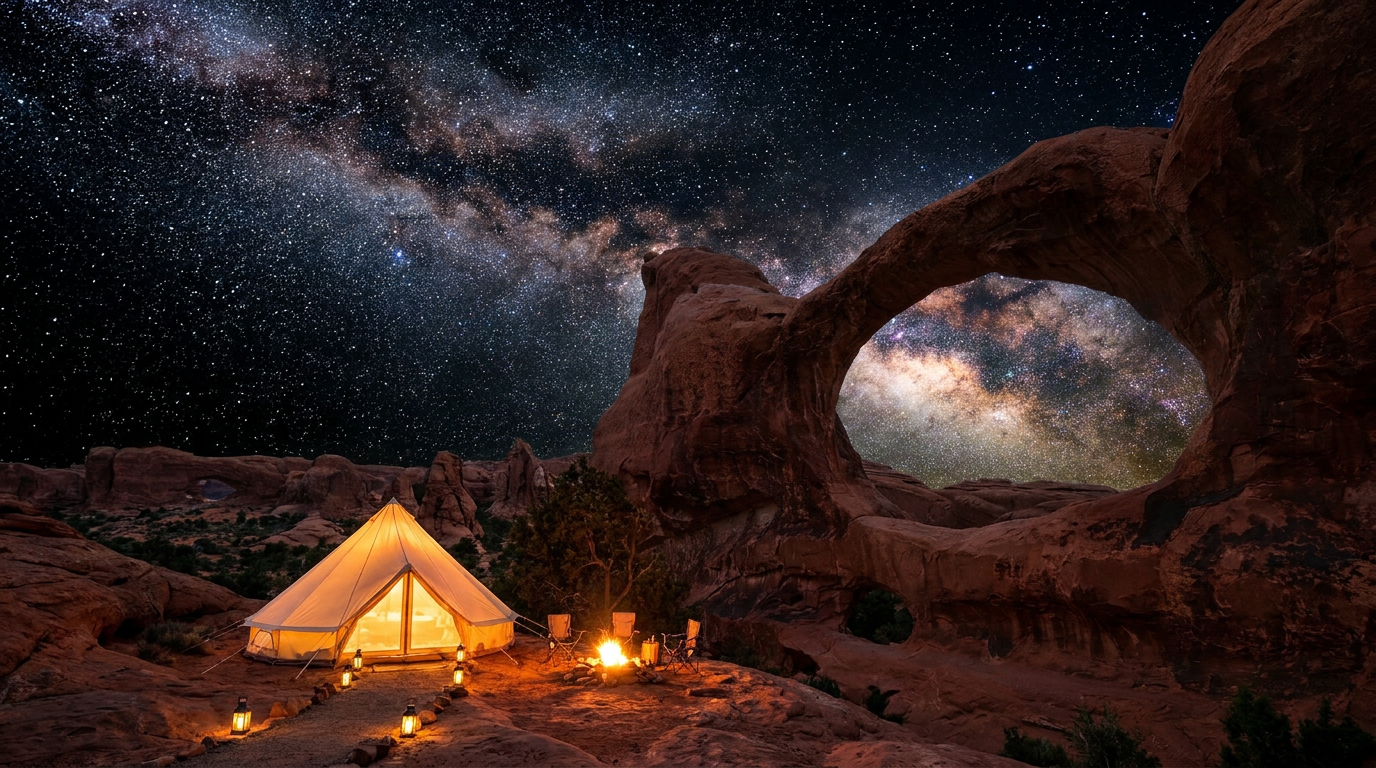
Even mainstream glamping resorts are redesigning their architecture to accommodate the trend. Tents with transparent sky-viewing roofs and strict property-wide blackout rules are becoming standard fare in remote hospitality. The goal is to allow guests to stargaze from the comfort of their beds, merging wilderness immersion with high-end luxury and comfort.[1]
Yet, as the sector grows, it faces challenges regarding accessibility and equity. The most pristine dark skies are often located in highly remote areas, requiring expensive travel and specialized lodging to access. There is a growing debate within the conservation community about how to ensure that the night sky—a universal human heritage—does not become exclusively the domain of the wealthy.[6]
To counter this, many certified Dark Sky Communities and National Parks are focusing on public access. Parks across the United States have implemented strict municipal lighting codes and host free ranger-led astronomy programs that allow residents and budget-conscious campers to enjoy the stars without paying for luxury resort access. These community-wide efforts prove that darkness can be preserved at the civic level.[5]

Ultimately, the rise of astrotourism represents a profound shift in how modern society values the natural world. For over a century, progress was measured by how brightly we could illuminate the night. Now, as the consequences of that illumination become clear, travelers are leading a global movement to reclaim the dark, proving that sometimes the most valuable resource is the one we simply leave alone.[7]
How we got here
1988
DarkSky International is founded to combat global light pollution and protect the night sky.
2001
Flagstaff, Arizona, is certified as the world's first International Dark Sky City.
2007
Mont-Mégantic in Quebec becomes the first certified International Dark Sky Reserve.
2024–2026
The solar maximum cycle triggers a surge in aurora visibility, accelerating the global astrotourism boom.
Viewpoints in depth
Rural Economic Developers
Viewing astrotourism as a sustainable, low-infrastructure lifeline for remote economies.
For destination marketing organizations and rural municipalities, dark skies represent an untapped natural resource that requires almost zero capital to develop. Unlike traditional tourism that demands heavy infrastructure, astrotourism simply requires turning off the lights. Because stargazers must stay overnight to view the sky, they inject significantly more money into local economies through lodging and dining, transforming off-season lulls into profitable booking periods.
Conservationists & Park Stewards
Using the economic value of astrotourism to fund ecological protection and combat light pollution.
Environmental advocates see the astrotourism boom as a Trojan horse for conservation. By proving that darkness has a high monetary value, they can convince local governments to enact strict lighting ordinances. These policies not only preserve the view for tourists but also protect nocturnal wildlife, restore disrupted ecosystems, and save municipalities millions of dollars in wasted energy costs.
Luxury Hospitality Industry
Positioning pristine darkness as the ultimate premium amenity for high-end travelers.
Resort developers and luxury hoteliers are capitalizing on the scarcity of the night sky by treating it as an exclusive luxury. By building permanent observatories, hiring resident astronomers, and designing suites with glass ceilings, they are transforming a free natural phenomenon into a highly curated, premium experience. For this sector, the darker the sky, the higher the nightly rate they can command.
What we don't know
- How long the current surge in aurora activity will last as the solar maximum peaks and eventually wanes.
- Whether rural infrastructure can handle the influx of astrotourists without degrading the very environments they come to see.
Key terms
- Astrotourism
- A form of travel focused on experiencing celestial phenomena and pristine night skies in areas free from artificial light pollution.
- Light Pollution
- The excessive or misdirected artificial light that obscures the night sky, wastes energy, and disrupts natural ecosystems.
- Solar Maximum
- The period of greatest solar activity during the sun's 11-year cycle, currently producing intense and frequent auroras.
- Bortle Scale
- A nine-level numeric scale that measures the brightness of the night sky and the observability of celestial objects, ranging from inner-city skies to pristine darkness.
Frequently asked
Do I need a telescope for astrotourism?
No. While some resorts offer telescopes, the primary draw of astrotourism is experiencing the naked-eye visibility of the Milky Way, meteor showers, and auroras in a truly dark environment.
What makes a location a certified Dark Sky Place?
Certification by DarkSky International requires a location to have an exceptional nocturnal environment and a proven commitment to protecting it through strict lighting ordinances and community education.
Why is astrotourism considered sustainable?
It requires minimal physical infrastructure and provides a direct economic incentive for communities to reduce light pollution, which in turn saves energy and protects nocturnal wildlife.
Sources
Source coverage
7 outlets
3 viewpoints surfaced







[1]ForbesLuxury Hospitality Industry
The Rise Of Astrotourism: 25 Hotels Leading The Stargazing Trend
Read on Forbes →[2]Miles PartnershipRural Economic Developers
Studying Dark Sky Tourism's Potential Economic Impacts
Read on Miles Partnership →[3]DarkSky InternationalConservationists & Park Stewards
International Dark Sky Places
Read on DarkSky International →[4]Astro4DevRural Economic Developers
Mission: Empowering Rural Communities through Astrotourism
Read on Astro4Dev →[5]National Park ServiceConservationists & Park Stewards
Night Skies - Stargaze
Read on National Park Service →[6]arXivRural Economic Developers
Astrotourism for socioeconomic development in rural areas
Read on arXiv →[7]Factlen Editorial TeamConservationists & Park Stewards
Synthesis by Factlen editorial team
Read on Factlen Editorial Team →

Every angle. Every day.
Get travel stories with full source coverage and perspective breakdowns delivered to your inbox.