
The New Standard of Play: How Hardware and Software Are Making Gaming Universally Accessible
Driven by modular hardware, AI-powered software, and system-level "co-pilot" modes, the video game industry is dismantling physical barriers to entry for millions of players.
By Factlen Editorial Team
- Hardware Manufacturers
- Focus on creating modular, affordable, and system-level tools that integrate seamlessly into existing console ecosystems.
- Accessibility Advocates
- Prioritize the removal of physical barriers to prevent social isolation and ensure disabled players have equal access to gaming communities.
- Alternative Input Innovators
- Push the boundaries of control schemes by utilizing AI, facial recognition, and foot-based hardware to bypass traditional hand-held gamepads.
What's not represented
- · Game Developers (balancing accessibility with intended difficulty)
- · Esports Tournament Organizers (standardizing adaptive hardware in competition)
Why this matters
For the hundreds of millions of gamers with disabilities, the standardization of adaptive hardware and AI-driven software means the difference between social isolation and active participation in one of the world's largest entertainment mediums.
Key points
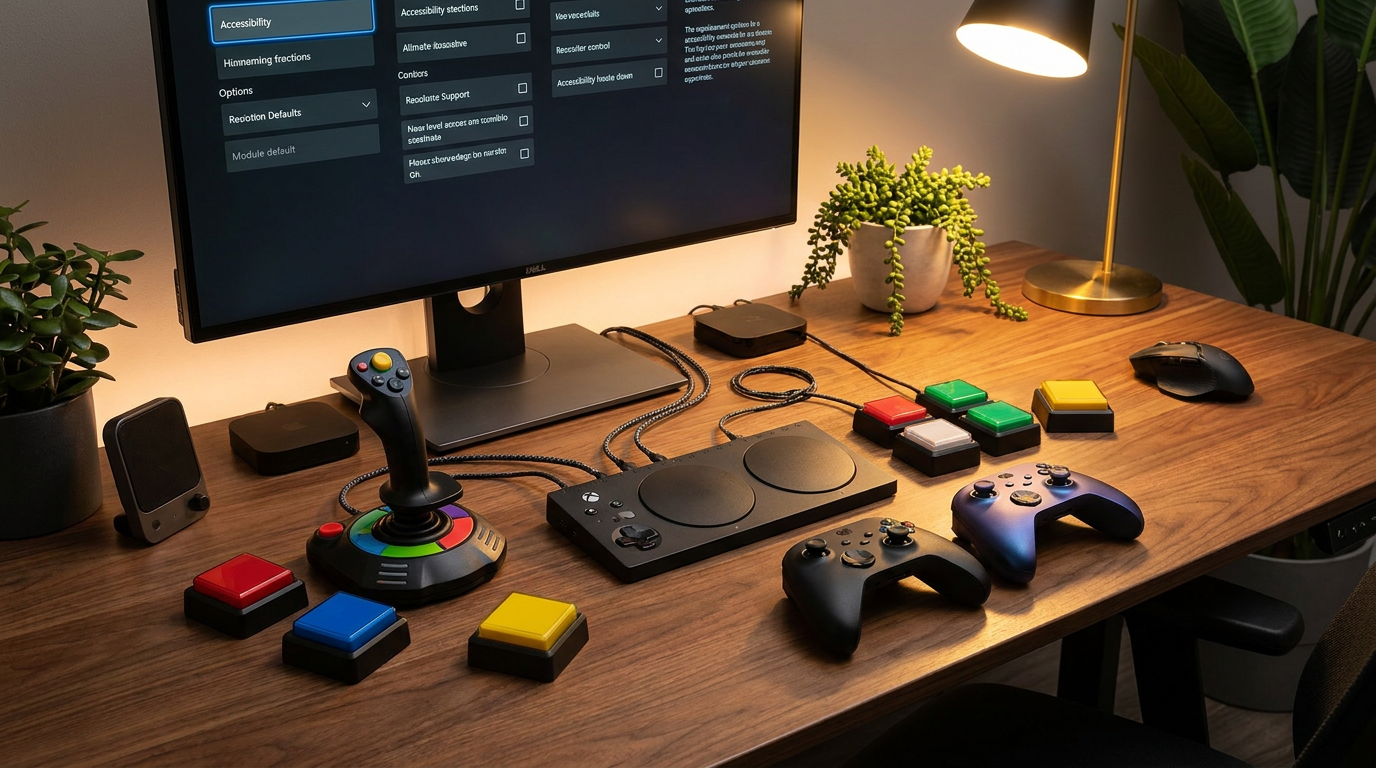
- Modular hardware hubs like the Xbox Adaptive Controller allow players to build custom rigs tailored to their physical needs.
- The $30 Xbox Adaptive Joystick and $90 PlayStation Access Controller provide affordable, highly customizable input options.
- AI-driven software can now translate facial expressions and voice commands into rapid in-game actions.
- System-level 'Co-Pilot' modes allow two controllers to act as one, enabling shared gameplay and distributed inputs.
- The disabled gaming community represents over 425 million players worldwide, driving a massive shift toward inclusive design.
For decades, the video game industry operated on a rigid assumption about its audience, designing standard controllers that required two hands, ten dexterous fingers, and rapid motor reflexes. If a player could not comfortably hold a standard gamepad, reach the shoulder bumpers, or rapidly mash a sequence of face buttons, they were largely locked out of the medium. Today, that exclusionary paradigm has fundamentally shifted. Driven by a combination of modular hardware engineering, system-level software updates, and artificial intelligence, gaming is undergoing a massive accessibility revolution that is redefining how players interact with digital worlds.[7]
The stakes for this shift extend far beyond simple entertainment. Video games are a primary social conduit in the modern era, serving as a vital way for people to connect, compete, and share experiences across physical distances. For the estimated 425 million gamers with disabilities worldwide, physical barriers to entry can directly result in social isolation. Recognizing this profound impact, major platform holders and independent hardware developers have spent the last few years consulting directly with the disability community to systematically dismantle these obstacles and build a more inclusive ecosystem.[1][5]
The result of this collaboration is a landscape where accessibility is no longer treated as an afterthought patched in via post-launch software updates, but rather as a foundational pillar of both game and hardware design. From AI software that translates subtle facial expressions into rapid button presses to system-level console features that allow two people to share control of a single in-game character, the industry is proving that complex, fast-paced digital environments can be successfully navigated by anyone, regardless of their physical mobility or motor control.[6][7]
The hardware revolution began in earnest with the introduction of modular hubs, most notably Microsoft's Xbox Adaptive Controller. Designed from the ground up as a highly flexible plug-and-play base station, it features large, easily pressable programmable buttons and an array of 3.5mm ports that allow players to connect external switches, mounts, and specialized joysticks. This device effectively decoupled the concept of a 'controller' from a single piece of molded plastic, allowing players to build custom, sprawling rigs tailored precisely to their specific physical needs and ranges of motion.[2][5]

Building on that successful foundation, Microsoft recently expanded its accessibility ecosystem with the Xbox Adaptive Joystick, which officially launched in early 2025. Priced affordably at $30, the wired companion device bears a striking resemblance to a Nintendo Wii nunchuck and is designed specifically for users with limited mobility. It can be comfortably controlled with one hand, mounted securely on a tabletop, or operated with non-hand body parts. Every button on the device is fully remappable, allowing it to seamlessly integrate into a player's existing adaptive setup.[1][2]
To further personalize the physical experience, hardware developers have fully embraced the potential of 3D printing. Through the Xbox Design Lab, players can download complimentary files to 3D-print custom thumbstick toppers that match their specific ergonomic requirements. In May 2026, the company expanded this lineup to include a highly requested 'Goal Post' shape. This new design was engineered to endure higher force and stay securely in place for players who use alternative grips or apply pressure differently than a standard, dome-shaped thumbstick requires.[1][4]
Sony has also made significant strides in the modular hardware space with the release of the PlayStation Access Controller. Priced at $90, the circular device features a wide array of swappable components, including various button shapes, magnetic tags, and adjustable stick caps. Crucially, it can be secured to industry-standard AMPS mounts, allowing it to be attached to wheelchairs or specialized desks. By allowing players to adjust the stick length and orient the controller in 360 degrees, the Access Controller provides a highly customizable, all-in-one solution for PlayStation 5 users.[3][5]

Sony has also made significant strides in the modular hardware space with the release of the PlayStation Access Controller.
Beyond the major console manufacturers, third-party companies and innovative startups are pushing the boundaries of alternative inputs even further. For players with limited upper-body mobility, a company called GLYDR has developed a sophisticated dual-foot controller. Originally inspired by virtual reality locomotion mechanics, the device allows players to map up to 16 distinct in-game actions directly to foot gestures. It features highly customizable dead zones and sensitivity settings to accommodate different ranges of motion, effectively offloading complex hand commands to the feet.[6]
Software innovations are also bridging the physical gap, particularly through the clever application of artificial intelligence. Programs like playAbility, which launched in late 2024, use AI to convert facial expressions and assistive devices into virtual gamepad inputs. By utilizing a standard webcam, players can assign subtle physical movements—such as a wink, an eyebrow raise, or a slight head tilt—to specific in-game actions. This allows a player to reload a weapon, open a map, or trigger an ability without ever touching a physical button.[6]
This AI-driven approach is increasingly being integrated directly into blockbuster, mainstream games. In 2026, Activision introduced native support for the Cephable accessibility platform in Call of Duty: Black Ops 7. This groundbreaking integration allows players to control the fast-paced, highly competitive shooter using voice commands, head movements, and facial expressions via a synchronized mobile or desktop app. It serves as a powerful proof of concept that even the most reflex-intensive competitive games can be successfully adapted for alternative, non-traditional inputs.[4]

While custom hardware and AI inputs are undeniably transformative, some of the most impactful accessibility features are now built directly into the console operating systems themselves. Chief among these is 'Co-Pilot' mode, a feature that fundamentally changes how games can be played and experienced. Available on Xbox consoles and recently introduced to the PlayStation 5 under the name 'Assist Controller' mode, this system-level feature allows two separate physical controllers to be registered by the console as a single player input.[3][4]
The practical implications of Co-Pilot mode are profound for disabled players. Primarily, it means they can spread their inputs across multiple devices to suit their physical capabilities. If a player cannot use one hand to operate an analog stick, they can place a second controller on the floor and use their foot, or mount a controller sideways on a desk and map the triggers to face buttons. It provides infinite ergonomic flexibility without requiring individual game developers to specifically code support for multiple input devices.[3]
Furthermore, Co-Pilot mode allows for seamless, dignified cooperative assistance. If a player encounters a sequence they physically cannot complete—such as a rapid button-mashing quick-time event or a complex jumping puzzle—a friend or family member holding the second controller can simply press the required button to help them past the obstacle. Crucially, this happens without the assisting player needing to physically take the primary controller away, preserving the disabled player's autonomy and keeping them fully immersed in the experience.[3]

Operating systems are also addressing the physical fatigue and pain associated with prolonged gaming sessions. Features like 'Toggle Hold' act similarly to 'Sticky Keys' on a traditional PC keyboard. Instead of requiring a player to continuously hold down a heavy trigger to aim a weapon or accelerate a digital car—an action that can cause severe strain for those with limited hand strength—Toggle Hold allows them to press the button once to engage the action, and press it again to release it.[1]
The industry-wide push for accessibility is not just a moral victory; it is also making undeniable economic sense. Organizations like AbleGamers estimate that the disabled gaming community represents tens of millions of players in the United States alone, with the broader disability market controlling an estimated $1.9 trillion in annual disposable income. By designing products that cater specifically to this demographic, companies are tapping into a massive, previously underserved market while simultaneously fulfilling a mandate to make their art more inclusive.[1][5]
Ultimately, the rapid evolution of gaming accessibility demonstrates a permanent shift from a 'one-size-fits-all' design mentality to a philosophy of universal, adaptable design. By providing players with an ever-expanding toolkit of modular hardware, AI-assisted software, and flexible system settings, the video game industry is ensuring that the joy, community, and challenge of digital play are available to everyone. In this new era of gaming, the controller is no longer a barrier to entry; it has become a customizable bridge.[7]

How we got here
2018
Microsoft releases the Xbox Adaptive Controller, establishing a new standard for modular accessibility hubs.
2023
Sony launches the PlayStation Access Controller, bringing a highly customizable, circular gamepad to the PS5 ecosystem.
Late 2024
AI-driven software like playAbility enters the market, allowing players to map facial expressions to in-game actions.
Early 2025
Microsoft releases the $30 Xbox Adaptive Joystick, providing an affordable, one-handed companion device.
May 2026
Xbox expands its 3D-printable thumbstick topper program with new shapes designed for higher force endurance.
Viewpoints in depth
Hardware Manufacturers
Platform holders view accessibility as a foundational pillar of modern console design.
Companies like Microsoft and Sony have shifted from treating accessibility as a niche software patch to a core hardware philosophy. By developing modular hubs like the Xbox Adaptive Controller and the PlayStation Access Controller, they aim to provide a standardized, plug-and-play ecosystem. Their strategy relies heavily on affordability and system-level integration, ensuring that features like Co-Pilot mode work across all games without requiring individual developers to code bespoke accessibility options.
Accessibility Advocates
Advocacy groups emphasize the social and psychological importance of inclusive gaming.
For organizations like AbleGamers and outlets like Disability Horizons, gaming is a vital social lifeline. They argue that physical barriers to entry don't just prevent people from playing a game; they lock individuals out of cultural conversations and online communities. Advocates stress the principle of 'nothing about us without us,' pushing companies to consult directly with disabled gamers during the R&D phase to ensure that new hardware genuinely meets the diverse needs of the community.
Alternative Input Innovators
Startups and software engineers are looking beyond the hands to create entirely new control paradigms.
While major console makers focus on modular buttons and joysticks, third-party innovators are exploring entirely different parts of the body. Companies developing devices like the GLYDR dual-foot controller or software like playAbility argue that true accessibility requires moving past the concept of a handheld gamepad altogether. By leveraging AI facial recognition and VR-inspired foot pedals, they are opening up competitive gaming to players with severe upper-body mobility limitations.
What we don't know
- How competitive esports leagues will standardize the use of AI-driven inputs and custom hardware in official tournaments.
- Whether Nintendo will adopt system-level features like Co-Pilot mode in its next-generation console.
- How quickly third-party game developers will universally adopt native support for platforms like Cephable.
Key terms
- Co-Pilot Mode
- A system-level feature that allows two separate controllers to be registered as a single player, enabling shared gameplay or distributed inputs.
- Adaptive Controller
- A modular hardware hub designed to connect various external switches, buttons, and joysticks for players with limited mobility.
- Toggle Hold
- A software accessibility setting that allows a player to press a button once to hold it down continuously, reducing physical strain.
- AMPS Mount
- An industry-standard screw pattern used to securely attach devices, such as accessibility controllers, to wheelchairs or specialized desks.
- Cephable
- An accessibility platform that translates voice commands, head movements, and facial expressions into digital inputs.
Frequently asked
What is the Xbox Adaptive Joystick?
Released in early 2025, it is a $30 one-handed wired controller that can be mounted or used with non-hand body parts, designed to complement existing adaptive setups.
Can two people play as one character on a PlayStation 5?
Yes. The PS5 features an 'Assist Controller' mode, similar to Xbox's 'Co-Pilot' mode, which allows two separate controllers to act as a single input device.
How does AI help with gaming accessibility?
Software like playAbility uses AI and webcams to track facial expressions—such as a wink or a smile—and translates them into specific button presses in a game.
Are these adaptive controllers expensive?
Prices vary, but major companies are aiming for affordability. The Xbox Adaptive Joystick costs $30, while the PlayStation Access Controller is priced at $90.
Sources
Source coverage
7 outlets
3 viewpoints surfaced







[1]ForbesHardware Manufacturers
Xbox Announces Accessible Controllers, Packaging, More
Read on Forbes →[2]GameSpotHardware Manufacturers
Xbox Adaptive Joystick Is Available Now
Read on GameSpot →[3]Access-AbilityAccessibility Advocates
PS5 Gets Co-Pilot Support Via 'Assist Controller' Mode
Read on Access-Ability →[4]Xbox WireHardware Manufacturers
Xbox Celebrates Global Accessibility Awareness Day with Improved Adaptive Thumbstick Toppers and More
Read on Xbox Wire →[5]Disability HorizonsAccessibility Advocates
Accessible gaming: making computer games accessible
Read on Disability Horizons →[6]Filament GamesAlternative Input Innovators
Accessible Control Schemes: Moving Beyond Remappable Buttons
Read on Filament Games →[7]Factlen Editorial TeamAlternative Input Innovators
Synthesis by Factlen editorial team
Read on Factlen Editorial Team →
More in gaming esports
See all 10 stories →Esports Economy
How Esports Survived Its 'Winter' and Found Sustainable Profitability in 2026
7 sources
Gaming Accessibility
The Accessibility Revolution: How Hardware and Software Innovations Are Opening Gaming to Everyone
7 sources
Game Accessibility
How the Video Game Industry Standardized Accessibility for Millions of Players
8 sources
AI NPCs
The End of the Dialogue Tree: How Generative AI is Rewiring Video Game NPCs
9 sources
Every angle. Every day.
Get gaming esports stories with full source coverage and perspective breakdowns delivered to your inbox.