
Steam Deck OLED vs. ASUS ROG Ally X: The Definitive 2026 Handheld PC Comparison
As the portable PC gaming market matures, Valve's console-like Steam Deck OLED and ASUS's brute-force ROG Ally X have emerged as the two definitive choices for players.
By Factlen Editorial Team
- Value & Simplicity Advocates
- Argue that handhelds should prioritize a seamless, console-like user experience, OLED visuals, and long battery life over raw benchmark numbers.
- Performance & Freedom Maximizers
- Believe that portable PCs must offer universal game compatibility, high refresh rates, and the raw horsepower to run modern AAA titles natively.
- Hardware Analysts
- Focus on the technical trade-offs, weighing the thermal efficiency of the Steam Deck against the RAM and battery upgrades of the Ally X.
What's not represented
- · Game developers optimizing specifically for handheld TDP limits
- · Cloud gaming advocates who bypass local hardware limits entirely
Why this matters
Choosing a handheld gaming PC dictates not just how much you spend, but which game libraries you can access and how much technical troubleshooting you will endure. Understanding the stark trade-offs between Valve's seamless Linux ecosystem and ASUS's powerful Windows hardware ensures you buy the device that actually fits your daily gaming habits.
Key points
- The Steam Deck OLED excels in console-like simplicity, battery efficiency, and OLED visual quality at a lower $549 starting price.
- The ASUS ROG Ally X offers brute-force performance with 24GB of RAM and a 120Hz VRR display for $999.
- SteamOS provides a seamless user experience but blocks games requiring kernel-level anti-cheat.
- Windows 11 on the Ally X allows native access to Xbox Game Pass and all multiplayer titles, despite some UI clunkiness.
- The Ally X's massive 80Wh battery solves previous generation power issues, though the Steam Deck remains more efficient for indie games.
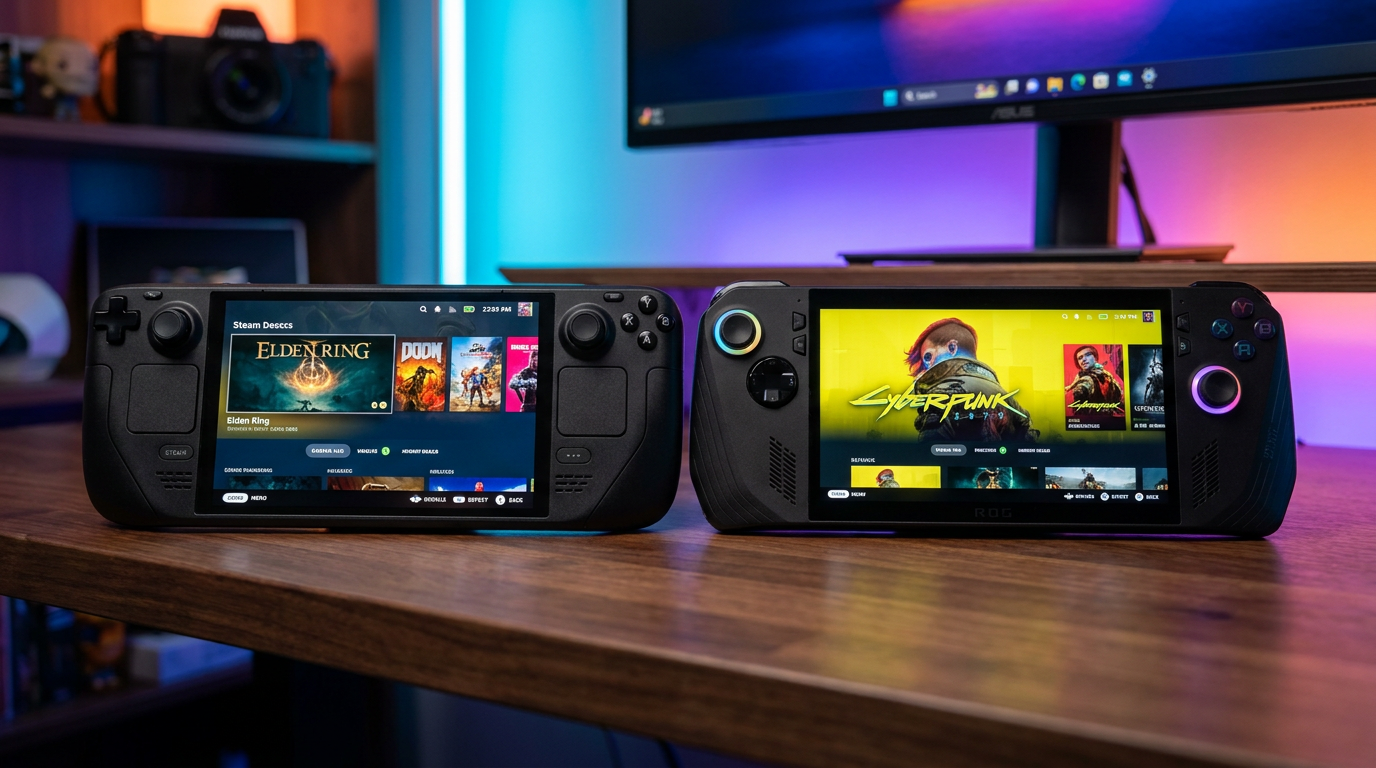
PC gaming has fundamentally shifted from the desk to the couch, and by 2026, the portable hardware market has matured into a definitive two-horse race. While newer entrants like the MSI Claw 8 AI+ and Lenovo Legion Go 2 have introduced massive screens and alternative chips, the industry consensus centers on two refined titans: Valve's Steam Deck OLED and the ASUS ROG Ally X. These devices represent entirely different philosophies about what a handheld PC should be. One is a tightly controlled, console-like walled garden optimized for efficiency, while the other is a brute-force Windows machine designed to push the boundaries of portable performance.[1][2][3]
The Steam Deck OLED presents a compelling case for console-like simplicity. **For:** It delivers an unmatched plug-and-play experience powered by Valve's custom SteamOS, a stunning 7.4-inch HDR OLED display, and exceptional battery efficiency at lower wattages. **Against:** It lacks the raw horsepower to push the newest AAA blockbusters at high frame rates, and its Linux foundation means games with kernel-level anti-cheat simply will not run natively. **Evidence:** Reviewers consistently praise its tight tuning, noting that while it maintains a stable 30 to 40 frames per second in heavy titles, it truly shines in indie games, stretching its 50Wh battery up to 12 hours.[3][7]
On the other side of the spectrum, the ASUS ROG Ally X is a portable powerhouse. **For:** Armed with the AMD Ryzen Z1 Extreme processor and a massive 24GB of fast LPDDR5X RAM, it brute-forces its way through demanding modern titles, while its native Windows 11 OS grants instant access to Xbox Game Pass and every anti-cheat multiplayer game. **Against:** Windows 11 remains clunky to navigate with joysticks, the device runs warmer under heavy load, and its $999 price tag is nearly double that of Valve's entry-level OLED. **Evidence:** Hardware analysts highlight its 1080p 120Hz IPS display and massive 80Wh battery, which successfully solved the battery woes of the original Ally to sustain high-wattage performance for two to six hours.[2][4][6]

When examining raw performance, the gap between the two devices is quantifiable and significant. The Steam Deck OLED relies on an older Zen 2 architecture paired with 16GB of RAM, capping its power draw at a highly efficient 15 watts. In contrast, the ROG Ally X pushes up to 30 watts and utilizes 24GB of RAM. That extra memory headroom is critical in 2026, as modern games increasingly demand more VRAM to load high-resolution textures. Testing reveals that the Ally X can smoothly run recent big-budget releases that the Steam Deck struggles to maintain at playable frame rates, especially when the Ally's resolution is scaled down to 720p to maximize its 120Hz refresh rate.[6][7]
The visual experience presents a classic trade-off between infinite contrast and high-speed fluidity. Valve equipped the Steam Deck OLED with a 1280x800 HDR OLED panel running at 90Hz. The inclusion of HDR and the perfect blacks of OLED technology makes colors pop and shadows pitch-black, setting a visual standard that traditional screens cannot match. ASUS, however, opted for a 7-inch 1080p IPS display with a 120Hz refresh rate and Variable Refresh Rate (VRR) technology. While it lacks the deep blacks of OLED, the VRR support is a game-changer for handhelds, smoothing out frame pacing and eliminating screen tearing when frame rates inevitably fluctuate in heavy PC games.[3][6]
Ergonomics and physical design also divide the two user bases. The Steam Deck is physically larger but surprisingly light, featuring offset analog sticks and dual haptic trackpads. These trackpads are a secret weapon, making mouse-heavy strategy games and city builders genuinely playable on the go. The ROG Ally X is denser and more compact, adopting a traditional Xbox-style asymmetrical stick layout. ASUS upgraded the Ally X with Hall effect joysticks—which use magnets to eliminate the risk of stick drift—and deeper, more comfortable grips that make long gaming sessions significantly more ergonomic than the first-generation model.[1][5]

Ergonomics and physical design also divide the two user bases.
Storage expansion and connectivity heavily favor the Windows machine. The ROG Ally X features dual USB-C ports, including one that supports ultra-fast USB 4, allowing users to charge the device and connect to an external display or GPU simultaneously without needing a dock. Furthermore, ASUS redesigned the internals to support standard M.2 2280 SSDs. This makes upgrading the storage to 2TB or 4TB incredibly cheap and easy compared to the Steam Deck, which relies on the smaller, more expensive M.2 2230 drive format and features only a single USB-C port.[6][7]
Battery anxiety was the defining flaw of the first generation of Windows handhelds, but the ROG Ally X addressed this by cramming in an unprecedented 80Wh battery. Despite this massive capacity advantage over the Steam Deck's 50Wh cell, battery life remains highly contextual. Because the Ally X draws significantly more power to feed its Z1 Extreme chip and 1080p screen, its battery drains rapidly at maximum settings. The Steam Deck OLED, constrained by its 15W limit and optimized SteamOS, runs cooler, quieter, and significantly longer when playing less demanding titles, making it the undisputed champion for long flights and indie game marathons.[4][7]
Hardware is only half the equation; the operating system dictates the daily friction of the user experience. SteamOS is frequently cited as the Steam Deck's greatest asset. It suspends and resumes games instantly, manages shader caches automatically, and feels indistinguishable from a dedicated console interface. The ROG Ally X relies on ASUS's Armoury Crate software layered over Windows 11. While ASUS has vastly improved its full-screen interface to hide the desktop, users will inevitably encounter Windows update prompts, launcher login screens, and touch-target frustrations that occasionally break the console illusion.[1][4][7]

However, that same Windows 11 friction is exactly what unlocks the ROG Ally X's greatest strength: universal compatibility. Because SteamOS is based on Linux, it relies on a compatibility layer called Proton to run Windows games. While Proton is remarkably effective, it cannot bypass kernel-level anti-cheat software. This means massive multiplayer titles like Destiny 2, Valorant, and Call of Duty will not run on a Steam Deck without installing Windows. The Ally X plays all of these natively, alongside offering a seamless, native installation of PC Game Pass, which remains a massive value add for subscribers.[6][7]
Price remains the final, and often most decisive, battleground. For gamers watching their wallets, the Steam Deck remains the undisputed king of value. The refined OLED version starts at $549, offering a premium experience at a mid-range price point. The ASUS ROG Ally X, positioned as a premium flagship, commands a steep $999. While the extra cost buys double the storage, 24GB of RAM, and a significantly faster processor, it pushes the device into the price territory of a mid-range gaming laptop, changing the value calculus for casual buyers.[4][5]
Ultimately, the choice comes down to what kind of gamer you are. **Fits well when:** The Steam Deck OLED is the definitive choice for players whose libraries are primarily on Steam, who prioritize battery life and OLED visuals, and who want a seamless, console-like experience without the hassle of tweaking settings. **Does not fit when:** Your primary games require kernel-level anti-cheat, you rely heavily on native Xbox Game Pass, or you demand 60+ frames per second in the absolute newest, most graphically intensive releases.[3][7]
**Fits well when:** The ASUS ROG Ally X is ideal for power users who want a zero-compromise, portable Windows PC that can brute-force modern games. It is the perfect fit for gamers who want access to every storefront, who play competitive multiplayer shooters, and who value a 120Hz VRR display for maximum fluidity. **Does not fit when:** You are on a strict budget, you despise troubleshooting Windows drivers on a 7-inch touchscreen, or you prefer a lightweight device that stays cool and quiet during long, casual gaming sessions.[2][6]
How we got here
February 2022
Valve launches the original LCD Steam Deck, proving the mainstream viability of the modern handheld PC market.
June 2023
ASUS releases the original ROG Ally, introducing the powerful Z1 Extreme chip but suffering from battery life and SD card issues.
November 2023
Valve releases the Steam Deck OLED, featuring a vastly improved screen, better battery life, and refined thermals.
July 2024
ASUS launches the ROG Ally X, doubling the battery capacity to 80Wh and increasing RAM to 24GB to fix the original model's shortcomings.
Mid 2026
The handheld market matures, leaving the Steam Deck OLED and ROG Ally X as the definitive choices for budget and premium tiers, respectively.
Viewpoints in depth
Value & Simplicity Advocates
The argument for prioritizing a seamless, console-like user experience.
This camp, championed by outlets like PC Gamer and Rock Paper Shotgun, argues that the true magic of a handheld lies in its ease of use. They point to Valve's SteamOS as the gold standard, noting that the ability to instantly suspend a game, wake it up hours later, and never see a driver update prompt makes the Steam Deck feel like a dedicated console. For these users, the inclusion of an HDR OLED screen and the ability to play indie games for up to 12 hours on a single charge far outweighs the inability to play the latest demanding AAA titles at 60 frames per second.
Performance & Freedom Maximizers
The argument for raw power and open ecosystem compatibility.
Reviewers focused on performance argue that a handheld PC should actually function as a PC. They highlight that the ROG Ally X's 24GB of RAM and Ryzen Z1 Extreme chip are necessary to keep up with modern gaming demands. More importantly, they emphasize the freedom of Windows 11. For this camp, being locked out of massive multiplayer games like Call of Duty due to Linux anti-cheat incompatibility is a dealbreaker. They view the Ally X's $999 price tag as a justified premium for a device that can natively run Xbox Game Pass, Epic Games, and any other launcher without requiring complex workarounds.
What we don't know
- When Valve will officially announce the hardware specifications and release window for the next-generation Steam Deck 2.
- Whether Microsoft will release a dedicated, lightweight 'Windows Handheld Mode' to permanently solve the UI friction on devices like the Ally X.
Key terms
- APU (Accelerated Processing Unit)
- A single chip that combines both the central processor (CPU) and graphics processor (GPU), commonly used in handheld gaming devices to save space.
- TDP (Thermal Design Power)
- The maximum amount of heat a chip is designed to generate, which directly correlates to how much battery power it consumes during gameplay.
- VRR (Variable Refresh Rate)
- A display technology that synchronizes the screen's refresh rate with the game's fluctuating frame rate, eliminating stuttering and screen tearing.
- Hall Effect Joysticks
- Thumbsticks that use magnetic fields instead of physical electrical contacts to measure movement, preventing the mechanical wear known as stick drift.
- SteamOS
- Valve's custom, Linux-based operating system designed specifically to run PC games in a streamlined, console-like interface.
Frequently asked
Can the Steam Deck play Xbox Game Pass games?
Natively, no. Because it runs Linux-based SteamOS, you can only play Game Pass titles via Xbox Cloud Gaming in a browser, or by undertaking the complex process of installing Windows on the device.
Does the ROG Ally X suffer from stick drift?
No. ASUS upgraded the ROG Ally X with Hall effect joysticks, which use magnets instead of physical electrical contacts to measure movement, effectively eliminating the mechanical wear that causes stick drift.
Which handheld has better battery life?
It depends on the game. The Steam Deck OLED is far more efficient at low wattages, lasting up to 12 hours in lightweight indie games. The ROG Ally X has a much larger 80Wh battery, allowing it to last longer (2 to 6 hours) when playing heavy AAA games at maximum power.
Can I upgrade the storage on both devices?
Yes, but the ROG Ally X is easier and cheaper to upgrade because it supports standard, full-size M.2 2280 SSDs. The Steam Deck requires the smaller, slightly more expensive M.2 2230 SSD format.
Sources
Source coverage
7 outlets
3 viewpoints surfaced







[1]PC GamerValue & Simplicity Advocates
The best handheld gaming PC 2026
Read on PC Gamer →[2]Tom's HardwarePerformance & Freedom Maximizers
Best Handheld Gaming PCs 2026: Windows and Steam Decks tested
Read on Tom's Hardware →[3]Rock Paper ShotgunValue & Simplicity Advocates
Best handheld PCs
Read on Rock Paper Shotgun →[4]Handheld Gaming HubPerformance & Freedom Maximizers
Top Recommendations for 2026
Read on Handheld Gaming Hub →[5]PCMagHardware Analysts
The Best Handheld Gaming PCs for 2026
Read on PCMag →[6]Pocket-lintPerformance & Freedom Maximizers
The ROG Ally X and the Steam Deck OLED side by side
Read on Pocket-lint →[7]EnebaHardware Analysts
ROG Ally vs Steam Deck: Which Handheld is Worth It?
Read on Eneba →
More in gaming esports
See all 10 stories →Esports Economy
How Esports Survived Its 'Winter' and Found Sustainable Profitability in 2026
7 sources

Gaming Accessibility
The Accessibility Revolution: How Hardware and Software Innovations Are Opening Gaming to Everyone
7 sources
Game Accessibility
How the Video Game Industry Standardized Accessibility for Millions of Players
8 sources

AI NPCs
The End of the Dialogue Tree: How Generative AI is Rewiring Video Game NPCs
9 sources

Every angle. Every day.
Get gaming esports stories with full source coverage and perspective breakdowns delivered to your inbox.