
The Mechanics of a Mega-IPO: How SpaceX Pulled Off a Historic $75 Billion Public Debut
SpaceX has shattered Wall Street records with a $75 billion initial public offering, bucking traditional underwriting norms. Here is how the largest public market debut in history actually worked behind the scenes.
By Factlen Editorial Team
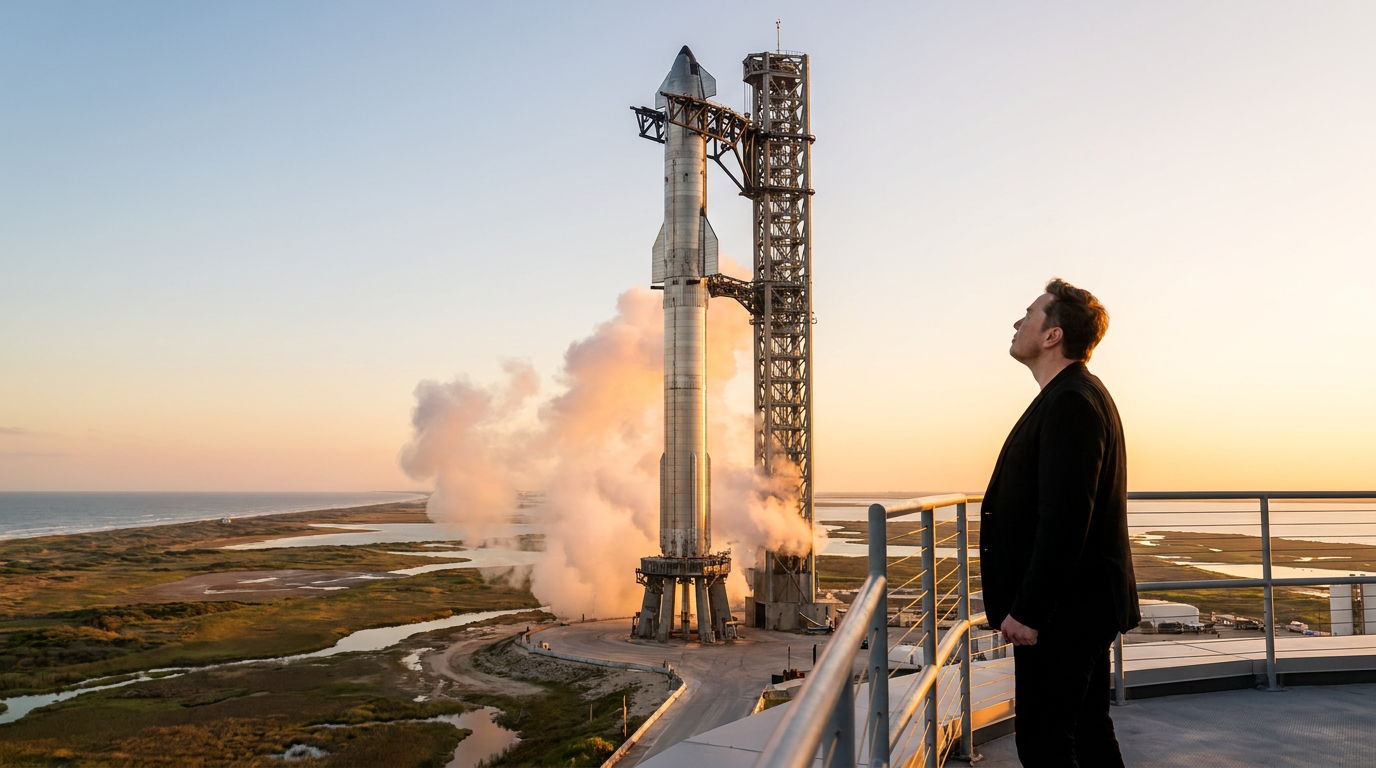
- Retail Investors & Optimists
- View the IPO as a historic democratization of access to the space economy and a massive success.
- Institutional Finance
- Focus on the trading volume, underwriting fees, and the structural mechanics of absorbing a $75 billion offering.
- Space Industry Analysts
- Analyze how the influx of capital will accelerate Starship development and expand the $1 trillion commercial space sector.
- Regulatory & Academic Observers
- Examine the S-1 disclosures, lock-up periods, and how mega-IPOs alter traditional price discovery models.
What's not represented
- · Early private equity investors seeking liquidity
- · Competitor aerospace firms facing new market dynamics
Why this matters
For years, everyday investors were locked out of the wealth generated by the world's most valuable private aerospace company. SpaceX's public debut not only democratizes access to the commercial space race but also rewrites the playbook for how massive technology firms transition to the public markets.
Key points
- SpaceX executed the largest IPO in history, raising $75 billion and tripling the previous record set by Alibaba.
- The company's S-1 filing revealed that Starlink subscriptions provide a massive, predictable cash flow to support its valuation.
- SpaceX bucked traditional Wall Street norms by dictating terms to underwriters and ensuring broader retail access.
- The $75 billion war chest will primarily fund the final development phases of the reusable Starship launch vehicle.
- Company insiders are subject to a lock-up period, preventing them from selling shares immediately and stabilizing the stock.
The opening bell on Wall Street rarely rings in a new era of human infrastructure, but the public debut of Space Exploration Technologies Corp. proved to be the exception. By raising a staggering $75 billion, SpaceX executed the largest Initial Public Offering (IPO) in financial history, fundamentally altering the landscape of the global space economy.[1][5]
To understand the sheer gravity of this financial event, one must look at the previous record holders. Alibaba’s 2014 debut raised $25 billion, a number that stood unchallenged for over a decade. SpaceX tripled that figure in a single morning, absorbing an unprecedented amount of global liquidity while bucking several deeply entrenched Wall Street norms in the process.[1][6]
The mechanics of moving a company from private venture to public titan require a massive orchestration of legal, financial, and regulatory machinery. The process officially begins with the Form S-1, a comprehensive registration document filed with the Securities and Exchange Commission (SEC) that outlines the company's business model, risks, and financial health.[3]

For years, SpaceX’s internal financials were a closely guarded secret, accessible only to a tight circle of venture capitalists and private equity firms. The S-1 filing forced the company to open its books to the public, revealing the exact revenue streams powering its ambitious lunar and Martian colonization goals.[3][6]
Analysts poring over the regulatory documents discovered that Starlink, the company’s satellite internet constellation, had transitioned from a capital-intensive research project into a massive cash-generating engine. This predictable, subscription-based revenue provided the financial bedrock necessary to justify the company's astronomical public valuation to institutional buyers.[5][6]
Traditionally, an IPO involves a "roadshow," where executives travel the globe pitching the stock to institutional investors—pension funds, mutual funds, and sovereign wealth portfolios. However, SpaceX took a highly unconventional approach, leveraging its immense public brand to dictate terms to the underwriters rather than adhering to the standard institutional discount model.[1][4]

Wall Street banks typically underprice IPOs slightly to ensure a "pop" on the first day of trading, rewarding their preferred institutional clients with immediate paper profits. In this case, the sheer retail demand forced a recalibration of how shares were allocated and priced, ensuring that everyday investors had a more equitable entry point into the stock.[1][4]
Academic research into mega-IPOs suggests that when a company reaches this scale before going public, the traditional dynamics of price discovery break down. Because SpaceX was already valued in the hundreds of billions privately, the public offering was less about raising survival capital and more about providing liquidity to early employees and long-term backers.[4][6]
Academic research into mega-IPOs suggests that when a company reaches this scale before going public, the traditional dynamics of price discovery break down.
Despite the unconventional approach, the major investment banks still reaped massive rewards. JPMorgan and other lead underwriters generated exceptional trading income from the sheer volume of shares changing hands, proving that even disruptive tech giants still need the plumbing of traditional finance to execute a $75 billion transaction smoothly.[2]
The influx of capital into SpaceX is expected to dramatically accelerate the broader commercial space economy. Industry reports project that the global space sector will exceed $1 trillion in annual revenue by the end of the decade, driven largely by the reduced launch costs pioneered by reusable rocket technology.[5]

With $75 billion in fresh capital, SpaceX is uniquely positioned to fund the final development phases of Starship, the fully reusable super-heavy lift launch vehicle. This unprecedented war chest effectively insulates the company's research and development pipeline from short-term macroeconomic shocks or credit crunches.[1][5]
However, the transition to public markets introduces new pressures. Private companies can optimize for decade-long horizons without worrying about quarterly earnings reports. Now, SpaceX executives will have to balance their interplanetary ambitions with the immediate demands of public shareholders and Wall Street analysts.[4][6]
One of the critical mechanisms stabilizing the stock in these early days is the "lock-up period." This is a legally binding agreement that prevents company insiders, early investors, and employees from selling their shares immediately after the IPO, ensuring that the market is not overwhelmed by sudden supply.[3][4]
Typically lasting between 90 to 180 days, the lock-up prevents a post-IPO crash. Investors and analysts are already marking their calendars for the expiration date, anticipating a surge in trading volume when millions of restricted shares finally become liquid and test the market's true appetite.[4][6]

Market historians are inevitably drawing comparisons to Tesla’s 2010 IPO. While Tesla debuted as a highly speculative automaker fighting for survival, SpaceX has entered the public arena as an established monopoly in commercial launch services, fundamentally altering the risk profile for retail investors.[1][6]
The success of this mega-IPO is also sending ripples through Silicon Valley. Dozens of highly valued "unicorns" that have delayed going public due to market uncertainty are now re-evaluating their timelines, encouraged by the market's willingness to absorb a $75 billion offering without destabilizing broader indices.[2][6]
Ultimately, the SpaceX IPO is more than just a financial milestone; it is a structural shift in how generational wealth is distributed. By transitioning to the public markets, the financial upside of the commercial space age is no longer restricted to venture capitalists, allowing anyone with a brokerage account to buy a stake in the infrastructure of the future.[1][5][6]
How we got here
2002
SpaceX is founded with the long-term goal of reducing space transportation costs and colonizing Mars.
2020
The company successfully launches its first commercial crew mission, cementing its dominance in the launch sector.
Late 2025
Rumors begin circulating on Wall Street that SpaceX is preparing its S-1 paperwork for a public offering.
Early 2026
SpaceX officially files its Form S-1 with the SEC, opening its financials to the public for the first time.
June 2026
SpaceX debuts on the public market, raising a historic $75 billion and shattering all previous IPO records.
Viewpoints in depth
Retail Investors & Optimists
View the IPO as a historic democratization of access to the space economy.
For over two decades, the immense wealth generated by SpaceX's technological breakthroughs was captured entirely by venture capitalists, private equity firms, and early employees. Retail advocates argue that this IPO corrects a long-standing structural flaw in modern finance, where the most transformative companies stay private during their highest growth phases. By going public, SpaceX allows everyday investors to directly participate in the financial upside of the commercial space age, treating the stock as a generational hold rather than a short-term trade.
Institutional Underwriters
Focus on the structural mechanics of absorbing a $75 billion offering.
From the perspective of Wall Street banks, the SpaceX IPO was a monumental stress test of global liquidity. Underwriters were tasked with pricing an asset that had no direct public market equivalent. While SpaceX bucked traditional roadshow norms, institutional players emphasize that the sheer volume of the transaction generated massive trading fees. Their primary concern moving forward is managing the volatility that will inevitably occur when the insider lock-up period expires and millions of restricted shares flood the open market.
Space Industry Analysts
Analyze how the influx of capital will accelerate Starship development.
Aerospace analysts view the $75 billion capital injection less as a financial event and more as a geopolitical and technological catalyst. This unprecedented war chest effectively guarantees that the Starship program—which is highly capital intensive—will not be derailed by short-term macroeconomic tightening. Analysts argue that by securing this funding, SpaceX has cemented its monopoly over heavy-lift launch services for the next decade, forcing legacy aerospace competitors to radically rethink their own funding and development models.
Regulatory & Academic Observers
Examine how mega-IPOs alter traditional price discovery models.
Financial academics point out that when a company reaches a valuation in the hundreds of billions before going public, the traditional IPO playbook breaks down. The S-1 disclosures revealed a company that operates more like a sovereign entity than a traditional tech startup. Academics caution that while the initial offering was a success, the true test will be how SpaceX's long-term, capital-intensive R&D timelines survive the public market's relentless demand for quarterly earnings growth and predictable profit margins.
What we don't know
- How the stock price will react when the 180-day insider lock-up period expires and millions of shares become liquid.
- Whether the public market's demand for quarterly profits will force SpaceX to alter its long-term, capital-intensive R&D timelines.
Key terms
- Form S-1
- A comprehensive registration document required by the SEC before a U.S. company can offer new securities to the public.
- Underwriter
- A financial institution, typically an investment bank, that administers the public issuance and distribution of securities from a corporation.
- Roadshow
- A series of presentations made in various locations leading up to an IPO, designed to generate interest among institutional investors.
- Retail Investor
- An individual, non-professional investor who buys and sells securities for their personal account, rather than on behalf of an institution.
- Liquidity
- The ease with which an asset, or security, can be converted into ready cash without affecting its market price.
Frequently asked
What is an IPO?
An Initial Public Offering (IPO) is the process by which a private company offers shares of its stock to the public for the first time, allowing anyone to invest.
How much money did SpaceX raise?
SpaceX raised $75 billion in its public debut, making it the largest IPO in financial history by a wide margin.
What is a lock-up period?
A lock-up period is a legally binding window—typically 90 to 180 days—during which company insiders and early investors are forbidden from selling their shares, preventing a sudden crash in the stock price.
Can anyone buy SpaceX stock now?
Yes. Because the company is now public, everyday retail investors can purchase shares through standard brokerage accounts.
Sources
Source coverage
6 outlets
4 viewpoints surfaced





[1]MarketWatchInstitutional Finance
How Elon Musk nailed the SpaceX IPO: ‘I’m not sure that this could have gone much better’
Read on MarketWatch →JPMorgan says investors are overlooking the upside to Wall Street banks that comes from SpaceX and other mega IPOs
Read on MarketWatch →[3]SECRegulatory & Academic Observers
Form S-1 Registration Statement: Space Exploration Technologies Corp.
Read on SEC →[4]Journal of Financial EconomicsRegulatory & Academic Observers
The Mechanics of Mega-IPOs and Retail Investor Access in the Modern Era
Read on Journal of Financial Economics →[5]Space FoundationSpace Industry Analysts
The Global Space Economy Report 2026: Commercial Milestones
Read on Space Foundation →[6]Factlen Editorial TeamRegulatory & Academic Observers
Synthesis by Factlen editorial team
Read on Factlen Editorial Team →

More in finance
See all 118 stories →Annuities
Do Fixed-Index Annuities Outperform the Market? The Evidence Behind the Pitch
6 sources

Retirement Planning
The Truth About Fixed Index Annuities: How the 'Zero Risk' Retirement Pitch Actually Works
7 sources

SpaceX IPO
SpaceX Completes Historic $75 Billion IPO, Vaulting Valuation Past $2 Trillion
8 sources
Economic Metrics
Headline vs. Core Inflation: How to Read the Economy's Thermometer in 2026
7 sources
Every angle. Every day.
Get finance stories with full source coverage and perspective breakdowns delivered to your inbox.