
The Local AI Revolution: How to Run Powerful LLMs on Your Own Laptop
As privacy concerns and cloud costs rise, a new ecosystem of open-source tools is allowing users to run highly capable AI models entirely offline on consumer hardware.
By Factlen Editorial Team
- Open-Source Developers
- Builders who value the zero marginal cost and offline capabilities of local models.
- Privacy & Enterprise Security
- Advocates for data sovereignty who view local AI as a necessary defense against cloud data harvesting.
- Hardware & Efficiency Researchers
- Engineers focused on compressing massive neural networks to fit on consumer silicon.
- General Synthesis
- Editorial overview of the local AI movement and its broader implications.
What's not represented
- · Cloud AI Providers
- · Hardware Manufacturers
Why this matters
Running AI locally gives you complete ownership of your data, eliminates monthly subscription fees, and allows you to use powerful generative tools entirely offline. It represents a major shift of AI power from centralized cloud servers back to individual users.
Key points
- Local LLMs run entirely on your device, ensuring complete data privacy and zero API costs.
- Tools like Ollama and LM Studio have made installation a simple, five-minute process.
- Quantization compresses massive models to fit within the 16GB RAM of standard modern laptops.
- Open-weight models like Gemma 4 and Qwen 3.6 now offer near-frontier performance on consumer hardware.
- A hybrid approach is emerging, using local AI for routine tasks and cloud AI for complex reasoning.
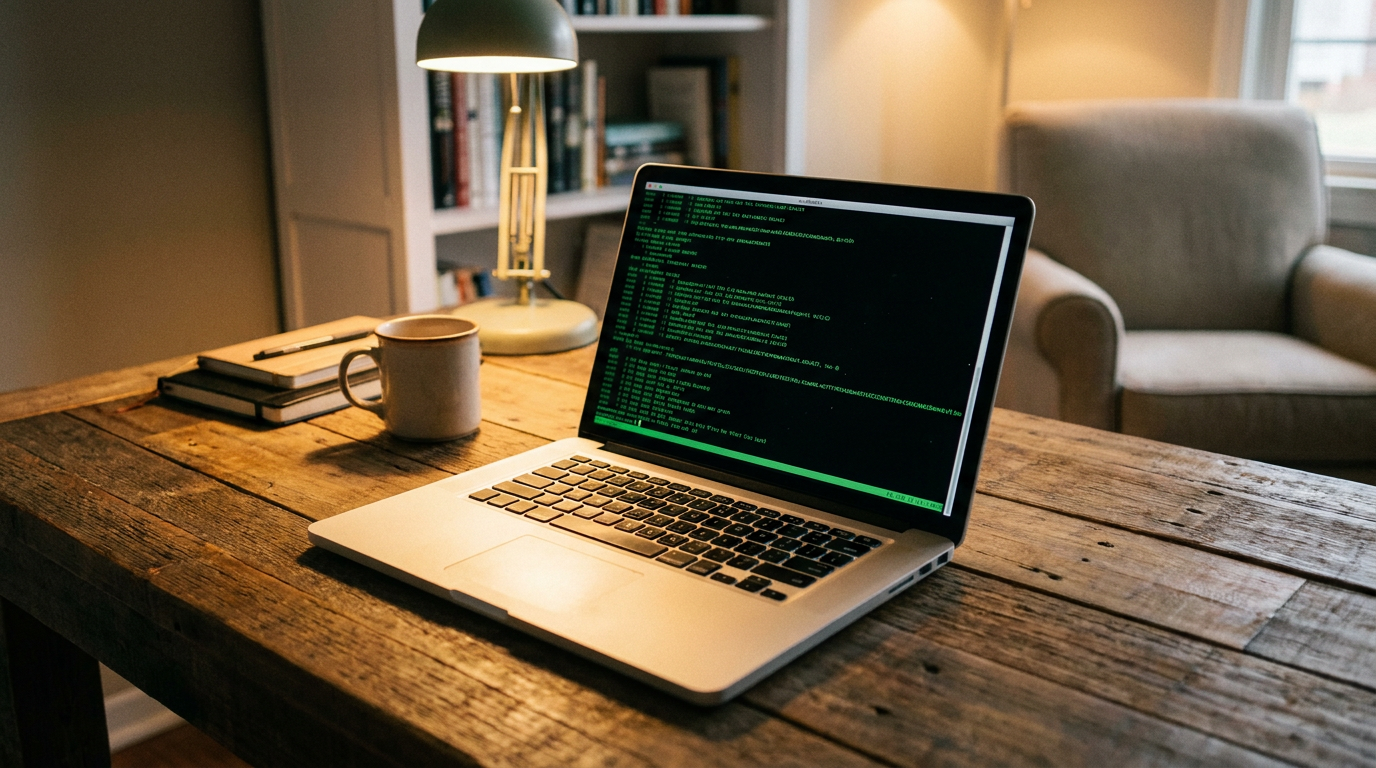
For years, using artificial intelligence meant renting a supercomputer by the word. Every time a user typed a prompt into a cloud-based assistant, that text was beamed to a massive data center, processed on industrial-grade silicon, and beamed back. It was a miracle of modern networking, but it came with a significant catch: users were entirely dependent on the cloud, tethered to an internet connection, and forced to hand over their data to a third-party corporation.
In 2026, that paradigm is fracturing. A quiet revolution has transformed artificial intelligence from a cloud-only service into a piece of software you can download and run entirely on your own laptop, phone, or desktop. This is the era of the local LLM—large language models that execute directly on consumer hardware without ever connecting to the internet, keeping all data strictly within the physical perimeter of the device.[4]
The shift is being driven by a convergence of open-weight models, clever software engineering, and increasingly powerful consumer chips. Tools like Ollama and LM Studio have turned what used to be a complex, terminal-heavy ordeal into a seamless five-minute installation process. Users can now browse a catalog of models, click download, and start chatting with an AI that lives permanently on their hard drive, completely free of charge.[1][6]
The most immediate catalyst for this migration is privacy. When an AI model runs locally, the data perimeter shrinks to the physical device itself. Prompts, personal documents, and proprietary code never leave the machine. For regulated industries like healthcare and finance, or simply for users who do not want their personal queries logged on a corporate server, this data sovereignty is a non-negotiable requirement.[4][6]

Every time you type something into a cloud AI tool, that data travels to a server you do not control, governed by terms of service that can change overnight. By running models locally, users bypass API agreements, third-party logging, and the lingering uncertainty about whether their private data might be quietly absorbed to train future iterations of a commercial model.[6]
Beyond privacy, the economics of local AI are fundamentally altering how developers build applications. Cloud AI providers charge per token—a fraction of a cent for every word read or generated. At scale, those fractions compound into massive monthly bills. Local inference shifts that computational cost entirely to the hardware the user already owns, effectively dropping the marginal cost of AI generation to zero.[1][4]
Then there is the surprising reality of latency. While cloud models are backed by vastly superior hardware, they are inherently bottlenecked by network round-trips. For a single user, a well-configured local setup can actually feel significantly faster, delivering first-token responses in under 40 milliseconds. There are no rate limits, no peak-hour server queues, and no service outages to disrupt the workflow.[1][3]
While cloud models are backed by vastly superior hardware, they are inherently bottlenecked by network round-trips.
But how does a model that normally requires a server farm fit onto a standard MacBook? The answer lies in a mathematical compression technique known as quantization. Uncompressed AI models require massive amounts of Video RAM to hold their neural weights. Quantization reduces the precision of those weights—often from 16-bit down to 4-bit—drastically shrinking the model's memory footprint with only a negligible drop in its actual intelligence.[2][7]

This compression, combined with the rise of the GGUF file format, means that a highly capable 8-billion parameter model can now run comfortably on a laptop with just 16GB of RAM. Apple's M-series chips, which feature unified memory shared seamlessly between the CPU and GPU, have proven particularly adept at this, turning standard consumer MacBooks into formidable AI workstations.[2][3][7]
The software ecosystem supporting this hardware has matured rapidly to meet demand. Ollama has emerged as the default package manager for local AI. Operating primarily from the command line, it allows developers to pull and run models with a single command. Crucially, Ollama spins up a local server that perfectly mimics the OpenAI API, meaning any existing app built for cloud models can be redirected to a local model simply by changing the URL to localhost.[1][6]
For users who prefer not to touch a terminal, LM Studio offers a highly polished graphical interface. It functions much like an app store for artificial intelligence, allowing users to search for models, compare their specific hardware requirements, and chat with them in a familiar, intuitive window without writing a single line of code.[6]
The models themselves have seen a staggering leap in capability over the past year. In 2026, the open-source landscape is dominated by highly efficient architectures. Google's Gemma 4 and Alibaba's Qwen 3.6 families offer Mixture of Experts designs, where a massive model only activates a small fraction of its neural pathways for any given word. This allows a 26-billion parameter model to run with the computational cost of a much smaller one.[5]

Meta's Llama 4 Scout and Microsoft's tiny Phi-4-mini push the boundaries even further, with the latter designed specifically to run natively on smartphones and edge devices. These models are not just novelties; they regularly score competitively with the frontier cloud models of just a year or two ago on complex coding, reasoning, and writing benchmarks.[5]
However, the local AI revolution is not without its practical limitations. If a task requires absolute frontier-level reasoning, massive context windows for analyzing thousand-page documents, or complex multi-step autonomous agent workflows, cloud models still hold a distinct advantage. Consumer silicon simply cannot match the brute force of a dedicated data center GPU cluster.[1][3]
Battery life is another highly practical constraint for mobile users. Running a neural network at full tilt is computationally expensive, and heavy local inference will drain a laptop or phone battery significantly faster than simply typing queries into a lightweight web browser.[3]

Because of these inherent trade-offs, the future of AI deployment is increasingly hybrid. Developers are designing intelligent systems that route routine, privacy-sensitive, or high-volume tasks to local models, while seamlessly reserving expensive cloud API calls for the most complex reasoning challenges that require maximum compute.[1][3]
Ultimately, the rise of local LLMs represents a profound democratization of artificial intelligence. It ensures that as AI becomes an infrastructural layer of modern computing, it does not remain exclusively locked behind the paywalls of a few centralized tech giants. By putting the weights directly on the user's device, local AI guarantees that the most powerful software ever created is truly owned by the people using it.[8]
How we got here
Early 2023
The release of LLaMA by Meta sparks the open-source AI movement, though models still require heavy server hardware.
Mid 2023
The llama.cpp project is launched, proving that quantized models can run efficiently on standard laptop CPUs.
Late 2023
Ollama and LM Studio are released, replacing complex terminal setups with one-click installations for local AI.
2024-2025
Apple Silicon and advanced quantization techniques make 16GB laptops the new standard for local AI workstations.
Mid 2026
Highly efficient Mixture of Experts (MoE) models like Gemma 4 bring near-frontier intelligence to consumer hardware.
Viewpoints in depth
Privacy & Enterprise Security
Advocates for data sovereignty who view local AI as a necessary defense against cloud data harvesting.
For compliance officers and enterprise IT, the cloud AI boom introduced a massive data leakage risk. Every prompt sent to an external API is a potential breach of privacy, intellectual property, or regulatory compliance. This camp argues that local LLMs are the only viable path forward for healthcare, finance, and legal sectors. By keeping the model weights and the inference engine entirely within the corporate firewall, organizations can leverage generative AI without rewriting their data governance policies or trusting third-party API agreements.
Open-Source Developers
Builders who value the zero marginal cost and offline capabilities of local models.
To the developer community, local AI is about freedom and economics. Cloud APIs charge per token, which makes high-volume applications prohibitively expensive to scale. By shifting the compute burden to the user's hardware, developers can build AI-integrated apps with zero ongoing inference costs. Furthermore, this camp values the ability to work offline, tinker with model weights, and build resilient systems that do not break when a centralized cloud provider experiences an outage.
Hardware & Efficiency Researchers
Engineers focused on compressing massive neural networks to fit on consumer silicon.
This camp is less concerned with the politics of data and more focused on the mathematics of compression. Researchers working on quantization and efficient inference view the local AI movement as a triumph of optimization. By reducing 16-bit floating-point weights to 4-bit integers, and by utilizing Mixture of Experts (MoE) architectures that only activate necessary parameters, they have managed to shrink supercomputer-grade intelligence into a format that runs on a standard laptop battery. Their ongoing goal is to push frontier-level reasoning onto even smaller edge devices.
What we don't know
- How quickly frontier cloud models will outpace the hardware capabilities of consumer laptops in the coming years.
- Whether major tech companies will attempt to lock down consumer hardware to prevent the sideloading of uncensored open-weight models.
Key terms
- Local LLM
- A large language model that is downloaded and executed entirely on a user's own device, requiring no internet connection.
- Quantization
- A mathematical compression method that reduces the memory footprint of an AI model so it can fit on consumer hardware.
- VRAM (Video RAM)
- The specialized memory on a graphics card used to store and process the massive neural weights of an AI model during generation.
- Unified Memory
- An architecture (popularized by Apple Silicon) where the CPU and GPU share the same pool of high-speed memory, highly beneficial for running large AI models.
- Mixture of Experts (MoE)
- An AI architecture that divides a model into specialized sub-networks, activating only a small fraction of its total parameters for any given task to save computational power.
Frequently asked
Do I need a powerful graphics card to run a local AI?
While a dedicated NVIDIA GPU is ideal for larger models, it is no longer strictly necessary. Modern laptops with 16GB of unified memory, particularly Apple Silicon Macs, can comfortably run highly capable 7B to 14B parameter models using CPU and integrated graphics.
Is a local AI as smart as ChatGPT?
Local models have closed the gap significantly, with models like Gemma 4 and Llama 4 performing on par with cloud models from a year or two ago. However, for the absolute cutting-edge reasoning and massive document analysis, frontier cloud models still hold an advantage.
Does running a local model cost money?
No. Once you have the hardware, the software (like Ollama or LM Studio) and the open-weight models are completely free to download and use. There are no per-message limits or monthly subscription fees.
What is quantization?
Quantization is a compression technique that reduces the precision of an AI model's neural weights (e.g., from 16-bit to 4-bit). This drastically shrinks the file size and memory requirements, allowing massive models to run on consumer laptops with minimal loss in quality.
Sources
Source coverage
8 outlets
4 viewpoints surfaced








[1]TechsyOpen-Source Developers
Run LLMs Locally 2026: The 5-Minute Setup for Any GPU
Read on Techsy →[2]MediumOpen-Source Developers
How Powerful Does Your Computer Need To Be To Run An Open-Source AI Model Locally In 2026?
Read on Medium →[3]AI MagicxHardware & Efficiency Researchers
On-device AI in 2026: Privacy, Latency, and the Hardware Revolution
Read on AI Magicx →[4]VDF AIPrivacy & Enterprise Security
What Is a Local LLM? Core Concepts and Enterprise Deployment
Read on VDF AI →[5]Till FreitagOpen-Source Developers
Open-Source LLMs Compared 2026 – 25+ Models You Should Know
Read on Till Freitag →[6]Canadian Compliance InstitutePrivacy & Enterprise Security
Running Local AI: Ollama vs LM Studio and the Privacy Imperative
Read on Canadian Compliance Institute →[7]GitHub PagesHardware & Efficiency Researchers
Efficient LLM Inference on Edge Devices
Read on GitHub Pages →[8]Factlen Editorial TeamGeneral Synthesis
Synthesis by Factlen editorial team
Read on Factlen Editorial Team →


Every angle. Every day.
Get ai stories with full source coverage and perspective breakdowns delivered to your inbox.