
An Arizona Startup Built a Spacecraft in 250 Days to Rescue a Sinking NASA Telescope
NASA has tapped commercial startup Katalyst Space to launch a first-of-its-kind robotic mission to catch and boost the aging Swift Observatory before it burns up in Earth's atmosphere.
By Factlen Editorial Team
- Astrophysics Community
- Values the preservation of an irreplaceable tool for studying the universe's most powerful explosions.
- Commercial Space Sector
- Views the mission as a crucial proof-of-concept for a new industry of on-orbit satellite servicing.
- Defense Planners
- Sees rapid satellite rendezvous capabilities as essential for national security and space domain awareness.
What's not represented
- · Taxpayer advocacy groups evaluating the cost-efficiency of repairing versus replacing government assets.
- · International space agencies monitoring the precedent set for managing aging orbital infrastructure.
Why this matters
If successful, this mission proves that multi-million-dollar satellites no longer have to be abandoned when their orbits decay. It opens the door to a new commercial industry of on-orbit servicing, repairing, and upgrading spacecraft.
Key points
- NASA's Swift Observatory, launched in 2004, is losing altitude due to atmospheric drag and solar storms.
- Arizona startup Katalyst Space was awarded a $30 million contract to rescue the telescope.
- Katalyst designed and built the LINK robotic servicing spacecraft in just 250 days.
- LINK will launch in June 2026, rendezvous with Swift, and use robotic arms to capture it.
- The mission will boost Swift to a higher orbit, extending its scientific life by several years.
- The effort marks a major milestone in commercial on-orbit satellite servicing.
For more than two decades, NASA’s Neil Gehrels Swift Observatory has served as the astrophysics community's cosmic first responder. Whenever a massive star collapses or two neutron stars collide, unleashing a blinding flash of gamma rays, Swift rapidly pivots to catch the explosion, beaming the coordinates to telescopes around the globe. But after 21 years of groundbreaking discoveries, the $500 million observatory is in trouble. It has no propulsion system of its own, and atmospheric drag is steadily pulling it back toward Earth.[1][5][7]
A recent surge in intense solar activity has only accelerated the crisis. Solar storms puff Earth's atmosphere outward, thickening the drag on low-Earth orbit satellites. Swift's altitude has plummeted from its original 363 miles down to roughly 225 miles. Without intervention, NASA estimates the telescope will cross a critical threshold by October 2026, inevitably burning up in the atmosphere shortly after.[1][4][5]
Rather than let a perfectly functional and scientifically invaluable asset be destroyed, NASA decided to try something it had never done before: hire a commercial startup to catch the falling telescope and push it back up. In September 2025, the agency awarded a $30 million contract to Katalyst Space Technologies, a young company based in Flagstaff, Arizona, to mount a daring robotic rescue mission.[2][3][4]

The timeline was punishing. Katalyst had less than a year to design, build, test, and launch a spacecraft capable of autonomous rendezvous and proximity operations. "Over the last nine months, we have gone from a clean sheet to a spacecraft that is currently integrated on a rocket on an airplane ready to go," said Kieran Wilson, the principal investigator for Katalyst's LINK spacecraft. The company completed the build in just 250 days.[1][3]
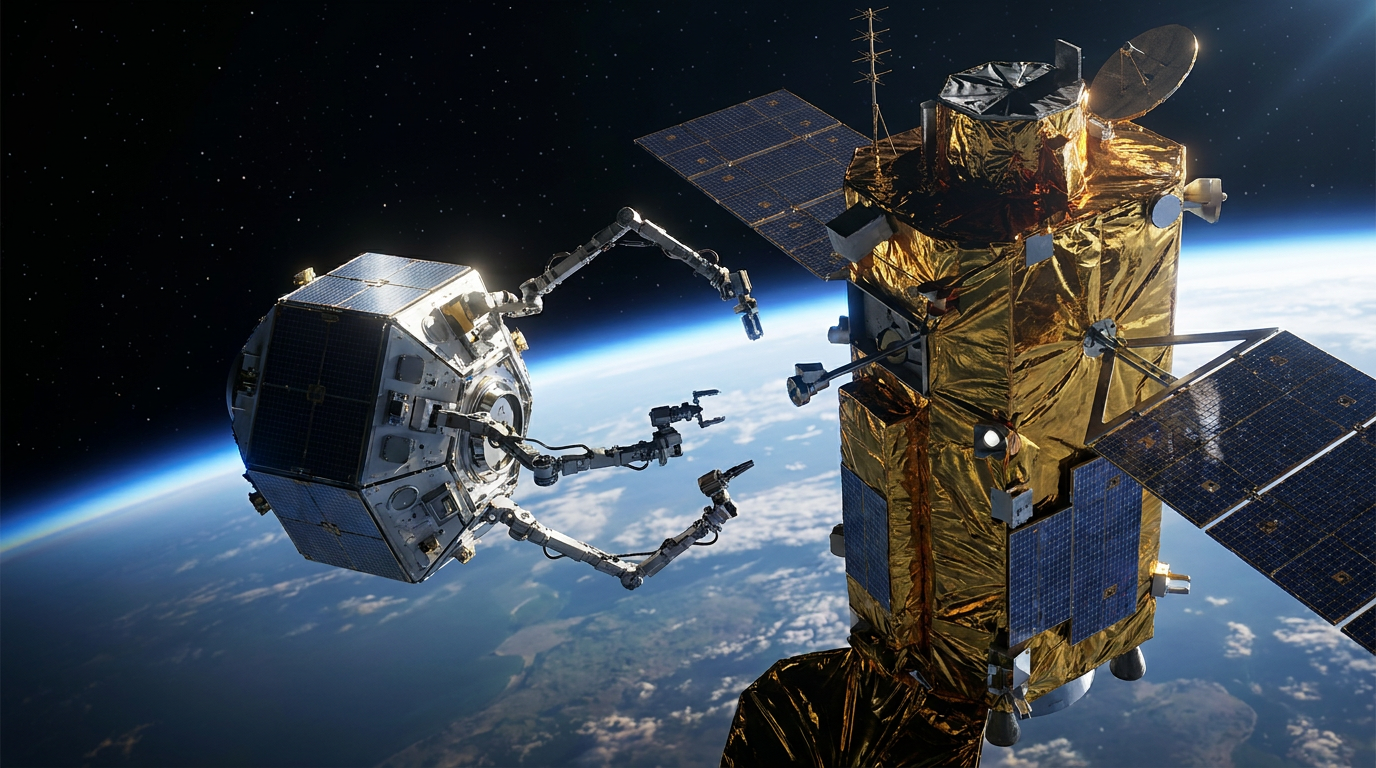
The resulting spacecraft, named LINK, is a hexagonal vehicle equipped with ion thrusters, advanced rendezvous sensors, and robotic arms. In April and May 2026, the Katalyst team brought LINK to NASA's Goddard Space Flight Center in Maryland for rigorous thermal vacuum and vibration testing, proving the rapidly assembled hardware could survive the brutal extremes of launch and orbit.[1][5]

The resulting spacecraft, named LINK, is a hexagonal vehicle equipped with ion thrusters, advanced rendezvous sensors, and robotic arms.
The mission, dubbed "Swift Boost," is scheduled to launch later this month. It will fly aboard a Northrop Grumman Pegasus XL rocket, which is dropped from a modified Lockheed L-1011 aircraft flying out of the Kwajalein Atoll in the Marshall Islands. Once in orbit, LINK will spend a few weeks commissioning its systems before beginning the delicate chase to catch up with Swift.[2][3][7]
The capture itself represents a monumental engineering challenge. Because Swift was launched in 2004, long before on-orbit servicing was considered viable, it is entirely "unprepared." It has no docking ring, no grappling fixtures, and no navigational aids for an approaching vehicle. LINK will have to autonomously match Swift's speed and orientation, carefully approach the fragile telescope, and use its robotic arms to grab onto the observatory's structural ring.[3][6]
Once secured, LINK will fire its electric propulsion system over several months, gradually raising the combined mass of both spacecraft back to a safe altitude above 300 kilometers. If successful, the maneuver will extend Swift's operational life by several years, allowing it to resume its hunt for the universe's most powerful explosions by the fall of 2026.[1][2][5]

For NASA, the $30 million price tag is a bargain compared to the cost of building and launching a replacement observatory, which would likely run into the hundreds of millions and take a decade to develop. Shawn Domagal-Goldman, NASA's director of astrophysics, noted that the agency embraced a "forward-leaning, risk-tolerant approach" specifically to prove that rapid commercial servicing is now a viable alternative to abandoning aging satellites.[2][4]
The implications extend far beyond astronomy. The ability to quickly launch a robotic servicer to rendezvous with an uncooperative target is a highly sought-after capability in the defense sector. Katalyst has already secured contracts with U.S. Space Command, which views "sustained space maneuver" as critical for national security in an increasingly contested orbital environment.[6]
If LINK succeeds, it will mark a paradigm shift in how humanity operates in space. Satellites will no longer be treated as disposable assets doomed by their fuel reserves or orbital decay. Instead, a new commercial ecosystem could emerge where spacecraft are routinely refueled, repaired, upgraded, and rescued—turning orbit from a graveyard of dead hardware into a dynamic, sustainable infrastructure.[1][6]
How we got here
Nov 2004
NASA launches the Swift Observatory to study gamma-ray bursts.
Aug 2025
NASA solicits commercial proposals to rescue the sinking telescope.
Sep 2025
Katalyst Space is awarded a $30 million contract to build a servicing spacecraft.
Apr 2026
The completed LINK spacecraft undergoes thermal and vibration testing at NASA Goddard.
Jun 2026
LINK arrives at Wallops Flight Facility for integration with the Pegasus XL launch vehicle.
Viewpoints in depth
Astrophysics Community
Focused on preserving a unique and irreplaceable scientific instrument.
For astronomers, losing Swift would leave a massive blind spot in our ability to monitor the transient universe. Because gamma-ray bursts are unpredictable and fleeting, Swift's ability to autonomously detect a flash and slew its instruments toward the source within seconds is unmatched. Researchers argue that spending $30 million to save a $500 million asset that is still fully functional scientifically is a massive win for the field, ensuring continuous data collection on black hole formations and neutron star collisions.
Commercial Space Sector
Viewing the mission as a proof-of-concept for a lucrative new on-orbit servicing industry.
Commercial space advocates see the Swift Boost mission as a watershed moment. Historically, satellites were built with absolute redundancy because they could never be touched again once launched. If Katalyst proves that a startup can build a robotic servicer in just 250 days and successfully dock with an unprepared satellite, it validates the business model for on-orbit repair, refueling, and debris removal. This could fundamentally change how satellites are designed, moving away from disposable architectures toward modular, serviceable platforms.
Defense and Strategic Planners
Interested in the national security applications of rapid satellite rendezvous.
The U.S. military is closely watching Katalyst's progress. The ability to rapidly launch a spacecraft that can autonomously approach and interact with an uncooperative target in orbit is a critical capability for space domain awareness and defense. U.S. Space Command refers to this as 'sustained space maneuver.' Demonstrating this technology on a civilian science mission proves that the U.S. industrial base can quickly field systems to inspect, protect, or move strategic assets in an increasingly contested orbital environment.
What we don't know
- Whether the autonomous capture mechanism will succeed, as Swift was never designed to be docked with.
- Exactly how many years of extended life the boost will provide to the observatory.
- If the rapid 250-day development cycle will reveal any unforeseen hardware issues once LINK is in orbit.
Key terms
- Gamma-ray burst (GRB)
- An immensely energetic explosion that has been observed in distant galaxies, often associated with the collapse of a massive star or the collision of neutron stars.
- Orbital decay
- The gradual decrease of the distance between two orbiting bodies, in this case caused by the drag of Earth's upper atmosphere on the satellite.
- On-orbit servicing
- The practice of repairing, refueling, or upgrading spacecraft while they are in space, rather than abandoning them.
- Unprepared satellite
- A spacecraft that was not designed with docking ports, grappling fixtures, or navigational aids to assist another vehicle in capturing it.
Frequently asked
Why is the Swift Observatory sinking?
Swift does not have its own propulsion system. Over 21 years, friction from the outer edges of Earth's atmosphere has slowly dragged it down, a process recently accelerated by solar storms expanding the atmosphere.
How will the LINK spacecraft catch Swift?
LINK will use advanced sensors to autonomously approach the telescope, match its speed, and use robotic arms to grab onto Swift's structural ring.
Why didn't NASA just build a new telescope?
Building a replacement for Swift would cost hundreds of millions of dollars and take years. The $30 million rescue mission is much cheaper and faster.
When will the rescue happen?
The LINK spacecraft is scheduled to launch in late June 2026, with the rendezvous and boost maneuvers taking place over the following months.
Sources
Source coverage
7 outlets
3 viewpoints surfaced







[1]ForbesCommercial Space Sector
Inside One Startup’s Race To Rescue NASA’s Sinking Space Telescope
Read on Forbes →[2]Space DailyCommercial Space Sector
A robotic spacecraft built by a Flagstaff, Arizona, startup is preparing to chase down one of NASA's space telescopes
Read on Space Daily →[3]The Indian ExpressCommercial Space Sector
Nasa is preparing an unprecedented mission to save one of its most successful space telescopes
Read on The Indian Express →[4]Noticias NeoCommercial Space Sector
NASA asks startup to save $500 million astronomy mission at risk of crashing
Read on Noticias Neo →[5]NASAAstrophysics Community
NASA's Swift Mission Gets a Boost
Read on NASA →[6]Katalyst SpaceDefense Planners
First-of-its-kind mission would extend Swift Observatory's life by years
Read on Katalyst Space →[7]WikipediaAstrophysics Community
Neil Gehrels Swift Observatory
Read on Wikipedia →



Every angle. Every day.
Get business stories with full source coverage and perspective breakdowns delivered to your inbox.