
How AI and Computer Vision Revolutionized Olympic Timing
From mechanical stopwatches to cameras capturing 40,000 frames per second, the technology behind Olympic timekeeping has eliminated human error. Today, AI systems track athletes' biomechanics in real-time, transforming both how races are judged and how humans train.
By Factlen Editorial Team
- Sports Technologists
- Focuses on the relentless pursuit of eliminating human error from competition.
- Athletes & Coaches
- Values the technology primarily as a biomechanical feedback tool to optimize training.
- Broadcasters & Fans
- Emphasizes how real-time data overlays transform the viewing experience into a legible narrative.
What's not represented
- · Lower-tier sports leagues that cannot afford advanced AI timing systems
- · Privacy advocates concerned about the mass collection of athletes' biometric data
Why this matters
As human athletic performance reaches its absolute physical limits, the difference between a gold medal and missing the podium is now measured in fractions of a millisecond. Understanding how this technology works reveals not just how sports are judged, but how artificial intelligence is fundamentally changing our understanding of human biomechanics.
Key points
- Modern Olympic timing relies on quantum timers and AI, completely removing human reaction time from the judging process.
- The latest finish-line cameras capture 40,000 digital images per second to separate athletes by microscopic margins.
- Computer vision systems track athletes' joints and movements in real-time without the need for wearable physical sensors.
- Electronic starting pistols broadcast sound through speakers behind each athlete to eliminate the speed-of-sound advantage.
- The biomechanical data gathered is used by coaches to optimize athlete training and by broadcasters to enhance live graphics.
In the world of elite sports, the margin between gold and silver has shrunk beyond the limits of human perception. When Michael Phelps out-touched Milorad Čavić by one-hundredth of a second at the 2008 Beijing Games, the naked eye was useless. It takes the average human roughly 300 to 400 microseconds just to blink—an eternity in a realm where victories are decided by fractions of a millimeter. To guarantee absolute fairness, the infrastructure of Olympic timekeeping has evolved into one of the most sophisticated technological ecosystems on the planet, stripping human error entirely out of the equation.[2][9]
The baseline for this technological arms race was remarkably analog. At the 1932 Summer Games in Los Angeles, a single Swiss watchmaker arrived with a suitcase containing 30 mechanical chronographs. These handheld stopwatches were accurate to one-tenth of a second, and officials would simply average the times recorded by three different judges to determine a winner. Today, that same responsibility requires hundreds of tons of equipment, miles of fiber-optic cabling, and hundreds of specialized engineers deploying quantum timers that deviate by no more than 23 nanoseconds over a 24-hour period.[5][8]
The first major leap toward automation occurred in 1948 with the introduction of the photoelectric cell, affectionately dubbed the "Magic Eye." Instead of relying on a judge to press a button when a runner broke a physical tape, a beam of light was projected across the finish line. The moment the winning athlete's torso broke the beam, the clock stopped automatically. Paired with the first photo-finish slit cameras, this system provided the first indisputable visual proof of a race's outcome, fundamentally changing how track and field events were adjudicated.[8]
However, automating the finish line in a swimming pool proved far more complex. The catalyst for change came during the 1960 Rome Games, when the men's 100-meter freestyle final ended in a chaotic dispute. Lance Larson and John Devitt appeared to touch the wall simultaneously. The manual stopwatches favored Larson, but the visual judges awarded the gold to Devitt. The resulting controversy forced the international swimming federation to demand a system that completely eliminated human judges from the finish line.[8]

The solution arrived at the 1968 Mexico City Games: the electronic touchpad. Installed on the pool wall in every lane, these bright yellow panels respond to the specific pressure of a swimmer's hand, allowing the athletes to literally stop their own clocks. The touchpad system was a revelation, instantly clarifying who finished first, second, and third without any room for debate. It remains the foundational technology of competitive swimming today, though the modern iterations are vastly more sensitive and durable.[5][8]
With the finish line automated, engineers turned their attention to the start. In sprint events, anticipating the gun by even a fraction of a second provides an insurmountable advantage. In 1984, pressure sensors were integrated directly into the starting blocks. These sensors measure the force exerted against the footrests 4,000 times per second. Because biomechanical studies show that a human cannot react to a sound in less than 0.100 seconds, the system automatically flags a false start if an athlete generates forward pressure before that threshold is crossed.[8]
With the finish line automated, engineers turned their attention to the start.
Even the speed of sound eventually became a liability. In a staggered track start, athletes in the outer lanes are further away from the starter's pistol than those on the inside. Because sound travels at roughly 343 meters per second, the runners closest to the gun were hearing the bang milliseconds before their competitors. To level the playing field, the traditional pistol was replaced by an electronic device. When the starter pulls the trigger, a light flashes, and the starting sound is instantly broadcast through individual speakers positioned directly behind every athlete's block.[5][8]
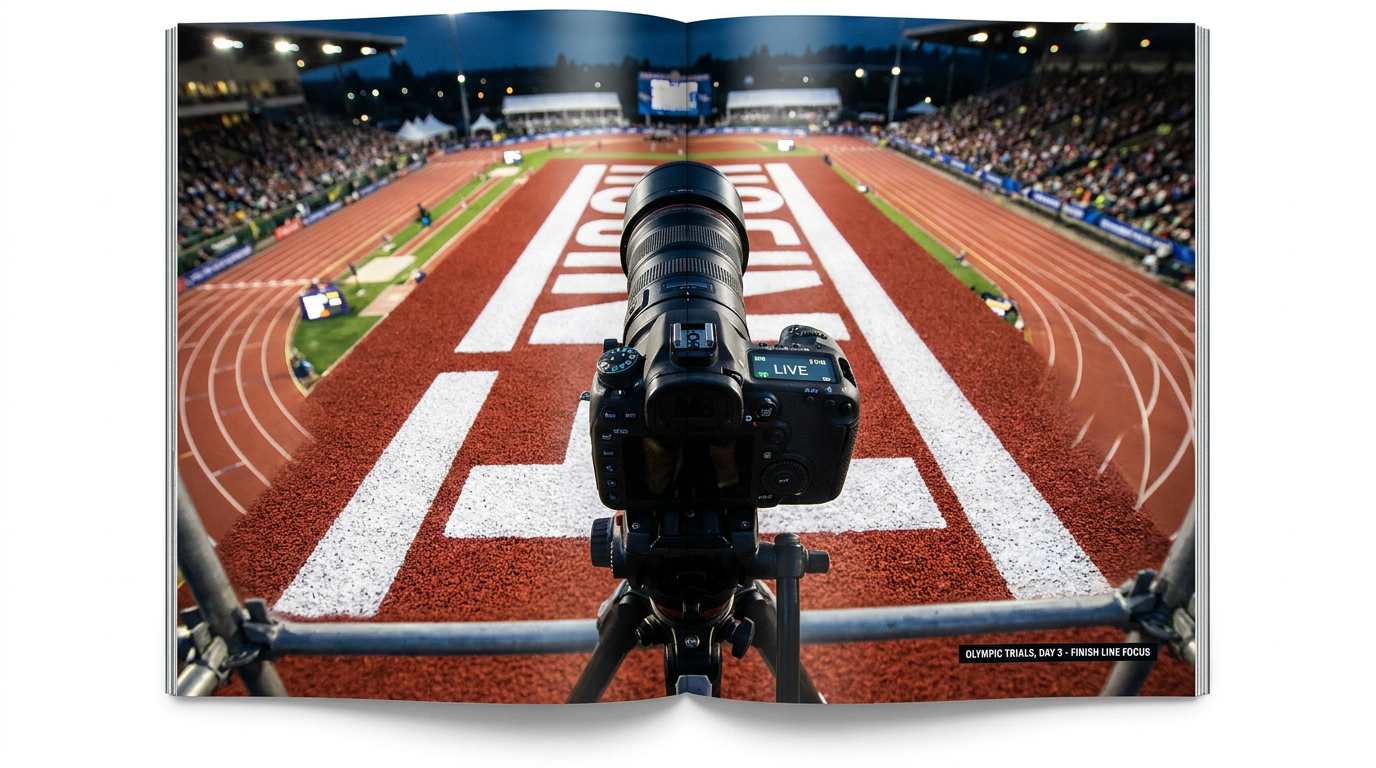
Today, the pinnacle of this timing architecture is the Scan'O'Vision Ultimate camera. Positioned perfectly aligned with the finish line, this device does not shoot traditional video. Instead, it captures up to 40,000 vertical digital image slices every single second. A computer seamlessly stitches these microscopic slices together to create a composite image of the athletes crossing the line, allowing judges to separate runners who finish within thousandths of a second of each other with absolute, pixel-perfect clarity.[1][4]

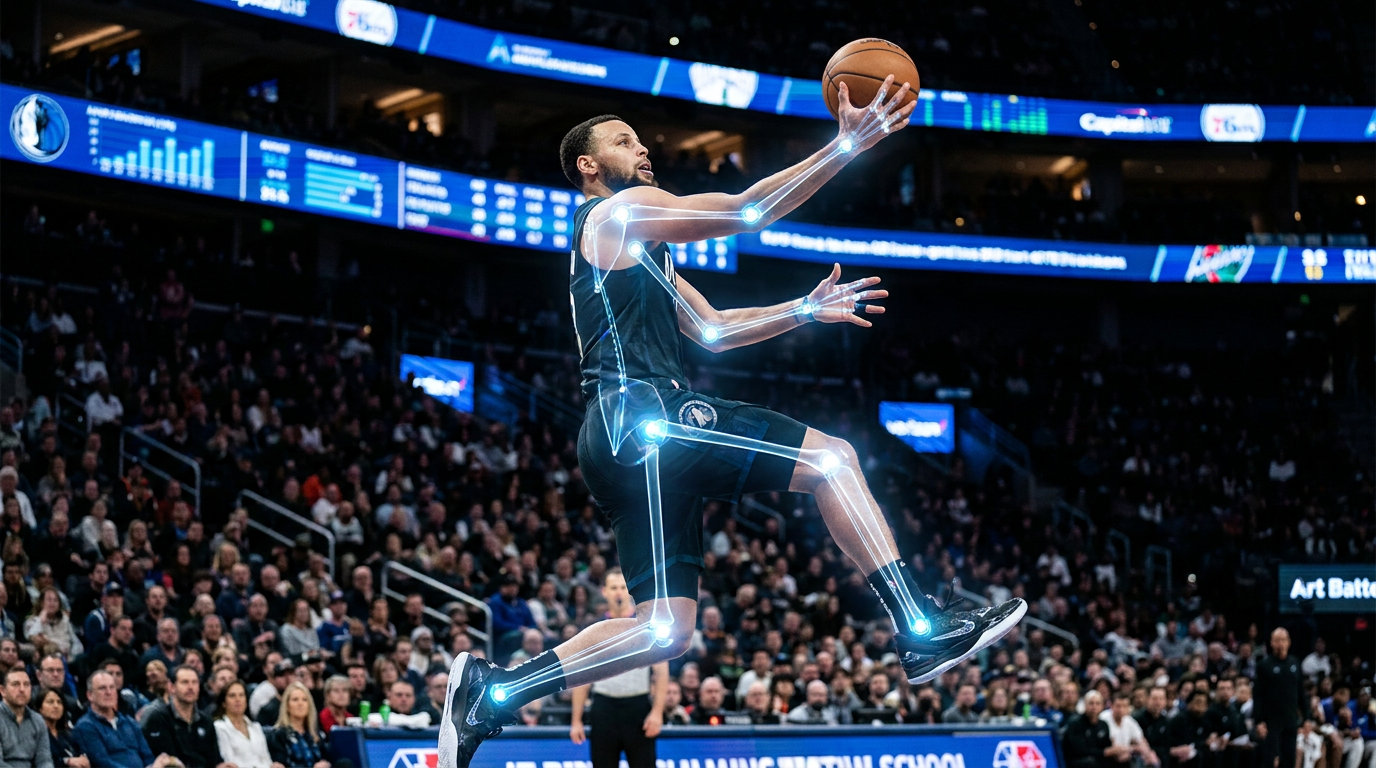
But the most profound shift in recent years is the transition from merely timing athletes to tracking them. The modern Olympic arena is now governed by Computer Vision and Artificial Intelligence. In the past, gathering biomechanical data required athletes to wear physical motion sensors woven into their bibs or uniforms. Today, high-definition camera arrays blanket the field of play, feeding live video into AI models that have been specifically trained on the physics and movements of individual sports.[1][4]
This AI-driven skeleton tracking maps the joints and limbs of the competitors in real-time, generating up to 2,000 data points per second without a single piece of wearable tech. In gymnastics and diving, the system automatically calculates the exact height of a jump, the airtime, and the precise angle of an athlete's feet during a complex rotation. In the pole vault, the AI automatically measures the exact millimeter gap between the athlete's body and the bar as they clear it.[1][4][7]
The applications extend across nearly every discipline. In beach volleyball and tennis, the computer vision models track the total distance each player covers, the speed of the ball, and the specific type of shot being played—categorizing smashes, blocks, and spikes on the fly. This invisible web of analytics captures the complete narrative of an event, revealing exactly where a match was won or lost in the microscopic details of human movement.[1]

For the millions of fans watching at home, this data is rendered instantly visible. Next-generation graphics engines, like Omega's Vionardo system, process the AI tracking data and superimpose it onto the live television broadcast in 4K ultra-high definition. Viewers can see live acceleration curves, live jump heights, and live distance deficits overlaid directly onto the athletes, transforming a confusing blur of elite speed into a legible, dramatic story.[4][8]
Ultimately, this technological revolution serves the athletes themselves. The granular data harvested by the computer vision systems is handed directly back to coaches and national federations. By analyzing the exact deceleration of a sprinter in the final ten meters, or the rotational velocity of a diver, athletes can make data-driven adjustments to their training. The technology that was originally designed simply to judge them fairly has evolved into the very tool they use to push the boundaries of human potential even further.[3][6][9]

How we got here
1932
Omega becomes the first official timekeeper, using 30 mechanical stopwatches accurate to one-tenth of a second.
1948
The photoelectric cell and first slit camera are introduced, automating the finish line.
1968
Electronic touchpads debut in the swimming pool, allowing athletes to stop their own time.
1984
Pressure sensors are added to starting blocks to automatically detect false starts.
2010
The traditional starting pistol is replaced by an electronic flash and speaker system.
2024
Computer vision and AI skeleton tracking are deployed to measure biomechanics without wearable sensors.
Viewpoints in depth
Sports Technologists
Focuses on the relentless pursuit of eliminating human error from competition.
For the engineers designing these systems, the primary goal is absolute, unassailable fairness. They argue that as athletes push the boundaries of human speed, the margins of victory shrink beyond human perception. Relying on a judge's eyesight or reaction time is no longer ethically viable when a lifetime of training comes down to a thousandth of a second. By automating every phase of a race—from the electronic starting pistol to the 40,000-frame-per-second finish line camera—technologists aim to remove the variable of human subjectivity entirely.
Athletes & Coaches
Values the technology primarily as a biomechanical feedback tool to optimize training.
While athletes appreciate the fairness of automated timing, their daily focus is on the secondary benefit: the massive yield of biomechanical data. Coaches argue that the 2,000 data points generated per second by AI skeleton tracking provide a revolutionary training advantage. By analyzing the exact deceleration curve of a sprinter in the final ten meters, or the precise rotational angle of a diver's hips, competitors can make microscopic, data-driven adjustments to their mechanics that were impossible to quantify a decade ago.
Broadcasters & Fans
Emphasizes how real-time data overlays transform the viewing experience into a legible narrative.
For sports media and the viewing public, the value of computer vision lies in storytelling. Broadcasters argue that elite sports happen too fast for a casual viewer to fully appreciate the skill involved. By taking the AI tracking data and rendering it as live, 4K graphics—showing a volleyball player's exact jump height or a tennis ball's trajectory—the technology translates a confusing blur of motion into a clear, dramatic narrative that deepens fan engagement.
What we don't know
- How quickly international sports federations will adopt these expensive AI tracking systems for lower-tier, non-Olympic competitions.
- Whether the massive influx of biomechanical data will eventually lead to a plateau in human athletic performance.
Key terms
- Computer Vision
- A field of artificial intelligence that enables computers to derive meaningful information from digital images and videos, used in sports to track athlete movements without sensors.
- Photoelectric Cell
- A sensor that emits a beam of light across a finish line; when an athlete breaks the beam, the clock automatically stops.
- Scan'O'Vision
- The proprietary high-speed photo-finish camera system that captures tens of thousands of vertical image slices per second to determine race winners.
- Skeleton Tracking
- An AI technique that maps the joints and limbs of an athlete in real-time to analyze biomechanics like jump height and rotation angles.
Frequently asked
How does the electronic starting pistol work?
Instead of a traditional gun, an electronic pistol triggers a flash of light and plays a sound through speakers located directly behind each athlete's starting block, ensuring everyone hears it at the exact same millisecond.
Do athletes have to wear sensors for the AI tracking?
No. Modern computer vision systems use arrays of high-definition cameras around the arena to track athletes' movements visually, eliminating the need for physical wearable sensors.
What happens if there is a power outage during a race?
The entire timing system runs on independent power sources separate from the venue's main grid, ensuring that times are recorded even in the event of a total stadium blackout.
How accurate is the modern finish-line camera?
The latest Scan'O'Vision Ultimate camera captures 40,000 digital images per second, allowing judges to separate athletes by microscopic margins.
Sources
Source coverage
9 outlets
3 viewpoints surfaced








[1]Olympics.comAthletes & Coaches
New technology from Worldwide Olympic Partner OMEGA
Read on Olympics.com →[2]HowStuffWorksSports Technologists
How Olympic Timekeeping Works
Read on HowStuffWorks →[3]STEP SoftwareSports Technologists
Precision Timing and Computer Vision
Read on STEP Software →[4]Swatch GroupSports Technologists
Omega's Next Generation Graphics Technology
Read on Swatch Group →[5]Sports IllustratedBroadcasters & Fans
How Olympic Timekeeping Works: Innovations Worth Watching
Read on Sports Illustrated →[6]Business InsiderAthletes & Coaches
The man responsible for timing at the Olympics explains the pressure
Read on Business Insider →[7]AxiosAthletes & Coaches
Olympic figure skating judging gets AI boost
Read on Axios →[8]Swisswatches MagazineBroadcasters & Fans
The Evolution of Olympic Timekeeping
Read on Swisswatches Magazine →[9]Factlen Editorial TeamSports Technologists
Synthesis by Factlen editorial team
Read on Factlen Editorial Team →

Every angle. Every day.
Get sports stories with full source coverage and perspective breakdowns delivered to your inbox.