
The Evidence for Agrivoltaics: How Dual-Use Solar is Reshaping Agriculture
Co-locating solar panels with active farmland is proving to be a highly effective solution to land-use conflicts, offering measurable gains in water retention, crop resilience, and overall land efficiency.
By Factlen Editorial Team
- Agricultural Producers
- Farmers and landowners focused on maintaining crop viability, securing dual-income streams, and building resilience against droughts.
- Energy Developers
- Solar industry stakeholders seeking to deploy utility-scale capacity while minimizing land-use conflicts and community opposition.
- Ecological Researchers
- Scientists studying the agronomic and environmental impacts of dual-use systems, including microclimates, soil health, and biodiversity.
- Policymakers
- Government agencies and regulators tasked with balancing aggressive renewable energy targets with national food security and rural economic health.
What's not represented
- · Traditional solar developers concerned about the higher capital expenditures of elevated racking
- · Local zoning boards navigating the taxation differences between agricultural and industrial land
Why this matters
By allowing land to simultaneously produce food and renewable energy, agrivoltaics solves one of the biggest bottlenecks in the climate transition—land scarcity—while providing farmers with a crucial financial lifeline against extreme weather.
Key points
- Agrivoltaics combines solar energy generation and agriculture on the same land, resolving conflicts over land scarcity.
- The practice can increase overall land-use efficiency by up to 73% compared to separate farming and solar operations.
- Solar panels create a microclimate that reduces soil evaporation by 15% to 30%, saving massive amounts of irrigation water.
- Shade-tolerant crops like lettuce and berries thrive under panels, while sun-intensive crops like wheat see yield reductions.
- The dual-income model provides farmers with financial resilience against droughts and fluctuating commodity prices.
The global transition to renewable energy has created an unintended conflict: the competition for land. As utility-scale solar farms expand to meet aggressive climate targets, they frequently displace active agricultural acreage, forcing rural communities to choose between clean power generation and vital food production.[6]
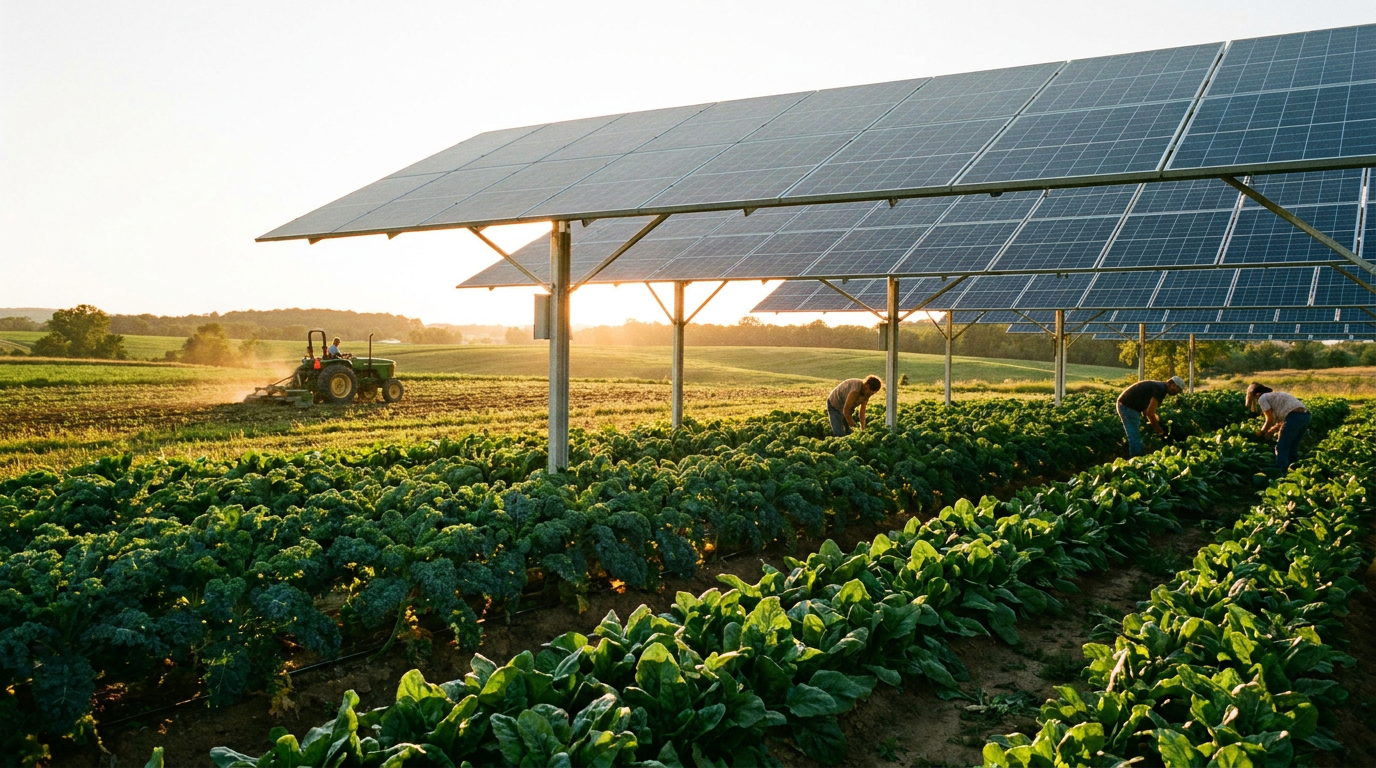
Agrivoltaics—the practice of co-locating solar photovoltaic panels and agriculture on the exact same plot of land—is emerging as a highly effective, evidence-backed solution to this zero-sum game. By elevating solar arrays to allow crops to grow or livestock to graze underneath, the system transforms resource competition into system circularity, allowing a single acre to yield both calories and kilowatt-hours.[2][6]
The core metric driving the adoption of agrivoltaics is the Land Equivalent Ratio (LER), which measures the combined output of a dual-use plot compared to separate single-use plots. According to landmark studies by Germany's Fraunhofer Institute for Solar Energy Systems, well-designed agrivoltaic installations can increase overall land-use efficiency by 35% to 73%.[3]
This efficiency gain occurs because the land is double-harvested. While a dedicated solar farm produces 100% of its potential energy and a dedicated wheat field produces 100% of its potential crop, an agrivoltaic farm might produce 80% of the optimal solar yield and 80% of the optimal crop yield, resulting in a combined Land Equivalent Ratio of 160%.[3][6]

Beyond simple spatial efficiency, the physical presence of the panels creates a distinct microclimate that actively benefits certain agricultural environments. Research published in Nature Sustainability demonstrates that the partial shading provided by solar arrays significantly reduces heat stress on plants during peak midday temperatures, a growing concern as global temperatures rise.[1]
This shading effect directly translates into substantial water savings, a critical advantage in arid and semi-arid regions. By lowering the ambient temperature beneath the panels and shielding the soil from direct solar radiation, agrivoltaic systems reduce evapotranspiration—the process by which water is transferred from the land to the atmosphere.[1][6]
This shading effect directly translates into substantial water savings, a critical advantage in arid and semi-arid regions.
Field data from the National Renewable Energy Laboratory (NREL) and the University of Arizona indicates that soil evaporation can be reduced by 15% to 30% under solar arrays. In water-stressed environments like the American Southwest and the Middle East, this allows farmers to maintain crop viability while drastically cutting their irrigation demands.[2]

However, the impact on crop yields is highly nuanced and species-dependent. The evidence shows that shade-tolerant crops—such as lettuce, tomatoes, berries, and certain root vegetables—thrive under agrivoltaic conditions, frequently seeing yield increases of 8% to 18% due to the mitigated heat stress and improved moisture retention.[1][6]
Conversely, sun-intensive staple crops like corn and winter wheat generally experience yield reductions of 25% to 40% when grown under solar panels. The success of an agrivoltaic project therefore hinges on precise agronomic planning, requiring developers to match the specific crop to the engineered light environment, panel height, and row spacing.[3][6]

The economic case for agrivoltaics is strengthening rapidly, driven by the dual-income stream it provides to farmers. By generating steady electricity revenue alongside seasonal crop sales, agricultural operations can buffer themselves against the financial volatility of droughts, extreme weather events, and fluctuating commodity prices.[4][6]
Policy frameworks are beginning to catch up with the science. In the United States, funding from the Inflation Reduction Act and the USDA's Rural Energy for America Program (REAP) is accelerating deployment. Meanwhile, in Europe, France has established a legal definition for agrivoltaics and currently boasts over 2 gigawatts of capacity in its development pipeline, prioritizing projects that actively improve agricultural resilience.[2][4]
The ecological benefits also extend beyond the crops themselves. Recent passive acoustic monitoring studies published in Global Ecology and Conservation found that bat and pollinator activity was significantly higher within ecovoltaic sites compared to traditional agricultural reference fields, suggesting that these dual-use landscapes can serve as vital habitat refuges early in the growing season.[5]

As the global agrivoltaics market—projected to reach $182 billion by 2034—continues to mature, the focus is shifting from proof-of-concept to standardized deployment. The evidence overwhelmingly indicates that when designed with local climate, soil, and crop requirements in mind, agrivoltaics offers a rare, scalable win-win for both the energy transition and global food security.[4][6]
How we got here
Early 1980s
German researchers Adolf Goetzberger and Armin Zastrow first propose sharing land between solar PV and crops.
2011
The term 'agrivoltaics' is coined, and early Land Equivalent Ratio (LER) models demonstrate potential efficiency gains.
2022
The US Inflation Reduction Act passes, indirectly accelerating agrivoltaics through broad clean energy and rural development funding.
2024
Global agrivoltaics market valuation surpasses $4.6 billion as commercial-scale deployments expand across Europe and Asia.
2026
France leads European deployment with over 2 gigawatts of agrivoltaic capacity in its active development pipeline.
Viewpoints in depth
Agricultural Producers
Farmers view agrivoltaics as a vital tool for climate adaptation and financial survival.
For the agricultural sector, the primary appeal of agrivoltaics is risk mitigation. As extreme heat and prolonged droughts make traditional farming increasingly precarious, the microclimate generated by solar panels offers a physical shield for crops and livestock. Crucially, the steady revenue from electricity generation provides a financial floor, ensuring that a bad harvest does not result in bankruptcy. Producers emphasize that systems must be designed around the farm's needs first—ensuring machinery can pass and water can flow—rather than treating the agriculture as an afterthought to the solar array.
Energy Developers
Solar companies see dual-use land as the key to unlocking gigawatts of capacity without community backlash.
Utility-scale solar developers are facing mounting opposition from rural communities concerned about the loss of arable land and the industrialization of the countryside. Agrivoltaics offers a compelling compromise that preserves the agricultural character of the land while allowing developers to meet aggressive clean energy targets. While developers acknowledge that elevating panels and spacing them wider increases initial capital expenditures by 10% to 20%, they argue that the smoother permitting process, community goodwill, and access to agricultural subsidies often make the lifetime economics highly favorable.
Ecological Researchers
Scientists emphasize that the success of agrivoltaics depends entirely on hyper-local agronomic matching.
The academic community stresses that agrivoltaics is not a silver bullet that works uniformly everywhere. Researchers point to the stark difference in outcomes between shade-tolerant crops, which often see yield boosts, and sun-intensive crops, which suffer under the panels. Their focus is on optimizing the Land Equivalent Ratio (LER) through advanced modeling, testing semi-transparent solar panels, and studying the long-term impacts on soil microbiomes and local pollinator populations to ensure the practice is genuinely sustainable over decades.
What we don't know
- How the long-term presence of solar infrastructure will affect deep soil health and compaction over a 30-year project lifespan.
- Whether the higher initial capital costs of elevated racking will prevent smaller, independent farms from adopting the technology without heavy subsidies.
- How local tax assessors will ultimately classify dual-use land, which currently sits in a gray area between agricultural and industrial zoning.
Key terms
- Agrivoltaics (AV)
- The practice of co-locating solar photovoltaic panels and agricultural production on the same plot of land.
- Land Equivalent Ratio (LER)
- A metric used to measure the combined productivity of a dual-use plot compared to separate single-use plots of the same total size.
- Evapotranspiration
- The combined process of water evaporating from the soil and transpiring from plant leaves into the atmosphere.
- Microclimate
- The localized climate conditions—such as temperature, humidity, and shade—created directly beneath and around the solar panels.
- Ecovoltaics
- A subset of agrivoltaics focused specifically on combining solar energy with native vegetation and pollinator habitats rather than commercial crops.
Frequently asked
Do solar panels reduce crop yields?
It depends heavily on the crop. Shade-tolerant plants like lettuce and berries often see yield increases of up to 18%, while sun-intensive crops like corn and wheat typically experience yield reductions of 25% to 40%.
Can farm machinery still operate under the panels?
Yes. Agrivoltaic systems are specifically designed with elevated racking and wider row spacing to accommodate standard tractors and harvesters, though this structural engineering increases initial construction costs.
How does agrivoltaics save water?
The partial shade from the solar panels lowers the ambient temperature and reduces direct sunlight on the soil, which significantly decreases evaporation and the amount of irrigation required to keep crops healthy.
Is agrivoltaics economically viable for farmers?
Yes. While the initial setup costs are higher than traditional solar, the dual-income stream from selling both electricity and crops provides long-term financial stability and protection against crop failures.
Sources
Source coverage
6 outlets
4 viewpoints surfaced





[1]Nature SustainabilityEcological Researchers
Synergies and trade-offs of multi-use solar landscapes
Read on Nature Sustainability →[2]National Renewable Energy Laboratory (NREL)Policymakers
Agrivoltaics: Solar and Agriculture Co-Location
Read on National Renewable Energy Laboratory (NREL) →[3]Fraunhofer ISEEcological Researchers
Agrivoltaics: Opportunities for Agriculture and the Energy Transition
Read on Fraunhofer ISE →[4]SolarPower EuropeEnergy Developers
Agri-Solar Best Practice Guidelines
Read on SolarPower Europe →[5]Global Ecology and ConservationEcological Researchers
Ecological outcomes of ecovoltaic designs
Read on Global Ecology and Conservation →[6]Factlen Editorial TeamAgricultural Producers
Synthesis by Factlen editorial team
Read on Factlen Editorial Team →
Every angle. Every day.
Get energy stories with full source coverage and perspective breakdowns delivered to your inbox.