
How AI, LIDAR, and Real-Time Data Are Solving Aviation's Invisible Threat: Clear Air Turbulence
A convergence of artificial intelligence, laser sensors, and crowdsourced data networks is giving pilots the ability to detect and avoid invisible rough air.
By Factlen Editorial Team
- Commercial Airlines
- Airline executives and dispatchers focused on operational efficiency, fuel savings, and passenger safety.
- Aviation Technologists
- Engineers and AI developers focused on pushing the boundaries of sensor and predictive technology.
- Meteorologists
- Atmospheric scientists studying the mechanics of jet streams and the impact of a warming climate.
What's not represented
- · Nervous flyers and passenger advocacy groups
- · Air traffic controllers
Why this matters
Turbulence is the leading cause of in-flight injuries and a major source of passenger anxiety. By making invisible rough air predictable, these new technologies promise smoother, safer flights while helping airlines reduce fuel consumption and carbon emissions.
Key points
- Clear Air Turbulence (CAT) is invisible to conventional weather radar, making it the leading cause of unexpected in-flight injuries.
- Japan's ANA recently became the first airline to deploy an AI-based prediction system, achieving an 86 percent accuracy rate.
- Airborne LIDAR technology is being developed to bounce lasers off microscopic aerosols, detecting CAT up to 11 miles ahead.
- IATA's Turbulence Aware platform now crowdsources real-time turbulence data from thousands of aircraft globally.
- Beyond safety, these technologies allow airlines to optimize flight paths, saving fuel and reducing carbon emissions.
For millions of passengers, the sudden chime of the fasten seatbelt sign and the ensuing jolt of rough air is the most anxiety-inducing part of flying. While turbulence is a routine atmospheric phenomenon that poses virtually no structural threat to modern commercial aircraft, it remains the leading cause of in-flight injuries to passengers and cabin crew.[5][8]
The most insidious form of this phenomenon is Clear Air Turbulence (CAT). Unlike convective turbulence, which is generated by towering thunderstorms and heavy precipitation, CAT occurs in cloudless skies, typically at high altitudes near jet streams. Because it lacks moisture, it is entirely invisible to the naked eye, and crucially, to conventional aircraft instruments.[3][6]
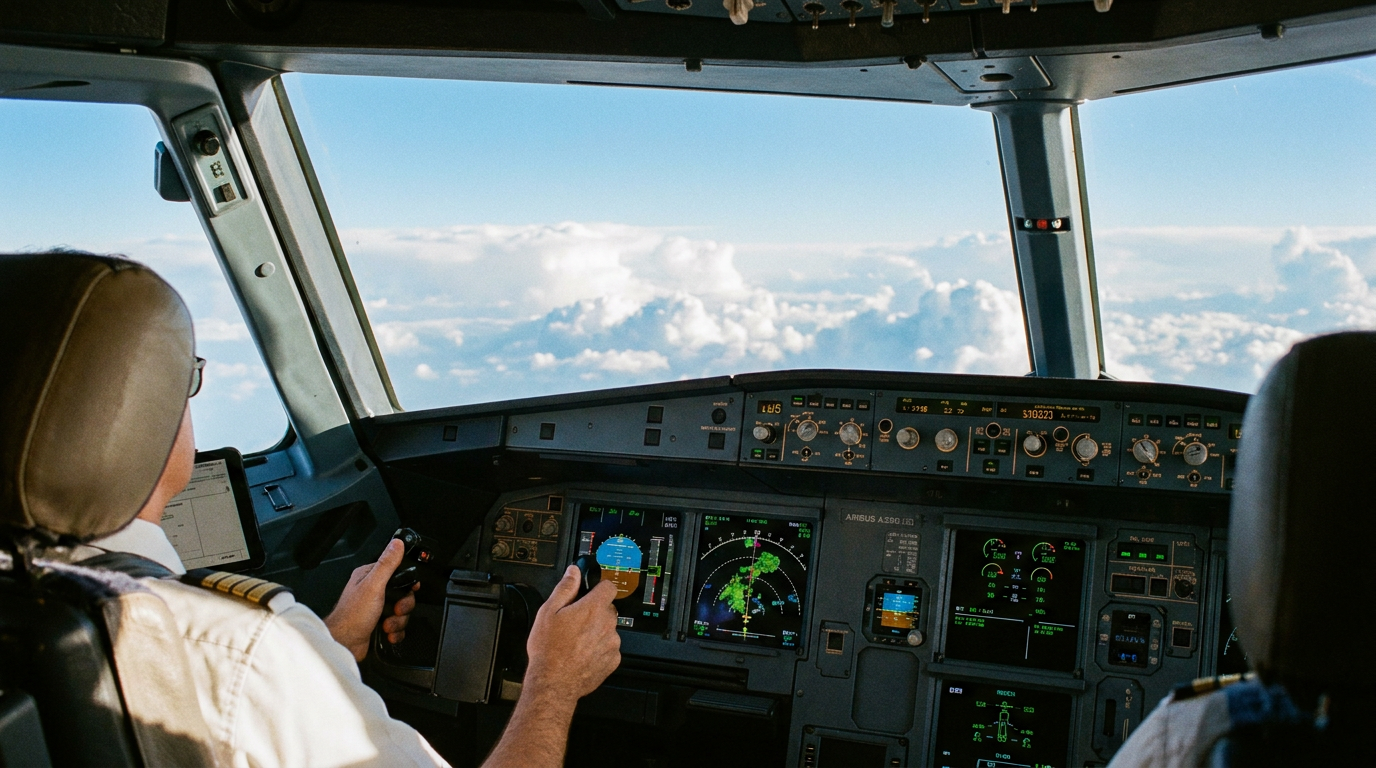
For decades, pilots have relied on a combination of pre-flight meteorological forecasts, onboard weather radar, and radioed reports from other aircraft to navigate rough air. However, traditional weather radar operates by bouncing radio waves off water droplets and ice crystals. When the air is clear, the radar screen remains blank, leaving flight crews with little to no warning before hitting a pocket of severe clear air turbulence.[3][6]

Now, a convergence of three distinct technological breakthroughs—artificial intelligence, laser-based LIDAR sensors, and real-time crowdsourced data networks—is fundamentally changing how the aviation industry detects and avoids invisible rough air.[1][3][5]
The first major leap is happening in the realm of predictive software. In August 2025, Japan's All Nippon Airways (ANA) became the first airline in the world to fully integrate an AI-based turbulence prediction service into its daily flight operations. Developed by BlueWX, a joint venture between ANA and Keio University, the system represents a paradigm shift in pre-flight and in-flight planning.[1][2][7]
Rather than relying solely on traditional meteorological models, the BlueWX system utilizes advanced deep learning algorithms trained on more than a decade of historical turbulence data. By recognizing complex, subtle atmospheric patterns that precede rough air, the AI can forecast turbulence with remarkable precision before the aircraft even leaves the tarmac.[1][7]
Following years of testing and operational trials involving 2,500 ANA pilots, the AI model demonstrated an 86 percent accuracy rate in predicting turbulence. This allows dispatchers and flight crews to adjust their routes and altitudes proactively, significantly reducing the likelihood of unexpected encounters and ensuring a smoother ride for passengers.[1][2][7]

Following years of testing and operational trials involving 2,500 ANA pilots, the AI model demonstrated an 86 percent accuracy rate in predicting turbulence.
While AI improves prediction, hardware engineers are working to give aircraft the ability to physically see clear air turbulence in real time. The Japan Aerospace Exploration Agency (JAXA), in collaboration with Boeing and Mitsubishi Electric, has spent over a decade developing airborne Doppler LIDAR systems specifically for commercial aviation.[3][6]
Unlike traditional radar, LIDAR emits focused pulses of laser light ahead of the aircraft. These lasers bounce off microscopic aerosols, dust particles, and even oxygen and nitrogen molecules suspended in the clear air. By measuring the Doppler shift—the change in the wavelength of the reflected light caused by the movement of those particles—the system can map the exact velocity and direction of the airflow ahead.[3][6]
JAXA's latest airborne LIDAR prototypes have successfully detected clear air turbulence up to 17.5 kilometers (about 11 miles) ahead of the aircraft. At cruising speeds, this provides pilots with tens of seconds of crucial lead time, which is more than enough to suspend cabin service, instruct passengers to buckle up, and secure the cabin before the first bump is felt.[6]
The third pillar of this safety revolution relies on the power of the network. The International Air Transport Association (IATA) has rapidly expanded its Turbulence Aware platform, a global data-sharing initiative that turns every participating aircraft into a real-time atmospheric sensor.[4][5]

Modern commercial jets are equipped with sensors that constantly measure the aircraft's Energy Dissipation Rate (EDR), an objective, mathematical calculation of the atmosphere's turbulent state. The Turbulence Aware platform automatically collects this anonymized EDR data from thousands of flights and beams it to a centralized ground server.[5][8]
The server processes the data and instantly broadcasts a real-time, three-dimensional map of turbulence back to the cockpit displays of all participating airlines. In 2023 alone, the system generated 38 million objective turbulence reports. The platform has seen massive recent adoption, with major carriers like Emirates, Singapore Airlines, British Airways, and Qatar Airways integrating the software into their fleets.[4][5][8]
The benefits of these combined technologies extend beyond passenger comfort and safety. When pilots lack precise turbulence data, they often take overly cautious, circuitous routes or request altitude changes that burn significantly more jet fuel. By providing pinpoint accuracy on where the rough air actually is, AI and real-time data allow aircraft to maintain optimal flight paths.[4][8]
This efficiency translates directly into reduced carbon emissions and lower operational costs for airlines. As climate models suggest that global warming may increase the frequency and severity of clear air turbulence in the coming decades, these technological mitigations are arriving exactly when the industry needs them most.[1][5]
The era of flying blind into clear air turbulence is rapidly drawing to a close. Through the synthesis of deep learning, laser optics, and global data sharing, the aviation industry is transforming its oldest invisible adversary into a predictable, manageable, and easily avoidable data point.[2][4][6]

How we got here
2010
JAXA and Boeing begin collaborative research on integrating LIDAR technology into commercial airplane platforms to detect clear air turbulence.
2018
The International Air Transport Association (IATA) launches the Turbulence Aware platform to crowdsource real-time turbulence data.
2019
All Nippon Airways (ANA) and Keio University launch a joint initiative to develop an AI-based turbulence prediction model.
2023
IATA's Turbulence Aware platform reaches a milestone, generating 38 million objective turbulence reports in a single year.
May 2024
Emirates becomes the latest major global carrier to integrate the IATA Turbulence Aware platform into its fleet operations.
August 2025
ANA becomes the first airline in the world to fully implement BlueWX's AI-based turbulence prediction service into its daily flight operations.
Viewpoints in depth
Aviation Technologists
Engineers and AI developers focused on pushing the boundaries of sensor and predictive technology.
For technologists, the turbulence problem is fundamentally a data and sensor challenge. They argue that human pilot reports (PIREPs) are too subjective and traditional radar is too limited. By deploying deep learning models that can process decades of atmospheric variables, and by miniaturizing Doppler LIDAR to fit on commercial airframes, they believe the industry can completely map the invisible atmosphere. Their ultimate goal is autonomous systems that can adjust flight control surfaces in real-time before the human body even registers a bump.
Commercial Airlines
Airline executives and dispatchers focused on operational efficiency, fuel savings, and passenger safety.
Airlines view turbulence mitigation through the lens of operational efficiency and customer experience. While passenger safety is the primary driver, carriers are equally motivated by the massive fuel costs associated with flying blind. When pilots deviate from optimal altitudes to avoid suspected rough air, fuel consumption spikes. By utilizing real-time data networks like IATA's Turbulence Aware, airlines can make surgical, data-driven route adjustments, saving millions of dollars in fuel and significantly reducing their carbon footprint.
Meteorologists
Atmospheric scientists studying the mechanics of jet streams and the impact of a warming climate.
Meteorologists emphasize that the atmosphere itself is changing, making technological interventions more urgent than ever. They point to studies indicating that global warming is increasing wind shear within the jet streams, which is the primary engine for clear air turbulence. From their perspective, while AI and LIDAR are excellent mitigation tools, the baseline volatility of the upper atmosphere is permanently shifting, requiring a complete overhaul of how aviation weather is modeled and forecasted.
What we don't know
- How quickly airborne LIDAR systems can be miniaturized and made cost-effective enough for fleet-wide installation on all commercial jets.
- The exact degree to which climate change will increase the frequency of severe clear air turbulence over the next two decades.
- Whether AI prediction models will maintain their high accuracy rates as global weather patterns become more erratic.
Key terms
- Clear Air Turbulence (CAT)
- Erratic air currents that occur in cloudless skies, typically at high altitudes near jet streams, making them invisible to the naked eye and standard radar.
- LIDAR (Light Detection and Ranging)
- A remote sensing technology that uses pulsed laser light to measure distances and detect the movement of microscopic particles in the air.
- Eddy-Dissipation Rate (EDR)
- An objective, mathematical metric used by modern aircraft sensors to calculate the exact intensity of atmospheric turbulence.
- PIREP (Pilot Report)
- A traditional, manual radio report made by a pilot to air traffic control to warn other aircraft about encountered weather conditions.
- Doppler Effect
- The change in frequency or wavelength of a wave, such as light or sound, in relation to an observer who is moving relative to the wave source.
Frequently asked
Can traditional weather radar detect clear air turbulence?
No. Traditional weather radar bounces radio waves off water droplets and ice. Because clear air turbulence lacks moisture, it is invisible to conventional radar systems.
How does AI help predict turbulence?
AI systems use deep learning algorithms trained on decades of historical weather and flight data to recognize complex atmospheric patterns that precede rough air, achieving up to an 86 percent accuracy rate.
What is the IATA Turbulence Aware platform?
It is a global data-sharing network where thousands of commercial aircraft automatically broadcast real-time, objective turbulence measurements to a central server, which then maps the rough air for all participating pilots.
Will climate change make turbulence worse?
Many atmospheric scientists predict that global warming will increase wind shear within jet streams, potentially leading to more frequent and severe clear air turbulence in the future.
Sources
Source coverage
8 outlets
3 viewpoints surfaced








[1]Aerospace Global NewsCommercial Airlines
ANA becomes first airline to adopt AI turbulence prediction
Read on Aerospace Global News →[2]Future Travel ExperienceAviation Technologists
All Nippon Airways launches innovative AI turbulence prediction tech for enhanced safety and CX
Read on Future Travel Experience →[3]Channel News AsiaMeteorologists
Could Lidar technology help planes avoid clear-air turbulence?
Read on Channel News Asia →[4]International Airport ReviewCommercial Airlines
IATA's Turbulence Aware platform expands in 2024 with six new airlines
Read on International Airport Review →[5]IATACommercial Airlines
Turbulence Aware: Mitigating the impact of turbulence
Read on IATA →[6]JAXAAviation Technologists
SafeAvio: Airborne Doppler LIDAR for Turbulence Detection
Read on JAXA →[7]BlueWXAviation Technologists
ANA Becomes World's First Airline to Launch BlueWX's Advanced AI Turbulence Prediction Technology
Read on BlueWX →[8]EmiratesCommercial Airlines
Emirates joins IATA Turbulence Aware Platform
Read on Emirates →


Every angle. Every day.
Get travel stories with full source coverage and perspective breakdowns delivered to your inbox.