
OLED vs. Mini-LED: The Definitive TV Technology Comparison for 2026
As television technology reaches new heights, the choice between the perfect blacks of OLED and the blistering brightness of Mini-LED remains the most critical decision for buyers.
By Factlen Editorial Team
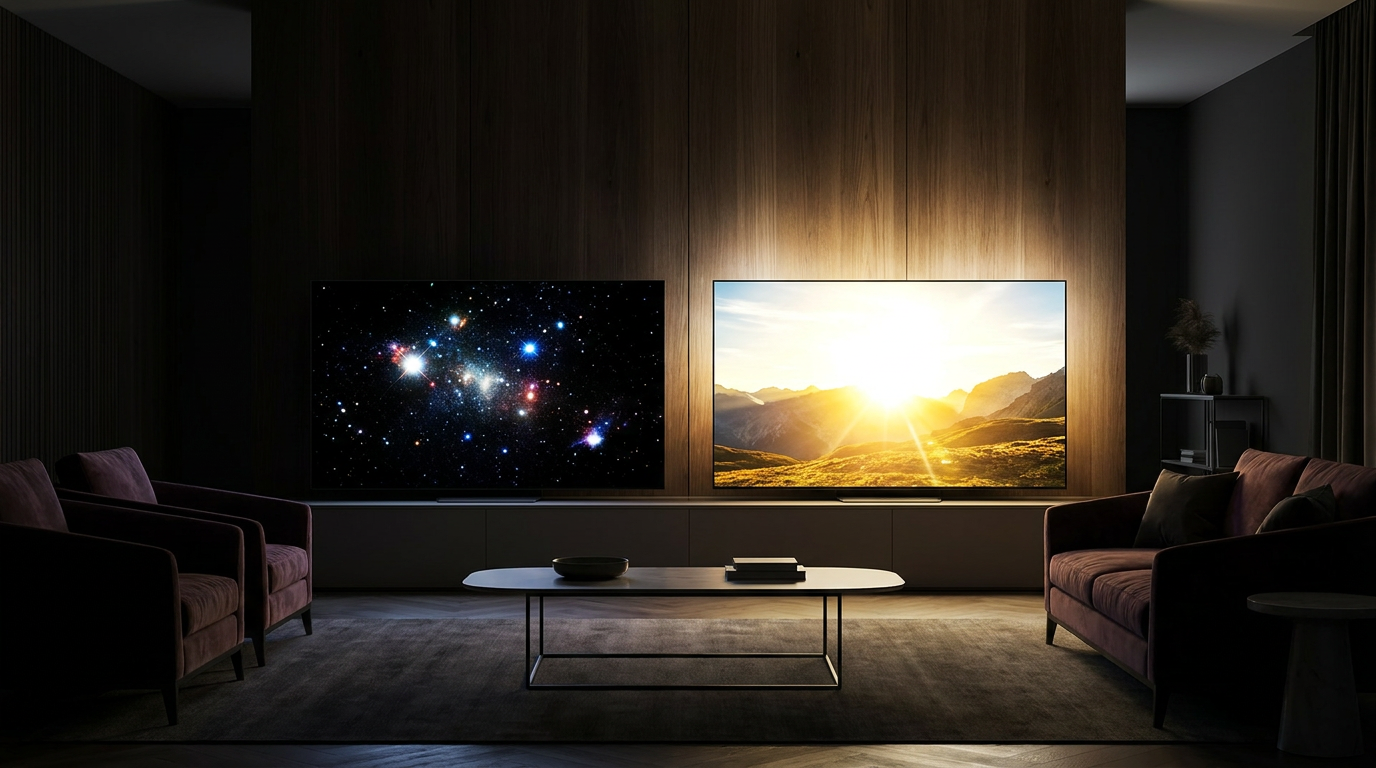
- Home Theater Purists
- Prioritize absolute black levels and infinite contrast for cinematic viewing in dark rooms.
- Bright-Room Consumers
- Value sustained brightness, glare reduction, and large screen sizes for daytime viewing.
- Competitive Gamers
- Focus on motion clarity, response times, and burn-in anxiety for heavy interactive use.
What's not represented
- · Budget-Conscious Buyers
- · Professional Color Graders
Why this matters
Choosing between OLED and Mini-LED is the single most consequential decision when buying a modern television, directly impacting both your viewing experience and your wallet. Understanding these trade-offs ensures you don't spend thousands of dollars on a screen that fights against the lighting conditions of your specific living room.
Key points
- OLED technology offers perfect black levels and infinite contrast by turning off individual pixels.
- Mini-LED panels utilize thousands of tiny backlights to achieve massive peak brightness, often exceeding 3,000 nits.
- OLED is widely considered the superior choice for dark, dedicated home theaters and cinematic viewing.
- Mini-LED excels in bright, sunlit living rooms and offers massive screen sizes at a lower cost.
- Burn-in remains a slight risk for OLEDs displaying static content, while Mini-LEDs are completely immune.
- The gap is narrowing as OLEDs get brighter and Mini-LEDs increase their dimming zone counts to reduce blooming.
The 2026 television landscape is defined by a single, inescapable choice for anyone upgrading their living room display: the battle between OLED and Mini-LED. While older, standard LED panels still populate the budget aisles of big-box retailers, the premium and mid-tier markets have entirely bifurcated into these two competing technologies. Buyers are no longer simply choosing a brand name; they are choosing a fundamental philosophy of how a screen produces light, color, and contrast. To understand the trade-offs, one must first understand the underlying architecture. OLED, which stands for organic light-emitting diode, is an emissive technology. This means every single pixel on the screen generates its own light and can be turned off completely independently of its neighbors. Mini-LED, conversely, is a transmissive technology. It utilizes a traditional liquid crystal display (LCD) layer to create the image, which is then illuminated from behind by a backlight grid made of thousands of microscopic LEDs grouped into localized dimming zones.[1][2][3]
The case for OLED rests almost entirely on its unrivaled contrast and absolute black levels. Because an OLED panel can completely cut power to individual pixels, it achieves a mathematically infinite contrast ratio. When a scene calls for pitch black, the screen emits zero nits of light in that exact spot, eliminating the grayish wash that plagues older televisions during dark cinematic sequences. The evidence for OLED's superiority in dark environments is definitive across the industry. Independent testing laboratories consistently award OLEDs the highest marks for dark-room performance because they suffer from absolutely zero blooming—the distracting halo effect that occurs when a bright object, like a white subtitle or a torch in a dark cave, bleeds light into the surrounding black areas. For cinephiles building a dedicated, light-controlled home theater, OLED remains the undisputed gold standard for visual fidelity.[3][5]
Beyond infinite contrast, OLED holds distinct, measurable advantages in motion handling and viewing angles. The technology boasts near-instantaneous pixel response times, often measured as low as 0.1 milliseconds. This instantaneous color switching makes it an elite choice for competitive gaming and fast-paced sports, where motion blur can obscure fast-moving targets or cause eye strain. Furthermore, OLED panels maintain their color accuracy, saturation, and contrast even when viewed from severe off-center angles. If a living room features wide, U-shaped seating where multiple viewers are watching from the sides of the room, an OLED ensures that the person sitting on the far edge of the couch sees the exact same vibrant image as the person sitting dead center.[2][4]

When evaluating gaming performance, the comparison becomes a tale of two distinct advantages. OLED panels are universally praised by competitive gamers for their near-instantaneous pixel response times, which virtually eliminate ghosting and motion blur during high-speed camera pans in first-person shooters. They also seamlessly support Variable Refresh Rate (VRR) technologies like Nvidia G-Sync and AMD FreeSync without compromising local dimming performance. However, Mini-LED strikes back with a distinct advantage for role-playing games and MMOs that feature persistent, static Heads-Up Displays (HUDs). Gamers who spend hundreds of hours playing a single title with static health bars and minimaps can do so on a Mini-LED without the lingering anxiety of permanent burn-in, while also enjoying blindingly bright HDR specular highlights during explosions or magical effects.[2][4]
The primary argument against OLED centers on its physical limitations with sustained brightness and the persistent, albeit reduced, risk of permanent image retention. While modern OLEDs are significantly brighter than their predecessors, they still rely on an Auto Brightness Limiter (ABL) to prevent the organic compounds from overheating. When displaying a full-screen bright image—such as a brightly lit hockey rink, a snow-covered landscape, or a glaring white commercial—the television will aggressively dim the overall picture to protect the panel. Additionally, burn-in remains a factor for specific, heavy-duty use cases. While manufacturers have introduced pixel-shifting algorithms and advanced heat sinks to mitigate the risk, leaving static elements on the screen for thousands of hours—such as news tickers, static desktop taskbars, or persistent gaming heads-up displays—can still cause permanent ghosting over the lifespan of the television.[3][4][6]
The primary argument against OLED centers on its physical limitations with sustained brightness and the persistent, albeit reduced, risk of permanent image retention.
The case for Mini-LED is built on blistering, uncompromised brightness and long-term durability that OLED simply cannot match. By utilizing thousands of miniaturized diodes packed tightly behind the LCD layer, these televisions can push peak highlights well past 2,000 nits, with some top-tier 2026 models capable of hitting an astonishing 5,000 nits. More importantly, they can sustain this high brightness across the entire screen without the aggressive dimming that throttles OLED panels. The evidence for Mini-LED shines brightest in sun-drenched living rooms. In environments with large windows, skylights, or harsh overhead lighting, an OLED's perfect blacks are often perceptually crushed by ambient glare. A high-end Mini-LED television punches through that ambient light effortlessly, maintaining vibrant color volume and a punchy High Dynamic Range (HDR) presentation that would look washed out on a dimmer screen.[1][4][6]
Mini-LED also claims a massive, undeniable victory in cost-to-size scaling, making it the champion of the ultra-large television market. Manufacturing massive OLED panels remains an incredibly expensive endeavor, with prices skyrocketing exponentially for models 77 inches and above. Mini-LED technology, built on mature LCD manufacturing processes, scales much more affordably. This dynamic allows consumers to purchase massive 85-inch, 98-inch, or even 115-inch Mini-LED displays for a fraction of the cost of a comparably sized OLED. For buyers prioritizing sheer screen real estate and cinematic scale on a more modest budget, Mini-LED is the clear mathematical winner, offering a highly immersive experience without requiring a second mortgage. Furthermore, the complete lack of organic compounds means Mini-LED owners never have to worry about permanent burn-in, regardless of what they watch.[2][4][5]

The argument against Mini-LED focuses on its inherent inability to control light at the individual pixel level. Even a premium Mini-LED television boasting 5,000 independent dimming zones is still grouping tens of thousands of pixels into a single backlight zone. When a brilliantly bright highlight sits directly adjacent to a pitch-black shadow, the zone must illuminate to show the bright object, which inevitably spills light into the dark areas. This creates a visible halo or blooming effect that can distract discerning viewers. Additionally, Mini-LED panels typically suffer from narrower viewing angles. As viewers move off-axis from the center of the screen, the contrast ratio degrades, colors can shift, and those blooming artifacts become significantly more pronounced. While some manufacturers apply wide-angle optical layers to mitigate this, it often comes at the expense of native contrast.[1][3]
The battle over High Dynamic Range (HDR) and color volume further highlights the divide between the two technologies. Mini-LED televisions, particularly those utilizing Quantum Dot enhancement layers, excel at displaying massive color volume at high brightness levels. When an HDR scene demands a vibrantly bright blue sky or a searingly hot explosion, Mini-LED can maintain deep color saturation at luminance levels where traditional OLEDs would begin to wash out or rely on white sub-pixels that dilute the color. However, the advent of QD-OLED (Quantum Dot OLED) in recent years has allowed emissive displays to fight back, combining the perfect blacks of OLED with the pure, bright color reproduction of quantum dots, creating a highly contested middle ground for HDR purists.[1][3]
The technological gap between the two display philosophies is actively narrowing in 2026, making the choice more nuanced than ever. Innovations like Quantum Dot OLED and Tandem OLED architectures are pushing emissive panels to new brightness thresholds, closing the gap in well-lit rooms and offering better color saturation at high luminance. Simultaneously, Mini-LED manufacturers are deploying increasingly sophisticated local dimming algorithms driven by advanced neural processors, alongside denser diode grids. These improvements are drastically reducing the blooming artifacts that once defined the technology, allowing the best Mini-LEDs to mimic OLED-like contrast in all but the most challenging scenes. As both technologies borrow strengths from one another, the decision increasingly comes down to the specific environmental conditions of the buyer's living room.[1][3]

Ultimately, OLED fits well when the viewing environment is controlled and absolute visual fidelity is the paramount priority. It is the definitive choice for dedicated home theaters, late-night movie watching, and high-end console gaming where motion clarity and shadow detail are critical. It thrives in spaces where its perfect blacks can be fully appreciated without the interference of heavy ambient light. Conversely, OLED does not fit well when the television acts as a constant background appliance displaying static news channels all day, or when it is placed in a sunroom with direct, unmitigated daylight. The lingering risk of burn-in from static logos and the aggressive dimming of bright, full-screen scenes make it a suboptimal choice for these specific, high-friction workflows.[4][5][6]
Mini-LED fits well when the television must compete with a bright, open-concept living space flooded with natural light. It is the ideal candidate for daytime sports viewing, casual family rooms, and buyers who want a massive, cinematic screen size without paying an exorbitant premium. Its total immunity to burn-in also makes it the safest, most durable choice for households that leave the television running all day on the same channel. However, Mini-LED does not fit well when the primary use case involves watching letterboxed movies in a pitch-black room. In those specific conditions, the glowing black bars and subtle haloing around bright objects will inevitably distract discerning viewers, reminding them that while the technology is incredibly powerful, it cannot completely cheat the physics of a transmissive backlight.[2][3][4]
How we got here
2013
The first commercial OLED televisions are introduced to the United States market, revolutionizing contrast and black levels.
2019
TCL launches the world's first Mini-LED television, introducing miniaturized backlights to dramatically improve LCD local dimming.
2022
Quantum Dot OLED (QD-OLED) enters the market, merging OLED's perfect blacks with quantum dot brightness and color volume.
2024
Mini-LED zone counts explode, with flagship models featuring over 5,000 independent dimming zones to combat blooming.
2026
Tandem OLED architectures and ultra-dense Mini-LED grids push both technologies to new extremes of brightness and precision.
Viewpoints in depth
Home Theater Purists
Prioritize absolute black levels and infinite contrast for cinematic viewing in dark rooms.
For cinephiles and display purists, the conversation begins and ends with contrast. This camp argues that the foundation of a realistic, three-dimensional image is the ability to produce true black. They point to laboratory measurements showing OLED's 0.000-nit black floor as the ultimate proof of superiority, arguing that even the best Mini-LEDs suffer from distracting blooming around subtitles and starfields. For this group, managing ambient light with blackout curtains is a small price to pay for pixel-perfect luminance control.
Bright-Room Consumers
Value sustained brightness, glare reduction, and large screen sizes for daytime viewing.
This perspective represents the reality of most modern living rooms, which feature large windows, open floor plans, and abundant ambient light. Advocates for this camp argue that OLED's perfect blacks are entirely negated by screen glare in a sunlit room. They champion Mini-LED for its ability to push 2,000 to 5,000 nits of brightness, ensuring that sports broadcasts and daytime television remain punchy and vibrant. Furthermore, they emphasize the cost-effectiveness of Mini-LED when scaling up to 85-inch or 100-inch displays, making massive screens accessible to everyday buyers.
Competitive Gamers
Focus on motion clarity, response times, and burn-in anxiety for heavy interactive use.
The gaming community is split based on the type of content they consume. Competitive players heavily favor OLED for its 0.1-millisecond response time, which eliminates motion blur during fast-paced action, providing a tangible competitive advantage. However, MMO and RPG players who leave static heads-up displays (HUDs) on screen for hundreds of hours often advocate for Mini-LED. This sub-camp prioritizes the peace of mind that comes with zero burn-in risk, allowing them to game indefinitely without worrying about permanently scarring their premium display.
What we don't know
- Whether Micro-LED—a technology combining OLED's pixel control with Mini-LED's brightness—will become affordable for average consumers before the end of the decade.
- Exactly how long the new Tandem OLED panels will last before experiencing noticeable degradation under heavy daily use.
- If Mini-LED zone counts will eventually reach a point of diminishing returns where blooming becomes imperceptible to the human eye.
Key terms
- OLED
- Organic Light-Emitting Diode; a display technology where each individual pixel generates its own light and can turn off completely to create perfect blacks.
- Mini-LED
- A transmissive display technology that uses a traditional LCD screen illuminated by thousands of microscopic LED backlights grouped into dimming zones.
- Nits
- A unit of measurement for luminance or brightness; higher numbers indicate a brighter screen.
- Blooming
- A visual artifact on LED/LCD televisions where light from a bright object bleeds into adjacent dark areas, creating a halo effect.
- Contrast Ratio
- The difference in light intensity between the brightest white and the darkest black a display can produce.
- Burn-in
- Permanent image retention on a screen caused by displaying a static image for an extended period, degrading the organic compounds in an OLED panel.
Frequently asked
Does OLED burn-in still happen in 2026?
While modern OLEDs use pixel-shifting and advanced cooling to mitigate the risk, burn-in is still possible if static images like news tickers or game HUDs are displayed for thousands of hours.
What is Mini-LED blooming?
Blooming, or the halo effect, occurs when the backlight zones behind a Mini-LED screen illuminate a bright object, spilling excess light into the surrounding dark areas of the picture.
Which TV is better for a bright living room?
Mini-LED is generally better for bright rooms because it can achieve significantly higher peak brightness (often over 2,000 nits), allowing it to cut through glare and sunlight.
Is QD-OLED different from standard OLED?
Yes. QD-OLED combines traditional OLED technology with a quantum dot color layer, resulting in higher peak brightness and more vibrant colors than older standard OLED panels.
Sources
Source coverage
6 outlets
3 viewpoints surfaced






[1]CNETBright-Room Consumers
OLED vs. Mini-LED: Which TV Technology Is Better?
Read on CNET →[2]Tom's GuideCompetitive Gamers
OLED vs Mini-LED: Which TV is best for you?
Read on Tom's Guide →[3]RTINGS.comHome Theater Purists
OLED vs LED (Mini LED): Which is better?
Read on RTINGS.com →[4]ZDNETBright-Room Consumers
Mini LED vs OLED: Which TV should you buy?
Read on ZDNET →[5]What Hi-Fi?Home Theater Purists
Mini LED vs OLED: which TV screen technology is better?
Read on What Hi-Fi? →[6]BGRCompetitive Gamers
Mini LED vs OLED: Which TV panel is better?
Read on BGR →
More in shopping
See all 7 stories →Display Tech
OLED vs. Mini-LED: The 2026 Gaming Monitor Trade-Off
6 sources
Consumer Deals
Amazon Sets Prime Day 2026 for Mid-July as Rival Retailers Launch Competing Summer Sales
7 sources

TV Displays
OLED vs. Mini-LED: The 2026 TV Buyer's Trade-Off Guide
7 sources
E-Bike Tech
How to Choose an Electric Bike: The 2026 Guide to Motors, Batteries, and Safety
8 sources

Every angle. Every day.
Get shopping stories with full source coverage and perspective breakdowns delivered to your inbox.