
The Chemistry of Culinary Emulsions: How to Master Sauces, Dressings, and Gravies
Understanding the microscopic science of emulsifiers can help home cooks permanently banish broken sauces and separated dressings.
By Factlen Editorial Team
- Culinary Scientists
- Focus on the molecular interactions, amphipathic properties, and kinetic stability of the liquids.
- Home Cooking Educators
- Focus on practical frameworks like the 9-3-1 ratio, accessible pantry ingredients, and foolproof rescue techniques.
- Professional Chefs
- Focus on the mechanical execution, shearing force, temperature control, and the resulting mouthfeel of the sauce.
What's not represented
- · Industrial Food Scientists
- · Dietitians
Why this matters
Mastering the physical chemistry of cooking separates intuitive guesswork from reliable technique. By understanding how oil and water interact, home cooks can save money on store-bought dressings, rescue expensive ingredients from the trash, and elevate everyday meals with restaurant-quality textures.
Key points
- An emulsion is a temporarily stable mixture of two unmixable liquids, typically oil and water.
- Emulsifiers, such as egg yolks or mustard, contain amphipathic molecules that bridge the gap between water and fat.
- Vigorous mechanical shearing and slow oil incorporation are required to break fat into microscopic, coatable droplets.
- A broken sauce can almost always be rescued by slowly whisking the split mixture into a fresh base of warm water or egg yolk.
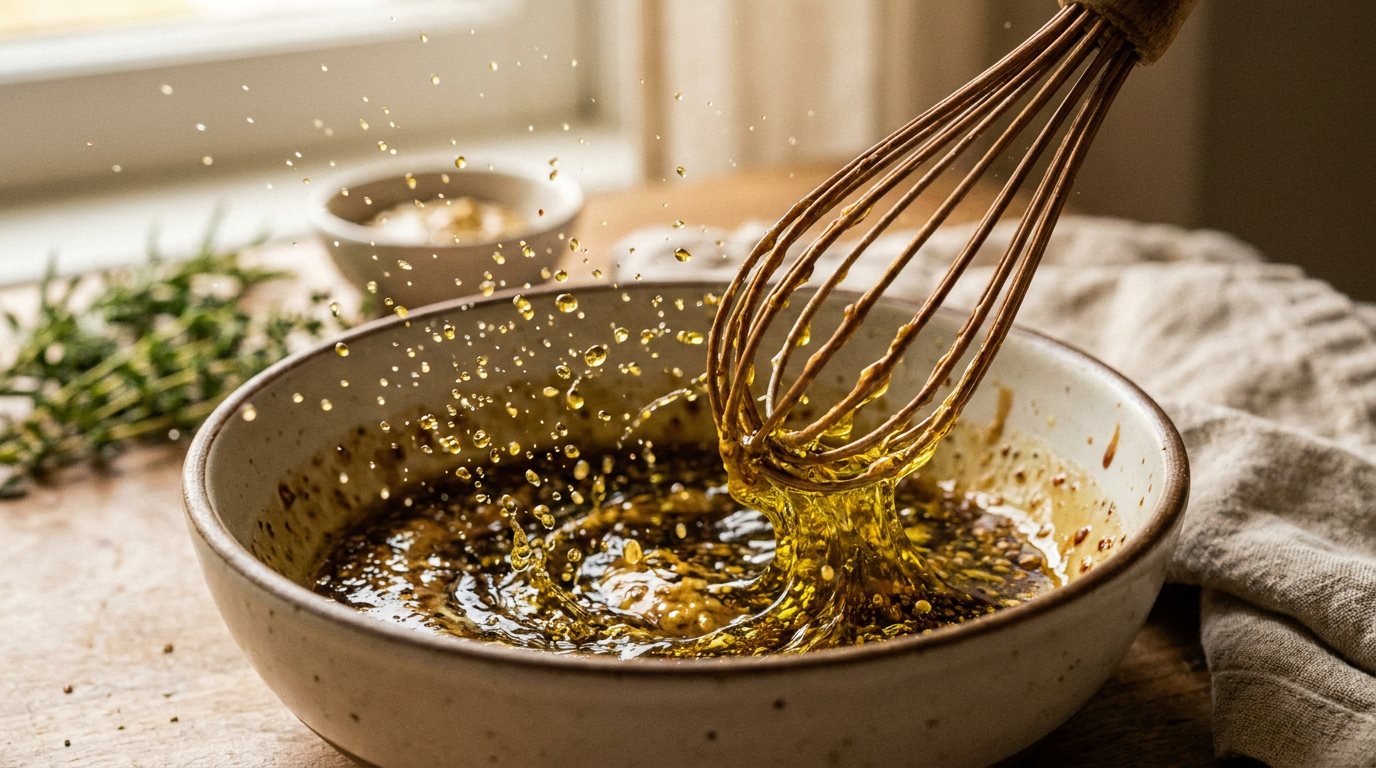
The universal kitchen heartbreak is a familiar one: standing over a saucepan, whisk in hand, watching a silky sauce suddenly curdle into a greasy, grainy mess. Whether it is a broken Hollandaise on a Sunday morning or a vinaigrette that stubbornly separates into distinct layers, the failure feels personal. But a split sauce is not a failure of culinary intuition; it is simply a matter of physics.[2][5]
At the heart of these kitchen struggles is the fundamental law of liquid dynamics: oil and water naturally repel each other. Water molecules are polar, meaning they have a slight electrical charge that makes them highly attracted to other polar molecules. Lipids, such as olive oil or butterfat, are nonpolar and lack this charge. When forced together, they immediately seek their own kind, separating into distinct layers to minimize contact.[6][7]
Overcoming this natural repulsion requires a process known as emulsification. An emulsion is a temporarily stable mixture of two immiscible liquids, achieved by breaking one liquid into microscopic droplets and suspending them evenly throughout the other. In the culinary world, this technique is the invisible architecture behind mayonnaise, béarnaise, pan sauces, and even the velvety texture of homogenized milk.[4][6]

To force these rival liquids into a harmonious state, cooks rely on a chemical mediator known as an emulsifier. Emulsifiers are amphipathic molecules, meaning they possess a split personality at the molecular level. One end of the molecule is hydrophilic, meaning it is deeply attracted to water, while the opposite end is hydrophobic, meaning it repels water and binds to oil.[6][7]
When introduced into a mixture of oil and water, these molecules act as microscopic diplomats. The hydrophobic tails embed themselves into the suspended fat droplets, while the hydrophilic heads face outward, gripping the surrounding water. This creates a protective barrier around each droplet, preventing them from coalescing and separating back into a greasy pool.[2][7]
Culinary emulsions generally fall into two distinct categories. The first, and most common, is the oil-in-water emulsion. In this structure, tiny droplets of oil are dispersed throughout a continuous water phase. This category includes vinaigrettes, mayonnaise, and milk. Because water is the continuous outer phase, these emulsions tend to feel lighter on the palate and pour easily.[3][4]
The second category reverses the architecture. In a water-in-oil emulsion, microscopic droplets of water are trapped within a continuous matrix of liquid fat. Butter is the most famous example of this structure, created when mechanical churning forces the water droplets in cream to become encased in butterfat. These emulsions are noticeably richer, coating the tongue and delivering a prolonged perception of fat and flavor.[3][4]

In a water-in-oil emulsion, microscopic droplets of water are trapped within a continuous matrix of liquid fat.
The secret to mastering these structures lies in choosing the right emulsifier. The undisputed king of kitchen emulsifiers is the egg yolk, which contains a powerful phospholipid called lecithin. Lecithin is highly effective at reducing the interfacial tension between oil and water, making it the structural backbone of classic mayonnaise and Hollandaise sauce.[3][7]
For those avoiding eggs, the pantry offers several alternatives. Mustard contains a complex carbohydrate called mucilage, a natural emulsifying compound that also provides a rounded, pungent heat to dressings. Garlic contains amphipathic compounds like diallyl sulfide, which help bind aioli. Meanwhile, modernist and vegan kitchens frequently turn to soy lecithin, a plant-based alternative that works at very low concentrations and carries a completely neutral flavor profile.[3][7]
While honey and tomato paste are often cited in recipes as emulsifiers, food scientists note a subtle distinction. These ingredients are technically stabilizers. They do not possess the amphipathic molecular structure needed to bind oil and water directly. Instead, their thick, viscous nature physically impedes the oil droplets from moving around and bumping into one another, thereby extending the lifespan of a temporary emulsion.[3][6]
Understanding the chemistry is only half the battle; the other half is mechanical execution. Creating the microscopic droplets required for a stable emulsion demands shearing force. This is why recipes insist on vigorous whisking, blending, or food processing. The mechanical action physically shatters the oil into millions of tiny spheres, increasing the total surface area that the emulsifier must coat.[4][5]
The rate at which the fat is introduced is equally critical. Pouring all the oil into the acid at once overwhelms the emulsifier, leaving it unable to coat the droplets before they merge back together. This is why professional chefs stream oil into their bases drop by drop, or in a painfully thin ribbon. The slow incorporation ensures that every newly sheared fat droplet is immediately wrapped in a stabilizing layer of lecithin or mucilage.[1][5]

Temperature also plays a pivotal role in emulsion stability. Cold ingredients are rigid and resist blending, which is why making mayonnaise with refrigerator-cold egg yolks often ends in disaster. Room-temperature ingredients flow more easily, allowing the emulsifier to rapidly coat the fat droplets. Conversely, excessive heat can denature the proteins in an egg yolk, causing a warm emulsion like Hollandaise to scramble and break.[2][5]
For everyday home cooking, culinary educators have distilled this complex chemistry into accessible frameworks. The most reliable is the "9-3-1 ratio" for vinaigrettes: nine parts oil, three parts acid, and one part emulsifier. This precise proportion ensures there is exactly enough emulsifier to bridge the two liquids without overwhelming the flavor profile of the dressing.[1][8]
Even armed with this knowledge, emulsions will occasionally break. A broken sauce looks curdled, with pools of clear fat separating from the opaque base. But because emulsification is a mechanical and chemical process, it can almost always be reversed. The fix is not to whisk the broken sauce harder, but to start a new, stable base and slowly incorporate the broken mixture into it.[2][5]

To rescue a split mayonnaise or Hollandaise, chefs recommend placing a single tablespoon of warm water or a fresh egg yolk in a clean bowl. By vigorously whisking the broken sauce into this new continuous phase, drop by drop, the emulsion is re-established. The water provides a fresh matrix for the oil droplets, while the mechanical shearing breaks the coalesced fat back down to size.[2]
Ultimately, mastering emulsions transforms a cook's relationship with the kitchen. It shifts the focus away from blindly following recipes and toward manipulating physical properties. Whether whisking a simple weeknight salad dressing or executing a flawless béarnaise for a dinner party, understanding the microscopic bridge between oil and water is the key to unlocking silken textures and elevated flavors.[8]
How we got here
1756
Mayonnaise is reportedly invented by the French chef of the Duc de Richelieu, substituting olive oil for cream in a victory feast.
Late 19th Century
The homogenizer is invented, allowing for the creation of stable, commercial milk emulsions by mechanically shattering milk fat.
1990s
The rise of modernist cuisine introduces soy lecithin and constructed creams to fine dining, allowing chefs to emulsify without eggs or dairy.
2020s
The democratization of food science leads home cooks to widely adopt immersion blenders and precise chemical ratios for everyday meals.
Viewpoints in depth
Culinary Scientists
Focus on the molecular interactions, amphipathic properties, and kinetic stability of the liquids.
For food chemists and researchers, emulsification is entirely a matter of kinetic stability and molecular geometry. They emphasize that without an amphipathic molecule to lower the interfacial tension between polar water and nonpolar lipids, phase separation is inevitable. This camp studies the precise HLB (hydrophilic-lipophilic balance) values of various compounds, noting that ingredients like honey and tomato paste are merely stabilizers that increase viscosity, rather than true emulsifiers like the lecithin found in egg yolks.
Professional Chefs
Focus on the mechanical execution, shearing force, temperature control, and the resulting mouthfeel of the sauce.
In commercial kitchens, the focus shifts from molecular theory to mechanical execution. Professional chefs view emulsification as a test of technique, relying on intense shearing force—via rapid whisking or high-powered immersion blenders—to physically shatter fat droplets. They prioritize temperature control, knowing that cold ingredients resist blending and hot ingredients can scramble proteins, and they value the distinct mouthfeel that different emulsion architectures (like oil-in-water versus water-in-oil) deliver to a finished dish.
Home Cooking Educators
Focus on practical frameworks like the 9-3-1 ratio, accessible pantry ingredients, and foolproof rescue techniques.
Educators aim to demystify the science, translating complex chemistry into actionable, foolproof rules for the home kitchen. They champion frameworks like the 9-3-1 ratio (nine parts oil, three parts acid, one part emulsifier) to help cooks build vinaigrettes without relying on recipes. More importantly, this camp emphasizes that a broken sauce is not a failure but a reversible physical state, teaching home cooks how to rescue split mayonnaise or Hollandaise with a tablespoon of warm water and a fresh whisk.
What we don't know
- How emerging plant-based hydrocolloids will fully replicate the complex mouthfeel of egg-yolk lecithin in commercial baking.
- The exact kinetic lifespan of certain temporary emulsions before microscopic coalescence becomes irreversible without mechanical intervention.
Key terms
- Emulsion
- A temporarily stable mixture of two unmixable liquids, such as oil and water.
- Emulsifier
- A molecule with both water-loving and oil-loving ends that binds immiscible liquids together.
- Amphipathic
- A chemical compound possessing both hydrophilic (polar) and hydrophobic (nonpolar) properties.
- Hydrophilic
- Having a strong affinity for water; the 'water-loving' end of a molecule.
- Hydrophobic
- Naturally repelling water; the 'oil-loving' end of a molecule.
- Shearing Force
- The mechanical action—like whisking or blending—used to break liquids into microscopic droplets.
- Coalescence
- The process where small droplets in an unstable emulsion merge back together, causing the sauce to break.
Frequently asked
Why do oil and water naturally separate?
Water molecules are polar and attract each other, while oil molecules are nonpolar. They separate into distinct layers to minimize contact between their incompatible structures.
What is the best way to fix a broken mayonnaise?
Start with a tablespoon of warm water or a fresh egg yolk in a clean bowl, then vigorously whisk the broken mayonnaise into it drop by drop to re-establish the emulsion.
Can I make an emulsion without eggs or dairy?
Yes. Mustard, garlic paste, and soy lecithin are highly effective plant-based emulsifiers used to bind vegan sauces and dressings.
Why do recipes say to add oil slowly?
Adding oil too quickly overwhelms the emulsifier, preventing it from coating the new fat droplets before they merge back together and break the sauce.
Sources
Source coverage
8 outlets
3 viewpoints surfaced






[1]Chef FattyHome Cooking Educators
The Science of the Perfect Vinaigrette (And 4 Recipes That Prove It)
Read on Chef Fatty →[2]Tales by TravelHome Cooking Educators
The Science of Silk: How to Master and Fix Culinary Emulsification
Read on Tales by Travel →[3]Molecular RecipesCulinary Scientists
Common Culinary Emulsions
Read on Molecular Recipes →[4]CookinGenieProfessional Chefs
The Ultimate Guide to Emulsions: Mastering the Art of Culinary Science
Read on CookinGenie →[5]CHEF iQProfessional Chefs
The Science of Emulsions: Perfecting Sauces and Dressings
Read on CHEF iQ →[6]EBSCO Research StartersCulinary Scientists
Emulsion | Chemistry
Read on EBSCO Research Starters →[7]Discover MagazineCulinary Scientists
Vinaigrette: The Chemistry of Salad Dressings
Read on Discover Magazine →[8]Factlen Editorial TeamHome Cooking Educators
Synthesis by Factlen editorial team
Read on Factlen Editorial Team →
More in food drink
See all 37 stories →Sustainable Viticulture
The Rise of PIWI Grapes: How Fungus-Resistant Vines Are Reshaping Sustainable Wine
6 sources
Flavor Science
The Science of Umami: How to Engineer Deep Savory Flavor in Plant-Based Cooking
6 sources

Cocktail Science
The Science of Clarified Milk Punch: How Curdled Milk Makes Crystal-Clear Cocktails
6 sources
Tea Chemistry
The Chemistry of Tea: How Processing and L-Theanine Alter the Health and Cognitive Effects of Camellia Sinensis
7 sources
Every angle. Every day.
Get food drink stories with full source coverage and perspective breakdowns delivered to your inbox.