
The Anatomy of Heirloom Furniture: How to Spot High-Quality Wood and Avoid 'Fast Furniture'
As the environmental toll of disposable 'fast furniture' mounts, understanding the hallmarks of quality wood construction—from dovetail joinery to solid hardwoods—can save consumers money and reduce landfill waste.
By Factlen Editorial Team
- Sustainable Design Advocates
- Argue that the environmental toll of disposable furniture necessitates a shift toward durable, circular materials.
- Traditional Craftsmanship Proponents
- Emphasize the structural superiority of solid wood and traditional joinery over mass-produced composites.
- Value-Conscious Consumers
- Prioritize immediate affordability and trend-adaptability, often driving the demand for flat-pack alternatives.
What's not represented
- · Fast furniture manufacturers
- · Low-income renters
Why this matters
Equipping yourself with the knowledge to identify true furniture craftsmanship prevents costly replacement cycles and protects your indoor air quality from the synthetic adhesives used in cheap composites.
Key points
- Fast furniture contributes to 12 million tons of annual waste in the US, with 80% ending up in landfills.
- High-quality pieces are constructed from solid hardwoods like oak, walnut, or maple, rather than engineered composites like MDF.
- Traditional joinery techniques, such as dovetail and mortise-and-tenon, indicate superior craftsmanship and longevity.
- Solid wood furniture is significantly heavier and produces a resonant sound when tapped, unlike hollow-sounding particleboard.
- Premium wood finishes enhance the natural grain rather than obscuring it with thick, glossy stains.
The modern furniture showroom is a masterclass in illusion. A sleek, mid-century modern credenza might look indistinguishable from a heritage piece on a screen, but the reality often arrives flat-packed in a cardboard box.[6]
This era of "fast furniture" has democratized interior design, allowing consumers to furnish entire apartments for the cost of a single heirloom dining table. However, the true cost of these disposable pieces is becoming impossible to ignore.[6]
Americans alone discard more than 12 million tons of furniture annually, a staggering 450 percent increase since 1960. Approximately 80 percent of this waste ends up in landfills, driven by products engineered with an intentionally short lifespan of just five to ten years.[1][2]

Beyond the landfill, the manufacturing process relies heavily on composite materials like particleboard and medium-density fiberboard (MDF). These materials are bound together using synthetic adhesives that often contain formaldehyde and volatile organic compounds (VOCs), which can off-gas into homes and degrade indoor air quality.[2][3]
Recognizing the environmental and financial toll of this cycle, a growing movement of consumers is returning to the principles of heirloom furniture. But identifying true quality requires looking past the surface veneer and understanding the anatomy of wood construction.[6]
The foundation of any lasting piece is the material itself. The highest quality furniture is crafted from solid wood, meaning the piece is constructed from single boards or panels glued together, rather than wood fibers pressed into a sheet.[4][5]
Solid wood is generally categorized into hardwoods and softwoods. Hardwoods, derived from slow-growing deciduous trees like oak, walnut, maple, and cherry, offer exceptional density and resistance to dings and scratches.[5]
Solid wood is generally categorized into hardwoods and softwoods.
Softwoods, such as pine and cedar, come from faster-growing coniferous trees. While less dense than hardwoods, a well-crafted solid pine piece can still outlast any MDF alternative. A simple field test—pressing a fingernail into a discreet area—can reveal the wood's density; if it leaves a visible dent, it is likely a softer wood that may not withstand heavy daily use.[4][5]

Even more critical than the wood species is the joinery—the method used to connect the pieces together. Joinery is the ultimate telltale sign of a manufacturer's commitment to quality and longevity.[4]
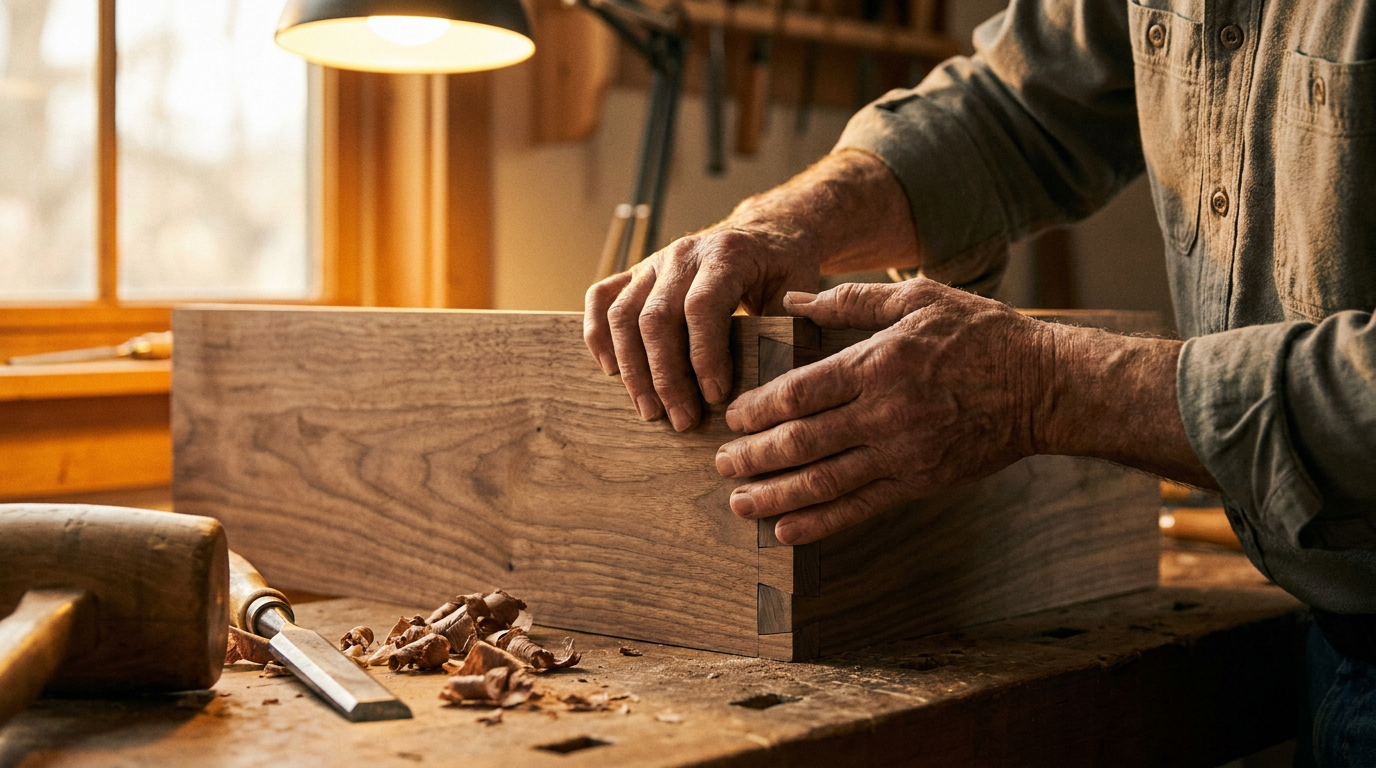
High-quality pieces rely on traditional, interlocking techniques. The gold standard for drawers and cabinetry is the dovetail joint, recognizable by its interlocking, puzzle-like square teeth. This design provides immense structural strength without relying solely on adhesives.[4]
For structural frames, such as table legs and chair supports, artisans use mortise-and-tenon joints. This technique involves inserting a narrowed end of one piece (the tenon) into a precisely cut hole (the mortise) in the opposing piece, creating a bond that can withstand decades of weight and movement.[4]

Conversely, fast furniture often relies on butt joints held together by staples, weak nails, or visible pools of glue. These connections are prone to failure under stress, leading to the familiar wobble that plagues cheap chairs and tables.[4]
Weight and stability offer immediate tactile clues. Solid hardwoods are inherently dense, giving quality furniture a substantial, grounded feel. A simple "knock test" on the surface of a table should produce a solid, resonant sound, whereas cheaper composite materials often sound hollow or tinny.[4][5]
Finally, the finish of the wood speaks volumes about the craftsmanship. A premium finish should be smooth to the touch, enhancing the natural grain and character of the wood rather than obscuring it. Thick, muddy, or overly glossy stains are frequently used to mask mismatched panels or lower-grade materials.[4][5]
Investing in high-quality wood furniture is a paradigm shift away from the disposable consumption model. While the upfront cost is undeniably higher, the cost-per-year of a piece that lasts a lifetime—and can be sanded, refinished, and repaired—ultimately eclipses the cycle of replacing cheap furniture every time a lease is signed.[6]

As the circular economy gains traction, the resale market for well-crafted solid wood pieces is thriving. By learning to identify the hallmarks of quality, consumers can furnish their homes with pieces that hold their value, protect indoor air quality, and keep millions of tons of waste out of the ground.[1][2][6]
Viewpoints in depth
Sustainable Design Advocates
Focus on the hidden ecological costs of disposable furniture.
Environmental researchers and sustainable design advocates argue that the true cost of fast furniture is deferred to the planet. They point to the 15 million hectares of forest logged annually and the massive carbon footprint of shipping flat-pack MDF across oceans. For this camp, investing in solid wood or buying secondhand is primarily an act of ecological harm reduction, aimed at keeping synthetic adhesives and non-recyclable composites out of landfills.
Traditional Craftsmanship Proponents
Emphasize structural integrity and the long-term value of artisanal techniques.
Woodworkers and traditional furniture makers view the shift toward engineered woods as a degradation of functional art. They argue that traditional joinery—like dovetails and mortise-and-tenon—was developed over centuries specifically to accommodate the natural expansion and contraction of solid wood. From this perspective, mass-produced pieces held together by staples and glue are inherently flawed, designed for planned obsolescence rather than generational use.
Value-Conscious Consumers
Prioritize immediate affordability and the flexibility to adapt to changing living situations.
Despite the environmental and structural critiques, the fast furniture model remains dominant because it solves an immediate consumer need: affordability and mobility. For renters, students, or young professionals who move frequently, investing thousands of dollars in heavy, solid wood furniture is often impractical. This perspective highlights that flat-pack furniture democratized interior design, allowing people to furnish their spaces stylishly without taking on debt, even if the pieces are ultimately temporary.
What we don't know
- How upcoming 'Right to Repair' legislation might force fast furniture manufacturers to design more modular, easily fixable products.
- Whether the rising costs of global shipping will naturally make locally crafted solid wood furniture more price-competitive with imported flat-pack items.
Key terms
- MDF (Medium-Density Fiberboard)
- An engineered wood product made by breaking down hardwood or softwood residuals into wood fibers, combining it with wax and a resin binder, and forming it into panels by applying high temperature and pressure.
- Veneer
- A very thin slice of real wood that is glued onto the surface of a cheaper material, like MDF or particleboard, to give the appearance of solid wood.
- Dovetail Joint
- A highly durable woodworking joint characterized by interlocking, fan-shaped cuts (pins and tails) that provide immense tensile strength, typically used in drawer construction.
- Mortise-and-Tenon
- A classic joint where a projecting piece of wood (the tenon) fits exactly into a corresponding hole (the mortise) in another piece, creating a strong, stable frame.
- VOCs (Volatile Organic Compounds)
- Harmful chemicals often found in the synthetic adhesives and finishes used in cheap furniture, which can slowly release (off-gas) into the air and degrade indoor air quality.
Frequently asked
What is the difference between solid wood and engineered wood?
Solid wood is cut directly from a tree and used as a single piece, offering superior durability. Engineered wood, like MDF or particleboard, is made by binding wood fibers and adhesives together under heat and pressure.
How can I tell if a piece of furniture is made of solid wood?
Solid wood is significantly heavier than engineered wood. You can also look at the edges; solid wood will have a continuous grain pattern that wraps around the edge, whereas engineered wood will often have a visible seam where a veneer was applied.
Are softwoods like pine bad for furniture?
Not necessarily. While softwoods are more prone to dents and scratches than hardwoods like oak or walnut, a well-constructed solid pine piece with traditional joinery will still outlast most engineered wood furniture.
What is a dovetail joint?
A dovetail joint is a traditional woodworking technique used to connect two pieces of wood, commonly found in high-quality drawers. It uses interlocking, wedge-shaped cuts that hold together tightly without relying solely on glue or nails.
Sources
Source coverage
6 outlets
3 viewpoints surfaced






[1]MediumSustainable Design Advocates
Fast Furniture's Environmental Impact: A Growing Concern
Read on Medium →[2]FibrenewSustainable Design Advocates
The Hidden Carbon Footprint of Fast Furniture
Read on Fibrenew →[3]UGREENSustainable Design Advocates
Understanding Fast Furniture: Environmental Impact and Sustainable Choices
Read on UGREEN →[4]Swoon WorthyTraditional Craftsmanship Proponents
How to Choose Good Quality Wood Furniture
Read on Swoon Worthy →[5]GrothouseTraditional Craftsmanship Proponents
How to Identify High Quality Wood Furniture
Read on Grothouse →[6]Factlen Editorial TeamValue-Conscious Consumers
Synthesis by Factlen editorial team
Read on Factlen Editorial Team →

Every angle. Every day.
Get shopping stories with full source coverage and perspective breakdowns delivered to your inbox.