
The 2% of GDP and the Seven Categories: How NATO Defines and Measures Member Defense Spending
NATO's 2% defense spending target relies on a standardized seven-category accounting framework that determines what qualifies as military expenditure. By harmonizing 32 different national budgets into a single metric, the alliance measures political commitment rather than direct combat readiness.

- Defense Economists
- Argue that the 2% metric is a flawed input measure that incentivizes creative accounting rather than actual capability generation.
- Alliance Leadership
- View the standardized categories as essential political tools for enforcing burden-sharing and ensuring minimum capital investment across 32 distinct national budgets.
- National Finance Ministries
- Focus on maximizing the classification of existing domestic expenditures, such as pensions and dual-use infrastructure, under NATO definitions to meet political thresholds.
Perspectives this story doesn't cover
- Taxpayer Advocacy Groups
- Defense Industry Contractors
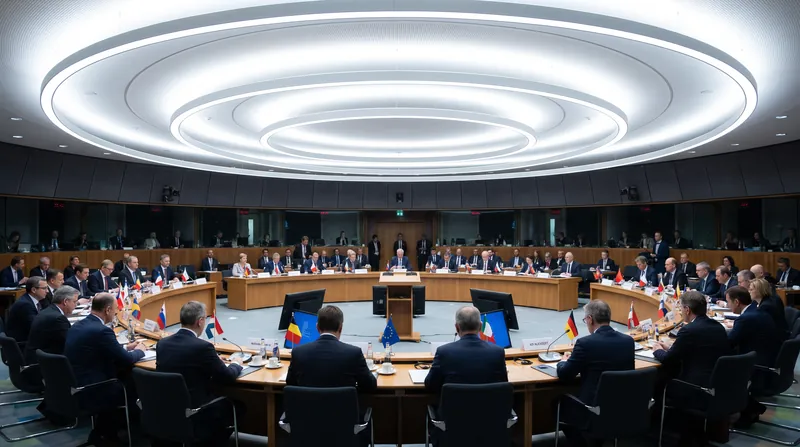
Inside the World Forum convention center during the NATO Summit in The Hague, member states finalized their latest defense investment pledges, anchoring them to a metric that has defined alliance politics for a decade: the 2% of GDP threshold [1]. The figure is universally cited in diplomatic disputes over burden-sharing, but the denominator—what actually counts as "defense spending"—is governed by a strict, standardized accounting framework. Because NATO comprises 32 sovereign nations, each with its own treasury, tax code, and military structure, comparing their budgets requires translating them into a common language.[1]
To achieve this comparability, NATO relies on a seven-category classification system. Every euro, dollar, or lira submitted to Brussels must be slotted into one of these buckets: military personnel, civilian personnel, operations and maintenance, procurement of major equipment, research and development, military infrastructure, and contributions to NATO common funding [4][5]. This structure ensures that a country cannot simply label general government expenditure as defense spending to meet the political target.[4][5]
Personnel costs consistently dominate these ledgers across the alliance. Under NATO rules, this category includes not just active-duty salaries, but also military pensions and employer contributions to healthcare [4]. For several member states, pension liabilities alone account for a double-digit percentage of their total recognized defense expenditure. This means demographic aging directly inflates their progress toward the 2% target without adding a single deployable soldier to the field [2][7].[2][4][7]
The most closely monitored of the seven categories is procurement. Alongside the 2% overall target, NATO requires members to dedicate at least 20% of their defense budgets to major equipment and research and development [6]. This sub-target was designed specifically to prevent states from hitting the 2% mark purely through bloated payrolls and legacy pension obligations, forcing capital investment into modern weapons systems and interoperable technology [3].[3][6]
The most closely monitored of the seven categories is procurement.
However, the boundaries of these categories often invite creative accounting from national finance ministries. Infrastructure spending, for example, counts if it is strictly for military use. But dual-use infrastructure—such as port expansions, reinforced bridges, or cyber defense networks that serve both civilian logistics and potential military mobility—creates friction between national auditors and NATO's Defence and Peace Economics directorate [4][5].[4][5]
When a member state attempts to classify paramilitary police forces, such as Italy's Carabinieri or France's Gendarmerie, as defense spending, NATO auditors must determine what percentage of those forces are trained and equipped for military operations under a defense command [4]. Only the deployable, military-capable fraction of these budgets is accepted into the official tally [7].[4][7]
Researchers at the Stockholm International Peace Research Institute (SIPRI) note that the 2% metric, while politically potent, is fundamentally an input measure rather than an output measure [2]. It tracks the volume of financial resources consumed, not the military capability generated. A nation spending heavily on inefficient domestic defense contractors may hit the 2% threshold while producing less actual combat power than a nation spending 1.5% on highly integrated, off-the-shelf systems [2][5].[2][5]
As the alliance looks beyond the 2026 Hague Summit, the debate is shifting from simply reaching the 2% floor to scrutinizing the composition of the spending [1][3]. The seven categories reveal the structural reality of the alliance: burden-sharing is measured not in battalions deployed or ships launched, but in standardized accounting lines approved by consensus.[1][3]
What to know
- NATO uses a strict seven-category accounting framework to measure defense spending across its 32 member states.
- Personnel costs, including military pensions and healthcare, often dominate national submissions.
- Members are required to spend at least 20% of their defense budgets on major equipment and research.
- The 2% metric measures financial inputs rather than actual military capability or combat readiness.
Key terms
- Defense Expenditure
- NATO's standardized definition of military spending, which includes personnel, equipment, infrastructure, and operations, regardless of which national ministry holds the budget.
- Major Equipment Sub-target
- The requirement that at least 20% of a member's defense budget be spent on new weapons systems and research, preventing budgets from being consumed entirely by payroll.
- Input Metric
- A measurement based on resources allocated, such as money spent, rather than the actual capability or output generated.
Reader questions
Does all military spending count toward the 2%?
No. Spending must fit within NATO's seven specific categories, and items like purely civilian infrastructure or non-deployable police forces are excluded.
Do military pensions count as defense spending?
Yes. Under NATO's standardized accounting, military pensions and employer healthcare contributions are classified under personnel costs.
What happens if a country misses the 2% target?
The 2% is a political guideline, not a legally binding treaty obligation, so there are no formal sanctions, though it creates significant diplomatic pressure.
Sources
Source coverage
8 outlets
3 viewpoints surfaced







- [1]NATOAlliance Leadership
The Hague Summit Declaration
Read on NATO → - [2]SIPRIDefense Economists
NATO's new spending target: challenges and risks associated with a political signal
Read on SIPRI → - [3]CSISAlliance Leadership
What Does NATO Defense Spending Look Like Heading into the Ankara Summit?
Read on CSIS → - [4]Conselho das Finanças PúblicasNational Finance Ministries
How much is actually spent on defence?
Read on Conselho das Finanças Públicas → - [5]Defence and Peace EconomicsDefense Economists
NATO's Two Percent Guideline: A Demand for Military Expenditure Perspective
Read on Defence and Peace Economics → - [6]CBC NewsNational Finance Ministries
NATO's two per cent spending target — where it came from, what it means
Read on CBC News → - [7]NATOAlliance Leadership
Defence Investment of NATO Countries (2014-2026)
Read on NATO → - [8]Factlen Editorial Team
Synthesis by Factlen editorial team
Read on Factlen Editorial Team →
Comments

More in News & Politics
See all →Global Development
The CPIA Score of 3.2 and the UN Mission Presence: How the World Bank Defines a Fragile State
6 sources

Carbon Budget
The Remaining Global Carbon Budget for 1.5°C and the 83% Probability Standard
5 sources

Senate Procedure
The Byrd Rule and the Three Tests: How the Senate Uses Reconciliation to Pass Legislation with a Simple Majority
5 sources

EU Governance
The 55% of Member States Representing 65% of the EU Population Threshold: How the European Union Passes Legislation
5 sources
Every angle. Every day.
Get News & Politics stories with full source coverage and perspective breakdowns delivered to your inbox.