
SpaceX Surpasses Amazon in Market Value Following Record-Shattering IPO
Days after executing the largest initial public offering in history, SpaceX's market capitalization eclipsed $2.66 trillion, making it the world's fifth-most valuable company.
By Factlen Editorial Team
- Bullish Investors & Retail Traders
- Supporters argue the premium valuation is justified by SpaceX's dual monopolies in commercial space and frontier AI.
- Cautious Market Analysts
- Financial experts warn that the stock's meteoric rise is artificially inflated by a tiny public float and speculative options trading.
- Broad Market Optimists
- Economic observers celebrate the IPO as a victory for retail investors who can finally access the decade's most important growth story.
What's not represented
- · Traditional Aerospace Competitors
- · Amazon Executives
Why this matters
The historic IPO democratizes access to the world's leading space and AI conglomerate, meaning millions of everyday investors will soon hold SpaceX in their retirement accounts and index funds.
Key points
- SpaceX's market capitalization surpassed $2.66 trillion, overtaking Amazon as the world's fifth-most valuable company.
- The stock surged nearly 50% from its $135 IPO price in just three days of trading.
- The company concurrently announced a $60 billion all-stock acquisition of AI coding startup Cursor.
- Analysts warn the stock's rapid ascent is amplified by a tiny 4% public float and heavy options trading.
- The record-shattering $85.7 billion IPO makes founder Elon Musk the world's first trillionaire.
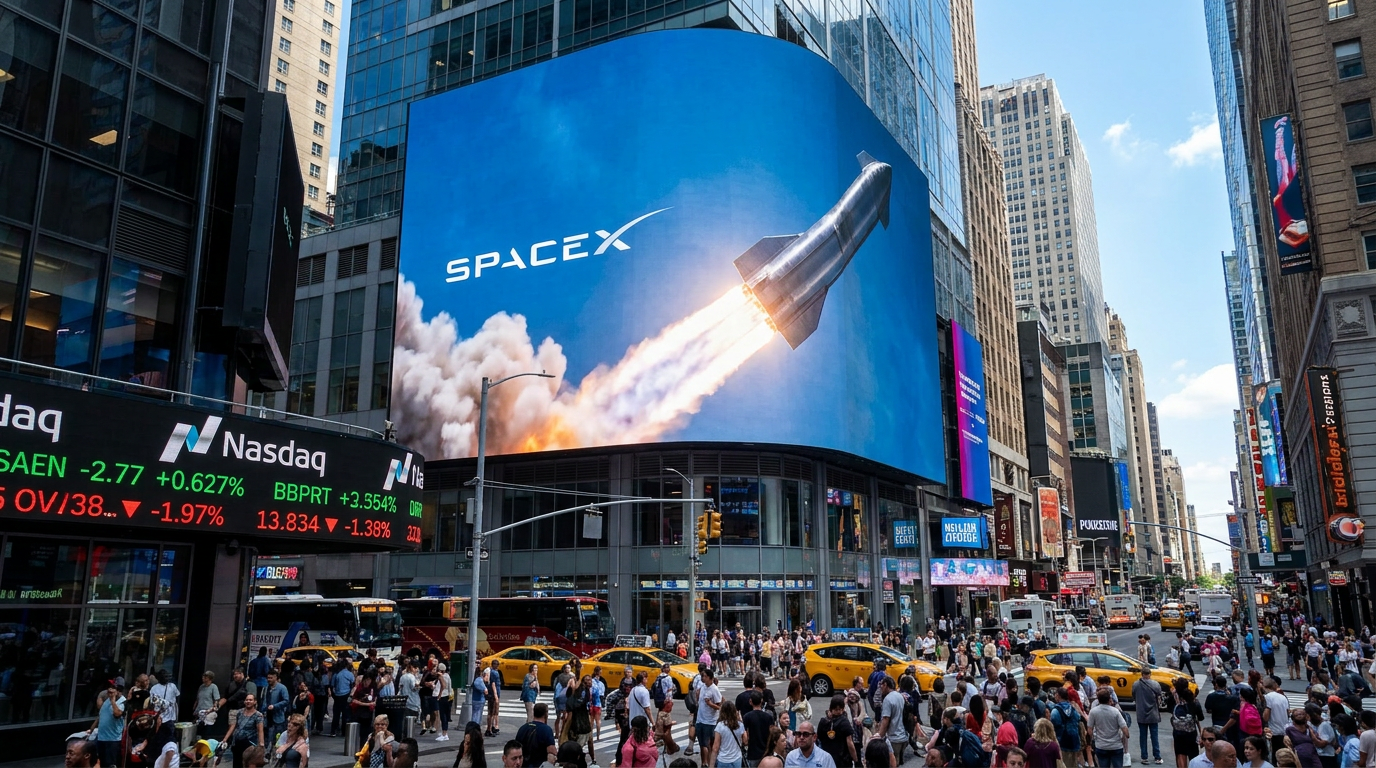
Just days after executing the largest initial public offering in history, SpaceX has fundamentally reordered the hierarchy of global corporate titans. On Tuesday, the aerospace and artificial intelligence conglomerate saw its market capitalization surge past $2.66 trillion, officially overtaking e-commerce giant Amazon to become the fifth-most valuable publicly traded company in the world. The milestone caps a breathtaking three-day rally for the newly minted public entity, which trades on the Nasdaq under the ticker symbol SPCX. Investors have clamored to secure a piece of Elon Musk’s sprawling empire, driving the stock price up nearly 50% from its initial offering price and cementing the company's status as a generational market heavyweight.[1][4]
The momentum was so fierce during Tuesday's trading session that SpaceX’s valuation briefly eclipsed Microsoft’s $2.93 trillion market cap, flirting with the title of the world’s fourth-largest stock before paring back some of those intraday gains. Shares, which debuted at $135 on Friday, rocketed past $213 by Tuesday morning as retail and institutional buyers flooded the order books. Trading volumes were staggering, with more than $52 billion worth of SpaceX shares exchanging hands—the highest turnover among all large U.S.-listed firms and exceeding the combined trading volumes of Nvidia, Microsoft, Tesla, and Apple on the same day.[3][5]
The sheer scale of the public offering has shattered previous Wall Street records. SpaceX initially set out to raise $75 billion, but overwhelming demand led underwriters to fully exercise their "greenshoe" option, purchasing additional shares and bringing the total capital raised to a staggering $85.7 billion. This massive influx of liquidity provides the company with an unprecedented war chest to fund its capital-intensive ambitions, from scaling the Starlink satellite broadband network to accelerating the development of its next-generation Starship rocket system.[3][4]

The meteoric rise of the stock has also rewritten the record books for individual wealth. SpaceX founder and chief executive Elon Musk, who retains roughly half of the company's outstanding shares, saw his personal net worth eclipse the $1.1 trillion mark following the IPO. According to wealth trackers, the surge officially makes Musk the first trillionaire in modern history, placing his fortune more than $1 trillion ahead of the next closest billionaires on the global rich list.[1][7]
Fueling the post-IPO frenzy was a major strategic move announced concurrently with the market surge: SpaceX formally exercised its option to acquire the artificial intelligence coding startup Cursor in a $60 billion all-stock transaction. The acquisition signals a rapid and aggressive consolidation of Musk’s technology assets under the SpaceX corporate umbrella, which recently absorbed his standalone artificial intelligence venture, xAI, earlier in the year.[1][5]
By pairing Cursor’s highly successful AI-powered software engineering tools with SpaceX’s massive Colossus supercomputer infrastructure, the company is positioning itself as a direct challenger to enterprise AI leaders like Microsoft and Anthropic. Cursor's annualized revenue had already topped $4 billion prior to the acquisition, and the integration of its capabilities is expected to supercharge SpaceX's internal software development while opening a highly lucrative new revenue stream in the commercial AI sector.[1][8]
However, market analysts caution that the stock’s breathtaking ascent is being amplified by structural market mechanics rather than pure fundamental valuation. Only about 4% to 5% of SpaceX’s total outstanding shares were made available for public trading on day one, creating an incredibly tight supply. This limited public float, colliding with massive retail and institutional demand, has created a powder keg of volatility, making the stock prone to massive price swings on relatively standard trading volume.[3][5]

However, market analysts caution that the stock’s breathtaking ascent is being amplified by structural market mechanics rather than pure fundamental valuation.
The launch of options trading for SPCX on Tuesday poured additional gasoline on the fire. More than a million options contracts changed hands by early afternoon as traders placed leveraged bets on the stock’s continued rise. Analysts note that this frenzied derivatives activity forces market makers to buy the underlying stock to hedge their positions, creating a feedback loop that artificially inflates the share price in the short term.[3][8]
The market enthusiasm stands in stark contrast to traditional valuation metrics, highlighting a fundamental disconnect between SpaceX and its new mega-cap peers. While Amazon posted $717 billion in revenue and $78 billion in net income last year, SpaceX remains a money-losing enterprise. The aerospace giant generated $18.7 billion in revenue in 2025 but posted a net loss of $4.9 billion, largely driven by heavy capital expenditures in rocket development and data center infrastructure.[1][8]
This financial reality gives the company a staggering price-to-sales ratio of more than 150. To put that premium into perspective, Nvidia—the undisputed darling of the artificial intelligence boom—trades at a trailing 12-month price-to-revenue ratio of roughly 20. Investors are clearly pricing in decades of flawless execution and total market dominance across both the commercial space and artificial intelligence sectors, leaving little room for operational missteps.[3][8]

Despite the eye-watering valuation, the IPO represents a massive shift in how everyday investors access the modern technology economy. For years, SpaceX’s explosive growth and technological breakthroughs were locked behind private equity gates, accessible only to venture capitalists and ultra-high-net-worth individuals. The public listing democratizes that growth, allowing retail investors to directly participate in the commercialization of space and the advancement of frontier AI models.[6]
That democratization will soon become automatic for millions of Americans. SpaceX is slated for fast-track inclusion into major market benchmarks, including the Nasdaq 100, FTSE Russell, and MSCI indexes by the end of June. Once added, passive exchange-traded funds and mutual funds will be forced to buy the stock, meaning everyday workers will soon hold a piece of SpaceX in their 401(k) retirement accounts, inextricably linking the company's success to the broader U.S. economy.[3][6]
As the initial lock-up periods begin to expire later this year—starting with a 20% release of insider shares in August—the market will test whether SpaceX’s valuation can withstand a flood of new supply. But for now, the company’s wildly successful transition to the public markets has vindicated its capital-intensive strategy, proving that Wall Street is more than willing to fund the next frontier of human exploration and computational intelligence.[5][6]
How we got here
April 2026
SpaceX confidentially submits a draft registration statement to the SEC, signaling its intent to go public.
June 12, 2026
SpaceX debuts on the Nasdaq at $135 per share, completing the largest IPO in history and raising $85.7 billion.
June 16, 2026
Shares surge past $213, pushing SpaceX's market capitalization over $2.66 trillion and surpassing Amazon.
Late June 2026
SpaceX is scheduled for fast-track inclusion into major market benchmarks, including the Nasdaq 100 and MSCI indexes.
Viewpoints in depth
Bullish Investors & Retail Traders
Supporters argue the premium valuation is justified by SpaceX's dual monopolies in commercial space and frontier AI.
For retail buyers and bullish institutional funds, traditional valuation metrics like price-to-sales ratios fail to capture SpaceX's true potential. They view the company not just as a rocket manufacturer, but as an unprecedented conglomerate that owns the infrastructure of the future. By combining the Starlink global internet monopoly with xAI's computational power and Cursor's software dominance, bulls argue SpaceX is building an unassailable moat. The intense demand reflects a belief that the company will eventually generate software-like margins across its hardware platforms.
Cautious Market Analysts
Financial experts warn that the stock's meteoric rise is artificially inflated by a tiny public float and speculative options trading.
Market analysts and portfolio managers urge extreme caution, pointing out that SpaceX is currently trading at a staggering 150 times its revenue while still posting multi-billion-dollar net losses. They argue the current $2.66 trillion valuation is distorted by the fact that only 4% to 5% of the company's shares are actually available to trade. When combined with a frenzy of leveraged options trading, this tight supply creates a 'meme-stock' dynamic that could violently reverse when insider lock-up periods expire in August and flood the market with new shares.
Broad Market Optimists
Economic observers celebrate the IPO as a victory for retail investors who can finally access the decade's most important growth story.
Beyond the daily price action, broad market optimists view the SpaceX IPO as a healthy democratization of American capitalism. For over a decade, the immense wealth generated by SpaceX's breakthroughs was captured exclusively by private equity firms and venture capitalists. Now, with the stock slated for fast-track inclusion in major indexes like the Nasdaq 100, everyday workers will benefit from the company's growth through their 401(k)s and mutual funds, tying the success of the space economy to the financial security of the general public.
What we don't know
- How the stock price will react when the first wave of insider lock-up periods expires in August, significantly increasing the public float.
- Whether SpaceX can rapidly scale its revenues to justify a price-to-sales ratio that currently exceeds 150.
- How regulatory bodies will respond to the rapid consolidation of frontier AI capabilities under the SpaceX corporate umbrella.
Key terms
- Market Capitalization
- The total dollar value of a company's outstanding shares of stock, calculated by multiplying the current share price by the total number of shares.
- Greenshoe Option
- A provision in an IPO underwriting agreement that allows the underwriters to sell more shares than originally planned if public demand is exceptionally high.
- Public Float
- The portion of a company's shares that are in the hands of public investors and available to trade, excluding shares held by insiders or restricted from sale.
- Price-to-Sales Ratio
- A valuation metric that compares a company's stock price to its revenues, revealing how much investors are willing to pay per dollar of sales.
Frequently asked
When did SpaceX go public?
SpaceX officially debuted on the Nasdaq exchange on Friday, June 12, 2026, under the ticker symbol SPCX.
How much did the SpaceX IPO raise?
The company initially raised $75 billion, but underwriters exercised a 'greenshoe' option that brought the total proceeds to a record-shattering $85.7 billion.
Why is the stock so volatile?
Only about 4% to 5% of SpaceX's total shares are currently available for public trading. This limited supply, combined with massive investor demand and heavy options trading, has caused significant price swings.
What is Cursor and why did SpaceX buy it?
Cursor is a highly successful AI-powered coding startup. SpaceX acquired it for $60 billion in stock to integrate its software engineering tools with SpaceX's massive supercomputer infrastructure.
Sources
Source coverage
8 outlets
3 viewpoints surfaced








[1]The GuardianBroad Market Optimists
SpaceX overtakes Amazon as world's fifth most valuable company
Read on The Guardian →[2]ForbesBullish Investors & Retail Traders
SpaceX Shares Soared More Than 10% Early Tuesday
Read on Forbes →[3]ReutersCautious Market Analysts
SpaceX vaults past Amazon's market value as options listing fuels surge
Read on Reuters →[4]Business InsiderBullish Investors & Retail Traders
SpaceX leapfrogs Amazon and hits a $2.7 trillion valuation in 3 days of trading
Read on Business Insider →[5]MarketWatchCautious Market Analysts
SpaceX briefly surpassed Microsoft on an intraday basis before surrendering some gains
Read on MarketWatch →[6]The Washington PostBroad Market Optimists
The SpaceX IPO has a bright side. It points to what is working in American capitalism.
Read on The Washington Post →[7]Space.comBullish Investors & Retail Traders
The IPO made Elon Musk the world's first trillionaire
Read on Space.com →[8]BNN BloombergCautious Market Analysts
SpaceX vaults past Amazon's market value as options listing fuels surge
Read on BNN Bloomberg →



Every angle. Every day.
Get business stories with full source coverage and perspective breakdowns delivered to your inbox.