
SpaceX Executes Largest IPO in History, Pushing Valuation Past $2 Trillion
SpaceX debuted on the Nasdaq in a record-shattering $75 billion public offering, surging nearly 20% on its first day of trading. The milestone cemented the aerospace giant's market dominance and made CEO Elon Musk the world's first trillionaire.
By Factlen Editorial Team
- Institutional Investors
- Focuses on the company's massive valuation, driven by its monopoly on commercial launch and Starlink's recurring revenue.
- Retail Investors
- Views the unusual 30% share allocation as a rare, democratized opportunity to participate in a generational technology company.
- Market Watchdogs
- Raises concerns about corporate governance, market concentration, and the societal implications of a trillion-dollar personal fortune.
What's not represented
- · Competitors in the legacy aerospace sector
- · Tax policy advocates
Why this matters
This historic public debut opens the commercial space economy to everyday investors and injects $75 billion into the development of interplanetary travel. It also fundamentally shifts the global wealth landscape, creating the first individual trillion-dollar fortune.
Key points
- SpaceX executed the largest IPO in history, raising $75 billion at a $1.77 trillion valuation.
- Shares debuted on the Nasdaq under the ticker SPCX, closing their first day up nearly 20%.
- The massive market capitalization pushed CEO Elon Musk's net worth past $1 trillion.
- An unusually high 30% of the offering was allocated to retail investors.
- The capital will fund the development of the Starship rocket and the Starlink satellite network.
SpaceX has officially entered the public markets, executing the largest initial public offering in the history of the global stock market. On Friday, June 12, the aerospace and satellite communications giant debuted on the Nasdaq exchange under the ticker symbol SPCX, successfully raising a staggering $75 billion in capital. The monumental offering comfortably unseated Saudi Aramco's $29 billion record set years prior, valuing Elon Musk's pioneering company at $1.77 trillion right out of the gate. The sheer scale of the capital raise underscores the market's immense appetite for commercial space ventures and satellite internet infrastructure.[1][3][6]
The market's reception to the listing was immediate and intensely aggressive. Despite utilizing an unconventional 'accept-it-or-leave-it' fixed IPO price of $135 per share—bypassing the traditional sliding-scale price discovery process—the stock opened trading at $150 just before noon. Momentum only accelerated from there. By the time the closing bell rang in New York, shares had surged nearly 20% to settle at $160.95. This explosive first-day pop pushed SpaceX's total market capitalization past the $2.1 trillion mark, instantly making it one of the most valuable publicly traded companies in the world, leaping ahead of established titans like Broadcom and Tesla.[1][2]

The sheer financial magnitude of the debut had a historic secondary effect: it officially minted the world's first trillionaire. Because founder and CEO Elon Musk controls roughly half of SpaceX's outstanding shares—alongside his massive equity stakes in Tesla, the brain-computer interface startup Neuralink, and the artificial intelligence venture xAI—the Friday surge pushed his estimated personal net worth to $1.1 trillion. The milestone marks a staggering concentration of personal wealth, reflecting the outsized premium investors are currently placing on Musk's portfolio of frontier-technology companies.[1][3]
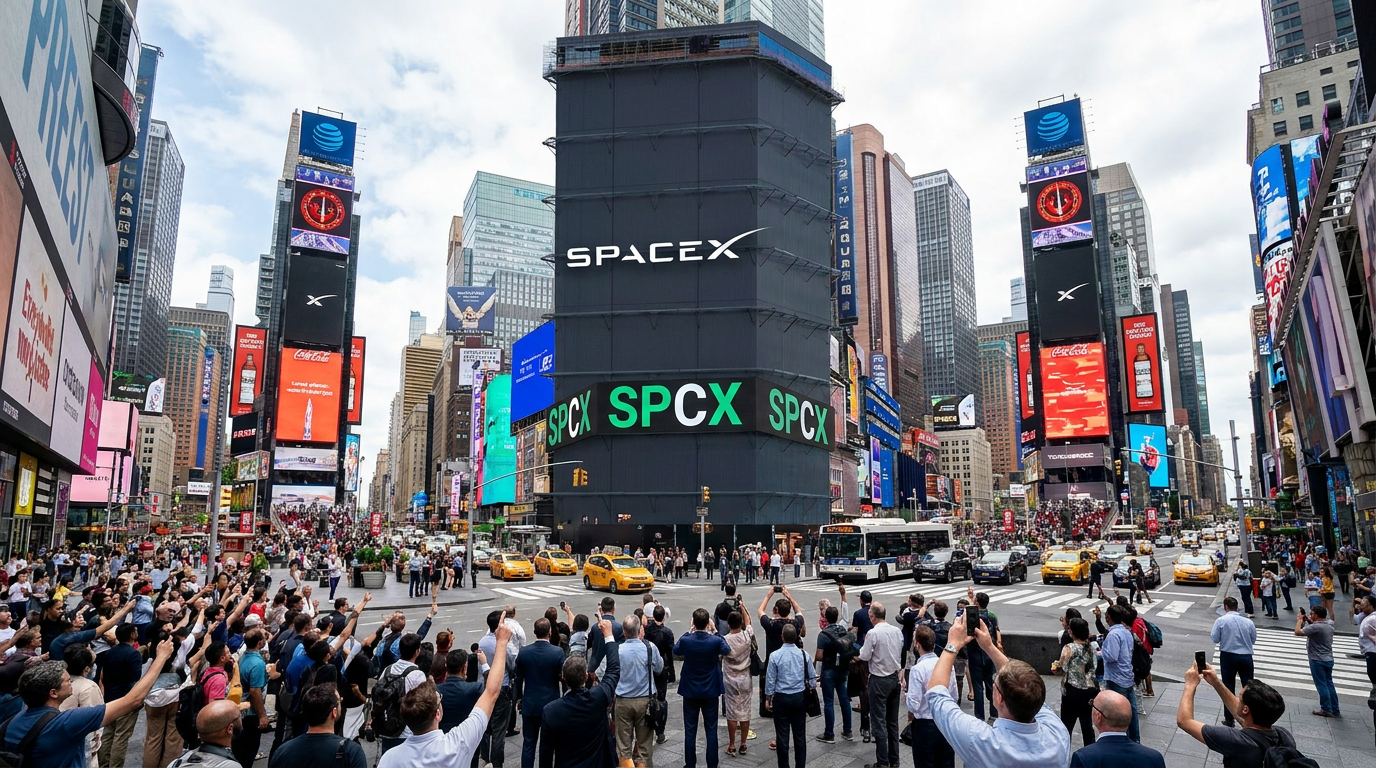
The atmosphere at the Nasdaq exchange in New York City matched the financial gravity of the moment. SpaceX executives, led by President and Chief Operating Officer Gwynne Shotwell, rang the opening bell as Elton John's iconic track 'Rocket Man' played across the bustling trading floor. In a flex of the company's unmatched operational cadence, Shotwell announced to the gathered crowd that SpaceX had already successfully launched a Falcon 9 rocket carrying 29 Starlink satellites from the Cape Canaveral Space Force Station in Florida that very same morning, seamlessly blending Wall Street pageantry with orbital logistics.[1]
The atmosphere at the Nasdaq exchange in New York City matched the financial gravity of the moment.
A defining and highly unusual feature of the SpaceX IPO was its broad accessibility to everyday retail traders. While standard public offerings typically reserve a meager 5% to 10% of shares for retail clients—leaving the vast majority for institutional whales—Musk directed that up to 30% of the SPCX allocation be made available to individual investors. This structural decision triggered a frenzy of retail demand, with major brokerages like Fidelity lowering their standard IPO participation minimums to just $2,000 to accommodate the massive influx of orders from everyday enthusiasts eager to own a piece of the space economy.[5][7]

Institutional appetite was equally voracious, completely overwhelming the available supply of shares. Financial reports indicated that the offering was nearly four times oversubscribed, with total investor demand exceeding $250 billion before the final pricing was even locked in. Wall Street heavyweights moved aggressively to secure their positions in the aerospace monopoly; asset management giant BlackRock alone reportedly placed an order for at least $5 billion in shares. To put that institutional hunger into perspective, BlackRock's single order nearly matched the entire capital raised by the year's previous largest IPO.[2][5]
Financial analysts and market strategists view the successful listing as a major catalyst for the broader technology sector, particularly for the booming artificial intelligence industry. Because SpaceX is closely integrated with Musk's AI startup, xAI, public markets are treating the aerospace IPO as a critical bellwether for a predicted wave of mega-offerings from pure-play AI firms like OpenAI and Anthropic later this year. The massive $75 billion influx of capital is specifically earmarked for SpaceX's most ambitious and capital-intensive projects, primarily the continued development of the fully reusable Starship rocket system and the rapid global expansion of the Starlink satellite internet constellation.[1][3][5]

However, the unprecedented scale of the offering has drawn sharp scrutiny from market watchdogs, progressive lawmakers, and economic equality advocates. Senator Elizabeth Warren formally petitioned the Securities and Exchange Commission to delay the IPO, citing deep concerns over corporate governance structures, retail investor protections, and the outsized influence the $2 trillion company will immediately exert on passive index funds and everyday retirement accounts. Meanwhile, international advocacy groups like Oxfam issued stark public warnings about the democratic and societal implications of a single individual amassing a trillion-dollar fortune, framing the wealth concentration as a systemic risk.[1][2][5]
Despite the political friction and governance debates, the successful listing fundamentally alters the landscape of the commercial space economy. For over two decades, SpaceX operated as a closely guarded private entity, funding its reusable rocket breakthroughs and satellite networks through private funding rounds and lucrative government defense contracts. Now, its financial future—and its explicitly stated mission to make humanity multiplanetary and colonize Mars—is directly tethered to the public markets. The transition invites unprecedented capital to fuel its interplanetary ambitions, but it also subjects the company to relentless quarterly scrutiny and the unpredictable whims of global shareholders.[1][3]
How we got here
April 2026
SpaceX confidentially submits a draft registration statement to the SEC.
May 20, 2026
The SEC publicly discloses SpaceX's S-1 filing, detailing its financials.
June 4, 2026
SpaceX launches its investor roadshow ahead of schedule due to a fast SEC review.
June 11, 2026
SpaceX officially prices its IPO at $135 per share, finalizing the $75 billion raise.
June 12, 2026
Shares begin trading on the Nasdaq, opening at $150 and closing near $161.
Viewpoints in depth
Institutional Investors
Focuses on the company's massive valuation, driven by its monopoly on commercial launch and Starlink's recurring revenue.
Wall Street analysts and institutional funds largely view the $1.77 trillion initial valuation as justified by SpaceX's absolute dominance in the commercial space sector. They point to the rapidly growing, high-margin recurring revenue from the Starlink satellite internet business, as well as the company's deep integration with future AI infrastructure, as primary drivers of long-term value. For these investors, the $75 billion capital injection is a necessary war chest to fund the capital-intensive development of the Starship rocket system.
Retail Investors
Views the unusual 30% share allocation as a rare, democratized opportunity to participate in a generational technology company.
Everyday traders and space enthusiasts see the IPO as a landmark moment for market accessibility. Historically, the most explosive growth of tech giants occurred in private markets, locking out retail investors until valuations were already astronomical. By allocating 30% of the offering to retail accounts, this camp believes SpaceX has democratized access to the space economy, allowing regular individuals to directly fund and profit from the mission to colonize Mars.
Market Watchdogs
Raises concerns about corporate governance, market concentration, and the societal implications of a trillion-dollar personal fortune.
Financial regulators and economic equality advocates view the massive public debut with deep apprehension. They argue that injecting a $2 trillion company directly into public markets will severely distort passive index funds, forcing millions of retirement accounts to heavily weight a single, highly volatile stock. Furthermore, they express alarm over the unprecedented concentration of wealth, warning that a single individual controlling a trillion-dollar fortune poses systemic risks to democratic institutions and market stability.
What we don't know
- How the massive influx of SpaceX stock will impact the weighting and stability of major passive index funds.
- Whether the SEC will take any delayed action regarding the governance concerns raised by lawmakers.
- How public market pressures for quarterly profits will affect SpaceX's long-term, high-risk Mars colonization timeline.
Key terms
- Initial Public Offering (IPO)
- The process by which a private company offers shares of its stock to the public for the first time.
- Market Capitalization
- The total value of a publicly traded company's outstanding shares, calculated by multiplying the share price by the number of shares.
- Retail Investor
- An individual, non-professional investor who buys and sells securities for their personal account.
- Oversubscribed
- A situation in an IPO where investor demand for shares exceeds the total number of shares being offered by the company.
Frequently asked
What is SpaceX's stock ticker symbol?
SpaceX trades on the Nasdaq exchange under the ticker symbol SPCX.
How much did SpaceX raise in its IPO?
The company raised a record-breaking $75 billion, surpassing Saudi Aramco's previous record of $29 billion.
Can regular people buy SpaceX stock?
Yes. In an unusual move, SpaceX allocated up to 30% of its initial shares to retail investors, and the stock is now available on public exchanges.
How did the IPO affect Elon Musk's net worth?
The surge in SpaceX's valuation pushed Musk's estimated net worth to $1.1 trillion, making him the world's first trillionaire.
Sources
Source coverage
7 outlets
3 viewpoints surfaced







[1]The GuardianMarket Watchdogs
SpaceX made the biggest stock market debut in history
Read on The Guardian →[2]ForbesRetail Investors
SpaceX Opened Trading At $150 Following Largest-Ever IPO
Read on Forbes →[3]ZacksInstitutional Investors
Elon Musk's SpaceX broke the record for the world's largest initial public offering
Read on Zacks →[4]BloombergInstitutional Investors
SpaceX Surge Further Boosts Saudi Billionaire Prince’s Fortune
Read on Bloomberg →[5]Capital.comInstitutional Investors
SpaceX IPO targets 12 June 2026 Nasdaq listing
Read on Capital.com →[6]SpaceXRetail Investors
SpaceX Announces Pricing of Initial Public Offering
Read on SpaceX →[7]FidelityRetail Investors
Key dates for the SpaceX Class A IPO
Read on Fidelity →

Every angle. Every day.
Get business stories with full source coverage and perspective breakdowns delivered to your inbox.