
Solid-State EV Batteries Move From Lab to Road in 2026
After years of development, automakers and battery startups are launching pilot production and real-world road tests of solid-state batteries, promising to double EV ranges and slash charging times.
By Factlen Editorial Team
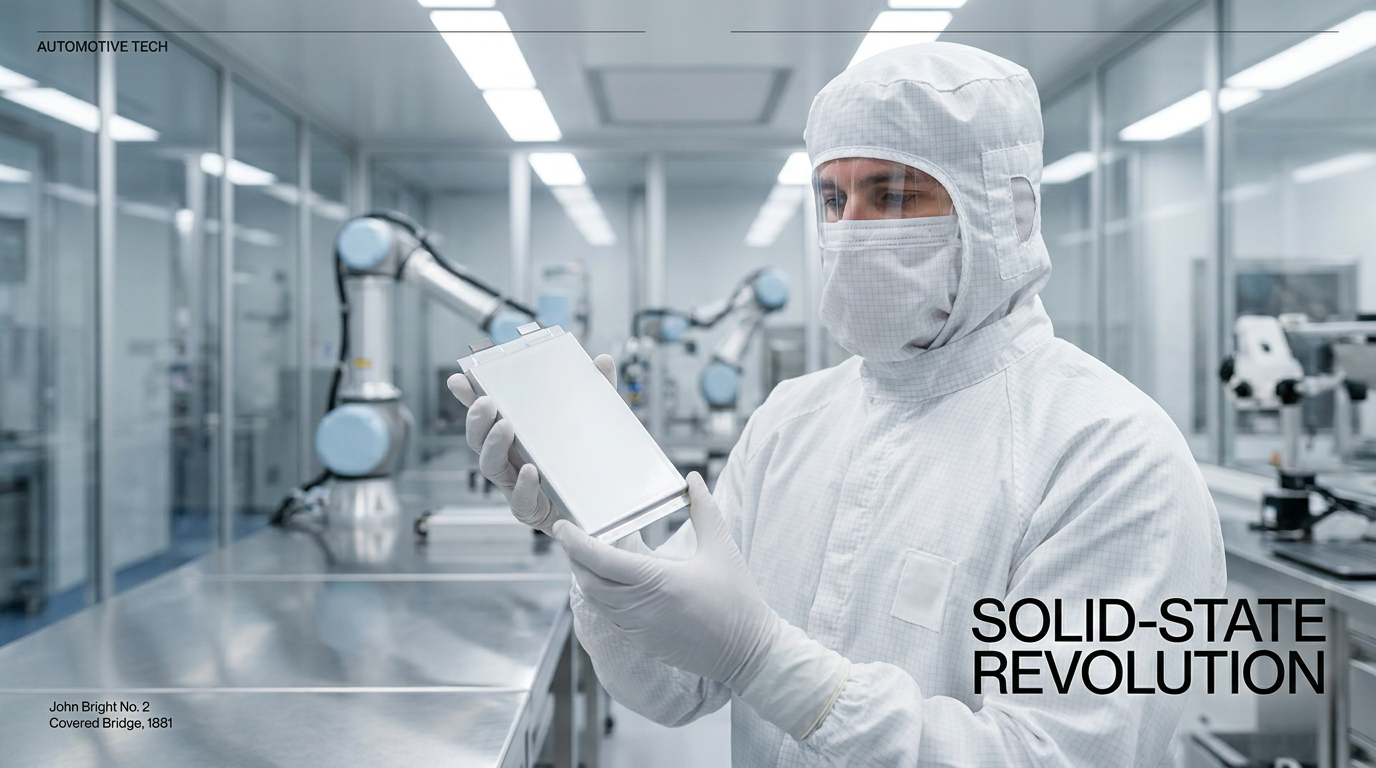
- Battery Innovators
- Startups focused on licensing proprietary solid-state chemistry to legacy automakers.
- Legacy Automakers
- Established manufacturers aiming to integrate the tech to electrify heavy trucks and SUVs.
- Chinese Manufacturers
- Vertically integrated giants aggressively pushing for immediate mass production.
What's not represented
- · Lithium-ion supply chain operators
- · Raw material miners
Why this matters
Solid-state batteries are widely considered the 'holy grail' of electric vehicles. By eliminating flammable liquids and doubling energy density, this technology will make EVs lighter, safer, and capable of traveling over 600 miles on a single 15-minute charge, removing the final barriers to mass adoption.
Key points
- Solid-state batteries replace flammable liquid electrolytes with stable solid materials, virtually eliminating EV fire risks.
- The technology allows for energy densities of up to 450 Wh/kg, doubling current driving ranges.
- Road testing is underway in 2026, with Stellantis integrating the technology into Dodge Charger development vehicles.
- Automakers like Toyota, Nissan, and Dongfeng are racing to scale production for commercial launches by 2028.
- The final hurdle remains manufacturing scale, as producing solid electrolytes requires immense precision and new equipment.
For a decade, solid-state batteries have been the "holy grail" of the electric vehicle industry—a revolutionary technology that always seemed perpetually five years away. Engineers and executives alike have long touted the chemistry as the ultimate solution to range anxiety, charging bottlenecks, and vehicle weight, only to repeatedly push back commercialization dates due to unforeseen manufacturing complexities. But in 2026, the timeline has suddenly collapsed into the present. What was once confined to pristine university laboratories and speculative investor pitch decks is now materializing on factory floors and public highways, signaling a fundamental shift in how the world will power its transportation.[1][2]
Across the globe, from Silicon Valley pilot lines to Chinese mass-production facilities, automakers and battery startups are finally moving solid-state technology out of the laboratory and onto public roads. The transition is happening simultaneously across multiple continents, driven by billions of dollars in joint ventures and government grants. Companies that spent the last five years quietly filing patents and testing single-layer coin cells are now inaugurating highly automated manufacturing lines capable of producing multi-layer cells at scale. This coordinated push represents the most significant leap in energy storage since the commercialization of the lithium-ion battery in the early 1990s.[1][3][4]
The stakes for the automotive industry are monumental, as the first companies to successfully commercialize this technology will likely dictate the next decade of market share. Solid-state batteries promise to double EV driving ranges, cut charging times to under 15 minutes, and virtually eliminate the fire risks associated with current lithium-ion packs. For consumers, this means an electric vehicle experience that finally mirrors the convenience of a internal combustion engine—pulling into a charging station, plugging in for the time it takes to grab a coffee, and driving away with enough range to cross multiple state lines without stopping.[2][3][5]
To understand why this is such a profound breakthrough, one must look at the anatomy of a conventional lithium-ion battery. Today's electric vehicles rely on a liquid electrolyte—an organic solvent that acts as a chemical highway, shuttling lithium ions back and forth between the positive cathode and the negative anode during the charging and discharging cycles. This liquid has been the industry standard for decades because it easily permeates the porous electrode materials, ensuring excellent ionic conductivity and reliable power delivery under normal operating conditions.[7]

While highly effective at conducting ions, this liquid solvent comes with a critical flaw: it is highly flammable. Under extreme stress, such as a severe physical collision that punctures the battery casing, or a software failure that leads to severe overcharging, the liquid can rapidly heat up and ignite. This triggers a dangerous, self-sustaining chain reaction known as thermal runaway, where the heat from one failing cell causes neighboring cells to ignite, resulting in intense, difficult-to-extinguish fires that have occasionally plagued the early generation of electric vehicles.[7]
Solid-state batteries solve this problem by replacing the volatile liquid with a stable, non-flammable solid material—typically a specialized ceramic, a polymer, or a sulfide glass. This fundamental chemistry swap completely alters the safety profile of the vehicle. Because the solid electrolyte is highly resistant to temperature spikes and physical damage, the risk of thermal runaway is virtually eliminated. In comparative testing, solid-state systems can withstand temperatures hundreds of degrees higher than conventional batteries before showing any signs of failure, making them inherently safer for mass-market adoption.[7]
But enhanced safety is only half the story. The introduction of a solid electrolyte unlocks a secondary, even more crucial innovation in battery design: the use of a pure lithium-metal anode. In current lithium-ion batteries, the anode is typically made of graphite, a heavy and bulky material that simply acts as a host structure to hold the lithium ions. By removing the graphite and using pure lithium metal, engineers can drastically reduce the size and weight of the battery while simultaneously increasing the amount of energy it can store.[1][6]
In traditional liquid-based batteries, attempting to use a lithium-metal anode is incredibly dangerous because it encourages the growth of "dendrites." These are microscopic, needle-like metallic whiskers that form on the anode during fast charging. Over time, these dendrites grow long enough to pierce the liquid electrolyte and the thin plastic separator, short-circuiting the battery and instantly causing a fire. The rigid physical barrier of a solid electrolyte suppresses this dendrite growth entirely, acting as a microscopic wall that allows ions to pass through while physically blocking the metallic whiskers, finally allowing engineers to safely harness the power of lithium metal.[6][7]
Over time, these dendrites grow long enough to pierce the liquid electrolyte and the thin plastic separator, short-circuiting the battery and instantly causing a fire.
The result of this chemical synergy is a massive leap in energy density—the metric that defines how much power a battery can store relative to its physical weight. While today's best lithium-ion cells hover around 250 to 300 watt-hours per kilogram (Wh/kg), the new generation of solid-state cells are consistently hitting 350 to 450 Wh/kg. This effectively doubles the energy capacity in the exact same physical footprint, allowing automakers to either build vehicles with 600-mile ranges, or build standard-range vehicles with battery packs that are half the size and weight, dramatically improving vehicle efficiency and handling.[2][3]

This theoretical advantage is no longer confined to white papers; it is actively being proven in real-world applications. In June 2026, automotive giant Stellantis and US-based battery developer Factorial Energy began testing solid-state batteries in Dodge Charger Daytona development vehicles on North American roads. These real-world trials have already demonstrated ultra-fast charging capabilities, bringing the battery from 15% to 90% capacity in just 18 minutes. The successful integration of these cells into Stellantis's STLA Large platform proves that the technology can interface with modern vehicle architectures and handle the rigorous demands of daily driving.[2]
Meanwhile, in California, battery startup QuantumScape recently celebrated a major manufacturing milestone by inaugurating its "Eagle Line" in San Jose. The highly automated pilot facility is currently producing anode-free, lithium-metal cells specifically designed for automotive OEM sampling and testing. This marks a critical transition for the company, moving away from hand-built lab experiments to scalable, machine-driven manufacturing. By utilizing a proprietary continuous-flow manufacturing process, QuantumScape aims to prove to its automotive partners—including Volkswagen—that its unique ceramic separator technology can be produced rapidly and reliably at commercial volumes.[1][6]
The race to achieve true mass production is fiercely competitive, with Chinese manufacturers setting highly aggressive timelines. Dongfeng Motor has announced concrete plans to begin mass-producing solid-state batteries in the second half of 2026. Their latest cells boast an impressive energy density of 350 Wh/kg, which the company claims will deliver a driving range exceeding 1,000 kilometers (620 miles) on a single charge. By leveraging China's massive, vertically integrated battery supply chain, Dongfeng hopes to bypass the pilot-plant phase and move directly into high-volume vehicle integration, potentially beating Western automakers to the consumer market.[3]
Dongfeng's rigorous pre-production testing has also highlighted another major advantage of solid-state chemistry: extreme weather resilience. In severe winter testing conducted earlier this year, the company's solid-state battery packs retained over 74% of their electrical charge at temperatures plunging to -22°F (-30°C). This is a scenario that severely degrades conventional liquid-electrolyte EV batteries, which often lose up to half their range in freezing conditions as the liquid becomes viscous and sluggish. The solid electrolyte's ability to maintain high ionic conductivity in the bitter cold could finally make EVs a practical choice for consumers in extreme northern climates.[3]

Legacy automakers are also accelerating their internal timelines to ensure they are not left behind in this generational shift. Toyota, which holds more solid-state battery patents than any other company in the world, recently secured Japanese government approval to begin production of next-generation cells by 2026. To support this rollout, Toyota has partnered with petroleum giant Idemitsu Kosan to build a large-scale solid electrolyte pilot plant. This facility will produce the specialized sulfide-based materials required for Toyota's batteries, ensuring a stable domestic supply chain as the automaker prepares to launch its first solid-state vehicles in 2027 or 2028.[4]
Nissan is taking a slightly longer view, officially targeting 2028 for the launch of its first solid-state electric vehicle, but the company is making rapid progress behind the scenes. Nissan has already successfully stacked 23-layer battery prototypes that meet the rigorous charge and discharge targets required for automotive use. Furthermore, the company is developing a proprietary dry-electrode manufacturing process that eliminates the need for toxic solvents and massive drying ovens. This manufacturing innovation is designed to significantly cut production costs, ensuring that when Nissan's solid-state vehicles do arrive, they can be priced competitively for the mass market.[5][7]
Despite the rapid progress and successful road tests, the industry still faces a daunting final hurdle: manufacturing scale. Building a flawless solid-state battery in a controlled laboratory or a low-volume pilot line is vastly different from churning out millions of cells per day at gigafactory scale. The solid electrolytes require immense precision to manufacture, as any microscopic defect or impurity can compromise the cell's performance. Furthermore, the industry must build entirely new supply chains for materials like sulfide glass and ultra-thin lithium foil, which are currently only produced in relatively small quantities.[1][3]

Another significant engineering challenge is ensuring perfect microscopic contact between the solid layers. In a traditional battery, the liquid electrolyte naturally flows into every pore of the electrodes, ensuring excellent contact. With solid-state batteries, engineers must find ways to press the solid layers together with enough force to maintain conductivity as the battery expands and contracts during charging, without cracking the brittle ceramic components. Because of these lingering manufacturing complexities, early solid-state vehicles will likely be premium, low-volume flagship models, with the technology taking several years to trickle down to affordable mass-market commuter cars.[1]
Nevertheless, the milestones achieved in 2026 signal a definitive point of no return for the automotive industry. The theoretical debates have ended, and the focus has shifted entirely to execution and scale. As automated production lines spin up in California and Japan, and test vehicles log real-world miles on North American and Chinese highways, the era of range anxiety and heavy, compromised battery packs is rapidly drawing to a close. Solid-state technology has finally arrived, paving the way for a new generation of electric mobility that is safer, lighter, and vastly more capable.[2][4]
How we got here
2020–2023
Battery startups and automakers achieve critical lab breakthroughs, proving solid-state chemistry works at a small scale.
Early 2025
Nissan opens its all-solid-state EV battery pilot production line at its Yokohama plant in Japan.
Feb 2026
QuantumScape inaugurates its Eagle Line in California to begin pilot production of solid-state cells for automakers.
June 2026
Stellantis and Factorial Energy begin real-world road testing of solid-state batteries in Dodge Charger development vehicles.
Late 2026
Chinese automaker Dongfeng targets the start of mass production for its 1,000-km range solid-state battery.
Viewpoints in depth
Battery Innovators
Startups view solid-state chemistry as a fundamental reset of the battery industry that allows new players to license IP to legacy giants.
Companies like QuantumScape and Factorial Energy argue that the transition to solid-state is too complex for traditional automakers to solve entirely in-house. By developing proprietary materials—like QuantumScape's ceramic separator or Factorial's FEST platform—these innovators position themselves as essential technology providers. They emphasize that early pilot lines prove the chemistry works, and the next phase is simply a matter of engineering the manufacturing equipment to scale.
Legacy Automakers
Established car manufacturers view solid-state batteries as the key to unlocking large electric SUVs and trucks without compromising payload.
For giants like Toyota and Nissan, solid-state technology is the ultimate equalizer in the EV race. Nissan executives have noted that the technology's ability to double energy density makes it feasible to electrify heavy pickup trucks and large SUVs that currently suffer from poor range. Legacy automakers are heavily focused on in-house development and joint ventures (like Toyota's partnership with Idemitsu Kosan) to ensure they control the intellectual property and supply chain for the next century of automotive manufacturing.
Chinese Manufacturers
Chinese automakers aim to leverage their existing dominance in battery manufacturing to be the first to achieve true mass production.
While Western and Japanese companies target late-decade rollouts, Chinese firms like Dongfeng are aggressively pushing for mass production as early as 2026. Leveraging China's massive, vertically integrated battery supply chain, these manufacturers are rapidly transitioning from lab prototypes to vehicle integration. They argue that their unparalleled manufacturing scale will allow them to absorb the initially high costs of solid-state production, effectively cornering the market before international rivals can bring their pilot lines up to gigafactory capacity.
What we don't know
- The exact price premium consumers will have to pay for the first generation of solid-state electric vehicles.
- How well the solid electrolytes will resist mechanical degradation over a 10- to 15-year vehicle lifespan.
- Whether the global supply chain can scale the production of specialized solid materials quickly enough to meet automaker targets.
Key terms
- Electrolyte
- The medium inside a battery that allows ions to flow between the positive and negative electrodes during charging and discharging.
- Dendrites
- Microscopic, needle-like metallic structures that can grow inside a battery, potentially piercing internal barriers and causing a short circuit.
- Energy Density
- A measure of how much energy a battery can store relative to its weight, typically expressed in watt-hours per kilogram (Wh/kg).
- Thermal Runaway
- A dangerous chain reaction inside a battery where excess heat causes further heating, potentially leading to a fire or explosion.
- Lithium-Metal Anode
- A highly efficient battery component that stores more energy than traditional graphite anodes, made possible by the protective barrier of a solid electrolyte.
Frequently asked
What makes a solid-state battery different from current EV batteries?
Current EV batteries use a liquid electrolyte to move energy between the anode and cathode. Solid-state batteries replace this liquid with a solid material, like ceramic or polymer, which is safer and allows for more energy storage.
Will solid-state batteries catch fire?
They are significantly safer than traditional lithium-ion batteries. Because they lack a flammable liquid solvent, the risk of thermal runaway and battery fires is virtually eliminated, even in a severe crash.
When can I buy a car with a solid-state battery?
Early models featuring solid-state batteries are expected to hit the market in limited numbers by late 2026 and 2027, with broader mass-market availability projected around 2028 to 2030.
Will they work better in cold weather?
Yes. Testing by manufacturers shows that solid-state batteries retain a much higher percentage of their charge in freezing temperatures compared to liquid-based batteries, which suffer severe range drops in the winter.
Sources
Source coverage
7 outlets
3 viewpoints surfaced







[1]InsideEVsBattery Innovators
QuantumScape Kicked Off Solid-State Battery Pilot Production. The Hard Part's Next
Read on InsideEVs →[2]ElectrekBattery Innovators
Solid-state batteries are now powering EVs in the real world
Read on Electrek →[3]CarsGuideChinese Manufacturers
Dongfeng solid-state batteries to be mass-produced in 2026 with 1000km-plus of driving range to rival BYD and Chery future models
Read on CarsGuide →[4]CBT NewsLegacy Automakers
Toyota to launch solid-state battery production by 2026
Read on CBT News →[5]Motor1.comLegacy Automakers
Nissan Says EV With Solid-State Batteries Is On Track For 2028 Release
Read on Motor1.com →[6]QuantumScapeBattery Innovators
QuantumScape Inaugurates Eagle Line for Solid-State Battery Pilot Production
Read on QuantumScape →[7]Nissan Motor CorporationLegacy Automakers
All-solid-state batteries | Innovation
Read on Nissan Motor Corporation →
Every angle. Every day.
Get transportation stories with full source coverage and perspective breakdowns delivered to your inbox.