
Rivian R2 vs. Tesla Model Y: The 2026 Midsize EV Showdown
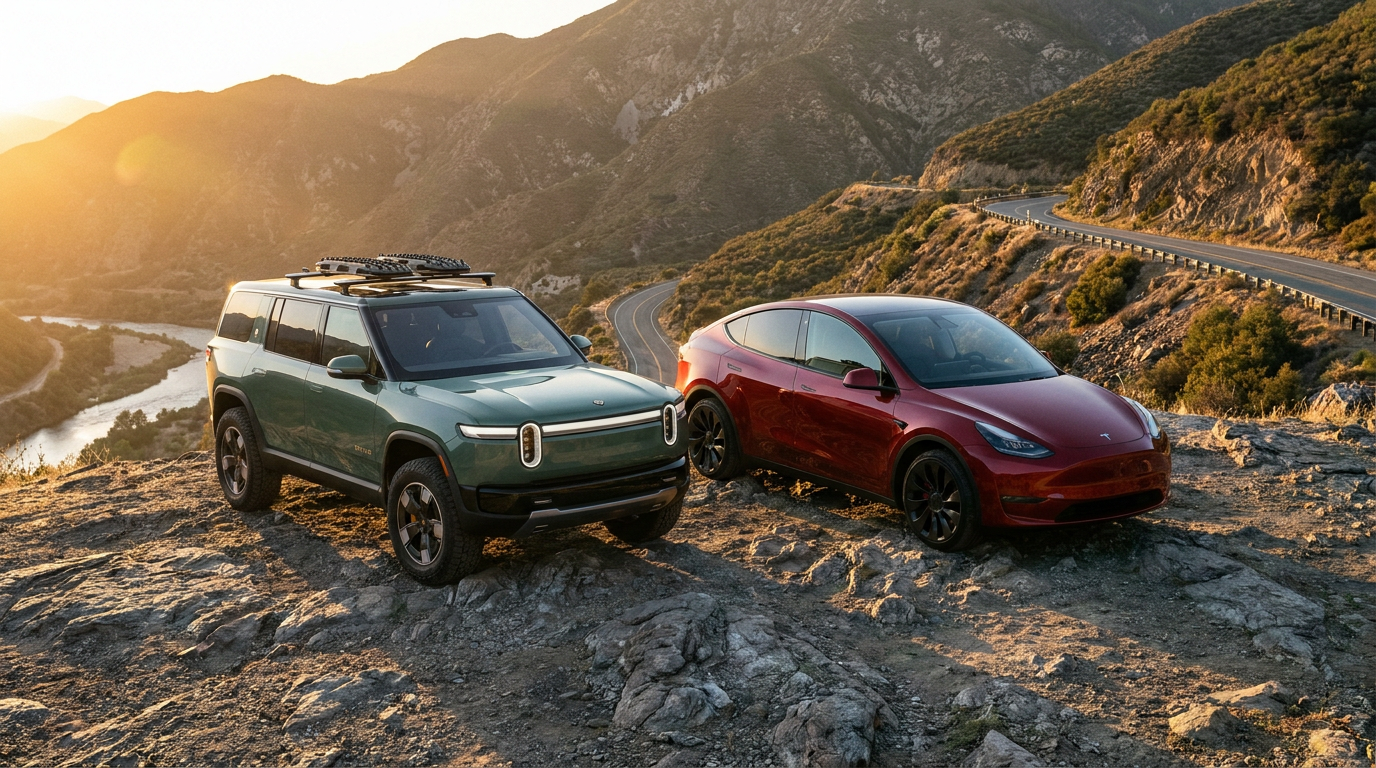
Rivian’s highly anticipated R2 SUV brings rugged off-road utility to the midsize EV segment, challenging the on-road refinement and pricing dominance of the refreshed Tesla Model Y.
By Factlen Editorial Team
- On-Road Efficiency Advocates
- Prioritizes aerodynamic design, fast-charging curves, and sports-sedan handling dynamics.
- Outdoor Utility Enthusiasts
- Values ground clearance, flat-folding cargo space, and rugged off-road capability.
- Value & Availability Shoppers
- Focuses on immediate delivery timelines and the lowest possible entry price.
What's not represented
- · Traditional Automaker Loyalists
- · Urban Commuters
Why this matters
The midsize electric SUV segment is the most fiercely contested battleground in the automotive industry. Choosing between these two heavyweights dictates not just your monthly payment, but whether your vehicle is optimized for efficient highway commuting or off-grid weekend adventures.
Key points
- The 2026 Rivian R2 challenges the Tesla Model Y with a rugged, boxy design and 9.6 inches of ground clearance.
- Tesla maintains a significant pricing advantage for early buyers, with base models starting at $39,990 compared to Rivian's $57,990 launch trim.
- Despite its aerodynamic shape, the Model Y Performance is slightly edged out by the R2 Performance in both range (306 vs 330 miles) and efficiency.
- Rivian offers superior cargo versatility, featuring seats that fold completely flat to provide 90.1 cubic feet of space.
- Both vehicles utilize the NACS charging standard, granting them equal access to the widespread Tesla Supercharger network.
For years, the Tesla Model Y has reigned undisputed over the midsize electric SUV market, blending sports-sedan acceleration with crossover utility to become the best-selling vehicle on the planet. But the automotive landscape of 2026 brings the most credible challenger yet: the Rivian R2. Designed specifically to target the heart of the EV market, the R2 shrinks the rugged, go-anywhere ethos of Rivian’s larger trucks into a more accessible footprint. The resulting matchup forces buyers to choose between two fundamentally different philosophies. Tesla continues to refine its aerodynamic, street-oriented formula with the recent 'Juniper' refresh, while Rivian banks on a boxy, adventure-ready aesthetic that feels more like a traditional SUV.[3][5]
The most immediate divergence between the two vehicles is pricing and availability, which heavily favors Tesla for buyers shopping on a strict budget today. The refreshed Model Y holds a clear advantage at the entry level, starting at an accessible $39,990 for the rear-wheel-drive standard version. In contrast, Rivian is executing a top-down launch strategy. The cheapest R2 available in the spring of 2026 is the fully loaded Performance Launch Edition, which commands $57,990. While Rivian has promised a base model starting around $45,000, those lower-priced trims will not reach driveways until 2027. For a consumer who needs a vehicle immediately and wants to keep their loan under fifty thousand dollars, the Model Y remains the default choice.[3][7][8]
However, when comparing the top-tier trims head-to-head, the financial gap vanishes and the performance metrics become fiercely competitive. The Rivian R2 Performance, priced at $57,990, lines up almost perfectly against the Tesla Model Y Performance, which totals approximately $57,490. At this price point, both vehicles are built in the United States—the Model Y in Texas and the R2 in Illinois—making them equally relevant for buyers tracking domestic-assembly tax incentives. Despite the Rivian producing a staggering 656 horsepower, the lighter and more aerodynamic Tesla remains slightly quicker in a straight line, rocketing to sixty miles per hour in just 3.3 seconds compared to the R2’s 3.6-second sprint.[3][4][6]
Efficiency and range present a surprising twist in this rivalry. Conventional automotive wisdom suggests that a sleek, teardrop-shaped crossover will always outlast a blunt, boxy SUV on a single charge. Yet, the Rivian R2 Performance achieves an EPA-estimated 330 miles of range, comfortably beating the 306-mile rating of the Model Y Performance. Furthermore, the R2 secures a 109 MPGe combined rating against the Tesla’s 104 MPGe. This means the Rivian is roughly five percent more efficient, despite carrying an extra 370 pounds of mass and standing three inches taller. It is a remarkable engineering feat that confirms Rivian’s new platform is genuinely competitive with Tesla’s industry-leading battery management.[2][6]

When it comes time to replenish those batteries, the playing field has been completely leveled. Both the 2026 Model Y and the Rivian R2 feature native North American Charging Standard (NACS) ports, granting both vehicles seamless, adapter-free access to the sprawling Tesla Supercharger network. Tesla still maintains a slight edge in charging curve optimization, completing a fast charge from ten to eighty percent in roughly 24 to 26 minutes. The Rivian requires about 29 minutes for the same task. While Tesla’s longer track record in battery thermal management shows, neither vehicle puts its owner at a meaningful disadvantage during a cross-country road trip.[3][8]
When it comes time to replenish those batteries, the playing field has been completely leveled.
The exterior design of these two vehicles dictates their physical capabilities, particularly when the pavement ends. The Model Y continues its legacy of futuristic curves, sitting relatively low to the ground with 6.6 inches of clearance. It is undeniably a street-oriented crossover. The Rivian R2, meanwhile, boasts a massive 9.6 inches of ground clearance, outclassing the Tesla by sixty percent. Combined with aggressive approach and departure angles and 32-inch tires, the R2 offers genuine off-road capability. It can navigate rocky trails and deep ruts that would easily scrape the underbelly of the Model Y, making it the clear victor for outdoor enthusiasts.[1][2][6]
Stepping inside the cabin reveals two vastly different approaches to interior technology and driver focus. Tesla famously omits a traditional instrument cluster, forcing the driver to glance at the central 15-inch touchscreen for speed, navigation, and vehicle status. While the recent Juniper refresh added better soundproofing and softer materials, the minimalist ethos remains polarizing. Rivian addresses this common complaint directly by providing a dedicated 12.3-inch digital gauge cluster right behind the steering wheel, complementing its own 15.6-inch main display. The R2’s interface features playful, high-resolution graphics that give the vehicle a distinct personality, contrasting sharply with the clinical, spreadsheet-like efficiency of Tesla’s software.[1][5]
Material choices further separate the two interiors. Both automakers emphasize sustainable, vegan leatherette, but the Rivian elevates the tactile experience by incorporating extensive open-pore wood trim and dual gloveboxes. The R2’s cabin feels flooded with light thanks to its upright windows and massive glass roof, offering excellent natural visibility over a flat hood. Tesla’s sloping roofline cuts into rearward visibility, though its streamlined dashboard creates an undeniable sense of airy openness. Early reviewers note that while Tesla has vastly improved its build quality and cabin quietness with the 2026 updates, the Rivian’s interior feels slightly more premium and solidly constructed.[1][4][5]

For families and gear-heavy travelers, cargo capacity is often the deciding factor, and here the Rivian’s boxy dimensions pay massive dividends. While second-row legroom is nearly identical at around 40 inches for both vehicles, the R2’s party trick is a seating system that folds completely flat—including the front seats. This transforms the cabin into a cavernous 90.1 cubic feet of total storage, effectively turning the SUV into a camper van. The Model Y provides a respectable 76 cubic feet of space, but its seats do not fold perfectly flat. However, the Tesla remains the only vehicle in this matchup to offer an optional, albeit cramped, third row for seven-passenger capacity.[1][2][6]
The storage battle extends to the front of the vehicles, where both utilize the space traditionally occupied by a gas engine. The Rivian R2 offers a 5.2-cubic-foot frunk, noticeably larger than the Model Y’s 4.1-cubic-foot compartment. While a single cubic foot may sound trivial on paper, it makes a tangible difference when packing muddy hiking boots, charging cables, or an extra duffel bag for a weekend getaway. Every bit of compartmentalized storage counts for family road trips, and Rivian’s dedication to maximizing these small utility spaces reinforces its branding as the ultimate adventure companion.[2]
On the open road, the differing centers of gravity dictate the driving dynamics. The Model Y, sitting lower and utilizing a highly refined adaptive suspension, drives much like a planted sports sedan. It corners flatly, exhibits minimal body roll, and begs to be pushed on winding canyon roads. The taller Rivian R2, while astonishingly quick in a straight line, cannot hide its height. Drivers will experience more noticeable body roll during sharp cornering, a natural trade-off for its superior ground clearance. However, that same long-travel suspension allows the R2 to absorb potholes and broken pavement far better than the stiffer Tesla, providing a more comfortable ride on poorly maintained city streets.[3][4]

Ultimately, the decision between the 2026 Rivian R2 and the Tesla Model Y is not a question of which vehicle is objectively superior, but which set of compromises best fits the buyer's lifestyle. Tesla offers an unbeatable combination of immediate availability, lower entry pricing, sports-car handling, and the industry’s most mature software ecosystem. Rivian counters with unmatched cargo versatility, genuine off-road chops, superior range in its top trim, and a character-rich design that stands out in a sea of aerodynamic teardrops. As the EV market matures, consumers finally have the luxury of choosing a vehicle that perfectly aligns with their specific daily needs and weekend aspirations.[3][5][8]
How we got here
2020
Tesla launches the Model Y, which quickly becomes the best-selling electric vehicle globally.
March 2024
Rivian officially unveils the R2 midsize SUV, targeting the exact segment dominated by the Model Y.
Early 2026
Tesla releases the highly anticipated 'Juniper' refresh for the Model Y, upgrading its interior and ride quality.
Spring 2026
The first Rivian R2 Performance Launch Edition models begin reaching customers.
2027
Rivian plans to release the entry-level $45,000 R2 trims to compete directly with the base Model Y.
Viewpoints in depth
The Rivian R2 Buyer
Prioritizes outdoor versatility, distinctive boxy design, and maximum cargo utility over on-road sports handling.
The case for the R2 rests on its massive 90.1 cubic feet of flat-folding cargo space and 9.6 inches of ground clearance, making it a true utility vehicle. The case against it centers on a higher initial launch price of $57,990 and a taller center of gravity that introduces noticeable body roll on paved roads. Evidence from early EPA testing shows it achieves an impressive 109 MPGe and 330 miles of range, proving its boxy shape does not ruin efficiency. This vehicle fits well when buyers want a rugged adventure platform that can double as a camper or gear-hauler. It does not fit when a buyer needs a budget-friendly entry-level EV immediately or prefers the planted, flat-cornering handling of a sports sedan.
The Tesla Model Y Buyer
Values immediate availability, lower entry pricing, and proven on-road efficiency.
The case for the Model Y is anchored by its highly accessible $39,990 starting price and sports-car-like 3.3-second sprint to 60 mph in the Performance trim. The case against it involves a minimalist interior that lacks a dedicated driver display, a smaller 4.1-cubic-foot frunk, and a ubiquitous design that blends into traffic. Evidence points to its superior fast-charging curve, completing a 10-to-80 percent charge in roughly 24 minutes thanks to years of software optimization. This vehicle fits well when buyers prioritize a refined, street-oriented commute and access to the most mature software ecosystem on the market. It does not fit when the weekend itinerary includes rocky trails, deep ruts, or sleeping in the back of the cabin.
What we don't know
- Whether Rivian can successfully scale production to meet the high demand for the R2 without delays.
- How the entry-level $45,000 Rivian R2 trims will perform in real-world testing once they launch in 2027.
Key terms
- NACS
- North American Charging Standard, the charging plug design originally developed by Tesla and now adopted by most major automakers, including Rivian.
- MPGe
- Miles Per Gallon Equivalent, a metric used by the EPA to compare the energy efficiency of electric vehicles to traditional gas-powered cars.
- Juniper Refresh
- The unofficial industry name for the 2026 update to the Tesla Model Y, which introduced better soundproofing, upgraded materials, and a refined suspension.
- Frunk
- A front trunk, utilizing the space under the hood where a traditional internal combustion engine would normally sit.
Frequently asked
Can the Rivian R2 use Tesla Superchargers?
Yes, the 2026 Rivian R2 comes equipped with a native NACS charge port, allowing adapter-free access to the Tesla Supercharger network.
Which vehicle offers more cargo space?
The Rivian R2 provides 90.1 cubic feet of total storage with its seats folded completely flat, surpassing the Model Y's 76 cubic feet.
Is the Rivian R2 available to buy right now?
The high-end Performance trim launches in spring 2026, but the more affordable entry-level trims will not be available until 2027.
Does the Tesla Model Y have a driver display?
No, the Model Y continues to rely entirely on its central touchscreen for all driving information, whereas the Rivian R2 includes a dedicated 12.3-inch digital gauge cluster.
Sources
Source coverage
8 outlets
3 viewpoints surfaced








[1]CarConfectionsOutdoor Utility Enthusiasts
Rivian R2 vs Tesla Model Y review 2026
Read on CarConfections →[2]CarBuzzOutdoor Utility Enthusiasts
Rivian Has Built The Superior Off-Roader
Read on CarBuzz →[3]Road EthosOn-Road Efficiency Advocates
Rivian R2 Vs. Tesla Model Y: An Honest Comparison For 2026 Buyers
Read on Road Ethos →[4]Bearded TeslaValue & Availability Shoppers
I finally got behind the wheel of the all-new Rivian R2!
Read on Bearded Tesla →[5]EdmundsValue & Availability Shoppers
The Rivian R2 hits the heart of the EV market
Read on Edmunds →[6]ElectrekOutdoor Utility Enthusiasts
Rivian R2 vs Tesla Model Y spotted side-by-side: Detailed size comparison
Read on Electrek →[7]Rivian ForumsValue & Availability Shoppers
2027 R2 vs. Model Y - Pricing & Ranges Comparison
Read on Rivian Forums →[8]AutoNocionOn-Road Efficiency Advocates
Is the Rivian R2 actually competing with the Tesla Model Y?
Read on AutoNocion →

Every angle. Every day.
Get automotive stories with full source coverage and perspective breakdowns delivered to your inbox.