
How Solid-State Batteries Will Transform Electric Vehicles
After years of laboratory development, solid-state battery technology is entering pilot production, promising to double EV range, slash charging times, and virtually eliminate battery fires.
By Factlen Editorial Team
- Legacy Automakers
- Incumbents view in-house solid-state development as a way to reclaim EV leadership and control their supply chains.
- Battery Tech Innovators
- Startups and specialized firms focus on licensing breakthrough chemistry rather than building vehicles.
- Industry Analysts
- Manufacturing experts caution that scaling the technology will be a slow, expensive process initially limited to luxury cars.
What's not represented
- · Lithium-ion manufacturers defending current tech
- · Raw material mining sector
Why this matters
Solid-state batteries solve the three biggest hurdles to EV adoption: range anxiety, long charging stops, and cold-weather performance. When commercialized, this technology will make electric vehicles as convenient to refuel and operate as traditional gas-powered cars.
Key points
- Solid-state batteries replace flammable liquid electrolytes with solid ceramics or polymers.
- The technology prevents dendrite growth, allowing for pure lithium metal anodes.
- Energy density is expected to double, pushing EV ranges past 600 miles.
- Major automakers and startups are targeting 2027-2028 for the first commercial vehicle launches.
For the past decade, the electric vehicle revolution has been powered by a single, ubiquitous technology: the lithium-ion battery. It is the workhorse of the modern era, propelling everything from smartphones to grid storage and millions of cars. Yet, as EV adoption scales globally, the inherent limitations of lithium-ion chemistry—range ceilings, prolonged charging times, and cold-weather degradation—have become the primary friction points for hesitant buyers.[1]
Enter the solid-state battery. Long described by engineers as the "holy grail" of energy storage, this technology is finally transitioning from laboratory theory to industrial reality. In 2026, the battery industry has crossed a critical threshold, moving from benchtop prototypes to active pilot production lines. This shift promises to fundamentally rewrite the capabilities of electric mobility, offering a leap in performance rather than an incremental step.[1][7]
To understand why solid-state technology is so transformative, one must first look at how current batteries operate. In a standard lithium-ion cell, energy is stored and released as lithium ions shuttle back and forth between two electrodes—the anode and the cathode. This movement is facilitated by a liquid electrolyte, a chemical solution that acts as the highway for the ions.[6][7]
While effective, this liquid electrolyte is the source of lithium-ion's greatest vulnerabilities. The organic solvents used are highly flammable. Under extreme stress, such as a severe physical impact, overcharging, or a manufacturing defect, the liquid can ignite, leading to a dangerous chain reaction known as thermal runaway.[7]
Furthermore, liquid electrolytes are susceptible to the formation of dendrites. These are microscopic, needle-like metallic structures that can grow from the anode during rapid charging. If a dendrite pierces the porous separator dividing the electrodes, it causes a short circuit, effectively killing the battery and potentially sparking a fire.[7]

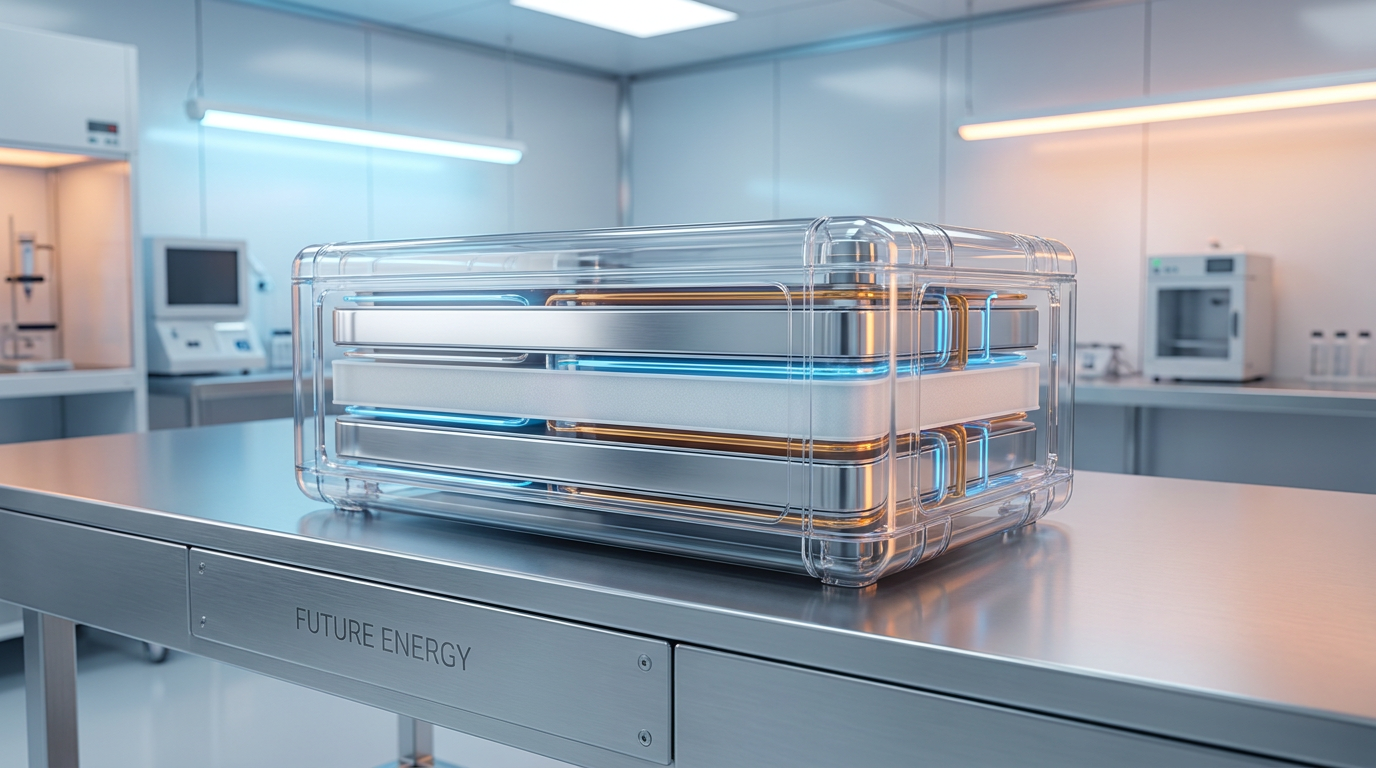
The solid-state breakthrough lies in a deceptively simple substitution: replacing the flammable liquid electrolyte with a solid material. Engineers are utilizing advanced ceramics, polymers, or sulfide-based glasses to act as both the electrolyte and the physical separator. This solid barrier allows lithium ions to pass through while physically blocking the growth of destructive dendrites.[7]
The immediate and most profound benefit of this architecture is safety. Solid electrolytes are inherently non-flammable. Comparative testing has shown that thermal events in solid-state systems do not begin until temperatures reach approximately 247°C, a stark contrast to the 90°C threshold where conventional lithium-ion batteries begin to destabilize. This virtually eliminates the risk of catastrophic battery fires.[7]
Beyond safety, the solid barrier unlocks a massive leap in energy density—the amount of energy stored per kilogram of weight. Because the solid electrolyte prevents dendrite growth, battery manufacturers can replace the bulky graphite anodes used today with pure lithium metal. This "golden combination" of lithium metal and a solid electrolyte dramatically shrinks the size and weight of the cell.[1][7]
Beyond safety, the solid barrier unlocks a massive leap in energy density—the amount of energy stored per kilogram of weight.
Today's best commercial lithium-ion batteries deliver an energy density of roughly 200 to 300 Watt-hours per kilogram (Wh/kg). The first generation of commercial solid-state batteries is targeting 400 to 500 Wh/kg, effectively doubling the energy storage capacity without increasing the physical footprint of the battery pack.[7]

For the driver, this translates directly into unprecedented range. Automakers developing solid-state vehicles are projecting single-charge ranges of 620 to 745 miles (1,000 to 1,200 kilometers). This effectively neutralizes range anxiety, allowing an EV to travel from New York to Detroit, or London to Berlin, without a single charging stop.[3][4]
When a stop is finally required, the charging experience will closely mirror the time spent at a traditional gas station. Because solid-state batteries are highly resistant to the heat generated by rapid energy transfer, they can accept a massive influx of power without degrading. Leading developers have demonstrated the ability to replenish a battery from 10% to 80% capacity in just 10 to 15 minutes.[4][5]
Solid-state chemistry also solves one of the most frustrating quirks of current EVs: winter range loss. Liquid electrolytes become viscous and sluggish in freezing temperatures, forcing the battery to expend its own energy just to keep itself warm. Solid electrolytes remain stable and conductive in extreme cold, ensuring that a vehicle retains its power and range even in sub-zero climates.[1][7]
The race to commercialize this technology has accelerated dramatically in 2026. Traditional automotive giants are pouring billions into in-house development. Toyota, which has amassed over a thousand patents in the space, has laid out a roadmap to introduce its first solid-state EVs by 2027 or 2028, partnering with energy firms to secure the necessary solid electrolyte materials.[4][7]
Nissan is operating on a similarly aggressive timeline. In early 2026, the automaker showcased its under-construction all-solid-state battery pilot line at its Yokohama plant. Nissan aims to launch its first in-house developed solid-state EV by fiscal year 2028, utilizing proprietary dry-electrode manufacturing techniques to drive down production costs.[2][3][6]

Alongside the legacy automakers, specialized battery technology companies are making significant strides. QuantumScape, a prominent startup backed by Volkswagen, inaugurated its "Eagle Line" pilot facility in early 2026. This highly automated line is designed to prove that its proprietary lithium-metal solid-state cells can be manufactured at scale, producing samples for automotive partners to test in real-world conditions.[5]
Rather than building its own gigafactories, QuantumScape is pursuing a licensing model. By acting as a technology developer and partnering with established manufacturers to produce the cells, the company aims to become the "Intel Inside" of the next-generation EV market, supplying its breakthrough separator technology across the industry.[5]
Despite the rapid progress, significant manufacturing hurdles remain. Building a solid-state battery requires extreme precision; the solid layers must maintain perfect contact with one another as the battery expands and contracts during charging. Scaling these delicate processes from a controlled pilot line to a factory churning out millions of cells annually is a monumental engineering challenge.[1][7]
Consequently, the rollout of solid-state vehicles will be gradual. When these batteries first hit the market in the late 2020s, they will likely be reserved for premium, high-performance vehicles where the high initial cost of the new technology can be absorbed. Mass-market adoption will follow in the 2030s as economies of scale drive down production expenses.[7]

In the interim, the EV market will be bridged by advanced lithium-ion chemistries and semi-solid batteries, which use a hybrid of solid and liquid components. But the trajectory is now clear. The transition to fully solid-state batteries is no longer a question of if, but when—promising to deliver the definitive electric vehicle experience the world has been waiting for.[1][7]
How we got here
2010s
Early laboratory research proves the theoretical viability of solid-state lithium-metal chemistry.
Late 2023
Toyota announces a major breakthrough in solid-state durability, targeting a 2027 commercial launch.
Early 2026
QuantumScape inaugurates its 'Eagle Line' pilot facility to produce solid-state cells for automotive testing.
2027–2028
Projected launch window for the first consumer electric vehicles powered by fully solid-state batteries.
Viewpoints in depth
Legacy Automakers
Incumbents like Toyota and Nissan view in-house solid-state development as a way to reclaim EV leadership.
For traditional automotive giants, solid-state technology represents a reset button. Companies that were perceived as slow to adopt conventional lithium-ion EVs are investing heavily in proprietary solid-state research. By developing the chemistry and manufacturing processes in-house, they aim to secure their supply chains and offer a product that leapfrogs the current market leaders in range and charging speed.
Battery Tech Innovators
Startups and specialized firms focus on licensing breakthrough chemistry rather than building vehicles.
Companies like QuantumScape approach the market as pure technology developers. Rather than taking on the massive capital expense of building gigafactories or entire vehicles, they focus on perfecting the complex materials science—such as the solid ceramic separator. Their goal is to prove the technology on pilot lines and then license the manufacturing blueprints to established automakers and battery producers.
Industry Realists
Manufacturing experts caution that scaling the technology will be a slow, expensive process.
While the laboratory performance of solid-state cells is undeniable, manufacturing analysts emphasize the extreme difficulty of mass production. Building these batteries requires unprecedented precision to maintain contact between solid layers as the cell expands and contracts. Realists argue that while the technology will arrive by 2028, it will initially be confined to high-end luxury vehicles, with mass-market parity still a decade away.
What we don't know
- The exact price premium solid-state batteries will carry when they first hit the consumer market.
- Which specific manufacturing technique (e.g., dry-electrode casting vs. polymer extrusion) will prove most scalable.
- How quickly the existing lithium-ion supply chain can pivot to support solid-state material demands.
Key terms
- Solid-State Battery
- A battery technology that uses a solid electrode and a solid electrolyte, instead of the liquid or polymer gel electrolytes found in lithium-ion batteries.
- Electrolyte
- The medium inside a battery that allows electrical charge (ions) to flow between the cathode and anode.
- Energy Density
- The amount of energy a battery can store relative to its weight or size, typically measured in Watt-hours per kilogram (Wh/kg).
- Dendrites
- Microscopic, needle-like metallic structures that can grow inside a battery during charging, potentially causing short circuits and fires.
Frequently asked
When will solid-state EVs be available to buy?
Early models are expected to debut between 2027 and 2028, primarily in premium or luxury segments. Mass-market availability will likely take until the early 2030s as production scales up.
Are solid-state batteries safer than current EV batteries?
Yes. By replacing the flammable liquid electrolyte with a solid ceramic or polymer, solid-state batteries virtually eliminate the risk of thermal runaway and battery fires.
Will solid-state batteries fix cold-weather range loss?
Largely, yes. Solid electrolytes remain stable and conductive in freezing temperatures, meaning the battery won't lose significant power or require as much energy to heat itself in the winter.
Sources
Source coverage
7 outlets
3 viewpoints surfaced







[1]Factlen Editorial TeamIndustry Analysts
Synthesis by Factlen editorial team
Read on Factlen Editorial Team →[2]BatteryTech OnlineIndustry Analysts
Nissan's Solid-State Plans Revealed: SSB-Powered EVs by 2029
Read on BatteryTech Online →[3]ElectrekBattery Tech Innovators
Nissan's first EV powered by solid-state batteries is on track for 2028
Read on Electrek →[4]Car and DriverLegacy Automakers
Toyota Lays Out Its EV Battery Road Map, Including a Solid-State Battery
Read on Car and Driver →[5]QuantumScapeBattery Tech Innovators
QuantumScape Inaugurates Eagle Line Pilot for Solid-State Battery Production
Read on QuantumScape →[6]Nissan GlobalLegacy Automakers
All-Solid-State Batteries (ASSBs)
Read on Nissan Global →[7]Electric Car SchemeIndustry Analysts
Solid-state: the battery everyone is waiting for
Read on Electric Car Scheme →
Every angle. Every day.
Get automotive stories with full source coverage and perspective breakdowns delivered to your inbox.