
Remarkable Fossils Prove Early Land Animals Skipped the Tadpole Stage
Exceptionally preserved 308-million-year-old fossils reveal that the first four-limbed vertebrates hatched as miniature adults, overturning 150 years of evolutionary theory about how animals conquered land.
By Factlen Editorial Team
- Paleontology Researchers
- Argue that the new fossils completely rewrite the narrative of the fin-to-limb transition.
- Evolutionary Biologists
- Acknowledge the physical proof while noting specialists already suspected diverse early life cycles.
- Science Educators
- Face the challenge of updating a 150-year-old curriculum standard regarding vertebrate evolution.
What's not represented
- · Modern Amphibian Specialists
Why this matters
For over a century, biology textbooks have taught that the first animals to walk on land used a tadpole-like metamorphosis to bridge the gap between water and earth. This discovery rewrites that fundamental chapter of evolutionary history, proving that our earliest four-limbed ancestors actually hatched as fully formed miniature adults.
Key points
- 308-million-year-old fossils from Illinois show early tetrapods hatched as miniature adults.
- The hatchlings lacked external gills and other features of an amphibian-like tadpole stage.
- This disproves the 150-year-old theory that metamorphosis was required to transition from water to land.
- The fossils include baby embolomeres, ancient predators that resembled crocodile-eel hybrids.
- Amphibian metamorphosis is now understood to be a later evolutionary adaptation, not an ancestral trait.
For more than a century, the story of how vertebrates conquered the land has been anchored by a seemingly logical assumption: the earliest four-limbed animals must have transitioned from water to earth much like modern frogs do today. Paleontologists theorized that pioneering tetrapods relied on an aquatic larval phase—complete with external gills—before undergoing a dramatic metamorphosis into air-breathing, land-dwelling adults.[4][5]
This textbook narrative suggested that a tadpole stage was the crucial evolutionary tool that allowed early vertebrates to practice breathing air and moving on limbs while still enjoying the safety of an aquatic environment. It was a neat, intuitive explanation for one of the most significant biological transitions in Earth's history.[2][5]
But a new study published in the journal Science has abruptly dismantled that 150-year-old paradigm. Exceptionally preserved fossils from the Mazon Creek deposits in Illinois reveal that the first animals with limbs never went through a tadpole stage at all. Instead, they hatched from their eggs looking like miniature adults, ready to feed and survive.[1][4][5]
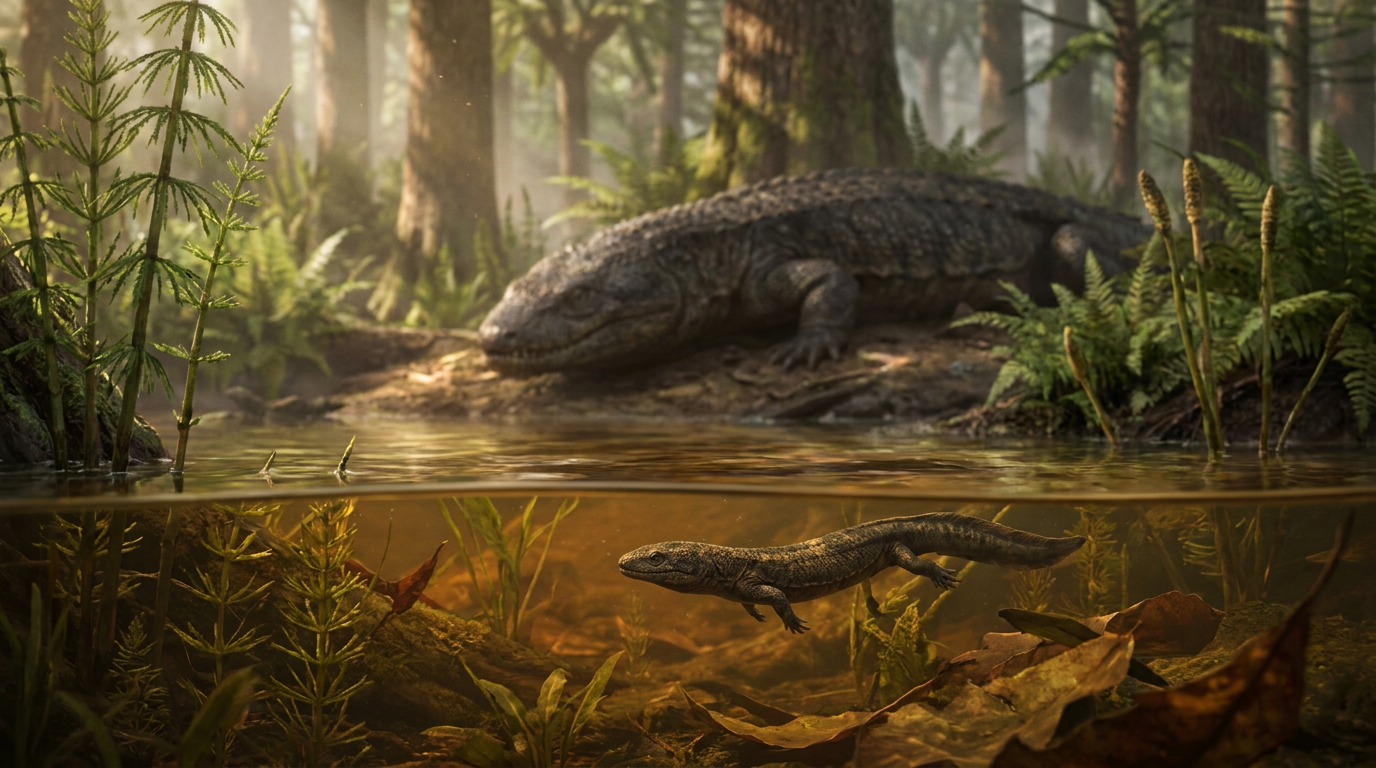
The research, led by Jason Pardo of the Field Museum of Natural History and Arjan Mann of the Lauer Foundation for Paleontology, examined the hatchlings of three different ancient animals related to the earliest land-goers. The centerpiece specimens were baby embolomeres—ancient, apex predators that resembled a cross between a crocodile and an eel.[1][2][3]

Dating back roughly 308 million years to the Carboniferous period, these hatchlings were only days or weeks old when they died. While adult embolomeres could grow to more than 10 feet in length, the fossilized babies were tiny. Yet, under scanning electron microscopes, they revealed a stunning level of anatomical maturity.[2][3]
The evidentiary record is definitive: the hatchlings completely lack the features associated with an amphibian-like larval stage. The researchers found no trace of the frilly external gills that characterize modern tadpoles and salamander larvae. Furthermore, the babies already possessed developing bones that, under the old model, should not have formed until after metamorphosis.[2][4][6]
“They came out of the egg looking like the adult,” Pardo explained. The fossils demonstrate a process known as direct development. Rather than undergoing massive tissue remodeling to transition from a larva to an adult, these early tetrapods simply grew larger over time, maintaining the same basic anatomical blueprint from birth.[2][5]
“They came out of the egg looking like the adult,” Pardo explained.
The preservation at Mazon Creek is so extraordinary that it captures soft tissues like skin and cartilage. Crucially, many of the tiny specimens still carried yolk in their bellies, indicating they hatched with enough stored energy to begin their lives immediately. Some even preserved the contents of their guts, proving they were functional, feeding animals right out of the egg.[2][5]

To ensure this wasn't an isolated anomaly, the researchers expanded their search. They examined other fossils from before and during the "fin-to-limb" transition, including finned megalichthyids and snake-like aïstopods. Across the board, they found no evidence of an amphibian-like life cycle. Direct development appeared to be the universal rule for these early lineages.[3][5]
Skeptics might wonder if the delicate external gills simply failed to fossilize. However, the Mazon Creek deposits provide a built-in control group. The same rock formations contain fossils of later, true amphibian relatives that do possess conspicuous external gills. The fact that the rock preserved gills in some species proves that their absence in the early tetrapods is a biological reality, not a geological artifact.[5]
This discovery fundamentally shifts our understanding of the timeline and mechanics of terrestrial colonization. If early tetrapods did not use metamorphosis to bridge the gap between water and land, their transition must have been much more gradual. The evidence suggests these animals likely stayed in aquatic or semi-aquatic environments for their entire lives, delaying a fully terrestrial existence for millions of years.[4][5]
Consequently, the classic amphibian life cycle—with its dramatic larval-to-adult transformation—is not an ancestral relic of the first land animals. Instead, it is a highly specialized adaptation that evolved much later, exclusively within the lineage leading to today's frogs, toads, and salamanders. Metamorphosis was not the key to leaving the sea; it was a later innovation for exploiting new ecological niches.[4][5]

While the findings rewrite general biology textbooks, some specialists note that the field had already begun to suspect a more complex reality. Evolutionary biologists point out that while the "tadpole" model was widely taught, recent decades of paleontology had cast doubt on whether all early tetrapods shared a single developmental pathway.[3]
Per Ahlberg, an expert in early tetrapod evolution, noted that scientists knew certain later groups, like the Temnospondyli, had salamander-like larvae. However, the new Mazon Creek data provides the hard, physical proof needed to finally decouple the origin of limbs from the origin of metamorphosis across the broader tetrapod family tree.[3]
Ultimately, the fossils prove that the evolutionary leap from fins to limbs was achieved by animals that were born ready to face the world as miniature adults. By bypassing the vulnerable larval stage, our earliest four-limbed ancestors utilized a straightforward, direct-development strategy that laid the groundwork for the eventual rise of reptiles, birds, and mammals.[1][4][5]
How we got here
375 Million Years Ago
The earliest known tetrapod relatives begin to develop limbs and venture into shallow waters and land.
308 Million Years Ago
The fossilized baby embolomeres live and die in the Mazon Creek swamps, hatching as miniature adults.
Late 19th Century
Paleontologists establish the assumption that early land animals used a tadpole-like larval stage to transition from water to land.
June 18, 2026
Researchers publish new fossil evidence in Science, disproving the 150-year-old metamorphosis theory.
Viewpoints in depth
Paleontology Researchers
The scientists who discovered the fossils argue this completely rewrites the narrative of how vertebrates transitioned to land.
Researchers like Jason Pardo and Arjan Mann view these fossils as a definitive paradigm shift. By proving that the earliest tetrapods hatched as miniature adults without external gills, they argue that the textbook story of a necessary 'tadpole phase' is obsolete. Their evidence suggests that direct development was the universal rule during the fin-to-limb transition, and that metamorphosis was not the evolutionary tool that allowed animals to conquer the land.
Evolutionary Biologists
Experts in early evolution agree the findings are monumental, but note the field had already begun to suspect a complex reality.
While acknowledging the exceptional nature of the Mazon Creek fossils, some evolutionary biologists emphasize nuance. Experts like Per Ahlberg point out that while general biology textbooks heavily pushed the 'tadpole' assumption, specialists in recent years did not necessarily believe that *all* early tetrapods had a larval stage. However, they agree that this new physical evidence conclusively proves that direct development was present at the very base of the tetrapod family tree.
Science Educators
Those responsible for teaching biology must now update a 150-year-old curriculum standard.
For over a century, the standard educational model for vertebrate evolution has relied on the frog life cycle as a proxy for how fish transitioned to land. Educators and textbook authors now face the task of revising this deeply entrenched narrative. The new consensus requires teaching that the earliest four-limbed animals bypassed the larval stage entirely, and that amphibian metamorphosis is a later, specialized adaptation rather than a primitive stepping stone.
What we don't know
- Exactly when and why the complex amphibian metamorphosis strategy evolved in later lineages.
- How these early miniature adults competed for resources in aquatic environments without the specialized feeding structures seen in modern larvae.
- Whether even older, undiscovered fossils from the Devonian period might show different developmental strategies.
Key terms
- Tetrapod
- The superclass of four-limbed vertebrate animals, which includes all living and extinct amphibians, reptiles, birds, and mammals.
- Embolomere
- An extinct group of early, predatory tetrapods that lived in swamps and lakes, resembling a cross between a crocodile and an eel.
- Direct development
- A biological life cycle where an animal hatches looking like a miniature version of the adult, completely bypassing a larval stage.
- Metamorphosis
- A rapid and profound biological transformation from an immature larval stage (like a tadpole) into a distinct adult form.
- Mazon Creek
- A world-renowned fossil site in Illinois celebrated for its exceptional preservation of soft tissues and complete skeletons from the Carboniferous period.
Frequently asked
Did the first land animals start out as tadpoles?
No. New fossil evidence shows that the earliest four-limbed animals hatched as miniature adults, skipping the tadpole stage entirely.
What kind of animal fossils did they find?
Researchers found fossilized hatchlings of several early tetrapods, most notably embolomeres, which were ancient predators that looked like a cross between a crocodile and an eel.
Why is this discovery so important?
It rewrites 150 years of evolutionary theory, proving that amphibian-like metamorphosis was not the mechanism that allowed our ancestors to transition from water to land.
If they didn't have gills, how did the babies survive?
The fossils show they hatched with yolk in their bellies and were immediately ready to feed and function in their aquatic environments.
Sources
Source coverage
6 outlets
3 viewpoints surfaced






[1]SciencePaleontology Researchers
Direct development of stem tetrapods across the fin-to-limb transition
Read on Science →[2]Science NewsScience Educators
A textbook assumption about early land vertebrates may be wrong
Read on Science News →[3]Live ScienceEvolutionary Biologists
Baby Crocodile-Like Fossils Just Blew up a Long-Held Evolution Theory
Read on Live Science →[4]404 MediaPaleontology Researchers
A New Fossil Discovery Just Rewrote 150 Years of Evolutionary Theory
Read on 404 Media →[5]Courthouse NewsPaleontology Researchers
Remarkable fossils rewrite the story of how animals conquered the land
Read on Courthouse News →[6]New ScientistScience Educators
Remarkable fossils rewrite the story of how animals conquered the land
Read on New Scientist →

More in science
See all 5 stories →Uranus Composition
Deep Atmospheric Gas Reveals Uranus Has a True Icy Center
7 sources

Autoimmune Research
Stem Cells Banish Severe Autoimmune Disease for 15 Years in Medical First
7 sources
ENSO Dynamics
As a New El Niño Begins, Scientists Weigh Evidence of Climate Change Supercharging the Phenomenon
7 sources

Every angle. Every day.
Get science stories with full source coverage and perspective breakdowns delivered to your inbox.