
Premier League Replaces FFP Rules with Squad Cost Ratio and Systemic Resilience Framework for 2026-27 Season
The Premier League has officially scrapped its legacy Profitability and Sustainability Rules in favor of a strict revenue-linked Squad Cost Ratio. The new framework limits on-pitch spending to 85 percent of revenue and introduces real-time financial stress tests for the 2026-27 season.


- League Administrators
- Prioritize real-time compliance, financial solvency, and alignment with European governing bodies.
- Challenger Clubs
- Value the 15 percent spending gap and rollover allowances that permit aggressive but sustainable investment to break into the elite.
- Financial & Legal Analysts
- Focus on the mechanics of the levy system and the systemic resilience tests as a barrier against club bankruptcies.
Fast facts
- The Premier League has replaced the legacy Profitability and Sustainability Rules (PSR) with the Squad Cost Ratio (SCR) for the 2026-27 season.
- Domestic clubs are capped at spending 85 percent of their football-related revenue on player wages, manager salaries, and transfer fees.
- Clubs competing in UEFA tournaments face a stricter 70 percent cap, aligning the Premier League with European financial regulations.
- A new buffer zone between 85 and 115 percent penalizes overspending with a cash levy, which is redistributed to compliant clubs.
- Investments in youth academies, women's teams, and stadium infrastructure remain exempt to encourage long-term club development.
Why this matters
For fans, this ends the era of delayed points deductions and opaque accounting. A club's ability to sign players is now strictly capped at 85 percent of their real-time revenue, fundamentally changing how teams build their squads and punishing overspending with immediate financial levies.
The era of delayed points deductions, opaque accounting loopholes, and multi-year financial tribunals is officially over. For Premier League fans, the league’s sweeping financial overhaul means the end of asterisks hovering next to the league table in May. Starting now, a club’s ability to sign a blockbuster striker or offer a record-breaking contract extension is directly and immediately tethered to the revenue they generate from their stadium, broadcasts, and commercial deals. The financial guardrails have shifted from retrospective punishments to real-time spending limits.[1]
Beginning with the 2026-27 season, the heavily criticized Profitability and Sustainability Rules (PSR) are officially dead. In their place, the Premier League has instituted the Squad Cost Ratio (SCR) and the Systemic Resilience Framework (SSR). Passed by a narrow 14-6 vote among member clubs late last year, the new regulatory system completely abandons the old model—which allowed clubs to lose up to £105 million over a rolling three-year period—in favor of a strict percentage-based cap on football operations. The shift represents a fundamental philosophical change in how the world's richest football league governs its internal economy.[3]
At the heart of the overhaul is the Squad Cost Ratio. Under the SCR framework, domestic Premier League clubs are legally restricted to spending a maximum of 85 percent of their football-related revenue on on-pitch costs. This stringent calculation explicitly includes player wages, head coach salaries, amortized transfer fees, and agent commissions. If a cost does not directly put a player on the pitch or a manager in the dugout, it falls outside the ratio. This fundamentally changes how sporting directors map out their summer transfer windows, forcing them to balance every incoming transfer fee against real-time commercial and matchday income.[4]
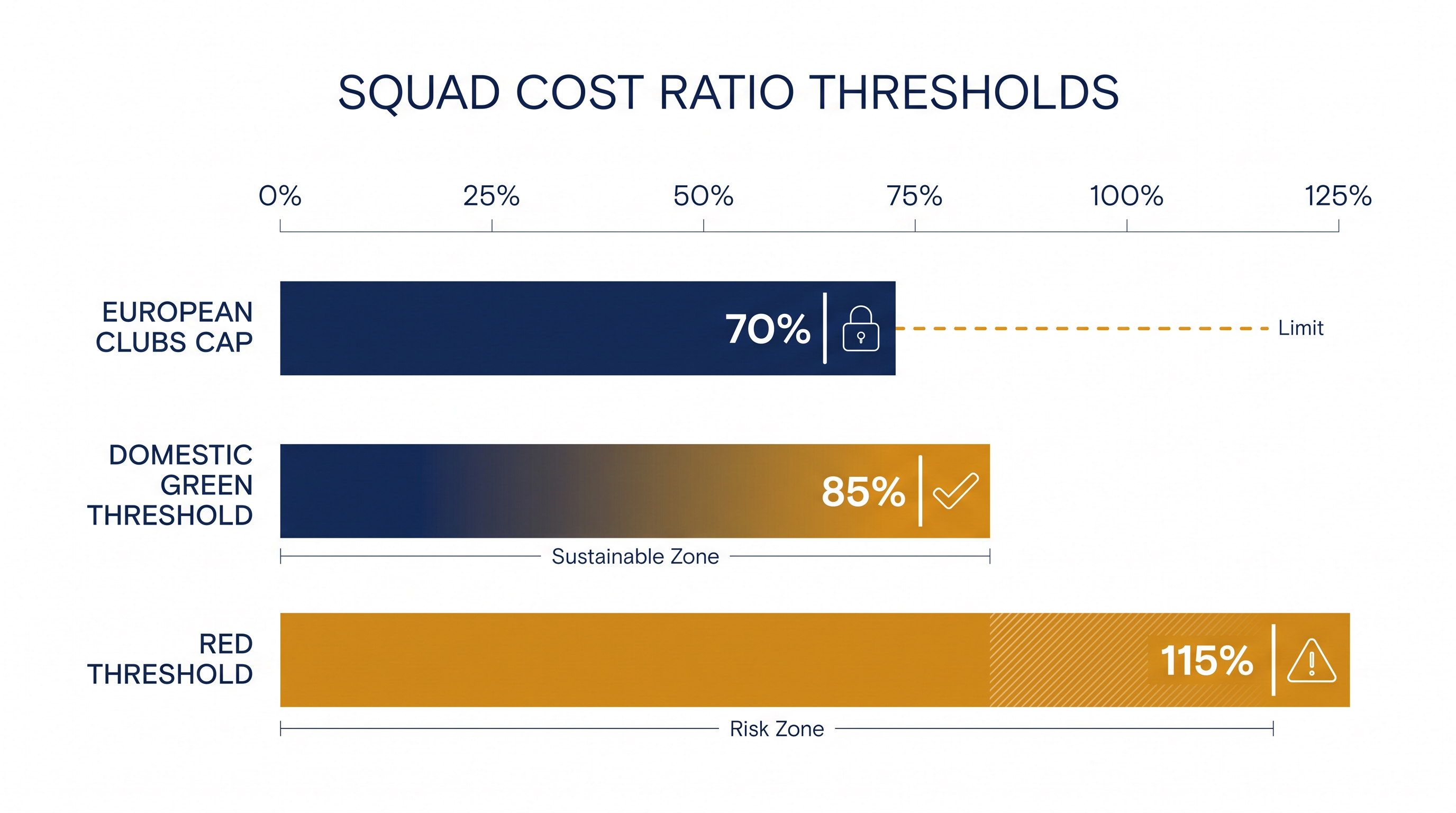
For the league's elite, the leash is even tighter. Any Premier League club competing in UEFA competitions—the Champions League, Europa League, or Conference League—must adhere to a stricter 70 percent spending cap. This dual-tier system intentionally aligns the Premier League with UEFA’s existing Financial Sustainability Regulations, preventing clubs from having to navigate two conflicting sets of accounting rules. Crucially, the 15 percent gap provides ambitious mid-table clubs with the financial headroom necessary to aggressively invest and challenge the established 'Big Six' without running afoul of the league's compliance officers.[6]
While the rules clamp down on excessive squad spending, they are explicitly designed to encourage holistic, long-term club building. Spending on youth academies, women's teams, stadium infrastructure, and non-playing administrative staff is entirely exempt from the 85 percent cap. By removing these expenditures from the SCR calculation, the league aims to incentivize owners to modernize their facilities and develop homegrown talent rather than funneling every available pound into the first-team wage bill.[1][4]
While the rules clamp down on excessive squad spending, they are explicitly designed to encourage holistic, long-term club building.
The most radical departure from the legacy PSR era lies in the new enforcement mechanics. The Squad Cost Ratio introduces a tiered compliance system built around a strict 'Green Threshold' set at 85 percent and a 'Red Threshold' capped at 115 percent. If a club's spending lands in the 30 percent buffer zone between these two markers, they do not face an immediate sporting sanction or points deduction. Instead, they are hit with a financial levy—a direct, escalating cash fine calculated by multiplying the total overspend by the exact percentage of the breach. This creates a graduated penalty system that punishes minor infractions with cash fines rather than league-altering point deductions.[3][5]
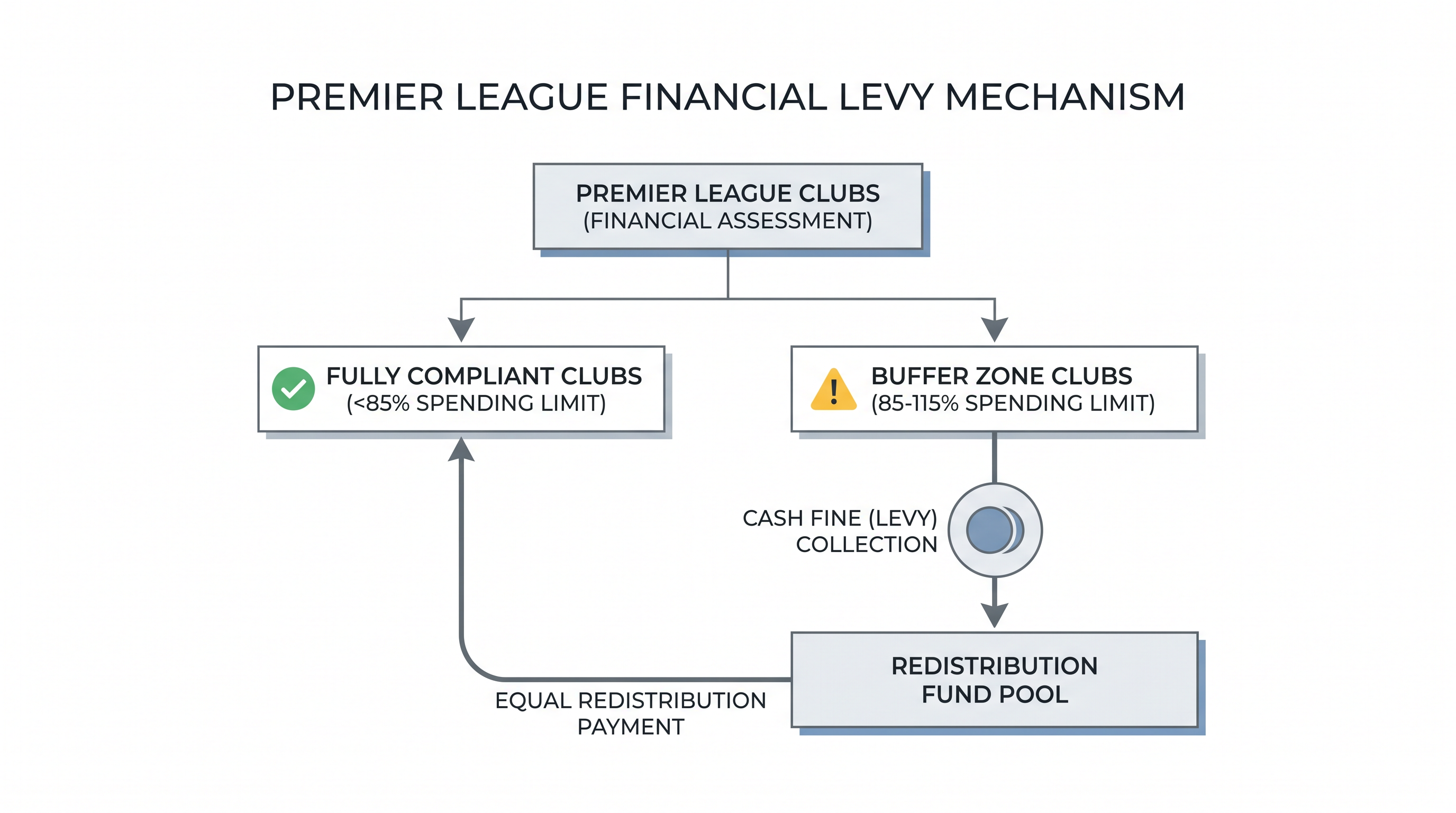
This levy system effectively creates a direct wealth transfer from the league's heaviest spenders to its most financially disciplined operators, as the collected fines are pooled and redistributed to fully compliant clubs at the end of the season. However, the financial safety net has a hard floor. If a club's squad costs breach the 115 percent Red Threshold, the financial levies are immediately abandoned in favor of automatic, severe sporting sanctions. Any club crossing this red line faces a baseline six-point deduction applied in the exact same season the breach occurs, ensuring immediate consequences for reckless spending.[2][3]
The framework has already seen strategic amendments driven by the clubs themselves to ensure flexibility. Following a targeted push led by Brighton & Hove Albion, the league approved a rollover mechanism to reward consistent financial discipline. Under this new amendment, clubs that operate below their 85 percent limit for two consecutive seasons can roll over up to 10 percent of that unused allowance into a third year. This allows exceptionally well-run clubs to execute a massive, targeted transfer window—perhaps to capitalize on a sudden European qualification—without triggering a levy or facing sanctions.[2]
While the Squad Cost Ratio dictates the transfer market, the accompanying Systemic Resilience Framework (SSR) serves as the league's ultimate bankruptcy failsafe. The SSR introduces mandatory, bi-annual liquidity stress tests and a strict positive equity requirement that tightens over the next three seasons. Clubs must now mathematically prove they have the liquid assets to survive a sudden revenue collapse or an unexpected relegation. This ensures that aggressive ownership gambling does not result in administration or the dissolution of historic community institutions, prioritizing long-term survival over short-term glory.[4][5]
The stakes for the upcoming campaign are already locked in. While the rules officially govern the 2026-27 season, the Premier League is currently operating under a 'shadow monitoring' phase to test the system's infrastructure. Clubs are actively submitting their projected revenues and squad costs now, with the first official, real-time compliance checks scheduled for March 2027. The era of buying success on credit and fighting the consequences in court years later is over; the era of the Squad Cost Ratio has definitively arrived.[1][5]
Viewpoints in depth
The Premier League's Stance
The governing body views the overhaul as a necessary shift from retrospective punishment to real-time financial sustainability.
League administrators argue that the legacy PSR system was fundamentally broken, leading to delayed sporting sanctions that compromised the integrity of the league table. By implementing the Squad Cost Ratio and the Systemic Resilience Framework, the Premier League aims to monitor compliance in real-time. The focus is on ensuring long-term solvency through mandatory liquidity stress tests, preventing clubs from gambling their existence on short-term on-pitch success.
Challenger Clubs' Perspective
Mid-table teams see the dual-tier spending caps and rollover allowances as a vital mechanism to break into the elite.
For clubs outside the traditional 'Big Six,' the new framework offers a distinct competitive advantage. Because teams competing in Europe are restricted to a 70 percent spending cap, domestic-only clubs have a 15 percent margin to aggressively invest in their squads. Furthermore, the Brighton-backed amendment allows exceptionally well-run clubs to roll over unused spending allowances, giving them the targeted financial firepower needed to challenge the league's wealthiest institutions without facing levies.
Financial Analysts' View
Sports economists highlight the levy system as a direct wealth transfer that heavily penalizes reckless ownership.
Financial and legal experts point to the 30 percent buffer zone as the most transformative element of the new rules. Instead of immediately docking points for minor breaches, the system imposes an escalating cash fine on clubs operating between the 85 and 115 percent thresholds. Because these levies are pooled and redistributed to clubs that remain fully compliant, analysts note it creates a powerful financial incentive for discipline, effectively forcing heavy spenders to subsidize their more prudent rivals.
Sources
Source coverage
6 outlets
3 viewpoints surfaced






[1]Premier LeagueLeague Administrators
Premier League introduces new financial rules for 2026/27
Read on Premier League →[2]The GuardianChallenger Clubs
Premier League set to amend spending rules to give clubs more flexibility for transfers
Read on The Guardian →[3]The EskChallenger Clubs
The shift from PSR to SCR
Read on The Esk →[4]BrabnersFinancial & Legal Analysts
What the new Premier League financial rules mean for clubs
Read on Brabners →[5]AnkuraFinancial & Legal Analysts
Premier League Replaces PSR: Full Breakdown of the New Squad Cost Ratio
Read on Ankura →[6]Football Finance LabFinancial & Legal Analysts
How the new Squad Cost Ratio (SCR) works
Read on Football Finance Lab →
Comments

More in sports
See all 13 stories →Standings
Standings Watch: Malawi and Zimbabwe Cling to the Inside Track Ahead of High-Stakes African Netball Qualifiers
6 sources

Standings
AFL Top-Four Race Tightens as Melbourne, Brisbane, and Adelaide Lock in Three-Way Tie for Double Chance
7 sources

Standings
Western Lacrosse Association Playoffs Begin as Four Teams Vie for Mann Cup Berth
6 sources

Standings
Snooker Standings: Jack Lisowski and Zhang Anda Hunt Top-16 Berths as Elite Race Intensifies
4 sources

Every angle. Every day.
Get sports stories with full source coverage and perspective breakdowns delivered to your inbox.