
CDC Updates Childhood Vaccine Schedule to 11 Core Diseases: What Parents Need to Know
The federal government has reorganized the childhood immunization schedule into three tiers, aligning the core universal list with several European nations while keeping all previously recommended vaccines fully covered by insurance.


- Pediatric & Medical Organizations
- Argues that universal recommendations are essential for maintaining high population immunity and preventing hospitalizations.
- Health Policy Analysts
- Focuses on the structural, insurance, and state-level implications of the federal schedule changes.
- Clinical Translators
- Focuses on how the policy shift changes the practical conversations between parents and doctors.
Summary
- The CDC has reorganized the childhood vaccine schedule from a single list of 17 diseases to a three-tier system featuring 11 universal recommendations.
- Vaccines for diseases like RSV, hepatitis A, and hepatitis B are now recommended primarily for high-risk groups.
- The flu shot, COVID-19 vaccine, and rotavirus vaccine have been moved to a 'shared clinical decision-making' tier.
- All vaccines previously on the schedule remain fully covered by insurance, Medicaid, and CHIP with no out-of-pocket costs.
- The policy shift aims to align the U.S. schedule with European nations like Denmark and provide parents with more individualized choices.
When the Department of Health and Human Services (HHS) announced it was reducing the universal childhood vaccine schedule from 17 diseases to 11, the immediate assumption across social media was that the removed vaccines were suddenly banned, deemed unsafe, or stripped of insurance coverage. In reality, the update is a structural reorganization rather than a removal. The vaccines are still available, still fully approved by the FDA, and still fully covered by insurance. The shift is designed to change the default assumption in the pediatrician's office, moving away from a blanket mandate for all shots and toward a more individualized conversation between doctors and parents.[5]
What actually changed is the federal government's default recommendation framework. Instead of a single, universal list of 17 diseases that every child is expected to be vaccinated against, the Centers for Disease Control and Prevention (CDC) has divided the schedule into three distinct tiers. This represents one of the most significant philosophical shifts in American public health policy in decades, moving the U.S. closer to the models used by several European nations. By categorizing vaccines based on universal need, specific risk factors, and shared clinical decision-making, the agency aims to provide families with more flexibility and transparency regarding why certain shots are recommended.[1][5]
The first tier is the "Universal" schedule. This core list retains the vaccines for 11 historically impactful diseases that the CDC deems essential for all children to receive, regardless of their individual risk factors. It includes measles, mumps, rubella, polio, pertussis (whooping cough), tetanus, diphtheria, Haemophilus influenzae type B (Hib), pneumococcal disease, human papillomavirus (HPV), and varicella (chickenpox). For these 11 diseases, the standard pediatric workflow remains entirely unchanged; doctors will continue to recommend them as the baseline standard of care for every healthy child.[3][5]
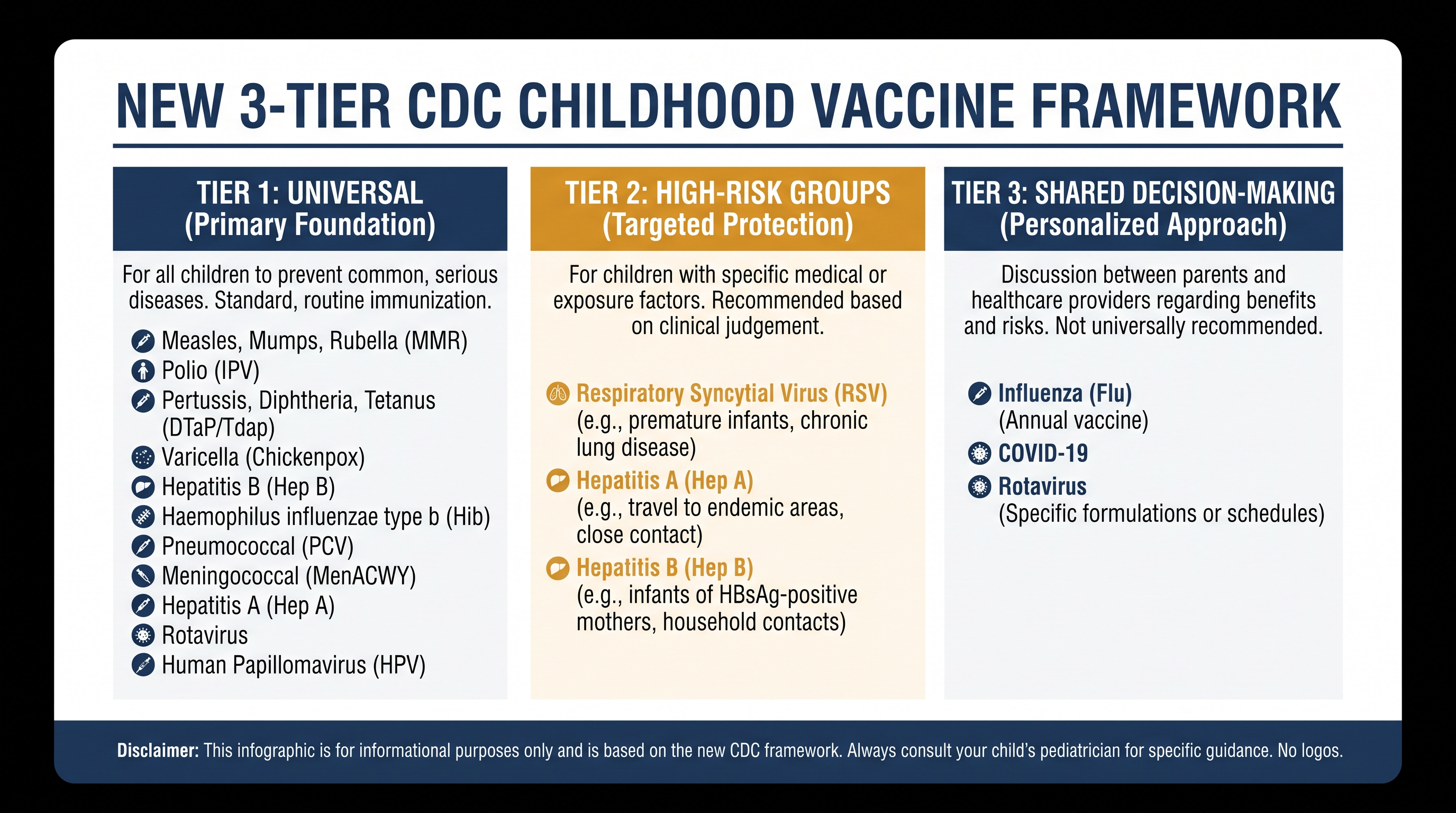
The second tier consists of immunizations recommended only for specific high-risk groups or populations. Vaccines protecting against respiratory syncytial virus (RSV), hepatitis A, hepatitis B, dengue, and two types of bacterial meningitis (MenACWY and MenB) have been moved to this category. For example, the hepatitis B vaccine, which was previously administered universally to newborns at birth, is now recommended primarily for infants whose mothers test positive for the virus or whose maternal status is unknown. This tier requires pediatricians to actively assess a child's specific environmental and health risks before recommending the shot.[4][5]
The third tier introduces a "shared clinical decision-making" model for several common vaccines. This category includes the annual influenza vaccine, COVID-19, rotavirus, and the hepatitis and meningitis vaccines for children who do not fall into the high-risk groups. Under this model, the federal government no longer issues a blanket recommendation. Instead, parents and pediatricians are encouraged to discuss the specific risks and benefits to decide what makes sense for the individual child. The vaccines remain highly accessible, but the decision to administer them is left entirely to the family's discretion after a clinical consultation.[1][2]
The policy shift, executed via a memorandum from Acting CDC Director Jim O'Neill following a presidential directive, aims to align the United States with the vaccination schedules of several peer nations. HHS officials specifically cited Denmark, which recommends vaccines for 10 diseases, as a model for the new U.S. framework. Proponents of the change argue that it empowers parents and reduces the feeling of coercion in pediatric care. By moving away from a one-size-fits-all mandate, the new schedule acknowledges that not every child has the exact same risk profile for diseases like hepatitis B or severe COVID-19.[1][3][5]
HHS officials specifically cited Denmark, which recommends vaccines for 10 diseases, as a model for the new U.S.
However, the reorganization has drawn sharp criticism from major medical organizations and academic institutions. The American Academy of Pediatrics and the American College of Physicians have warned that the U.S. lacks the robust public health infrastructure, universal healthcare access, and homogenous population of countries like Denmark, making a direct comparison fundamentally flawed. These groups argue that the universal schedule was designed specifically to protect a diverse, highly mobile population across a massive geographic area. They caution that fragmenting the recommendations could lead to localized outbreaks in communities with lower baseline immunity.[2][3]

Academic medicine experts have expressed particular concern that moving vaccines like rotavirus and influenza to the shared decision-making tier will inevitably lead to lower overall vaccination rates. They argue that the previous universal schedule was highly effective at preventing severe illness and hospitalizations. By adding conversational friction to the process and removing the default recommendation, public health officials worry that more children will be left vulnerable to severe seasonal respiratory illnesses, which already place a massive burden on pediatric hospitals every winter.[2][5]
A critical point of confusion and anxiety for many families has been the question of cost and insurance coverage. Because the Affordable Care Act (ACA) legally ties preventive care coverage directly to CDC recommendations, parents and healthcare advocates worried that vaccines moved off the universal list would suddenly require expensive out-of-pocket payments. This would have created a massive barrier to access for low-income families who still wished to receive the flu shot, rotavirus vaccine, or RSV immunization for their infants.[1][4]
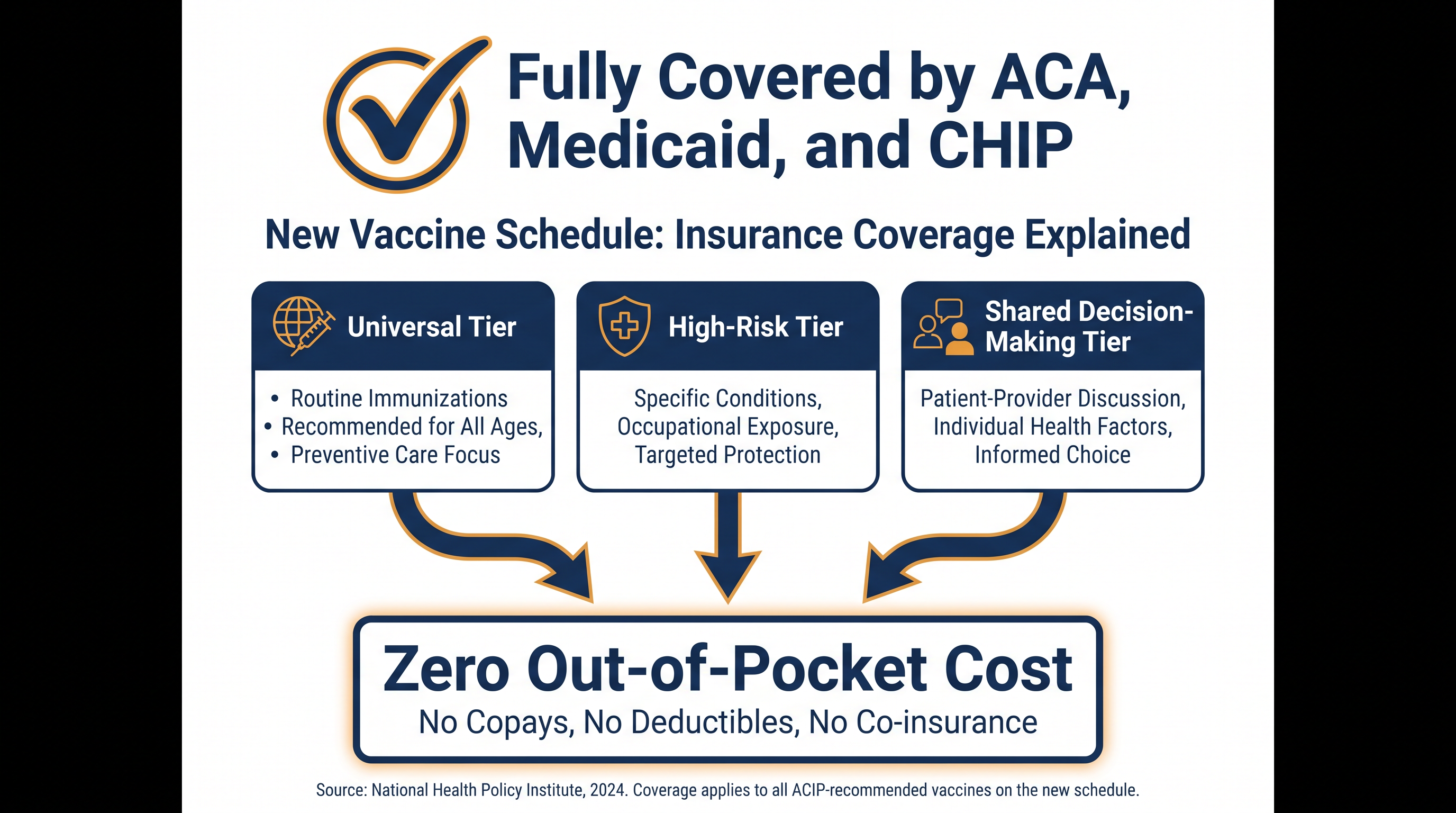
To address these concerns, HHS has explicitly clarified that the financial structure supporting childhood immunizations will not change. All vaccines that were recommended as of December 31, 2025, will continue to be fully covered without cost-sharing under ACA-compliant commercial insurance plans, Medicaid, the Children's Health Insurance Program (CHIP), and the federal Vaccines for Children (VFC) program. Regardless of which tier a vaccine now occupies, families will not have to pay out-of-pocket to receive it, ensuring that the shift in policy does not inadvertently price families out of preventive care.[4][5]
For parents, the most immediate practical takeaway is that the annual pediatric well-visit will require a more active and detailed conversation. Rather than simply receiving a standard, predetermined battery of shots based solely on a child's age, families will need to review the shared decision-making tier with their doctor. Pediatricians will likely spend more time discussing the specific risk factors for diseases like RSV, which remains a leading cause of infant hospitalization in the U.S., to determine if a child qualifies for the high-risk tier or if parents want to opt-in proactively.[2][5]
State laws will also play a significant role in how this federal policy shift plays out on the ground. While the CDC sets the overarching federal schedule, individual state health departments and legislatures determine which specific vaccines are legally required for public school and daycare entry. It remains to be seen how states will adapt their local mandates in response to the new federal tiers, and whether some states will choose to maintain their own universal requirements that exceed the new CDC baseline.[1][4]
Ultimately, the vaccines themselves have not changed, and the clinical safety and efficacy data underlying them remains exactly the same. What has shifted is the fundamental philosophy of federal public health guidance. By moving from a centralized, universal directive to a more individualized, decentralized approach to pediatric care, the government is placing more responsibility—and more choice—directly into the hands of parents and their local pediatricians. Families who wish to follow the previous, more comprehensive schedule are fully empowered and financially supported to do so, while those seeking a more tailored approach now have the official framework to support that choice.[5]
Definitions
- Shared clinical decision-making
- A medical approach where healthcare providers and parents work together to make healthcare choices, weighing the risks and benefits of a treatment for the specific individual.
- Universal schedule
- The core list of vaccines that public health authorities recommend for every child, regardless of their specific individual risk factors.
- ACA preventive coverage
- A federal requirement that insurance plans cover certain preventive services, including CDC-recommended vaccines, without charging a copayment or coinsurance.
Chronology
Dec 2025
A presidential memorandum directs HHS to review the U.S. childhood vaccine schedule and compare it to peer nations.
Jan 2026
HHS and the CDC officially issue the reorganized three-tier childhood immunization schedule.
Jan 2026
Major medical organizations issue statements criticizing the shift, while HHS confirms insurance coverage remains intact.
Analysis by camp
Pediatric & Medical Organizations
Major medical groups argue the changes risk lowering vaccination rates for serious illnesses.
Groups like the American Academy of Pediatrics emphasize that the previous universal schedule successfully prevented millions of hospitalizations. They argue that moving vaccines for prevalent diseases like influenza and rotavirus to a 'shared decision-making' model introduces unnecessary friction that will inevitably lower uptake. Furthermore, they caution that comparing the U.S. to countries like Denmark ignores significant differences in public health infrastructure, population scale, and baseline disease transmission rates.
Federal Administration & Policy Reformers
Proponents argue the tiered system empowers parents and aligns with international norms.
The administration and its supporters view the reorganization as a necessary step to rebuild trust in public health by reducing federal mandates. By shifting to a model that emphasizes shared clinical decision-making for non-core diseases, they argue the system respects parental autonomy and acknowledges that children have different individual risk profiles. They point to several European nations that successfully maintain high public health standards with a smaller core list of universal vaccines.
Questions & answers
Are the removed vaccines now banned or unavailable?
No. The vaccines moved off the universal list are still FDA-approved, fully available, and can be administered by your pediatrician.
Will I have to pay out-of-pocket for vaccines like the flu shot or rotavirus?
No. HHS has confirmed that all vaccines recommended as of late 2025 will continue to be fully covered by insurance, Medicaid, and CHIP without cost-sharing.
Why did the CDC make this change?
The reorganization was directed by the administration to align the U.S. schedule more closely with peer nations like Denmark, shifting toward a model that emphasizes individualized risk assessment and parental choice.
Does this change what vaccines my child needs for school?
Not immediately. School entry requirements are set by individual state governments, not the federal CDC. States will decide whether to update their local mandates based on the new federal tiers.
Limits of the evidence
- How individual state health departments will adjust their mandatory school-entry vaccination requirements in response to the new federal tiers.
- Whether the shift to a shared decision-making model will significantly lower national vaccination rates for diseases like influenza and rotavirus over the next several years.
Significance
This shift from a one-size-fits-all schedule to a tiered system gives parents more direct input into their child's healthcare. It requires families to have more detailed conversations with their pediatricians about which optional vaccines make sense for their specific risks, without losing insurance coverage for any of them.
Sources
Source coverage
5 outlets
3 viewpoints surfaced





[1]KFFHealth Policy Analysts
The New Federal Vaccine Schedule for Children: What Changed and What Are the Implications?
Read on KFF →[2]Association of American Medical CollegesPediatric & Medical Organizations
Academic medical doctors explain the potential impact of new vaccine guidelines
Read on Association of American Medical Colleges →[3]University of Minnesota CIDRAPPediatric & Medical Organizations
HHS announces unprecedented overhaul of US childhood vaccine schedule
Read on University of Minnesota CIDRAP →[4]State Health and Value StrategiesHealth Policy Analysts
HHS Announces Major Updates to Childhood Immunization Schedule
Read on State Health and Value Strategies →[5]Factlen Editorial TeamClinical Translators
Synthesis by Factlen editorial team
Read on Factlen Editorial Team →
Comments

Every angle. Every day.
Get health stories with full source coverage and perspective breakdowns delivered to your inbox.