
Anthropic Valuation Nears $1 Trillion, Becomes World's Most Valuable Pure-Play AI Company
Anthropic's implied valuation has approached the $1 trillion mark on secondary markets, driven by unprecedented enterprise revenue growth. The milestone officially makes the Claude developer the world's most valuable independent artificial intelligence firm.
By Harper Lane


- Financial Markets & Investors
- Focuses on the unprecedented revenue velocity and the impending IPO liquidity event.
- Enterprise AI Adopters
- Prioritizes stability, coding capabilities, and the practical value of Claude in production environments.
- AI Industry Analysts
- Views the valuation shift as a victory for safety-conscious, research-first development.
Why this matters
The shift in valuation crowns a new leader in the generative AI race, signaling that enterprise reliability and coding capabilities are driving the market more than consumer hype. For investors and businesses, Anthropic's impending IPO will redefine how capital flows into the artificial intelligence sector.
Key points
- Anthropic's implied valuation has neared $1 trillion on secondary markets, officially surpassing OpenAI.
- The company's annualized revenue run rate has surged to nearly $47 billion, driven by enterprise adoption.
- A massive $65 billion Series H funding round in May set a hard post-money valuation of $965 billion.
- Anthropic is reportedly preparing for an initial public offering that could take place as early as late 2026.
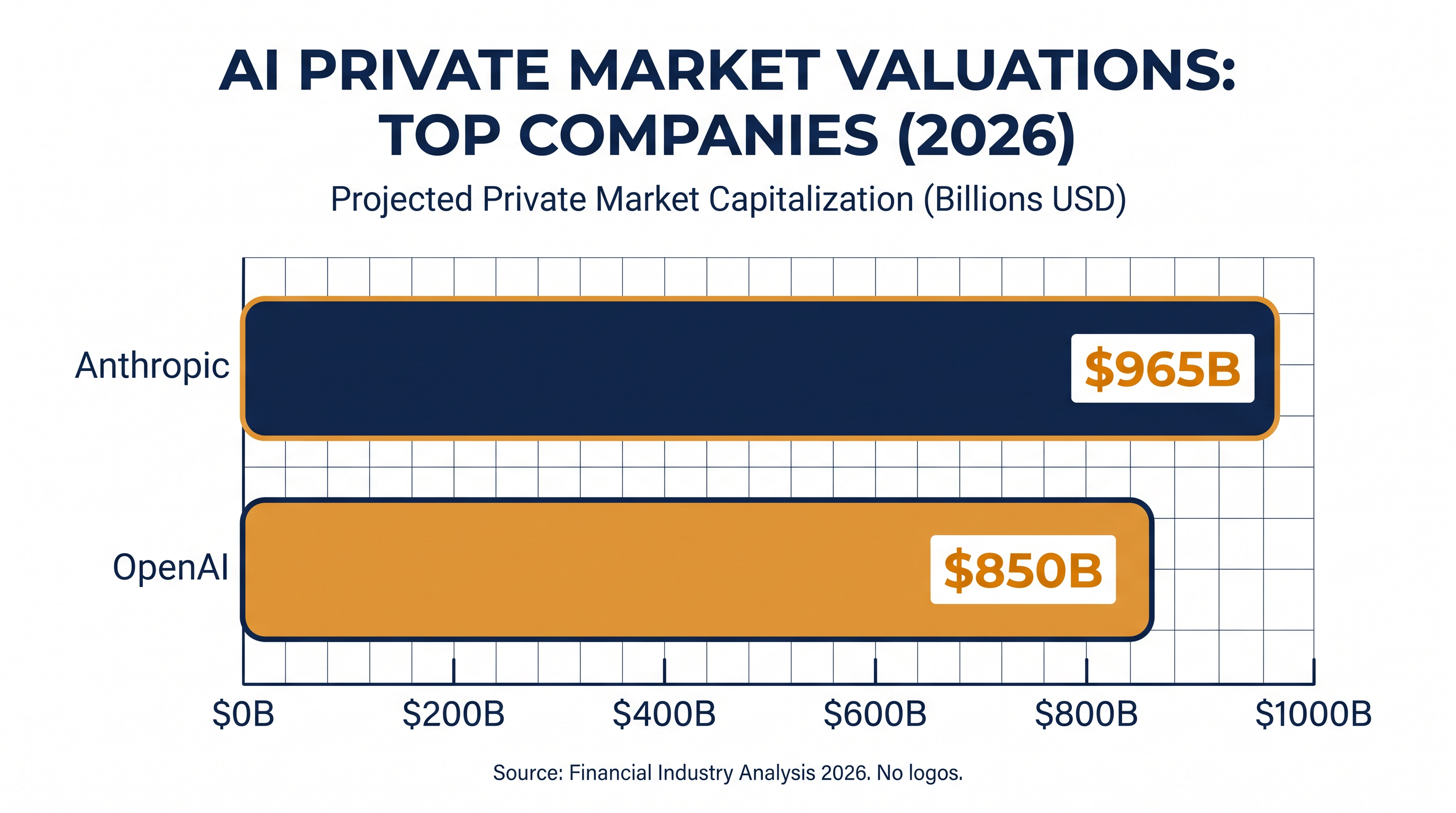
The short version stated plainly: Anthropic is now the most valuable independent artificial intelligence company in the world. Driven by a massive surge in enterprise adoption and a staggering acceleration in revenue, the San Francisco-based startup's valuation is rapidly approaching the $1 trillion threshold on secondary markets. This financial milestone officially unseats OpenAI, which most recently commanded an $850 billion valuation, and marks a decisive shift in the generative AI landscape. The market has effectively crowned a new leader, one that prioritized structural safety and enterprise utility over consumer-facing hype.[1][3]
The financial mechanics behind this historic re-rating are rooted in unprecedented revenue velocity rather than speculative market hype. In late May, Anthropic closed a massive $65 billion Series H funding round that set a hard post-money valuation of $965 billion. Since that round closed, intense demand on secondary markets has pushed the implied valuation even higher. Institutional investors are aggressively seeking shares, with industry reports indicating that some venture capitalists have offered to liquidate personal real estate just to secure equity in the company before a potential public listing.[4][5]
To understand how a company that was widely considered a distant second just eighteen months ago captured the market, one must look at the underlying revenue engine. Anthropic's annualized revenue run rate has exploded, crossing the $47 billion mark by mid-2026. This represents a nearly five-fold increase in less than a year, a growth curve that effectively rewrites the comparables for hyper-growth software companies. No organization in the history of the technology sector has scaled its enterprise revenue at this velocity, providing the hard financial data required to justify a near-trillion-dollar price tag.[3][4]
The mechanism driving this unprecedented adoption is not consumer mindshare or viral chatbot usage, but deep enterprise utility. While competitors focused on consumer-facing applications and broad multimodal capabilities, Anthropic quietly optimized its Claude model family—specifically Claude Opus and the newly introduced Claude Code—for complex, multi-step enterprise workflows. Coding and software engineering tasks now represent the vast majority of enterprise generative AI usage, and Anthropic's architecture has proven uniquely suited to these high-context, low-tolerance corporate environments where accuracy is paramount.[1][5]
This architectural advantage stems directly from how the models are trained and deployed at scale. Rather than relying entirely on brute-force compute scaling, Anthropic has focused heavily on structural efficiency and interpretability. The company is generating its massive revenue while reportedly spending significantly less on compute infrastructure than its primary rivals. By delivering models that can manage entire project repositories and validate code autonomously, Anthropic has successfully transitioned from selling an experimental novelty to providing core, indispensable enterprise infrastructure.[3][5]
This architectural advantage stems directly from how the models are trained and deployed at scale.
The market's definitive verdict also reflects a broader strategic divergence between the industry's two heavyweights. Two years ago, OpenAI dominated the narrative, with its leadership serving as the highly visible public face of the artificial intelligence revolution. Anthropic, founded by former OpenAI research director Dario Amodei and his sister Daniela, pursued a much quieter, research-first trajectory centered on constitutional AI and strict safety guardrails. The current valuation suggests that enterprise customers ultimately prioritized reliability, security, and predictable performance over consumer brand recognition.[1][4]
This near-trillion-dollar war chest buys Anthropic a unique and highly valuable kind of stability. For the Fortune 500 companies currently integrating Claude into their proprietary systems, the massive valuation serves as a guarantee of vendor permanence. Enterprise chief information officers are significantly more willing to commit to long-term, expensive AI transformations when they are confident the underlying model provider has the capital required to survive the grueling compute arms race, scale its infrastructure, and outlast any potential market downturns or regulatory shifts.[3][6]

Attention across the financial sector is now turning toward the public markets. Anthropic is reportedly laying the groundwork for an initial public offering, with major investment banks already in early discussions to underwrite the listing. An IPO, potentially slated for late 2026 or early 2027, would rank among the largest technology debuts in history. More importantly, it would provide retail investors their first direct, pure-play exposure to the frontier model layer of the artificial intelligence industry, a segment previously locked behind private equity.[2][6]
A public listing of this magnitude would fundamentally alter the capital dynamics of the entire AI sector. Until now, the massive financial returns generated by foundational models have been largely confined to private venture capital, sovereign wealth funds, and the balance sheets of incumbent tech giants like Microsoft and Amazon. An Anthropic IPO would test the broader public market's appetite for AI pure-plays and potentially force competitors to accelerate their own liquidity timelines to remain competitive in the race for talent and capital.[2][6]
For now, the technology industry is rapidly adjusting to a new hierarchy. The $150 billion valuation gap between Anthropic and OpenAI is not a rounding error; it is a clear, undeniable signal of where institutional capital believes the durable value in artificial intelligence will ultimately be captured. As foundational models become increasingly commoditized, the victor is proving to be the company that can most effectively, reliably, and safely embed its technology into the daily operations of the global economy, moving beyond the chat interface and into the core logic of modern business.[1][4]
How we got here
January 2021
Dario and Daniela Amodei leave OpenAI to found Anthropic with a focus on AI safety.
Summer 2022
Anthropic finishes training the first version of Claude, delaying release for internal safety testing.
February 2026
Anthropic raises $30 billion in a Series G round, reaching a $380 billion valuation.
May 2026
A $65 billion Series H round closes, pushing the post-money valuation to $965 billion and surpassing OpenAI.
August 2026
Secondary market demand pushes Anthropic's implied valuation toward the $1 trillion threshold as IPO preparations accelerate.
Viewpoints in depth
Financial Markets & Investors
Institutional capital views Anthropic's revenue velocity as unprecedented and highly bankable.
For venture capitalists and secondary market buyers, Anthropic's appeal lies in its hard numbers rather than speculative potential. The company's ability to scale its annualized revenue run rate to nearly $47 billion in a matter of months has rewritten the expectations for hyper-growth software. Investors argue that this enterprise-driven revenue provides a stable foundation that justifies the near-trillion-dollar valuation, making Anthropic the most anticipated public listing of the decade.
Enterprise AI Adopters
Corporate technology leaders prioritize Anthropic's stability and specialized coding capabilities.
Chief Information Officers and enterprise developers emphasize that Anthropic won the market by focusing on utility over flash. By optimizing the Claude model family for complex, multi-step software engineering workflows, Anthropic provided a tool that directly impacts corporate bottom lines. For these adopters, the massive valuation is less about league tables and more about vendor permanence—ensuring that the infrastructure they are building upon will be supported for years to come.
AI Industry Analysts
Industry observers see the valuation shift as a victory for safety-conscious, research-first development.
Analysts point out the stark contrast between the strategies of the industry's top two players. While competitors focused on rapid consumer releases and public mindshare, Anthropic's leadership maintained a quiet focus on constitutional AI and structural efficiency. The market's decision to reward Anthropic with the top valuation is interpreted as a signal that the next phase of the AI revolution will be won by reliable, highly interpretable systems rather than consumer-facing chatbots.
Sources
Source coverage
6 outlets
3 viewpoints surfaced






[1]The GuardianAI Industry Analysts
Anthropic reaches valuation of $965bn, beating OpenAI to become world's most valuable AI firm
Read on The Guardian →[2]BloombergFinancial Markets & Investors
Anthropic Targets IPO as Valuation Nears $1 Trillion Mark
Read on Bloomberg →[3]TechCrunchEnterprise AI Adopters
Anthropic's $65B Series H Makes It The Most Valuable AI Startup
Read on TechCrunch →[4]ReutersFinancial Markets & Investors
Anthropic Overtakes OpenAI in Revenue Run Rate, Investors Clamor for Shares
Read on Reuters →[5]Anthropic NewsroomEnterprise AI Adopters
Anthropic raises $65B in Series H funding at $965B post-money valuation
Read on Anthropic Newsroom →[6]BBCFinancial Markets & Investors
Anthropic Share Sale Plan as Valuation Approaches $1 Trillion
Read on BBC →
Comments
Every angle. Every day.
Get ai stories with full source coverage and perspective breakdowns delivered to your inbox.