
House Passes 'Main Street Capital Access Act,' Easing Rules for Mid-Sized and Community Banks
The U.S. House passed a sweeping banking deregulation package that raises regulatory thresholds and eases capital requirements, drawing praise from community lenders and sharp warnings from financial watchdogs.

- Community Banking Advocates
- Argue that right-sizing regulations will free up capital for local lending and reverse industry consolidation.
- Financial Reform Advocates
- Warn that the legislation dismantles critical safeguards and increases the risk of mid-tier bank failures.
- Industry Analysts
- Anticipate a mixed outcome of increased local chartering alongside accelerated regional bank consolidation.
How we got here
2010
The Dodd-Frank Act establishes strict regulatory thresholds for banks following the global financial crisis.
2018
Congress passes a bipartisan rollback raising the enhanced scrutiny threshold from $50 billion to $250 billion.
Spring 2023
Silicon Valley Bank and Signature Bank collapse, sparking a regional banking crisis and calls for tighter oversight.
January 2026
The Main Street Capital Access Act is introduced in the House Financial Services Committee.
July 21, 2026
The House passes the legislation in a 270-155 vote, sending the package to the Senate.
Why it matters
This legislation fundamentally rewrites the rules for thousands of U.S. banks, potentially making it easier for small businesses to get loans while simultaneously allowing mid-sized banks to take on more risk without strict federal oversight.
The U.S. House of Representatives passed a sweeping overhaul of banking regulations on Tuesday, raising the asset thresholds that trigger strict federal oversight and easing capital requirements for newly formed lenders. The Main Street Capital Access Act cleared the chamber in a 270-155 vote, with 56 Democrats joining a near-unanimous Republican bloc to advance the most significant financial deregulation package since 2018. The legislation fundamentally alters how the Federal Reserve and the Federal Deposit Insurance Corporation supervise mid-sized and community banks, aiming to reverse a decades-long decline in local bank formation while drawing fierce pushback from financial watchdogs who warn of renewed systemic risk.[1][2]
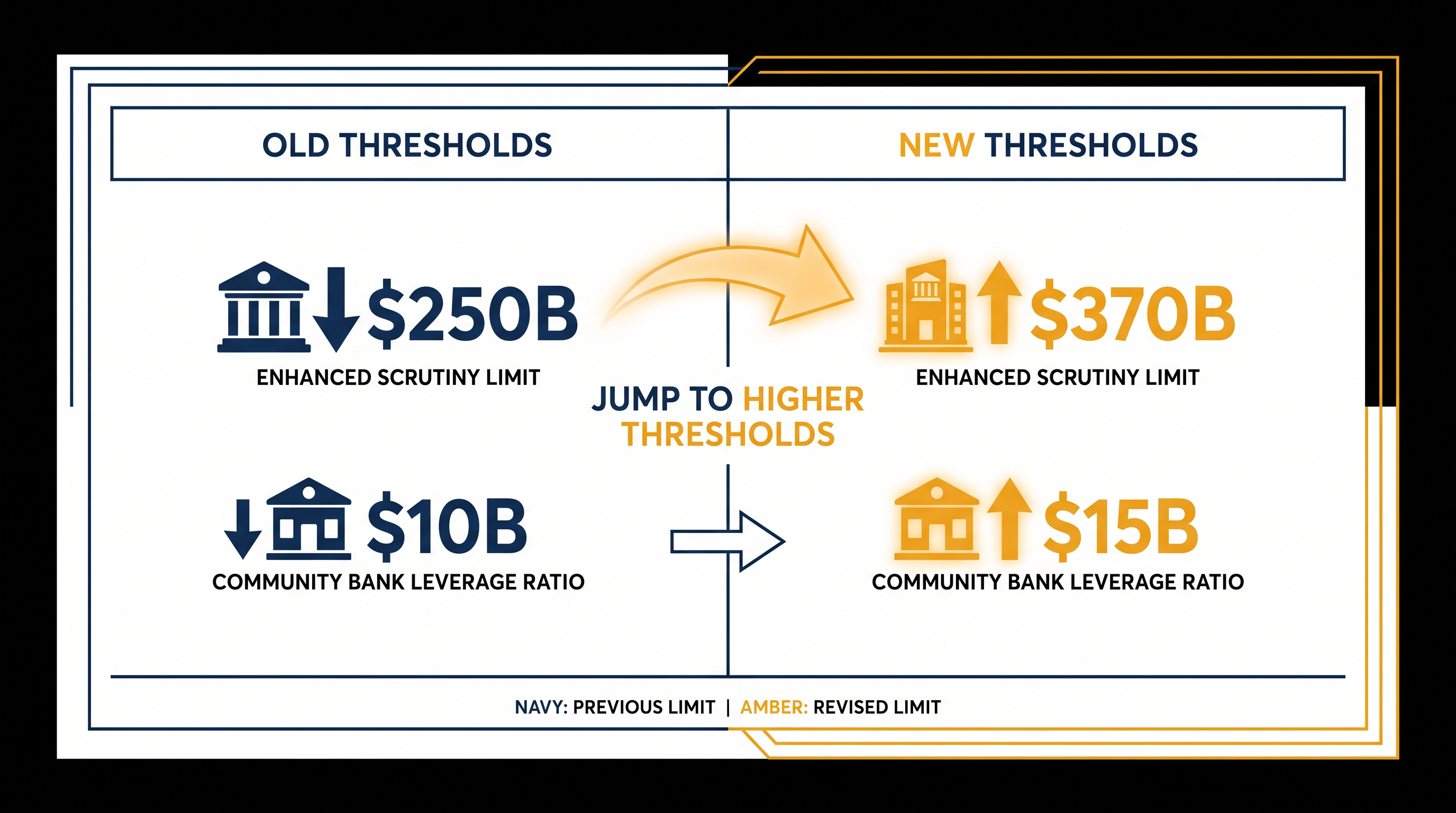
At the core of the legislation is a significant upward revision of the asset thresholds that dictate regulatory intensity across the U.S. financial system. The bill raises the ceiling for enhanced regulatory scrutiny from $250 billion to $370 billion in assets. This shift effectively exempts a wider swath of regional banks from the strictest federal stress-testing and liquidity regimes that were originally implemented in the wake of the 2008 financial crisis. By moving this regulatory goalpost, lawmakers are allowing mid-sized institutions to grow substantially larger before they are required to hold the massive, highly liquid capital buffers demanded of globally systemic banks.[1][7]
For smaller institutions, the legislative package expands eligibility for the simplified Community Bank Leverage Ratio framework, raising the qualification cap from $10 billion to $15 billion in assets. Crucially, it also lowers the required capital cushion for those qualifying banks from the current 8% to 10% range down to a 6% to 8% band. This technical adjustment allows community banks to hold less capital in reserve against their active loan portfolios. Proponents argue this will theoretically free up billions of dollars in trapped liquidity that can immediately be deployed as commercial real estate loans, small business credit, and residential mortgages in local markets.[2][4]
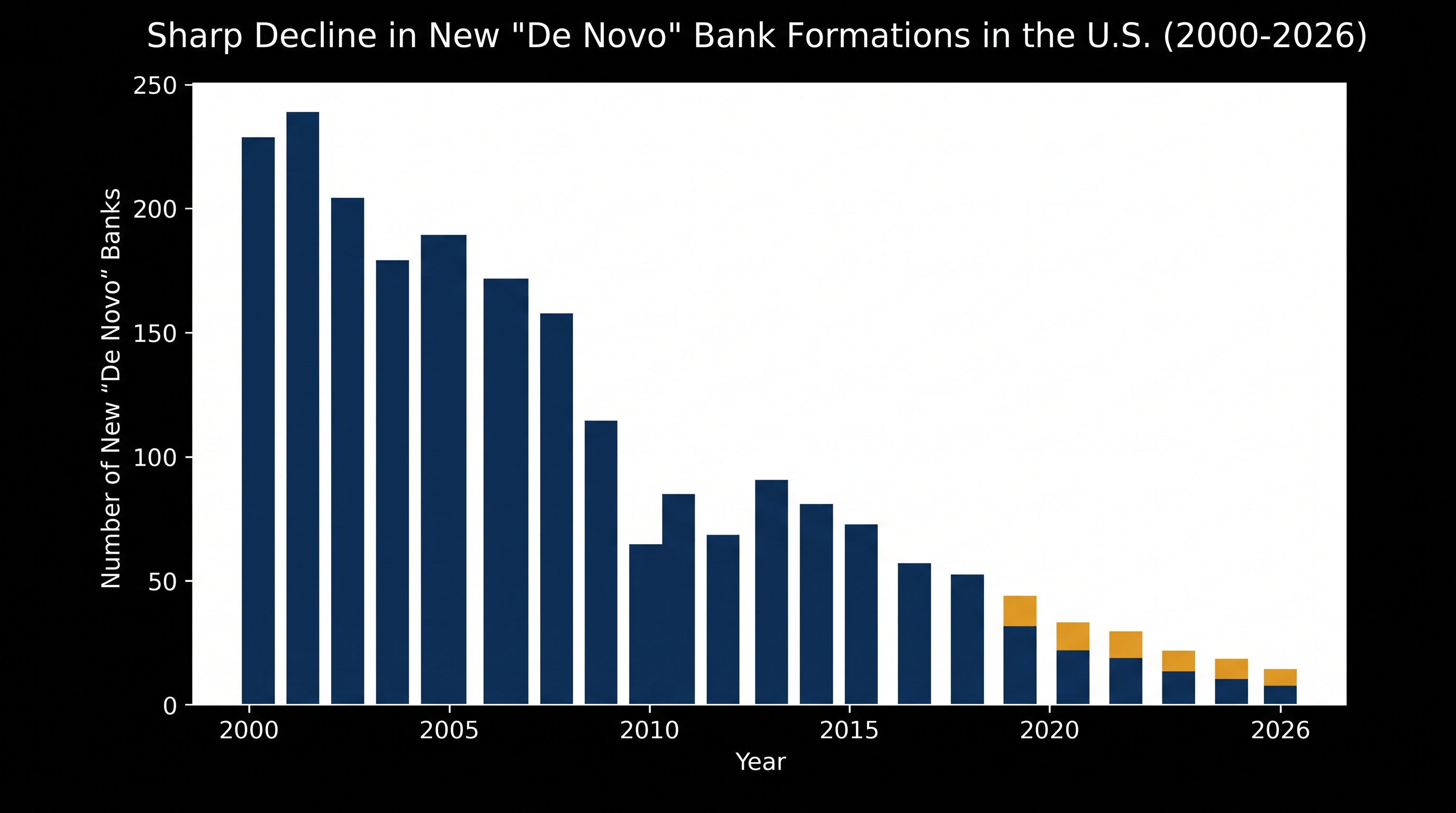
To address the near-total halt in the creation of new "de novo" banks over the past fifteen years, the legislation grants newly chartered institutions a three-year phase-in period to meet standard federal capital requirements. Since the implementation of the Dodd-Frank Act, the immense upfront capital required to satisfy regulators has made starting a new community bank financially unviable for most local investor groups. By offering a three-year regulatory runway, the bill's authors hope to incentivize the launch of new local depositories. This is particularly targeted at rural counties and underserved urban areas that have effectively become banking deserts following successive waves of industry consolidation and branch closures.[3][4]
The legislation also overhauls the bank merger process, which industry executives have long criticized as opaque, politicized, and agonizingly slow. The bill establishes a strict 90-day deadline for regulatory agencies to approve or deny consolidation applications once the initial paperwork is deemed complete. Controversially, if regulators fail to finalize their evaluation within 120 days, certain merger applications would receive automatic approval, regardless of whether the antitrust or safety reviews are finished. Furthermore, the bill raises the asset threshold under the Federal Reserve's Small Bank Holding Company Policy Statement from $3 billion to $25 billion, allowing significantly more holding companies to operate with higher debt levels while acquiring smaller competitors.[1][7]
The legislation also overhauls the bank merger process, which industry executives have long criticized as opaque, politicized, and agonizingly slow.
Proponents of the measure argue that the current regulatory framework suffocates local credit markets by forcing rural and community lenders to comply with costly compliance regimes designed for trillion-dollar Wall Street behemoths. Representative French Hill, the bill's primary sponsor and a former community banker, asserted that right-sizing these regulations will directly translate to economic growth on Main Street. Banking trade groups, including the American Bankers Association and the Ohio Bankers League, lobbied heavily for the measure. They maintain that disproportionate compliance costs have driven the relentless consolidation of the banking sector by making independence simply too expensive for small lenders to maintain.[3][4]
Financial watchdogs and progressive lawmakers argue the legislation suffers from historical amnesia, pointing directly to the 2023 regional banking crisis that saw three of the four largest bank failures in U.S. history. Critics, including Representative Maxine Waters, noted that the spectacular collapse of Silicon Valley Bank and Signature Bank was precipitated by a similar 2018 legislative rollback that raised the enhanced scrutiny threshold from $50 billion to $250 billion. Opponents argue that raising that ceiling yet again to $370 billion invites a repeat of that exact crisis, allowing mid-sized banks to take on massive interest-rate and liquidity risks without adequate federal monitoring or stress testing.[2][5]
Advocacy groups like Public Citizen and Americans for Financial Reform warned that lowering capital requirements for untested new banks will inject systemic fragility back into the financial system. They argue that the three-year phase-in period for de novo banks essentially allows untested institutions to experiment recklessly with federally insured depositor money before proving their financial viability. Furthermore, these groups contend that the fast-tracked merger approvals will actually harm local communities by accelerating the very consolidation the bill claims to prevent. They warn that mid-tier banks will aggressively swallow up smaller community lenders under the newly relaxed antitrust review timelines, ultimately reducing competition.[5][6]
Beyond capital and asset thresholds, the bill fundamentally alters the day-to-day mechanics of bank supervision. It explicitly removes "reputational risk" from the criteria federal examiners can use to evaluate a bank's health and operations. Critics argue this omission ignores the reality of modern, social-media-driven bank runs, where reputational damage can drain billions in deposits in a matter of hours. Additionally, the legislation mandates that regulators tailor their rules and supervisory actions not just to a bank's overall size, but to its specific business model and individual risk profile, creating a highly customized regulatory environment for thousands of different institutions.[6][7]
Consumer advocates warn this tailoring provision could paralyze the federal supervisory process entirely. By requiring bespoke regulation for every institution, the law effectively allows any bank to sue regulatory agencies for failing to adequately customize oversight to their specific operations. Legal experts suggest this could bring routine enforcement actions to a standstill, as agencies would be forced to defend the precise tailoring of every supervisory demand in federal court. This litigation risk would likely drain resources from the Federal Deposit Insurance Corporation and the Federal Reserve, creating a chilling effect on examiners who might hesitate to flag risky behavior for fear of triggering a protracted legal battle.[6]

Industry analysts view the legislation as a double-edged sword that could simultaneously spur local lending and accelerate mid-tier consolidation. While the de novo provisions might successfully launch new community charters in underserved markets, the loosened merger reviews and higher asset thresholds could trigger a wave of acquisitions among banks in the $10 billion to $50 billion range. These institutions, suddenly freed from the costs of crossing the previous regulatory thresholds, may view the new landscape as an optimal environment for aggressive expansion. The result could be a barbell-shaped banking sector: a surge of tiny new local banks on one end, and rapidly expanding regional giants on the other.[7]
The legislation now heads to the Democratic-controlled Senate, where its sweeping threshold changes face a steep climb. Senate Banking Committee leadership has historically opposed broad deregulatory packages, particularly those that alter the rules for banks holding hundreds of billions of dollars in assets. However, the strong bipartisan showing in the House—where over a quarter of the Democratic caucus broke ranks to support the measure—suggests a path forward. Capitol Hill strategists believe that while the $370 billion threshold hike may be stripped out, the targeted provisions aimed strictly at community banks under $10 billion could eventually find their way into a compromise package before the end of the legislative session.[1][2]
What to know
- The House passed the Main Street Capital Access Act 270-155, with 56 Democrats joining Republicans.
- The bill raises the threshold for enhanced regulatory scrutiny from $250 billion to $370 billion in assets.
- Newly formed 'de novo' banks would receive a three-year phase-in period to meet federal capital requirements.
- Federal regulators would face a strict 90-day deadline to approve or deny bank merger applications.
- Critics warn the bill mirrors 2018 rollbacks that preceded the 2023 collapse of Silicon Valley Bank.
Where opinion splits
Community Banking Advocates
Argue that right-sizing regulations will free up capital for local lending and reverse industry consolidation.
Trade groups like the Ohio Bankers League and the American Bankers Association argue that post-2008 regulations were designed to rein in globally systemic Wall Street banks, but inadvertently suffocated local lenders with disproportionate compliance costs. They contend that lowering capital requirements for de novo banks and raising the leverage ratio thresholds will allow community banks to deploy trapped capital into local small business loans and mortgages, rather than spending it on regulatory overhead.
Financial Reform Advocates
Warn that the legislation dismantles critical safeguards and increases the risk of mid-tier bank failures.
Organizations like Public Citizen and Americans for Financial Reform view the bill as a dangerous rollback of systemic guardrails. They point to the 2023 collapse of Silicon Valley Bank as direct evidence of what happens when enhanced scrutiny thresholds are raised. By allowing banks to grow to $370 billion in assets before facing strict stress tests, and by fast-tracking merger approvals, critics argue the legislation socializes the risk of bank failures while privatizing the profits of aggressive expansion.
Industry Analysts
Anticipate a mixed outcome of increased local chartering alongside accelerated regional bank consolidation.
Financial sector analysts suggest the bill will create a barbell effect in the banking industry. While the three-year capital phase-in will likely succeed in spurring the creation of new, small community banks in underserved areas, the relaxed merger timelines and higher asset thresholds will simultaneously encourage mid-sized banks to aggressively acquire competitors. This could lead to a landscape dominated by very small local lenders and massive regional giants, hollowing out the middle tier of the banking sector.
Sources
Source coverage
7 outlets
3 viewpoints surfaced




[1]American BankerIndustry Analysts
House passes Main Street Capital Access Act
Read on American Banker →[2]Dodd Frank UpdateIndustry Analysts
House passes bipartisan 'Main Street Capital Access Act'
Read on Dodd Frank Update →[3]House Financial Services CommitteeCommunity Banking Advocates
House passes Main Street Capital Access Act
Read on House Financial Services Committee →[4]Ohio Bankers LeagueCommunity Banking Advocates
House passes Main Street Capital Access Act
Read on Ohio Bankers League →[5]Americans for Financial ReformFinancial Reform Advocates
AFR Statement Urging House to Oppose Harmful Bank Deregulation
Read on Americans for Financial Reform →[6]Public CitizenFinancial Reform Advocates
Please vote NO on HR 6955, Main Street Capital Access Act
Read on Public Citizen →[7]CCG CatalystIndustry Analysts
The Main Street Capital Access Act: A Double-Edged Sword for Banks
Read on CCG Catalyst →
Comments

Every angle. Every day.
Get finance stories with full source coverage and perspective breakdowns delivered to your inbox.