
New Mexico Court Orders Meta to Pay $567M and Alter Algorithms in Landmark Youth Mental Health Ruling
A state judge has ordered Meta to fund a half-billion-dollar mental health abatement program and implement strict usage caps for minors, testing the limits of state-level software regulation.
By Wei Zhang


- State Regulators
- Focus on holding platforms financially accountable for the societal costs of their product design.
- Tech Industry Defenders
- Argue the mandates are technically unfeasible and scapegoat social media for broader issues.
- Legal Observers
- Analyze the novel application of public nuisance law to software and its precedent for future litigation.
At a glance
- A New Mexico judge ordered Meta to pay $567 million into a youth mental health abatement fund.
- The penalty follows a $375 million jury verdict in March, bringing Meta's total state liability to $942 million.
- The court mandated a 90-hour monthly usage cap for minors on Facebook and Instagram.
- Meta is prohibited from sending push notifications to underage users between 10 p.m. and 7 a.m.
- The state successfully argued that Meta's platform design constitutes a 'public nuisance' under the law.
- Meta plans to appeal the ruling, arguing the state is scapegoating the company for broader societal issues.
Why it matters now
This ruling moves the legal fight over social media from financial penalties to direct product intervention. If upheld, it forces tech giants to fundamentally alter how their algorithms and notifications function for minors on a state-by-state basis.
Inside a Santa Fe courtroom, First Judicial District Court Judge Bryan Biedscheid deployed an analogy originally introduced by the defense to limit their liability, turning it instead into a half-billion-dollar mandate. He compared Meta's social media platforms to a "polluting factory," where the advertising and content are the manufactured goods, and the psychological harm to children is the toxic runoff. With that framing, the court ordered the parent company of Facebook and Instagram to pay $567 million into an abatement fund designed to treat the youth mental health crisis in New Mexico.[1][5]
The ruling marks the conclusion of a two-phase landmark trial that has become a blueprint for how states might regulate the attention economy. The $567 million penalty arrives on top of a $375 million civil fine levied by a jury in March, bringing Meta's total financial liability in the state to nearly $942 million. While the sheer scale of the fine—representing a fraction of Meta's $60 billion annual profit—grabbed immediate attention, the court's accompanying technical mandates represent a far more complex challenge for the Silicon Valley giant.[1][4]
Beyond the financial penalty, the judge ordered sweeping architectural changes to how Meta's applications function for underage users within New Mexico's borders. The court mandated a hard cap on usage, restricting minors to no more than 90 hours per month on the platforms. Furthermore, Meta is now prohibited from sending push notifications to underage accounts between the hours of 10 p.m. and 7 a.m., a direct strike against the behavioral nudges designed to pull users back into the feed during typical sleep hours.[3][5]
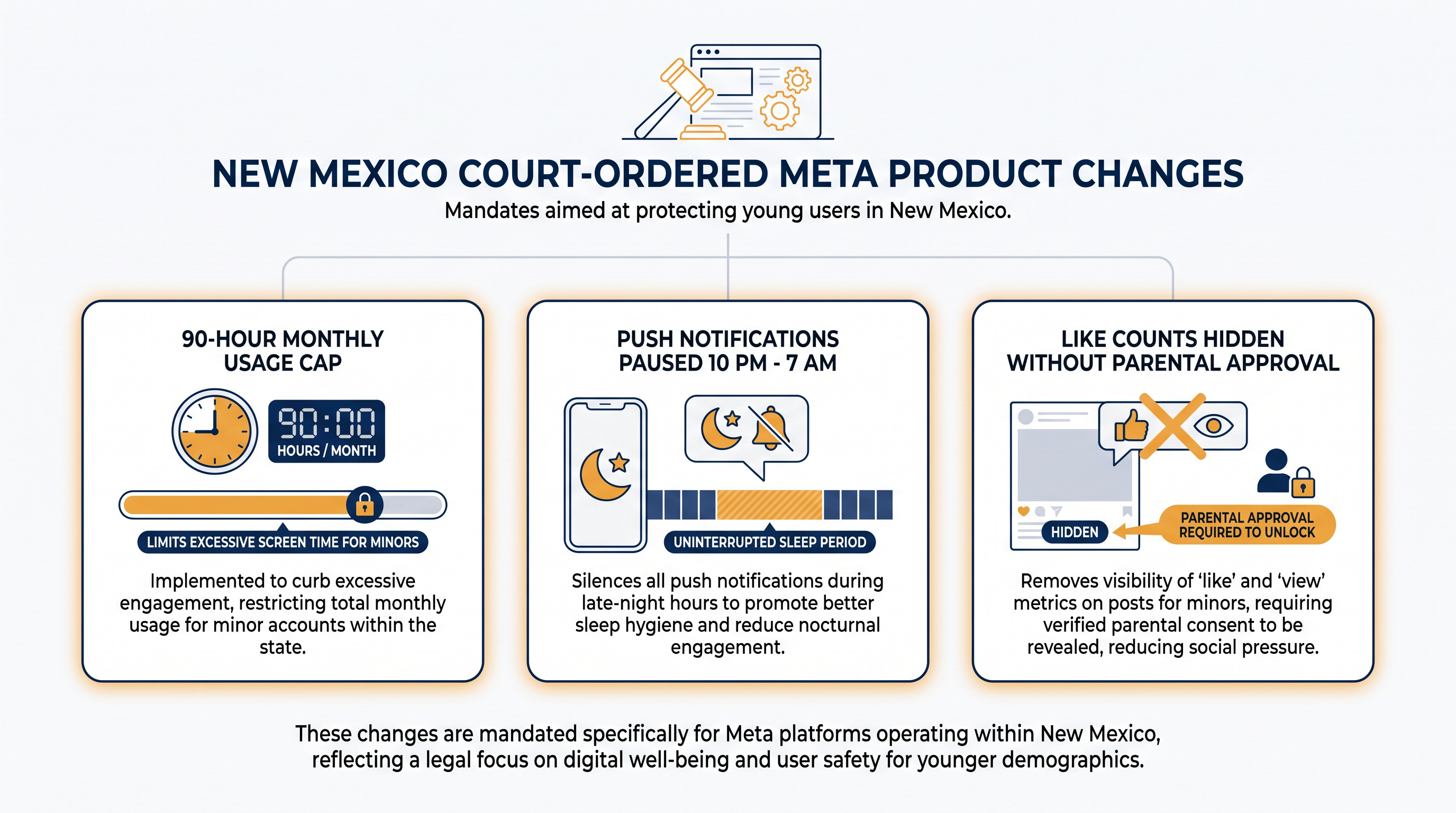
The court also targeted the core metrics of social validation that drive platform engagement. Under the new order, Meta must remove visible "Like" counts for users under 18 unless explicit parental approval is granted. These product interventions shift the legal battleground from abstract consumer protection to direct, state-level software engineering, forcing a global platform to geofence its user experience based on state lines.[5]
However, the technical reality of enforcing these mandates remains highly uncertain. To implement a 90-hour cap or age-gate Like counts, a platform must first accurately know the age of the person holding the device. The court acknowledged this hurdle, ordering Meta to improve its "age assurance tools" and specifically mandating the development of a dedicated "under-13-years-of-age prediction model" over the next two years.[2]
However, the technical reality of enforcing these mandates remains highly uncertain.
This is where the court's demands collide with the current limits of artificial intelligence. Meta has previously touted its use of AI to estimate user age based on behavioral signals, such as the accounts a user interacts with and the content they consume. Yet, behavioral age-gating is notoriously imprecise, functioning more as a probabilistic guess than a definitive ID check. Determined teenagers routinely bypass these systems, and building a model that can flawlessly distinguish a 12-year-old from a 14-year-old without requiring hard government identification remains an unsolved computer science problem.
The legal mechanism that enabled these mandates is equally novel. Rather than relying solely on traditional consumer protection laws, New Mexico successfully argued that Meta's product design constitutes a "public nuisance." This legal doctrine is typically reserved for environmental disasters, opioid manufacturers, or tobacco companies. By applying it to software, the state convinced the court that algorithms optimized for engagement are actively degrading public health and safety.[3][6]
The evidence supporting this conclusion was gathered through a state-led undercover investigation. During the trial's first phase, prosecutors revealed that agents had created social media accounts posing as children to document how the platforms operated. The state argued that Meta's algorithms not only fostered addictive usage patterns but actively connected minors with predators, all while the company allegedly concealed the extent of the danger.[1][5]
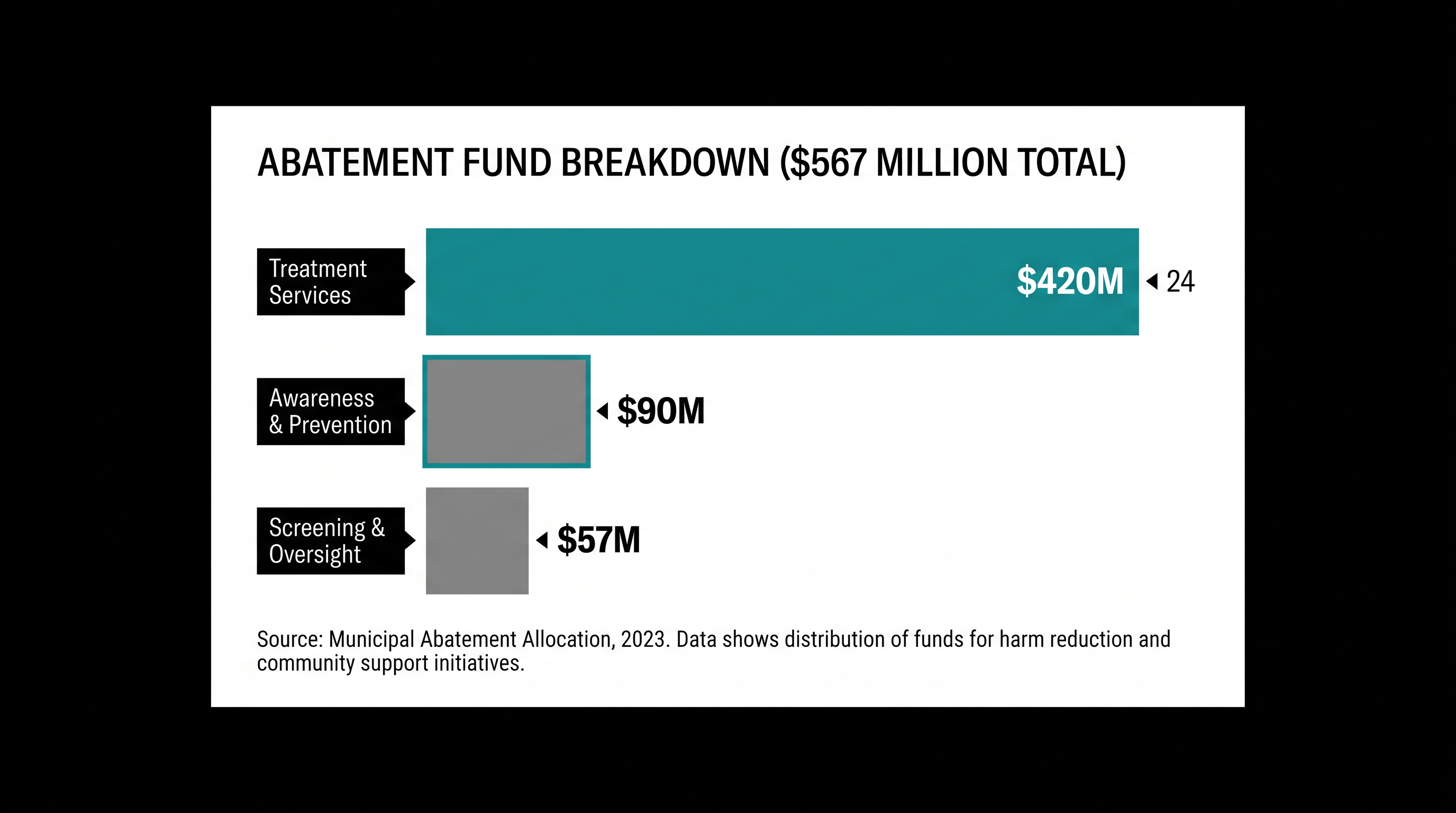
The financial structure of the $567 million abatement fund reflects the "public nuisance" framework. Rather than paying out individual settlements, the bulk of the money—$420 million—is strictly earmarked for community and family-based mental health treatment services across New Mexico. The remaining funds will finance awareness campaigns, screening programs, and the ongoing administrative oversight of the fund itself over the next five years.[1][5]
Meta has consistently pushed back against the state's characterization of its products and intends to appeal the ruling. Andy Stone, Meta's vice president of communications, stated that the company disagrees with the judgment, while defense attorneys have argued that the state is unfairly scapegoating a single technology company for a complex, multi-faceted societal crisis. The company maintains that it has invested heavily in safety features and parental controls that the court failed to adequately weigh.[4][5]
The enforcement of this ruling will likely be paused as the appeals process unfolds, but the precedent it sets is already rippling outward. New Mexico is not acting in isolation; the state's victory provides a tested legal playbook for other jurisdictions. Meta is currently facing a consolidated federal lawsuit in California brought by 33 states, alongside numerous municipal and school district lawsuits pursuing similar claims.[1][3]

If the New Mexico ruling survives the appellate courts, it could force a fundamental redesign of the consumer internet. The prospect of 50 different states imposing 50 different sets of algorithmic rules, usage caps, and notification curfews is a logistical nightmare for hyperscalers. Ultimately, the case tests whether the "engagement at all costs" business model has finally hit a hard legal ceiling, and whether software companies can be held financially responsible for the psychological externalities of their code.
Terms to know
- Public Nuisance
- A legal doctrine traditionally used against polluters or opioid manufacturers, applied here to argue that a company's product actively degrades public health and safety.
- Abatement Fund
- A pool of money ordered by a court to be used specifically to remedy or reduce the harm caused by the defendant's actions.
- Age Assurance
- Techniques and AI models used by platforms to estimate a user's age based on behavioral signals, rather than requiring formal identification.
- Geofencing
- The use of GPS or IP addresses to create a virtual geographic boundary, allowing software to apply different rules to users in specific states.
The backstory
2023
New Mexico Attorney General Raúl Torrez files a lawsuit against Meta over child safety and platform addiction.
March 2026
A Santa Fe jury finds Meta liable for violating the state's Unfair Practices Act, levying a $375 million penalty.
May 2026
The second phase of the trial concludes, focusing on whether Meta's platforms constitute a public nuisance.
August 2026
Judge Bryan Biedscheid orders Meta to pay an additional $567 million and implement strict product changes.
Different angles
State Regulators & Child Safety Advocates
Argue that tech platforms must be held legally and financially responsible for the psychological externalities of their product design.
This camp views the 'public nuisance' legal strategy as a necessary evolution in tech accountability. They argue that traditional consumer protection laws are insufficient to address algorithms that are intentionally optimized for addiction. By treating social media platforms like polluting factories, advocates believe states can force fundamental architectural changes—such as disabling engagement metrics and enforcing curfews—that companies refuse to implement voluntarily.
Tech Industry Defenders
Contend that the ruling scapegoats a single company for a complex societal issue and demands technically unfeasible solutions.
Industry representatives and defense attorneys argue that the youth mental health crisis is multifaceted, driven by pandemic isolation, economic stress, and broader cultural shifts, rather than just social media usage. Furthermore, they highlight the technical impossibility of the court's demands. Mandating an AI model that can flawlessly predict if a user is under 13 without requiring hard government ID is currently beyond the capabilities of computer science, making the ruling an unenforceable mandate.
Still unresolved
- Whether the appellate courts will uphold the application of 'public nuisance' law to software design.
- How Meta can technically enforce a 90-hour usage cap without requiring hard age verification for all users.
- If other states will successfully replicate this legal strategy in the pending 33-state consolidated lawsuit.
Questions readers ask
Where does the $567 million go?
The bulk of the money, $420 million, is earmarked for community and family-based mental health treatment services in New Mexico. The rest funds awareness, prevention, and screening programs.
Will Facebook and Instagram change for everyone?
No. The court's order only applies to underage users located within the state of New Mexico, though the technical implementation of such state-specific rules remains complex.
How will Meta know if a user is under 18?
The court ordered Meta to improve its 'age assurance tools' and develop an AI model to predict if users are under 13, though behavioral age estimation is currently imprecise.
Is this the end of the legal battle?
No. Meta has stated it will appeal the ruling. Additionally, the company faces a consolidated federal lawsuit brought by 33 other states in California.
Sources
Source coverage
6 outlets
3 viewpoints surfaced






[1]PBS NewsState Regulators
New Mexico court orders Meta to pay $567 million over mental health harms to kids online
Read on PBS News →[2]The Next WebLegal Observers
A New Mexico court orders Meta to pay $567m over harm to teens
Read on The Next Web →[3]The Business TimesLegal Observers
US court orders Meta to pay US$567m over harms to children's mental health
Read on The Business Times →[4]MashableTech Industry Defenders
Meta ordered to pay $567 million in New Mexico case
Read on Mashable →[5]Courthouse NewsLegal Observers
New Mexico judge orders Meta to pay $567 million for youth mental health
Read on Courthouse News →[6]TechPolicy.PressState Regulators
New Mexico Court Orders Meta to Pay to Establish $567 Million Fund to Abate Harms to Youth
Read on TechPolicy.Press →
Comments

Every angle. Every day.
Get technology stories with full source coverage and perspective breakdowns delivered to your inbox.