
Snooker Standings: Jack Lisowski and Zhang Anda Hunt Top-16 Berths as Elite Race Intensifies
With the lucrative China Open underway in Taiyuan, the battle for snooker's elite top 16 is heating up as Jack Lisowski and Zhang Anda look to unseat Si Jiahui and Ding Junhui.
By Ryder James

- Top-16 Challengers
- Players just outside the elite bracket who view major tournaments as critical opportunities to break in and avoid grueling qualifiers.
- Incumbent Elite
- Players currently holding the 14th to 16th spots who must defend their rolling prize money to maintain their automatic seeding.
- Neutral Analysts
- Commentators who relish the high-stakes drama the rolling ranking system produces, noting how every frame impacts the standings.
The competing cases
The Challengers' Push
The urgent drive for players like Jack Lisowski to secure automatic qualification.
For players ranked 17th through 25th, the World Snooker Tour can be a grueling grind of preliminary qualifiers. Breaking into the top 16 is viewed as a career-altering milestone, granting direct access to the televised stages of the Triple Crown events. Challengers approach high-value tournaments like the China Open knowing that a single deep run can erase a £40,000 deficit and secure months of guaranteed elite-level exposure.
The Defenders' Burden
The immense pressure on the incumbent top 16 to protect their rolling points.
Because the ranking system operates on a two-year rolling basis, players like Si Jiahui and Ding Junhui are constantly losing the prize money they earned 24 months prior. This creates a relentless treadmill where simply maintaining form is not enough; they must actively replace expiring points with new deep runs. Playing on home soil in China adds both a comforting advantage and an intense layer of national expectation to their defense.
What’s at stake
Securing a top-16 ranking is the holy grail of professional snooker, granting players automatic entry into the sport's most prestigious Triple Crown events without enduring grueling qualifying rounds. For players on the bubble, a single deep tournament run can alter the trajectory of their entire season.
The 2026/27 World Snooker Tour season is officially in full swing, and while the battle for the World No. 1 spot remains relatively static, the race for the elite top 16 is providing massive early-season drama. As the tour descends on Taiyuan City this week for the newly revived China Open, a massive £1.2 million prize fund is on the line, injecting a wealth of crucial ranking points into the ecosystem. For players hovering just outside the top-16 bubble, the tournament represents a golden opportunity to secure the sport's most coveted status: automatic qualification for the Masters and the World Championship. The margins are razor-thin, and a single deep run in Shanxi Province could alter the trajectory of a player's entire campaign.[1][2][3][6]
Leading the charge from the outside looking in is England's Jack Lisowski. The talented left-hander, known for his rapid and attacking flair on the baize, currently sits at World No. 17 with a provisional ranking total of £392,100. Lisowski is agonizingly close to the elite bracket, trailing China's Si Jiahui—who occupies the critical 16th spot with £428,000—by approximately £36,000. Because professional snooker operates on a two-year rolling prize money system, players must constantly earn new prize money to replace the earnings from two years ago that drop off their total. This rolling pressure means that the standings can shift violently after a high-stakes event like the China Open, giving Lisowski a clear mathematical path to leapfrog his rivals if he can string together a series of victories.[2][3][6]
Lisowski is far from the only contender eyeing a breakthrough. Just behind him at World No. 18 is China's Zhang Anda, holding a provisional total of £363,600, followed closely by England's Elliot Slessor at No. 19 with £360,700. Both men are well within striking distance of the top 16, knowing that a run to the quarter-finals or semi-finals in Taiyuan could provide the financial boost needed to cross the threshold. Analysts and fans have noted that the current density of talent between the 15th and 25th spots is creating one of the most competitive mid-table environments in recent tour history. Every frame carries massive importance, as falling short means enduring the grueling, multi-round qualifying events required to reach the televised stages of the Triple Crown tournaments.[1][2][5][6]
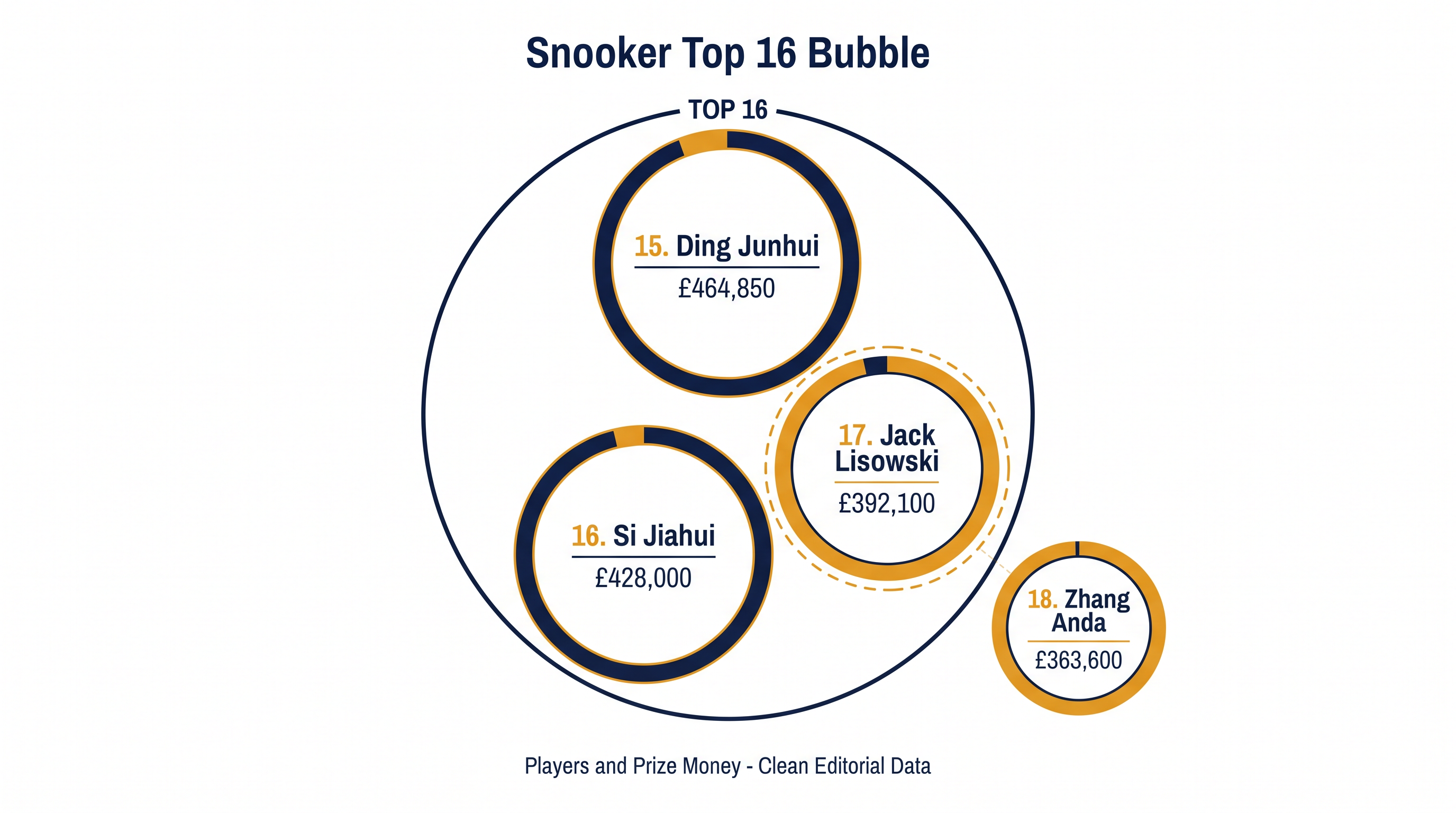
The pressure on the incumbent elite to defend their territory is equally immense. Si Jiahui and 15th-ranked Ding Junhui (£464,850) are both fighting to protect their positions on home soil this week. Ding, a national hero whose unforgettable 2005 China Open victory ignited the country's massive snooker boom, will be desperate to maintain his automatic seeding in front of a passionate local crowd. Ronnie O'Sullivan currently sits at 14th with £515,750, keeping him relatively safe for the immediate future, but the rolling ranking system spares no one who suffers a prolonged dip in form. The hometown advantage for the Chinese contingent could prove pivotal as they attempt to fend off the European challengers.[1][2][3]
The pressure on the incumbent elite to defend their territory is equally immense.
The return of the China Open to the international calendar after a six-year absence has been widely celebrated by tour officials and players alike. WPBSA Chairman Jason Ferguson highlighted the massive impact the event has on the global game during Friday's opening ceremony, noting that Taiyuan provides a magnificent stage worthy of the tournament's historic stature. The sheer scale of the £1.2 million prize pool means that the financial rewards—and the corresponding ranking points—are heavily weighted toward the latter stages of the week. For the bubble players, surviving the early rounds is not just about the immediate paycheck; it is a strategic necessity to keep their top-16 dreams alive heading into the autumn schedule.[1][3][6]
Further up the rankings, the hierarchy remains firmly established. Judd Trump is comfortably entrenched as World No. 1 with a staggering £1,579,550, fresh off his impressive victory at the Shanghai Masters earlier this month. Australia's Neil Robertson holds the No. 2 spot with £1,201,200, having banked significant points from his recent triumphs. Zhao Xintong (£1,178,550) and Wu Yize (£1,114,900) round out the top four, showcasing the historic strength of the Chinese contingent at the very pinnacle of the sport. While the battle for the number one spot may require months to unfold, the volatility at the bottom of the top 16 offers immediate, week-to-week suspense.[2][3][4][5]
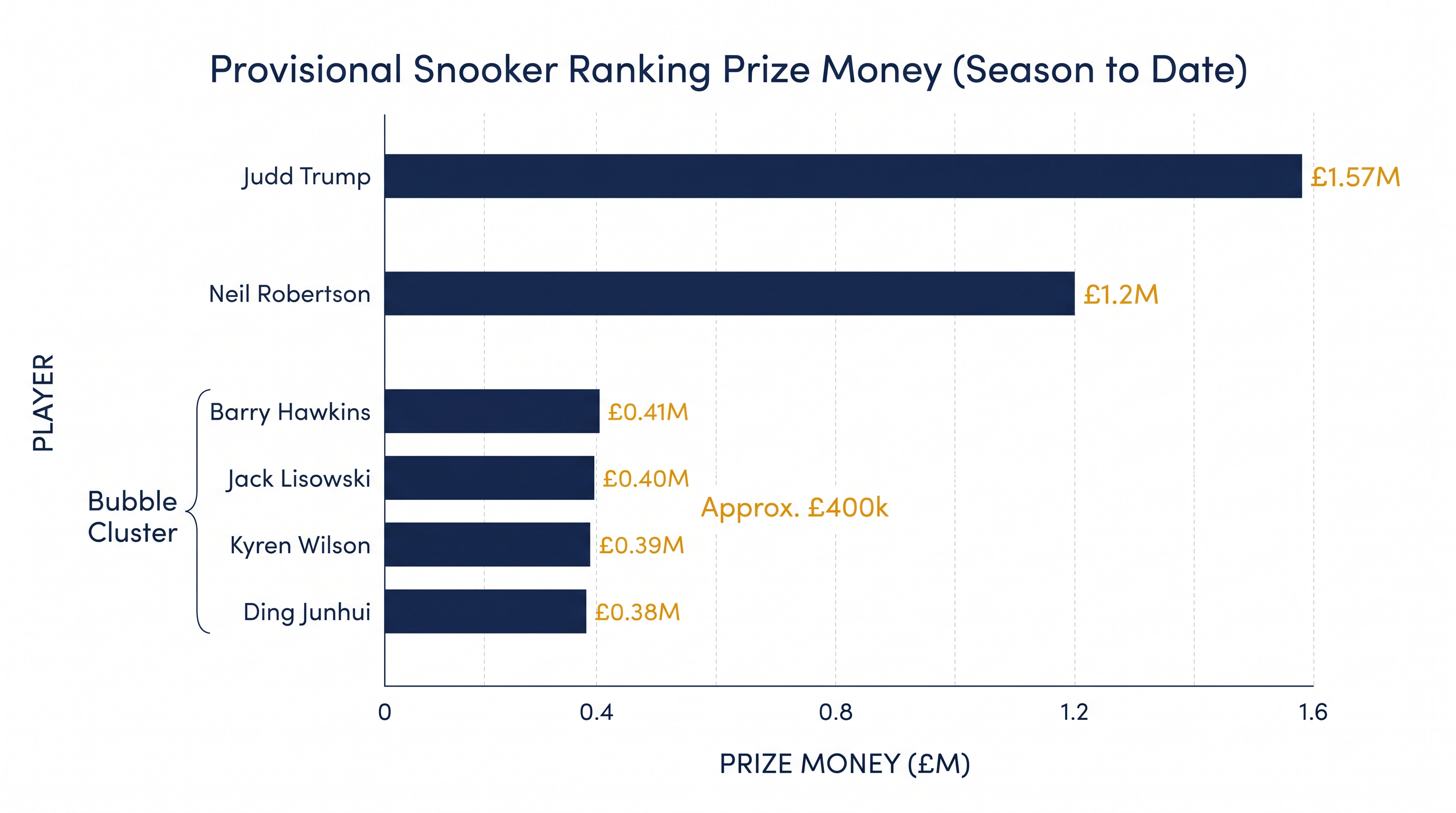
For the challengers, the mathematical reality is stark but encouraging. The £36,000 gap separating Lisowski from Si Jiahui can be erased with a single standout performance, but it also requires the incumbent players to stumble early. This dynamic creates a fascinating tournament-within-a-tournament, where players are not only focused on their own matches but are actively scoreboard-watching to track the progress of their direct ranking rivals. The mental fortitude required to perform under this specific brand of pressure separates the seasoned veterans from the emerging prospects, adding a rich layer of psychological intrigue to the tactical battles on the baize.[2][3][5][6]
As the China Open progresses toward its climactic weekend, the snooker world will be watching the provisional rankings just as closely as the trophy presentation. Whether Jack Lisowski can finally convert his undeniable talent into a sustained top-16 residency, or whether the defending elite like Si Jiahui and Ding Junhui can hold the line, remains the most compelling narrative of the early season. With the lucrative autumn and winter events looming on the horizon, securing that elite status now offers a vital runway of stability, making every pot, safety, and clearance in Taiyuan a potentially season-defining moment.[1][2][3][5][6]

Key takeaways
- Jack Lisowski and Zhang Anda are actively hunting a return to the elite top 16.
- The ongoing China Open offers a massive £1.2 million prize fund, injecting crucial ranking points.
- Si Jiahui and Ding Junhui are defending their 16th and 15th spots on home soil.
- Judd Trump remains comfortably entrenched as World No. 1 following his Shanghai Masters victory.
Unsettled ground
- Whether the immense pressure of playing on home soil will help or hinder the Chinese players defending their top-16 spots.
- Exactly how many points will be required to secure a top-16 spot by the time the winter Triple Crown events arrive.
Background
May 2026
The 2025/26 season concludes, resetting the two-year rolling points for several bubble players.
July 2026
The new 2026/27 season begins, offering the first fresh ranking points of the campaign.
August 2, 2026
Judd Trump wins the Shanghai Masters, solidifying his grip on the World No. 1 spot.
August 7, 2026
The China Open begins in Taiyuan, offering a £1.2 million prize fund and massive ranking implications.
Terms in play
- Top 16
- The highest-ranked 16 players on the World Snooker Tour, who receive automatic entry into major tournaments without playing qualifiers.
- Rolling Rankings
- A system where a player's ranking is determined by the prize money they have earned over the preceding two years, with older points constantly dropping off.
- Triple Crown
- Snooker's three most prestigious and historic tournaments: the World Championship, the UK Championship, and the Masters.
- Qualifiers
- Preliminary knockout rounds that players ranked outside the top 16 must navigate to reach the main, televised stages of major events.
Frequently asked
Why is the top 16 so important in snooker?
Being in the top 16 grants automatic qualification to the sport's biggest events, allowing players to skip grueling, multi-round qualifying stages.
How close is Jack Lisowski to the top 16?
Lisowski is currently ranked 17th, trailing 16th-placed Si Jiahui by approximately £36,000 in the provisional standings.
How does the snooker ranking system work?
Rankings are based on a two-year rolling prize money list. Players must constantly earn new prize money to replace the earnings from two years ago that drop off their total.
Sources
Source coverage
6 outlets
3 viewpoints surfaced






[1]World Snooker TourIncumbent Elite
China Open Returns to Taiyuan
Read on World Snooker Tour →[2]Snooker.orgTop-16 Challengers
Provisional Rankings 2026/2027
Read on Snooker.org →[3]SnookerHQTop-16 Challengers
Snooker rankings: update after the 2026 Championship League
Read on SnookerHQ →[4]Liquipedia
2026 World Snooker Tour Participants and Rankings
Read on Liquipedia →[5]Hot Shot SnookerNeutral Analysts
Snooker Rankings Shake-Up After World Open
Read on Hot Shot Snooker →[6]WikipediaNeutral Analysts
Snooker world rankings
Read on Wikipedia →
Comments
More in sports
See all 13 stories →Standings
Standings Watch: Malawi and Zimbabwe Cling to the Inside Track Ahead of High-Stakes African Netball Qualifiers
6 sources

Standings
AFL Top-Four Race Tightens as Melbourne, Brisbane, and Adelaide Lock in Three-Way Tie for Double Chance
7 sources

Standings
Western Lacrosse Association Playoffs Begin as Four Teams Vie for Mann Cup Berth
6 sources

Standings
Luke Littler Dominates 2026 PDC Standings as New Generation Surges Past Established Giants
7 sources

Every angle. Every day.
Get sports stories with full source coverage and perspective breakdowns delivered to your inbox.