
New York City Land Trust Makes History With First Commercial Property Purchase
The East New York Community Land Trust is acquiring a $2.3 million warehouse to create the East Brooklyn Liberation Center, marking the first time an NYC land trust has purchased a commercial property off the private market.
By Factlen Editorial Team
- Neighborhood Organizers
- View land acquisition as a necessary defensive strategy to build local power and prevent the displacement of long-term residents and businesses.
- Housing Justice Advocates
- Emphasize the scalable nature of the land trust model to permanently remove properties from the speculative market and ensure lasting affordability.
- Solidarity Economy Analysts
- Contextualize the purchase within a broader national shift toward cooperative economics, worker-owned businesses, and alternative financing.
- Urban Planners
- Focus on the safe reclamation of former industrial sites and the integration of community-owned hubs into sustainable neighborhood development.
What's not represented
- · Private real estate developers operating in East New York
- · City officials managing the 2016 neighborhood rezoning
Why this matters
As gentrification accelerates across major cities, community land trusts offer a proven blueprint for residents to permanently secure affordable housing and commercial space. This milestone demonstrates that grassroots organizations can successfully compete with private developers to keep local wealth and culture within the neighborhood.
Key points
- The East New York Community Land Trust is buying a $2.3 million warehouse in Brooklyn.
- It is the first time an NYC land trust has purchased a commercial property off the private market.
- The 9,500-square-foot building will become the East Brooklyn Liberation Center.
- The space will house the trust's headquarters, local worker co-ops, and cultural organizations.
- Funding came from over $722,000 in grassroots donations and low-interest nonprofit loans.
- The purchase aims to protect local businesses from displacement caused by gentrification.
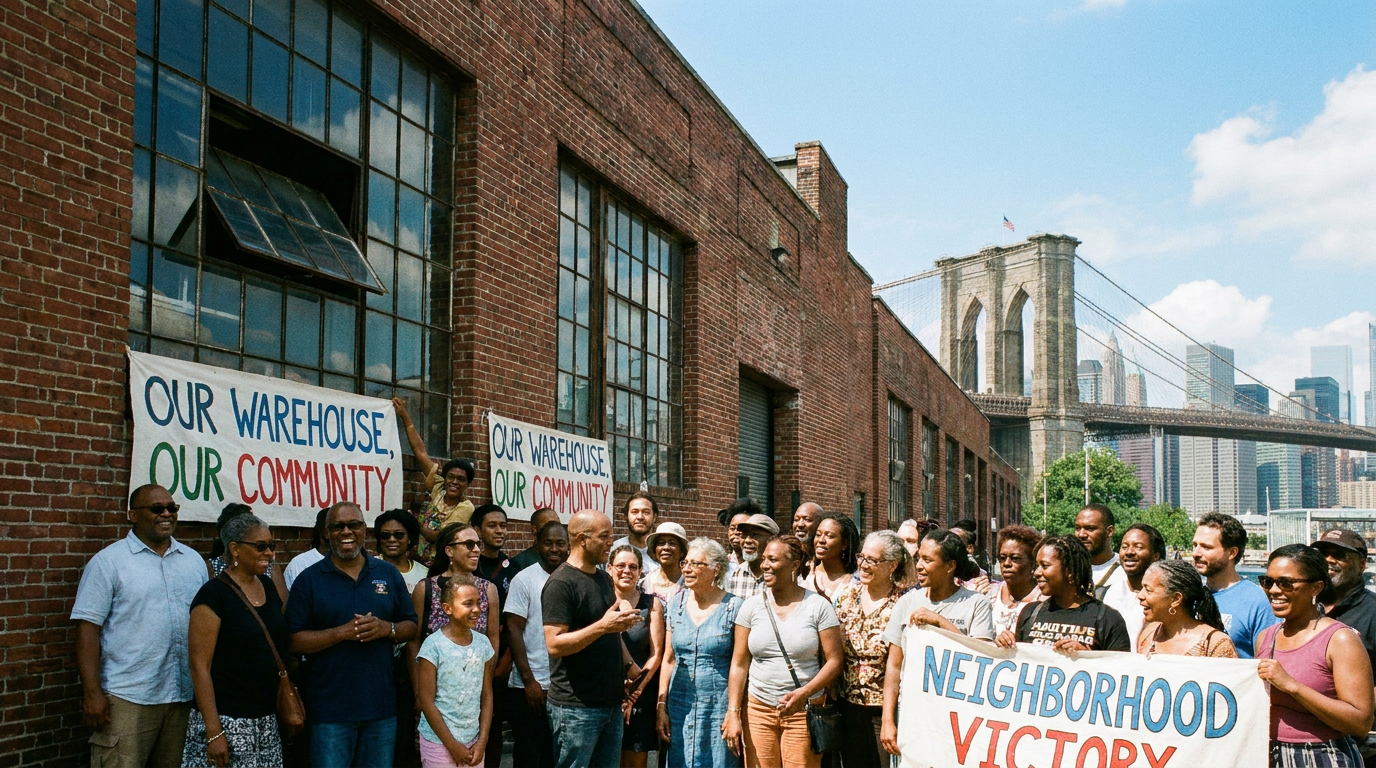
In a landmark victory for neighborhood organizers, the East New York Community Land Trust (ENYCLT) is set to become the first organization of its kind in New York City history to purchase a commercial property off the private market. The group is finalizing the $2.3 million acquisition of a two-story warehouse at 161 Jamaica Avenue, which will be transformed into the "East Brooklyn Liberation Center." The move represents a major evolution for the city's land trust movement, expanding its focus from residential housing to commercial real estate in an effort to anchor local businesses against the tide of gentrification.[1][3][5]
The 9,500-square-foot brick building has lived many lives over its 120-year history, serving as a wagon painting business, a radio coil manufacturer, and a cabinet-making shop. Soon, it will serve as the permanent headquarters for ENYCLT, which has rapidly outgrown its shared coworking space as its dues-paying membership approaches 100 residents. Beyond office space for the trust, the Liberation Center will offer deeply affordable, long-term leases to local worker cooperatives, small businesses, and cultural groups like Preserving East New York.[1][2][7]
"Removing land from the speculative market is building power in the neighborhood," said Boris Santos, president of ENYCLT. For organizers, securing the Jamaica Avenue property at a below-market price is a strategic defensive maneuver. East New York and neighboring Brownsville—working-class communities where Black and Hispanic residents make up over 80 percent of the population—have faced a rising affordability crisis and intense real estate speculation following a controversial 2016 neighborhood rezoning.[1][2][7]
Community land trusts operate by acquiring property and removing it from the private market permanently, ensuring that the land is governed democratically by residents and used for the public good. While several New York City CLTs have previously acquired properties transferred from the city government for nominal fees, purchasing a standalone commercial building directly off the speculative market proves that grassroots organizations can successfully compete with private developers.[1][4][7]

The $2.3 million purchase is being financed through a patchwork of solidarity economy mechanisms. ENYCLT secured low- and no-interest loans from nonprofit lenders, including the New Economy Loan Fund and Working World. To cover the down payment, closing costs, and immediate repairs, the trust launched a grassroots fundraising campaign, successfully raising over $722,000 toward an $800,000 goal by late May.[2][7]
The $2.3 million purchase is being financed through a patchwork of solidarity economy mechanisms.
Because the Jamaica Avenue warehouse has a long industrial history, the acquisition required rigorous environmental due diligence. Recent Phase I and Phase II environmental assessments confirmed the site is clean, clearing the way for the community hub without the need for extensive brownfield remediation. This green light allows the trust to focus its capital entirely on renovating the space for public use rather than environmental cleanup.[6]
The commercial acquisition builds on a historic residential victory ENYCLT secured just two years prior. In February 2024, the organization made waves by purchasing a 20-unit rent-stabilized apartment building at 248 Arlington Avenue—the first time an NYC land trust bought a multifamily building from a private landlord. Working alongside the tenants, who had endured years of neglected repairs and lack of heat, the trust is currently converting that building into a shared-equity housing cooperative.[1][4]

The success in East New York is part of a broader explosion of community ownership models nationwide. From employee ownership trusts in the restaurant industry to community-owned solar grids, alternative economic structures are gaining mainstream traction as communities seek to build localized wealth. In New York City alone, the number of active land trusts has skyrocketed since 2020, coordinated through the NYC Community Land Initiative.[2][5]
For the residents of East New York, the Liberation Center is more than just a real estate transaction; it is a blueprint for neighborhood survival. By securing permanent, community-controlled commercial space, the trust is ensuring that the local organizations and businesses that define the neighborhood's culture will not be priced out as development pushes eastward from Bushwick and Bedford-Stuyvesant.[1][2][7]

As the final closing paperwork is signed this month, ENYCLT is already looking ahead to its next targets. The new headquarters will provide the physical infrastructure needed to expand their organizing capacity, support tenant takeovers of predatory buildings, and advocate for citywide legislation that gives nonprofits the first right to purchase properties when landlords sell. "You'll be seeing us going after more and more buildings," Santos noted.[1][2][7]
How we got here
2016
East New York undergoes a controversial neighborhood rezoning, sparking a wave of real estate speculation and rising rents.
2020
The East New York Community Land Trust (ENYCLT) is founded by local residents to combat displacement and build community wealth.
February 2024
ENYCLT makes history by purchasing a 20-unit residential building at 248 Arlington Avenue directly from a private landlord.
May 2026
The trust successfully raises over $722,000 in grassroots donations to fund its first commercial real estate acquisition.
June 2026
ENYCLT finalizes the $2.3 million purchase of the 161 Jamaica Avenue warehouse to create the East Brooklyn Liberation Center.
Viewpoints in depth
Neighborhood Organizers
View land acquisition as a necessary defensive strategy to build local power and prevent displacement.
For grassroots organizers, purchasing property is the most direct way to combat the forces of gentrification. They argue that rezoning efforts and speculative real estate investments inherently extract wealth from low-income communities of color. By removing land from the private market entirely, organizers believe they can create permanent strongholds where local culture, businesses, and residents can thrive without the constant threat of rising rents or eviction.
Housing Justice Advocates
Emphasize the scalable nature of the land trust model to permanently remove properties from the speculative market.
Housing advocates view the East New York victory as a proof of concept that can be replicated citywide. They point out that while fighting slumlords in court is necessary, transitioning buildings into shared-equity cooperatives and community-owned commercial spaces addresses the root cause of the affordability crisis. Advocates are increasingly pushing for legislation, such as the Community Opportunity to Purchase Act, which would give nonprofits the first right of refusal when landlords sell their buildings.
Solidarity Economy Analysts
Contextualize the purchase within a broader national shift toward cooperative economics and alternative financing.
Economic analysts note that the funding model for the Liberation Center—relying on grassroots donations and low-interest loans from mission-driven lenders—demonstrates the viability of a 'solidarity economy.' They argue that as traditional banking and real estate markets become increasingly inaccessible to working-class communities, alternative financial ecosystems are stepping in to fund worker cooperatives, employee ownership trusts, and community land acquisitions.
What we don't know
- Exactly which local businesses and worker cooperatives will be selected as the first tenants of the Liberation Center.
- Whether the New York State legislature will pass the Tenant Opportunity to Purchase Act, which would make future acquisitions easier for land trusts.
Key terms
- Community Land Trust (CLT)
- A community-governed nonprofit that buys and holds land to ensure it remains permanently affordable and serves the local neighborhood's needs.
- Speculative Market
- A real estate environment where investors buy properties primarily in the hope that their value will increase rapidly, often leading to gentrification and displacement.
- Shared-Equity Cooperative
- A housing model where residents own shares in their building, keeping purchase prices affordable while limiting how much profit can be made upon resale to maintain affordability for future buyers.
- Solidarity Economy
- An economic framework that prioritizes social profitability, mutual aid, and democratic control over maximizing financial profit.
- Phase I/II Environmental Assessments
- Standardized investigations used to determine if a commercial or industrial property has soil or groundwater contamination before a purchase is finalized.
Frequently asked
What is a Community Land Trust (CLT)?
A CLT is a nonprofit organization that acquires land and removes it from the speculative real estate market. The land is owned collectively by the community to ensure permanent affordability for housing or commercial use.
Why is this purchase a milestone for New York City?
While NYC land trusts have previously acquired residential buildings or properties transferred from the city government, this is the first time a trust has purchased a commercial property directly off the private market.
How was the $2.3 million purchase funded?
The acquisition was financed through a combination of grassroots donations—raising over $722,000 toward an $800,000 goal—and low-interest loans from nonprofit solidarity economy lenders.
What will the East Brooklyn Liberation Center be used for?
The 9,500-square-foot warehouse will serve as the headquarters for the East New York Community Land Trust and provide deeply affordable space for local worker cooperatives, small businesses, and cultural groups.
Sources
Source coverage
7 outlets
4 viewpoints surfaced






[1]Next CityNeighborhood Organizers
A Community Land Trust Is Purchasing Commercial Property in NYC for the First Time
Read on Next City →[2]BrownstonerNeighborhood Organizers
Community Land Trust Plans 'Liberation Center' in East New York Warehouse
Read on Brownstoner →[3]Giving CompassHousing Justice Advocates
Community Land Trust Purchases First Piece of Property in New York City
Read on Giving Compass →[4]The NationHousing Justice Advocates
Community Land Trusts Are Standing Up to New York City's Worst Landlords
Read on The Nation →[5]The StakeholdSolidarity Economy Analysts
P. Terry's Puts Employee Ownership Trusts On The Menu
Read on The Stakehold →[6]Smart Growth AmericaUrban Planners
How Community Land Trusts are reclaiming brownfields — and why it matters now
Read on Smart Growth America →[7]East New York Community Land TrustNeighborhood Organizers
The East Brooklyn Liberation Center
Read on East New York Community Land Trust →
Every angle. Every day.
Get community stories with full source coverage and perspective breakdowns delivered to your inbox.