
Israeli Airstrikes in Beirut Threaten to Derail Imminent U.S.-Iran Peace Deal
Just hours before Washington and Tehran were expected to sign an agreement ending their nearly four-month war, Israeli strikes on a Hezbollah stronghold in Lebanon have thrown the diplomatic breakthrough into jeopardy.
By Factlen Editorial Team
- Iranian Leadership
- Views the Lebanese front as inseparable from the broader U.S.-Iran conflict.
- U.S. & Mediating Diplomats
- Focused on compartmentalizing regional skirmishes to secure a historic strategic agreement.
- Israeli Defense Establishment
- Maintains that Israel must secure its northern border regardless of U.S. diplomatic timelines.
What's not represented
- · Lebanese civilians displaced by the ongoing strikes in the Dahiyeh suburbs.
- · Global shipping companies awaiting the reopening of the Strait of Hormuz.
Why this matters
The collapse of this peace deal would prolong the closure of the Strait of Hormuz, sustaining the severe spike in global energy prices and risking a wider ballistic missile war across the Middle East.
Key points
- Israeli warplanes struck a Hezbollah command center in Beirut's Dahiyeh district on Sunday.
- The attack occurred hours before the U.S. and Iran were expected to sign a historic peace deal.
- Iranian officials warned the strike crosses a red line and could derail the diplomatic framework.
- The proposed deal aims to reopen the Strait of Hormuz and unfreeze $25 billion in Iranian assets.
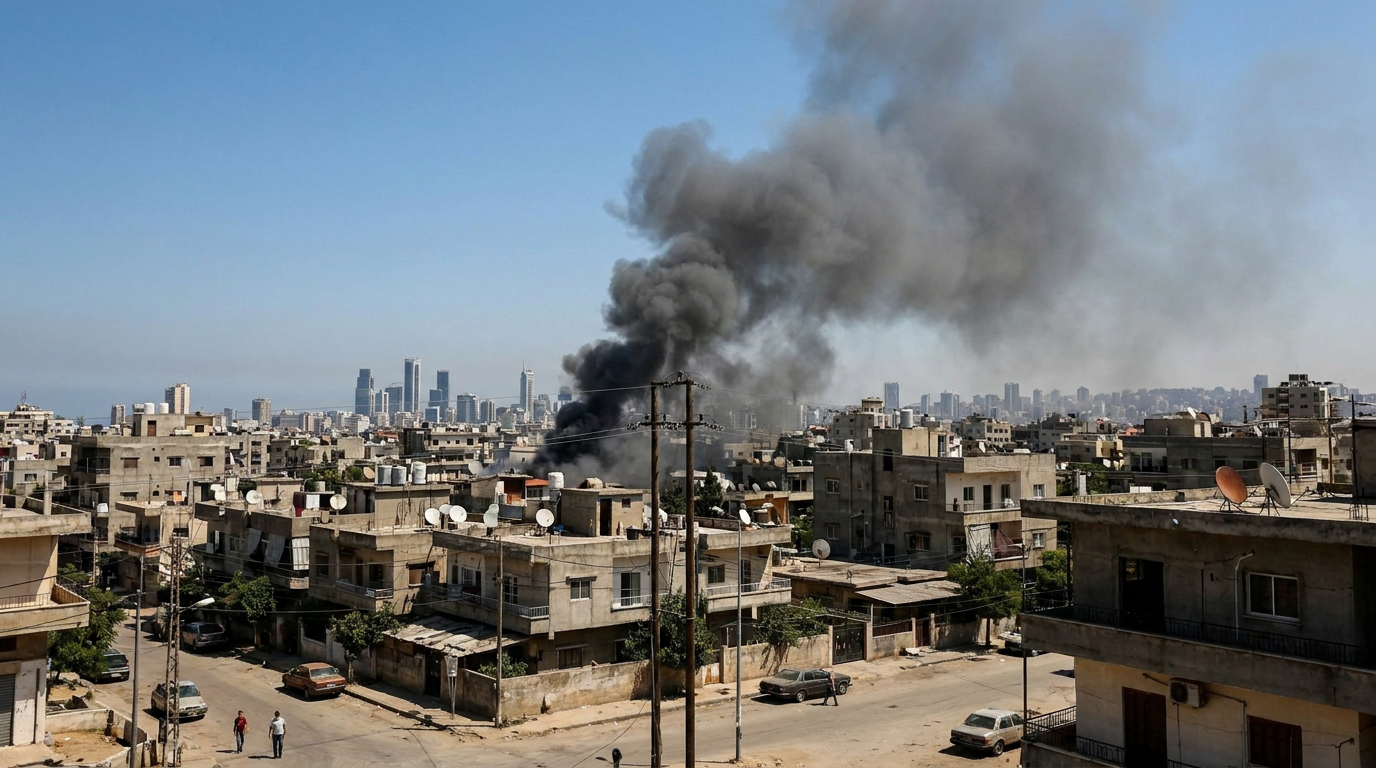
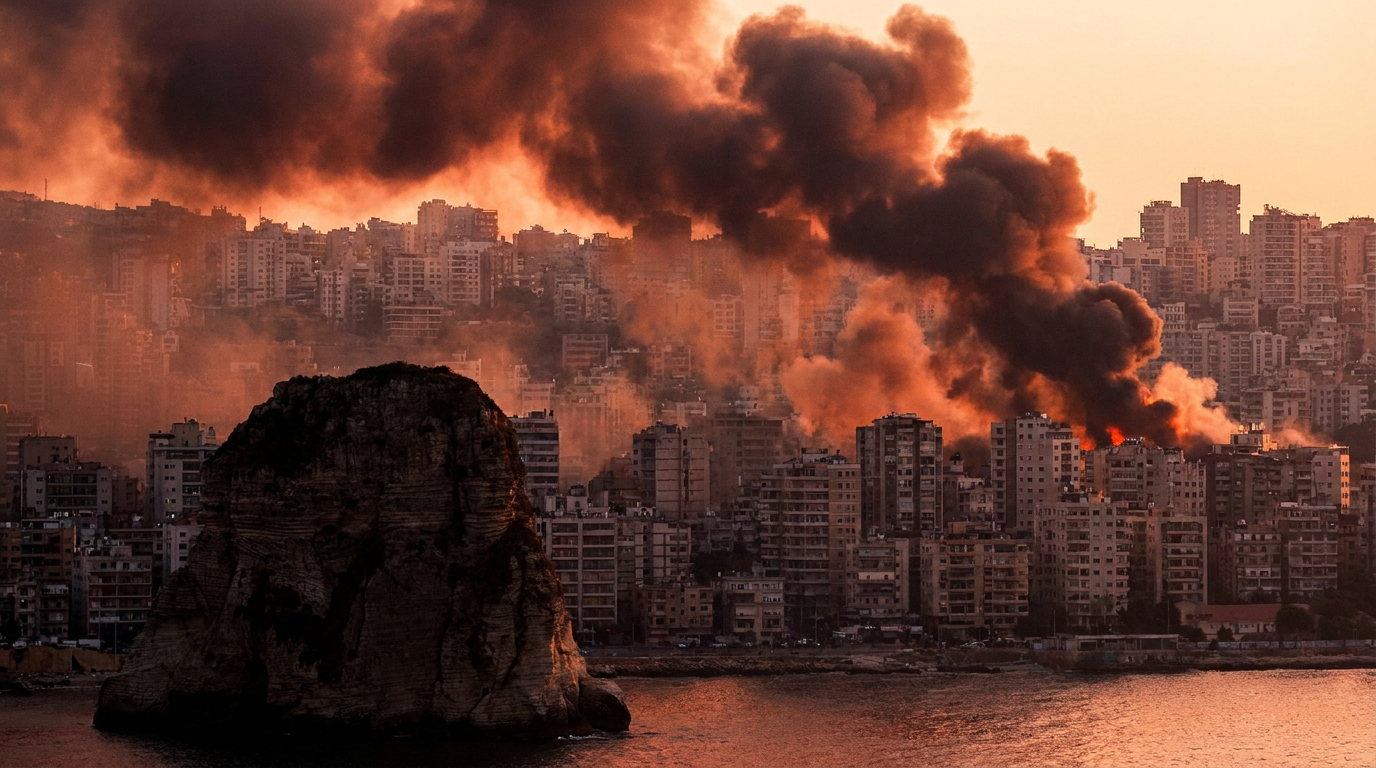
Just hours before the United States and Iran were scheduled to sign a historic peace agreement to end their nearly four-month war, Israeli warplanes struck the southern suburbs of Beirut. The bombardment on Sunday targeted a Hezbollah command center in the Dahiyeh district, sending plumes of smoke over the Lebanese capital and throwing a fragile diplomatic breakthrough into severe jeopardy.[1][2][5]
The timing of the strike illustrates the deeply interconnected and volatile nature of the region's conflicts. U.S. President Donald Trump and Pakistani Prime Minister Shehbaz Sharif, who has served as the lead mediator, had publicly forecast that a U.S.-Iran deal would be signed electronically on Sunday.[2][7][8]
However, the Israeli military operation has prompted Tehran to cast immediate doubt on that timeline. Iran's top negotiator, Mohammad Baqer Qalibaf, stated that the attack on Beirut demonstrates Washington either lacks the will to restrain its ally or the ability to fulfill its diplomatic commitments.[2][5]
To understand how an airstrike in Lebanon threatens a bilateral agreement between Washington and Tehran, one must examine the origins of the current war. The conflict erupted on February 28, 2026, following a joint U.S.-Israeli strike that killed Iran's Supreme Leader Ali Khamenei.[7][8]

In the immediate aftermath, Hezbollah—Iran's most powerful regional proxy—began firing missiles into northern Israel to support Tehran. While a fragile ceasefire between the U.S. and Iran took hold on April 7, the northern front between Israel and Hezbollah has remained highly active.[5][8]
The core diplomatic friction lies in the scope of the proposed peace deal. Iran has consistently demanded that any permanent truce with the United States must also include a cessation of Israeli hostilities against Hezbollah in Lebanon.[5][8]
Israel, conversely, maintains that it is not a party to the U.S.-Iran negotiations and will not allow its security to be dictated by them. Prime Minister Benjamin Netanyahu and Defense Minister Israel Katz issued a joint statement asserting that Sunday's strike was a direct, necessary response to Hezbollah launching three projectiles into Israeli territory earlier in the day.[2][5][6]
Israel, conversely, maintains that it is not a party to the U.S.-Iran negotiations and will not allow its security to be dictated by them.
The Israeli military claimed the strike precisely targeted a senior command-and-control official belonging to Hezbollah's Radwan Force—an elite special operations unit—operating out of a five-story residential building in Dahiyeh.[5][6]

Beyond the immediate violence, the stakes of the U.S.-Iran deal carry massive implications for the global economy. The nearly four-month conflict has effectively shut down commercial shipping through the Strait of Hormuz, a narrow maritime chokepoint that handles roughly a fifth of the world's oil consumption.[7][8]
This blockade has strangled global energy supplies and driven a severe spike in prices. A central pillar of the proposed U.S.-Iran Memorandum of Understanding requires Tehran to immediately reopen the strait to all commercial vessels.[4][7]
In exchange, the draft agreement reportedly outlines a phased lifting of U.S. sanctions and the unfreezing of approximately $25 billion in Iranian assets. The mechanism for releasing these funds is highly complex, designed to build trust between two deeply adversarial nations.[4][7]
Iranian sources indicate that Tehran is demanding a concrete, guaranteed first step—likely involving the transfer of funds through Qatari intermediaries—before committing to the broader framework. Tehran has cited past U.S. reversals as the reason it will not accept vague and unreal promises.[3][4]

The most sensitive component of the proposed deal involves Iran's nuclear program. The agreement would establish a 60-day window following the initial signing to negotiate the dismantling or dilution of Iran's enriched uranium stockpile.[4][8]
U.S. officials maintain that this framework will permanently block Iran's path to a nuclear weapon, which was a primary justification for the initial military escalation in February. However, Israeli officials have reportedly expressed deep reservations, arguing the deal fails to address Iran's ballistic missile capabilities and provides Tehran time to rebuild its military strength.[6][8]
The immediate hurdle remains the fallout from the Beirut strikes. Iranian military officials, including Brigadier General Mohammad Jafar Asadi, have vowed that the attack will not go unanswered, raising the specter of renewed ballistic missile exchanges.[2][5]
In a desperate bid to salvage the agreement, Qatari mediators hurriedly flew to Tehran on Sunday. Their diplomatic task is monumental: convincing Iranian leadership to compartmentalize the Lebanese theater from the broader strategic goal of ending the U.S.-Iran war.[2][8]

Whether these mediators succeed will determine the immediate future of the Middle East. The region now stands at a precipice, waiting to see if the historic peace deal can survive the gravitational pull of its interconnected proxy conflicts, or if the war is about to enter a volatile new phase.[1][3][8]
How we got here
Feb 28, 2026
U.S. and Israel launch strikes on Iran, killing Supreme Leader Ali Khamenei and sparking a regional war.
March 2, 2026
Hezbollah begins firing missiles into Israel in support of Tehran, opening a second front in Lebanon.
April 7, 2026
A fragile ceasefire takes hold between the U.S. and Iran, halting direct military confrontation.
June 13, 2026
U.S. and Pakistani leaders announce a peace deal is imminent and could be signed within 24 hours.
June 14, 2026
Israel strikes a Hezbollah command center in Beirut, prompting Iranian threats to walk away from the negotiating table.
Viewpoints in depth
Iranian Leadership
Views the Lebanese front as inseparable from the broader U.S.-Iran conflict.
Tehran argues that the United States and Israel operate as a unified front, making it impossible to sign a bilateral peace deal with Washington while Israeli warplanes bomb Iranian allies in Beirut. Iranian negotiators view the Dahiyeh strikes not as a localized border dispute, but as a deliberate test of Iran's resolve and a potential violation of the April ceasefire. For Iran's military establishment, failing to respond to the assassination of a Hezbollah commander would project weakness at a critical diplomatic juncture.
Israeli Defense Establishment
Maintains that Israel must secure its northern border regardless of U.S. diplomatic timelines.
Israel is not a signatory to the emerging U.S.-Iran Memorandum of Understanding and views the negotiations with deep skepticism. The Israeli defense establishment argues that the proposed deal enriches Tehran while failing to address the immediate threat posed by Hezbollah's entrenched forces in Lebanon. From Jerusalem's perspective, halting operations against Hezbollah to accommodate Washington's signing ceremony would essentially grant the militant group immunity to launch drones and rockets into northern Israel.
U.S. & Mediating Diplomats
Focused on compartmentalizing regional skirmishes to secure a historic strategic agreement.
For Washington and mediators in Islamabad and Doha, the primary objective is ending the four-month war and reopening the Strait of Hormuz to stabilize global energy markets. Diplomats are attempting to thread a nearly impossible needle: convincing Iran that Israel's actions in Lebanon are independent of U.S. policy, while simultaneously pressuring Israel to minimize escalations that could collapse the fragile diplomatic track. They argue the strategic benefits of the deal—particularly the 60-day window to dismantle Iran's nuclear material—outweigh the localized violence.
What we don't know
- Whether Iran will officially walk away from the peace deal or merely delay the signing to save face.
- If Hezbollah will escalate its cross-border attacks in response to the assassination of its Radwan Force commander.
- How the $25 billion in frozen assets will be securely transferred if the diplomatic trust continues to erode.
Key terms
- Strait of Hormuz
- A narrow maritime chokepoint between the Persian Gulf and the Gulf of Oman that handles roughly a fifth of the world's oil consumption.
- Dahiyeh
- The densely populated southern suburbs of Beirut that serve as Hezbollah's primary political and military stronghold.
- Radwan Force
- Hezbollah's elite special operations unit, tasked with cross-border infiltration and advanced tactical operations.
- Memorandum of Understanding (MoU)
- A formal agreement between two or more parties that establishes a framework for future detailed negotiations, used here for the initial U.S.-Iran truce.
Frequently asked
Why is Israel bombing Beirut if the U.S. and Iran are signing a peace deal?
Israel is not a party to the U.S.-Iran bilateral negotiations and states it is responding to Hezbollah drone and rocket attacks on northern Israel.
What does the U.S.-Iran peace deal actually do?
The draft agreement would extend the current ceasefire, reopen the Strait of Hormuz to commercial shipping, unfreeze $25 billion in Iranian assets, and establish a 60-day window to negotiate limits on Iran's nuclear program.
Will the deal still be signed?
It remains highly uncertain; while U.S. and Pakistani officials pushed for a Sunday signing, Iranian negotiators have warned that the Beirut strikes could collapse the diplomatic track.
Sources
Source coverage
8 outlets
3 viewpoints surfaced








[1]AxiosU.S. & Mediating Diplomats
Iran warns Israel's Beirut strike could derail U.S. deal
Read on Axios →[2]The GuardianU.S. & Mediating Diplomats
Middle East crisis live: Trump says Iran deal will be signed today but Tehran casts doubt on timing as Israel launches strikes on Beirut
Read on The Guardian →[3]Al JazeeraIranian Leadership
Iran warns strikes on Beirut could derail diplomacy
Read on Al Jazeera →[4]The New ArabIranian Leadership
Iran says no final decision taken over US peace deal; Israel bombs Beirut
Read on The New Arab →[5]CBC NewsIsraeli Defense Establishment
Israeli military strikes Beirut suburbs ahead of anticipated U.S.-Iran deal
Read on CBC News →[6]The Media LineIsraeli Defense Establishment
Israel Targets Hezbollah Commander in Beirut Amid Iran Deal Push
Read on The Media Line →[7]The Washington PostU.S. & Mediating Diplomats
U.S. and Iran to close deal within a day, Trump says, but Tehran yet to confirm
Read on The Washington Post →[8]CBS NewsU.S. & Mediating Diplomats
Live Updates: Qatari mediators travel to Tehran to finalize truce in U.S.-Iran war
Read on CBS News →

More in news politics
See all 6 stories →Voting Systems
Does Ranked-Choice Voting Work? Fact-Checking the Data Behind the Ballot Reform
0 sources
Social Media Policy
UK to Announce 'Australia Plus' Social Media Ban for Under-16s
0 sources
Information Ecosystem
Fact-Checking the Cure: The Evidence Behind 'Pre-Bunking' Political Misinformation
0 sources

U.S.-Iran Deal
Israeli Airstrikes in Beirut Threaten Historic U.S.-Iran Peace Deal Hours Before Signing
0 sources
Every angle. Every day.
Get news politics stories with full source coverage and perspective breakdowns delivered to your inbox.