
Inside the Solid-State Battery: How the Next Generation of Power Actually Works
By replacing flammable liquids with rigid ceramics, solid-state batteries promise to double EV ranges and eliminate fire risks. Here is the science behind the breakthrough, and the manufacturing hurdles keeping it out of your driveway.
By Factlen Editorial Team
- Battery Manufacturers
- Focused on the brutal realities of scaling production and the timeline for mass-market adoption.
- Material Scientists
- Focused on the atomic-level challenges of dendrite suppression and interface physics.
- Automakers & Aerospace
- Focused on the performance gains, range extension, and new vehicle form factors unlocked by the technology.
What's not represented
- · Consumer Electronics Brands
- · Raw Material Miners
Why this matters
The lithium-ion battery has powered the digital revolution, but its limits are causing range anxiety in EVs and fire risks in consumer gadgets. Solid-state technology is the key to unlocking 1,000-kilometer vehicle ranges, 10-minute charge times, and the dawn of commercial electric aviation.
Key points
- Solid-state batteries replace the flammable liquid electrolyte found in standard lithium-ion cells with a rigid solid material like ceramic or glass.
- This solid barrier allows engineers to use a pure lithium metal anode, effectively doubling the battery's energy density.
- The technology drastically reduces fire risks, raising the threshold for dangerous thermal events from 90°C to over 247°C.
- Early solid-state packs are already being tested in motorized aircraft, achieving 410 Wh/kg compared to standard 250 Wh/kg cells.
- Mass commercialization is delayed by 'interface resistance'—the microscopic gaps that form when pressing two solid materials together.
For three decades, the rechargeable battery has been defined by a single, stubborn architecture. The lithium-ion cell tucked inside almost every smartphone, laptop, and electric vehicle has transformed modern society, but it is fundamentally hitting a chemical wall.[1]
Consumers feel this limitation daily: phones that die by evening, electric vehicles that induce range anxiety, and the persistent, underlying risk of battery fires. To push past these boundaries, the energy storage industry is turning to a technology that has lived in laboratories for years but is finally entering real-world production in 2026: the solid-state battery.[1][6]
To understand why solid-state technology is considered a generational leap, one must first look at how conventional batteries operate. Every battery consists of three primary components: a negative electrode (the anode), a positive electrode (the cathode), and an electrolyte sitting between them.[5]
In a standard lithium-ion battery, this electrolyte is a liquid solvent. When a device is drawing power, lithium ions swim through this liquid from the anode to the cathode, while electrons take an external route to power the device. When charging, the process reverses.[7]

The liquid electrolyte is highly effective at conducting ions, but it carries inherent flaws. It is volatile, temperature-sensitive, and highly flammable. Under extreme stress—such as a physical crash, overcharging, or severe heat—the liquid can ignite, triggering a dangerous chain reaction known as thermal runaway.[7][8]
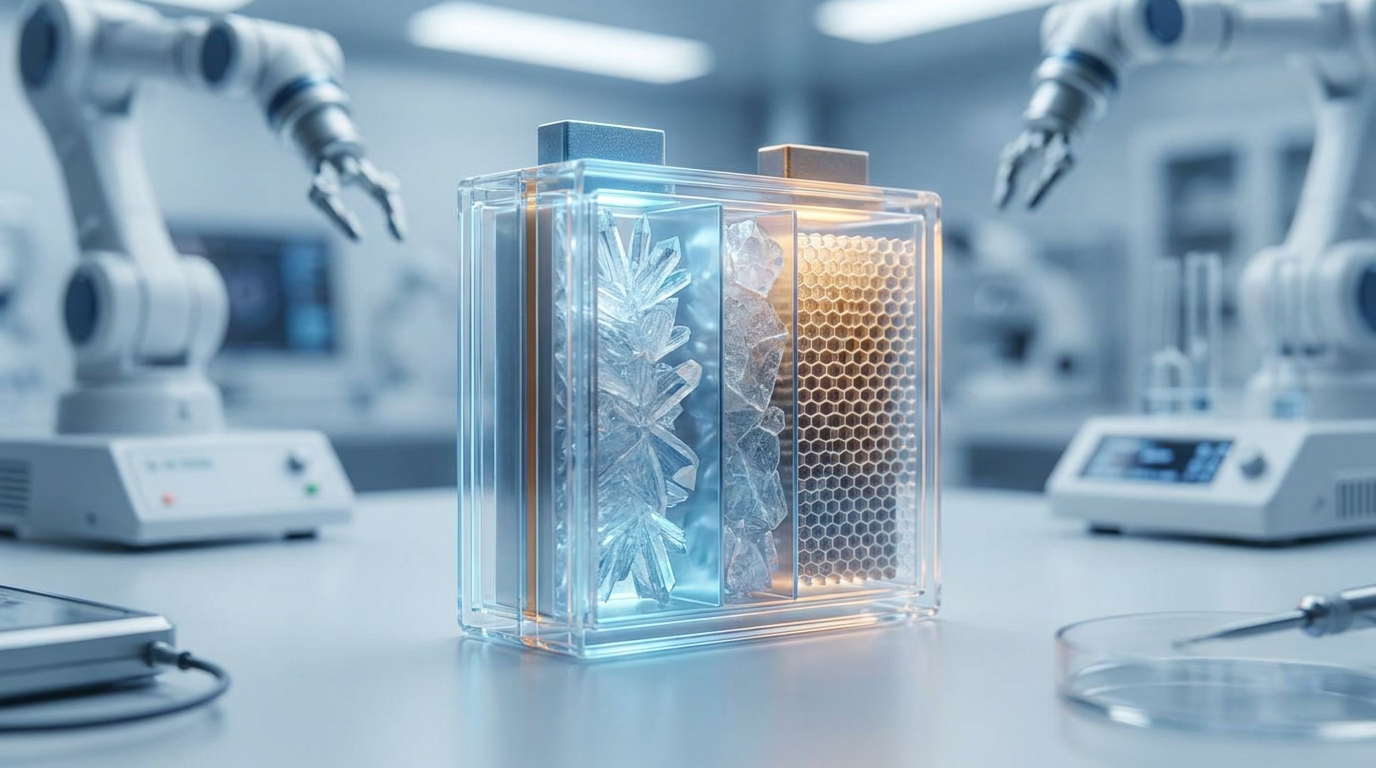
A solid-state battery fundamentally alters this equation by replacing the liquid solvent with a solid material, typically a specialized ceramic, glass, or sulfide compound. This single material swap eliminates the flammable liquid entirely, drastically raising the temperature at which thermal events occur from around 90°C in conventional cells to over 247°C.[1][5]
But safety is only half the story. The true prize of solid-state architecture is a massive increase in energy density—the amount of power a battery can store relative to its weight, measured in watt-hours per kilogram (Wh/kg).[8]
In traditional batteries, the anode is typically made of graphite, a bulky material required to safely absorb lithium ions without causing dangerous metallic growths. Because a solid electrolyte is physically rigid, it acts as a mechanical barrier, allowing engineers to discard the heavy graphite and use an anode made of pure, metallic lithium.[5][7]
In traditional batteries, the anode is typically made of graphite, a bulky material required to safely absorb lithium ions without causing dangerous metallic growths.
This "lithium metal anode" is the holy grail of battery chemistry. By removing the dead weight of graphite, solid-state cells can pack significantly more energy into the same physical footprint. Current top-tier lithium-ion batteries max out between 200 and 260 Wh/kg. Solid-state prototypes in 2026 are already hitting 400 to 500 Wh/kg, effectively doubling the energy density.[5][6]

The real-world implications of this leap are staggering. For the automotive industry, it translates to electric vehicles capable of traveling over 1,000 kilometers (620 miles) on a single charge, while reducing the overall weight of the battery pack by up to 30 percent.[6]
The technology is also unlocking entirely new modes of transportation. In mid-2026, researchers successfully tested a solid-state battery pack in a motorized glider aircraft. While their standard lithium-ion pack delivered 250 Wh/kg, the solid-state replacement achieved 410 Wh/kg, providing enough power to fly the craft to 24,000 feet.[4]

Furthermore, solid electrolytes handle the thermal stress of rapid charging far better than liquids. While conventional fast-charging degrades liquid cells over time, solid-state architectures can theoretically accept an 80 percent charge in just 10 to 15 minutes without suffering the same long-term damage.[6]
Despite these transformative advantages, the transition from laboratory prototypes to mass-market dominance is proving to be a brutal engineering challenge. The primary bottleneck lies not in the chemistry itself, but in the physics of manufacturing at scale.[2][3]
In a liquid battery, the electrolyte naturally flows into every microscopic crevice of the electrodes, ensuring perfect contact. In a solid-state battery, pressing two rigid solid materials together leaves microscopic gaps. This "interface resistance" restricts the flow of ions and degrades the battery's performance.[1][2]
To force these solid layers into atomic-level contact, manufacturers are resorting to extreme measures. According to industry leaders, engineers currently utilize warm isostatic pressing at up to 6,000 atmospheres of pressure just to bind the components together. Scaling this high-pressure, ultra-dry manufacturing process to produce millions of cells cost-effectively remains the industry's highest hurdle.[2][3]
Additionally, while solid electrolytes are rigid, they are not entirely immune to dendrites—microscopic, needle-like structures of lithium that can grow during charging. Over time, these dendrites can exploit microscopic cracks in the ceramic or sulfide layers, eventually piercing the separator and causing a short circuit.[5][8]

Because of these manufacturing and durability hurdles, the rollout of solid-state technology is happening in phases. In 2026, the market is seeing the introduction of "semi-solid" or hybrid batteries, which use a mostly solid structure but retain a tiny amount of gel or liquid to bridge the interface gaps.[3]
True, all-solid-state batteries are currently restricted to premium, low-volume applications, such as high-end electric motorcycles, aerospace prototypes, and luxury automotive platforms. Major battery manufacturers project that the production threshold for large-scale, mass-market commercialization—defined as equipping one million vehicles—will likely not be reached until the early 2030s.[2]
The lithium-ion battery will not disappear overnight; its manufacturing scale and economic efficiency make it the undisputed king of the present. But as the engineering bottlenecks of interface resistance and dendrite suppression are slowly solved, solid-state technology is poised to redefine the limits of portable power for the next generation.[1][3]
How we got here
1990s
Lithium-ion batteries are commercialized, becoming the standard for portable electronics.
Early 2020s
Billions are invested in solid-state startups as the theoretical limits of liquid lithium-ion become apparent.
2026
Semi-solid hybrid batteries enter low-volume production for premium EVs and test aircraft.
2027-2028
Projected timeline for major automakers to release their first true all-solid-state prototype vehicles.
Early 2030s
Anticipated window for high-volume, mass-market commercialization of all-solid-state cells.
Viewpoints in depth
Battery Manufacturers
Focused on the brutal realities of scaling production.
While acknowledging the superior chemistry, manufacturing giants emphasize that solving solid-solid interface resistance requires entirely new factory techniques. Engineers must use thousands of atmospheres of pressure to bind the cells, making current production prohibitively expensive and pushing mass-market adoption into the 2030s.
Material Scientists
Focused on the atomic-level challenges of the technology.
Researchers are primarily concerned with engineering the perfect solid electrolyte—whether sulfide, oxide, or polymer-based. Their goal is to find a material that can perfectly suppress lithium dendrite growth without becoming too brittle to manufacture or too reactive to ambient moisture.
Automakers & Aerospace
Focused on the design liberation the technology provides.
For car designers, a 30 percent lighter battery pack means better handling, more interior space, and vastly improved efficiency. For aerospace engineers, breaking the 400 Wh/kg barrier is the critical threshold needed to make electric flight commercially viable, moving the industry away from fossil fuels.
What we don't know
- Which solid electrolyte material—sulfide, oxide, or polymer—will ultimately win the race for mass-market standardization.
- Exactly how much a true all-solid-state EV replacement battery will cost consumers when it first hits showrooms.
- Whether the extreme pressure required for manufacturing can be reduced enough to make the cells as cheap as current lithium-ion technology.
Key terms
- Electrolyte
- The medium inside a battery that allows charged ions to flow back and forth between the positive and negative ends.
- Anode
- The negative electrode of a battery, which stores lithium ions when the battery is fully charged.
- Cathode
- The positive electrode of a battery, where ions travel to release energy and power a device.
- Dendrite
- Microscopic, needle-like metallic growths that can form inside a battery, potentially piercing the separator and causing a short circuit.
- Thermal Runaway
- A dangerous, unstoppable chain reaction where a battery overheats and catches fire, typically caused by a short circuit in a flammable liquid electrolyte.
- Wh/kg (Watt-hours per kilogram)
- The standard measurement of energy density, indicating how much power a battery can hold relative to its physical weight.
Frequently asked
Will solid-state batteries make my phone thicker?
No. Because they do not require bulky safety separators to contain liquid, solid-state batteries can actually be made thinner while holding more power.
Do solid-state batteries charge faster?
Yes. Solid materials handle the heat and stress of rapid charging much better than liquids, potentially allowing an 80 percent charge in just 10 to 15 minutes.
Why aren't they in all electric cars yet?
Manufacturing them at scale is incredibly difficult. Pressing two solid materials together leaves microscopic gaps that restrict power flow, requiring extreme pressure and expensive new factory processes to solve.
Sources
Source coverage
8 outlets
3 viewpoints surfaced








[1]Factlen Editorial Team
Synthesis by Factlen editorial team
Read on Factlen Editorial Team →[2]CarNewsChinaBattery Manufacturers
CATL Chairman Details Solid-State Battery Manufacturing Bottlenecks
Read on CarNewsChina →[3]Battery Tech OnlineBattery Manufacturers
Solid-State Batteries: The Divide Between Promise and Reality
Read on Battery Tech Online →[4]HackadayAutomakers & Aerospace
Solid-State Batteries Take To The Sky
Read on Hackaday →[5]OssilaMaterial Scientists
Solid-State vs Lithium-Ion Batteries
Read on Ossila →[6]Bonnen BatteriesAutomakers & Aerospace
Solid-State Batteries (SSBs) in 2026: The Ultimate Guide
Read on Bonnen Batteries →[7]Flash BatteryMaterial Scientists
What are solid-state batteries and how do they work: differences with lithium batteries
Read on Flash Battery →[8]WikipediaMaterial Scientists
Solid-state battery
Read on Wikipedia →


Every angle. Every day.
Get guides stories with full source coverage and perspective breakdowns delivered to your inbox.