
How 'Spaced Repetition' and Retrieval Practice Are Replacing Traditional Cramming in K-12 Classrooms
Cognitive science is reshaping K-12 education as schools abandon massed practice in favor of spaced repetition and active retrieval, two evidence-backed methods that dramatically improve long-term memory.
By Nabil Faris


- Cognitive Psychology Researchers
- Focus on the biological mechanisms of memory decay and the empirical evidence supporting active recall.
- Applied Learning Strategists
- Focus on translating laboratory memory research into practical, everyday study habits and classroom routines.
- Educational Synthesis
- Focus on the broader implications of shifting K-12 policy away from massed practice and toward evidence-based instruction.
Common questions
Does retrieval practice require more testing and grading?
No. Retrieval practice is most effective when it is low-stakes or ungraded, such as using flashcards, verbal warm-ups, or ungraded 'brain dumps' at the start of class.
How long should the intervals be in spaced repetition?
While algorithms vary, a common and effective schedule involves reviewing material one day after initial learning, then three days, seven days, and thirty days later.
Is cramming ever effective?
Cramming can produce high scores on a test taken the very next day, but the information is stored in fragile short-term memory and is typically forgotten within weeks.
Can spaced repetition be used for complex subjects like math?
Yes. Research shows that spaced retrieval strengthens the application of formulas and problem-solving skills, not just the memorization of vocabulary or historical dates.
The short answer
- Spaced repetition involves reviewing material at increasing intervals, which flattens the brain's natural forgetting curve.
- Retrieval practice requires students to actively pull information from memory, creating a 'desirable difficulty' that strengthens neural pathways.
- Studies show that distributing study time across multiple weeks yields significantly higher test scores than cramming in a single session.
- Re-reading notes creates a 'fluency illusion,' giving students a false sense of mastery without building durable long-term memory.
- Implementing these cognitive science strategies requires no new curriculum, just a shift in how classroom time is scheduled.
In 1885, German psychologist Hermann Ebbinghaus memorized thousands of nonsense syllables to map exactly how fast the human brain forgets new information. He discovered that without active reinforcement, the mind discards up to 70 percent of newly learned material within 24 hours. This phenomenon, known as the forgetting curve, illustrates that memory decay is not a personal failure but a predictable biological default. The brain prioritizes efficient storage, rapidly pruning information that is not actively recalled or used. For over a century, this foundational insight into human memory remained largely confined to cognitive psychology laboratories, while traditional education systems continued to rely on study methods that directly contradict how the brain actually works.[4]
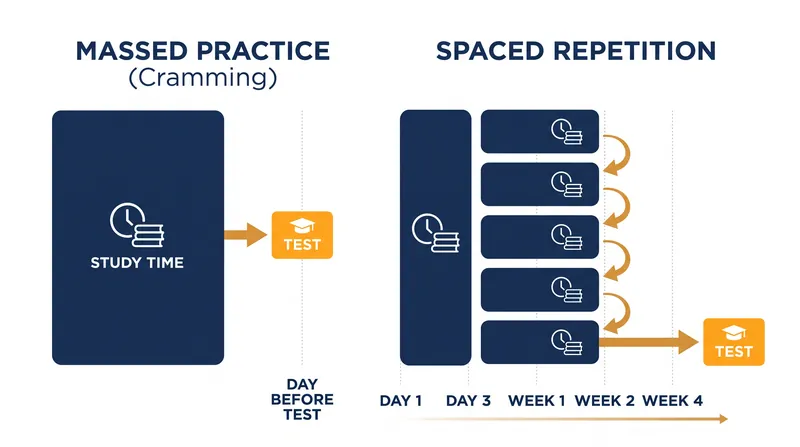
For generations, the default study strategy in K-12 education has been "massed practice"—the familiar ritual of cramming twenty spelling words, a chapter of history, or a set of math formulas the night before an exam. Massed practice feels highly productive in the moment because it creates a "fluency illusion." When a student re-reads a textbook for three hours, the material feels fresh and easily accessible in their short-term working memory. However, because the brain has not been forced to work hard to retrieve the information, the neural pathways remain fragile. The student may pass the test the next morning, but the knowledge typically evaporates within a few weeks, leaving them unprepared for cumulative final exams or advanced coursework.[1]
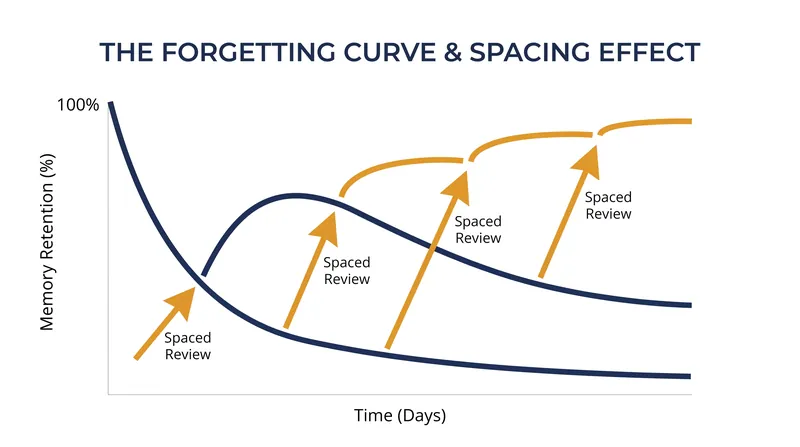
Today, a quiet revolution grounded in cognitive science is replacing that outdated model. Schools and independent learners are increasingly adopting spaced repetition, an evidence-based technique that interrupts the brain's forgetting curve. The actionable takeaway for educators and parents is straightforward: studying the same material for twenty minutes across three different weeks yields dramatically higher long-term retention than studying for an hour in a single sitting. By reviewing information at gradually expanding intervals—for example, one day after the initial lesson, then three days, then a week, and then a month later—students force their brains to reconstruct the memory just as it is beginning to fade.[2]
The engine driving the success of spaced repetition is a mechanism known as retrieval practice, or the testing effect. The American Psychological Association defines the testing effect as the finding that taking a test on previously studied material leads to significantly better retention than simply restudying it. Rather than viewing tests solely as assessment tools to measure what a student knows, cognitive scientists now recognize testing as one of the most powerful learning tools available. When a student actively pulls information out of their memory without looking at their notes, the effort required physically strengthens the memory trace and makes future retrieval faster and more reliable.[3][5]
The engine driving the success of spaced repetition is a mechanism known as retrieval practice, or the testing effect.
This process works because it introduces what psychologists call a "desirable difficulty." When a student reviews material immediately after learning it, the cognitive effort is low. But when they wait until the information is on the verge of being forgotten, the brain must work significantly harder to rebuild the connection between neurons. That productive struggle—the feeling of reaching for a word or formula that is just on the tip of the tongue—is precisely what triggers the biological mechanisms that make memories stick. Each successful retrieval under these conditions signals to the brain that the information is important and must be migrated into permanent long-term storage.
Implementing these strategies in a K-12 environment requires no expensive software or curriculum overhauls; it simply demands a shift in how classroom time is scheduled. Instead of teaching a concept, testing it on Friday, and moving on permanently, teachers are interleaving older material into daily routines. A common technique is the "brain dump," where students are given a blank sheet of paper and asked to write down everything they remember about a topic covered two weeks ago. Other classrooms rely on low-stakes, ungraded quizzes at the start of a period to reactivate prior learning. By removing the grade penalty, teachers encourage students to embrace the struggle of retrieval without the anxiety of a formal assessment.[1][2]

Despite the robust empirical data supporting spaced repetition, integrating it into traditional school environments presents distinct challenges. The primary hurdle is the standard academic calendar, which is often segmented into fast-paced, discrete units that actively discourage looping back to older material. Teachers frequently report feeling pressured by district pacing guides to cover new state standards rather than pausing to reactivate prior learning. Furthermore, retrieval practice inherently feels more difficult and frustrating for students than the comforting ease of highlighting a study guide. Earning student buy-in requires educators to explicitly teach the science of learning, helping children understand that the struggle to remember is a sign of brain growth, not a lack of intelligence.[1]
When successfully integrated, however, the combination of spaced repetition and retrieval practice does more than just boost academic outcomes. It fundamentally alters a student's relationship with learning and failure. By demonstrating that forgetting is a biological default that can be hacked through strategic timing, these methods build profound metacognitive awareness. Students learn to trust the process of effortful recall, reducing the severe test anxiety that typically accompanies last-minute cramming. As more districts train educators in the science of memory, the focus of K-12 instruction is slowly shifting from what teachers can put into students' heads to how effectively students can pull that information back out.[1]
Why it matters
For decades, students have relied on cramming—a method that guarantees they will forget most of what they learned within weeks. By adopting spaced repetition and retrieval practice, schools can permanently improve how children retain knowledge, reducing test anxiety and saving thousands of hours of wasted study time.
Competing readings
Cognitive Scientists
Researchers who study the mechanics of human memory and advocate for evidence-based study habits.
Cognitive scientists view the traditional K-12 reliance on massed practice as a fundamental mismatch with human neurobiology. They argue that the brain is designed to discard unused information to prevent cognitive overload. By introducing "desirable difficulties"—challenges that make learning feel effortful in the short term—retrieval practice forces the brain to reconstruct memories, thereby strengthening neural pathways. Researchers emphasize that the goal is not to make learning easy, but to make it durable, warning that the "fluency illusion" created by re-reading notes gives students a false sense of mastery.
Classroom Educators
Teachers tasked with implementing the science of learning within the constraints of traditional school calendars.
For classroom teachers, the appeal of retrieval practice lies in its flexibility and lack of required materials. Techniques like "two things" (asking students to recall two facts from the previous day) or low-stakes quizzes can be seamlessly integrated into daily routines. However, educators frequently point out the friction between spaced repetition and rigid district pacing guides. When state standards demand that a new topic be covered every few days, finding the instructional time to continuously loop back to months-old material requires significant planning and can feel at odds with administrative expectations.
Students and Parents
Families navigating the transition from traditional cramming to evidence-based study routines.
For students, the transition from cramming to spaced repetition often involves a difficult adjustment period. Because active retrieval highlights exactly what a student has forgotten, it can initially feel discouraging compared to the false confidence provided by re-reading notes. Parents navigating at-home study routines frequently have to unlearn their own educational habits, shifting from asking "Did you read the chapter?" to "Can you write down three things you remember from the chapter?" Once the initial friction passes, however, families report a significant reduction in the anxiety and conflict that typically surround high-stakes exam preparation.
The sequence
1885
German psychologist Hermann Ebbinghaus publishes his research on the 'forgetting curve,' demonstrating how quickly unreinforced memories decay.
1939
Herbert Spitzer conducts a massive study on 3,500 Iowa students, proving that testing improves long-term retention.
1978
Researchers Thomas Landauer and Robert A. Bjork formally test spaced repetition algorithms, proving their efficacy in vocabulary acquisition.
2006
The Institute of Education Sciences begins heavily funding cognitive science research to bridge the gap between laboratory memory studies and K-12 classrooms.
2019
The publication of 'Powerful Teaching' brings the concepts of retrieval practice and spaced repetition into mainstream K-12 professional development.
Jargon, explained
- Spaced Repetition
- A learning technique where material is reviewed at gradually increasing intervals to optimize long-term memory retention.
- Retrieval Practice
- The act of actively pulling information out of memory, such as taking a practice test, rather than passively re-reading notes.
- Massed Practice
- The common study method of concentrating review into a single, intensive session, colloquially known as cramming.
- Forgetting Curve
- A mathematical formula describing the rate at which the brain loses newly learned information if it is not actively reviewed.
- Desirable Difficulty
- A learning task that requires a considerable but manageable amount of effort, thereby improving long-term retention.
- Fluency Illusion
- The false sense of mastery a student feels when re-reading material, mistaking short-term recognition for long-term understanding.
What’s still unclear
- It remains unclear how to perfectly optimize spacing intervals for every individual student without relying on algorithmic software.
- Researchers are still studying how retrieval practice impacts students with severe working memory deficits or specific learning disabilities.
- The long-term effect of replacing traditional unit testing with continuous, interleaved assessment on state standardized test performance requires more longitudinal data.
Sources
Source coverage
5 outlets
3 viewpoints surfaced



[1]Factlen Editorial TeamEducational Synthesis
Synthesis by Factlen editorial team
Read on Factlen Editorial Team →[2]WikipediaCognitive Psychology Researchers
Spaced repetition
Read on Wikipedia →Testing effect
Read on Wikipedia →Forgetting curve
Read on Wikipedia →[5]American Psychological AssociationCognitive Psychology Researchers
Testing effect
Read on American Psychological Association →
Comments


Every angle. Every day.
Get education stories with full source coverage and perspective breakdowns delivered to your inbox.