
How Sloped Airbags Revolutionized Snowboarding Progression and Safety
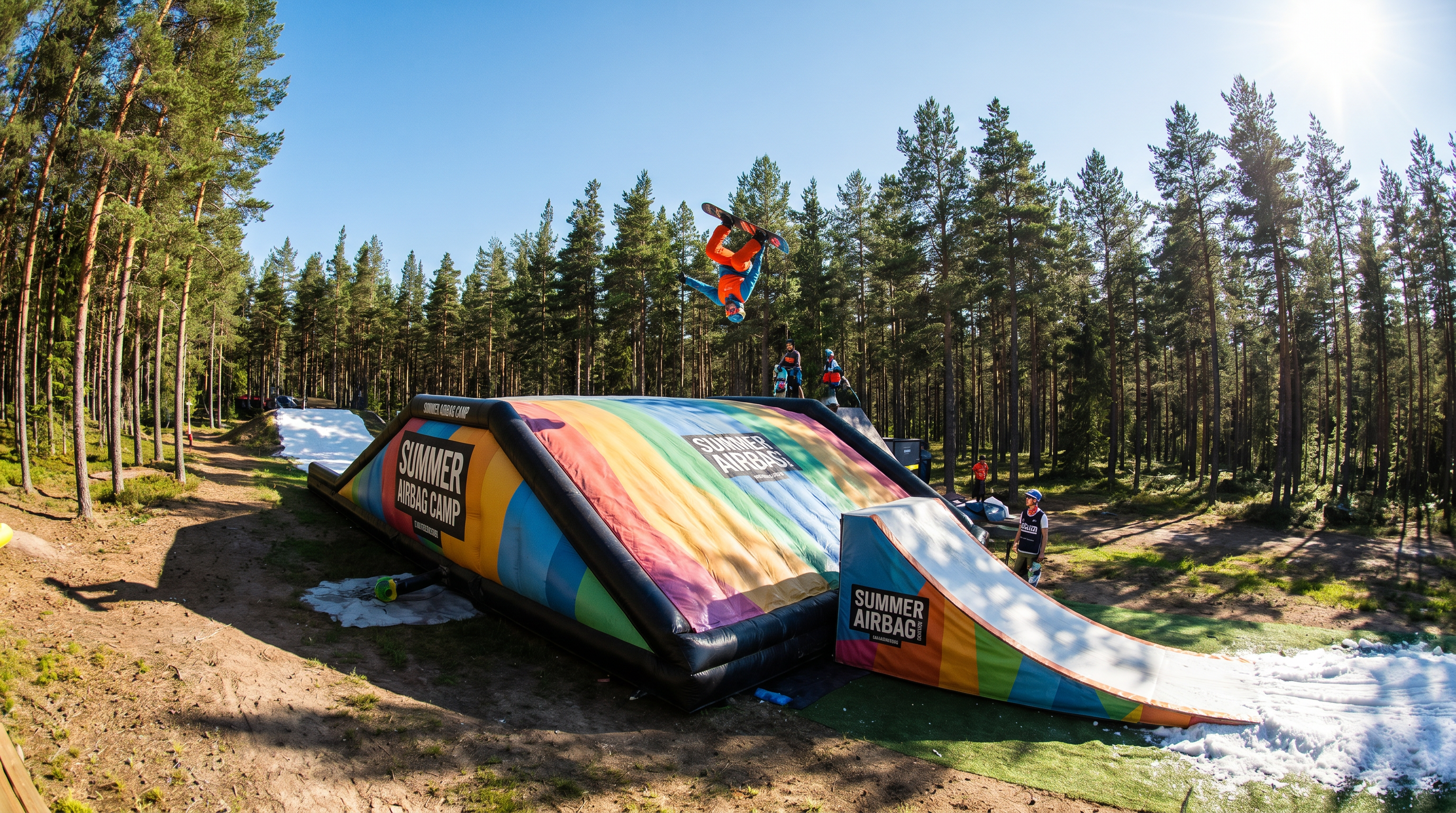
Massive inflatable landing zones have evolved from flat stunt cushions to highly engineered, sloped facilities. By mimicking the exact pitch of a snow landing, modern airbags allow athletes to safely master high-risk tricks before taking them to the mountain.
By Factlen Editorial Team
- Elite Athletes & Coaches
- Argues that airbags are essential for unlocking new axes of rotation and extending careers by avoiding the heavy impacts of trial-and-error on snow.
- Facility Engineers
- Focuses on the technical challenge of mimicking snow through dual-chamber pressure systems and low-friction topsheets.
- National Governing Bodies
- Views progression centers as critical infrastructure for developing competitive Olympic pipelines and ensuring athlete safety.
What's not represented
- · Medical professionals treating extreme sports injuries
- · Amateur riders without access to elite facilities
Why this matters
As freestyle tricks become increasingly dangerous, the physical toll on athletes has skyrocketed. These engineered training facilities democratize progression, allowing riders to safely learn maneuvers that would otherwise carry a high risk of catastrophic injury.
Key points
- Modern sloped airbags allow snowboarders to practice high-risk aerial maneuvers without the physical consequences of crashing on hard snow.
- Advanced topsheet materials enable athletes to land on their boards and ride away, building crucial muscle memory.
- Facilities utilize synthetic dry-slope in-runs, permitting year-round training regardless of weather or snow conditions.
- The technology has become mandatory infrastructure for Olympic programs, extending athletes' careers by reducing repetitive impact injuries.
The evolution of freestyle snowboarding has pushed the boundaries of human flight. With athletes now routinely executing triple and quadruple corks in competition, the margin for error has effectively vanished.[6]
In the past, learning a new rotation meant accepting the brutal physical consequences of failure. A rider would launch off a massive snow jump, attempt a new axis of rotation, and often endure a bone-rattling crash on hardpack snow if their timing was even slightly off.[6]
This high-stakes trial and error severely limited how quickly the sport could progress. Athletes could only endure a handful of heavy impacts per season before injuries sidelined them, forcing them to spend crucial development months in physical therapy.[6]
Today, the landscape of winter sports training has been completely transformed by the widespread adoption of sloped airbag facilities. These massive inflatable landing zones have become mandatory infrastructure for anyone looking to compete at the elite level.[6]

Early iterations of snowboard airbags were essentially flat, oversized stunt cushions. While they prevented catastrophic injuries, they forced riders to land on their backs or sink into a soft pit, interrupting the natural flow of the trick and providing limited transferability to real snow conditions.[4][5]
The technology has since undergone a radical redesign. Modern progression airbags are built on a steep incline, precisely mimicking the pitch and transition of a real mountain jump.[4]
This sloped architecture is paired with advanced "topsheet" technology—a non-grippy, non-abrasive surface layer that allows a snowboard or ski to slide smoothly upon impact.[4]
Instead of sinking into a foam pit, athletes can now spot their landing, touch down on their board, and physically ride away from the trick just as they would on a pristine powder day.[4]

Beneath the topsheet, sophisticated dual-chamber systems manage the impact. A firm lower foundation chamber protects the rider from the ground, while an adjustable upper chamber absorbs the fall.[4]
Beneath the topsheet, sophisticated dual-chamber systems manage the impact.
Facility operators can tune the pressure of this upper chamber. They can leave it incredibly soft for an athlete attempting a dangerous new flip for the first time, or firm it up to simulate the rigid resistance of a competition halfpipe.[4]
The scale of these facilities has grown to match the ambition of the athletes. At the Wy'East Mountain Academy in Oregon, a newly installed airbag measures a staggering 80 feet wide and 200 feet long.[2][3]
Recognized as the largest of its kind in North America, the Wy'East facility features a 30-foot-wide takeoff and an adjustable ramp that can alter both distance and pitch to accommodate different skill levels.[2]
Olympic legend Shaun White, an investor in the academy, recently inaugurated the massive jump. Despite a career defined by pushing the sport's limits, White noted that the sheer scale and safety of the new facility was unlike anything he had access to during his competitive peak.[2][3]
The U.S. Ski & Snowboard team has fully integrated this technology into its Olympic pipeline. The organization recently designated Woodward Copper in Colorado and Woodward Park City in Utah as official training centers through the 2026 Milano Cortina Games.[1]

By utilizing synthetic "dry slope" materials on the in-run, these facilities operate year-round. Athletes no longer have to chase winter across the globe to New Zealand or Switzerland just to maintain their aerial awareness.[2][4]
The true value of the airbag lies in repetition. An athlete can attempt a highly complex, high-risk maneuver dozens of times in a single afternoon, building vital muscle memory without the fear of a season-ending crash.[5]
However, coaches and athletes are quick to point out that airbags do not make snowboarding easy; they simply change where the difficulty is addressed.[5]
The transition from the forgiving surface of an airbag to the unforgiving reality of a frozen mountain remains a massive psychological and physical hurdle. The margin for error on snow is extremely small, and even a perfectly executed trick can become dangerous if the athlete lands slightly off-angle.[5]

On a real snow jump, a rider must contend with variable wind, changing snow conditions, and the absolute necessity of landing with perfect edge control to avoid catching a rail.[5][6]
Ultimately, these progression centers serve as a crucial bridge. By removing the physical trauma from the learning phase, airbags are extending athletes' careers and ensuring that the future of snowboarding is defined by gravity-defying progression rather than devastating injuries.[6]
How we got here
Early 2000s
Athletes begin using flat stunt airbags to practice basic aerial maneuvers, though landings remain unrealistic.
2016
Progression centers begin adopting sloped airbag designs, allowing riders to mimic the angle of a real mountain jump.
2022
U.S. Ski & Snowboard officially designates Woodward facilities as national training centers, cementing airbags in the Olympic pipeline.
2025
Wy'East Mountain Academy debuts an 80-by-200-foot sloped airbag, the largest of its kind in North America.
Viewpoints in depth
Elite Athletes & Coaches
The focus is on unlocking new tricks and extending careers.
For the athletes actually throwing their bodies into the air, the airbag is a career-extending necessity. Coaches emphasize that the ability to attempt a triple cork twenty times in an afternoon—without the risk of a blown knee or a concussion—allows for a pace of progression that was physically impossible a decade ago. It shifts the learning curve from a test of pain tolerance to a test of biomechanical precision.
Facility Engineers
The focus is on the technical challenge of mimicking the physics of snow.
Engineers behind systems like SunparkAirbag and Bagjump view the challenge as a physics problem. Their goal is to eliminate the 'bounce' of a traditional inflatable while providing enough resistance to simulate a snow landing. By developing dual-chamber pressure systems and low-friction topsheets, they have successfully created an environment where the kinetic energy of a landing is absorbed without halting the rider's forward momentum.
Traditionalists & Snow Purists
The focus is on the gap between controlled environments and the raw mountain.
While acknowledging the safety benefits, some purists worry about the 'airbag gap.' They argue that mastering a trick in a perfectly controlled, windless environment with a soft landing can create a false sense of security. When athletes transition these tricks to a real mountain, they must suddenly contend with flat light, icy transitions, and variable weather—variables that an airbag simply cannot replicate.
What we don't know
- It remains difficult to quantify exactly how much the psychological safety of an airbag alters an athlete's biomechanics compared to a real snow jump.
- The long-term impact of year-round dry-slope training on athletes' joints, compared to traditional seasonal rest periods, is still being studied.
Key terms
- Sloped Airbag
- An inflatable landing zone built on an angle to mimic the steep pitch of a real snow jump, allowing riders to ride away rather than sinking.
- Dry Slope
- A synthetic surface used on the in-run of a jump that mimics the grip and glide of snow, allowing year-round training.
- Topsheet
- The specialized, non-abrasive top layer of a modern airbag that allows skis and snowboards to slide smoothly upon landing.
- Progression Center
- A dedicated year-round facility utilizing airbags, trampolines, and dry slopes to help athletes safely learn new maneuvers.
Frequently asked
Do snowboarders actually ride away on the airbag?
Yes. Unlike older flat airbags where riders sank into a pit, modern sloped airbags use a slick topsheet that allows the athlete to land and slide to a stop.
Can anyone use these facilities?
While some massive setups are reserved for national teams, many progression centers and resorts offer introductory airbag sessions for intermediate riders looking to learn basic jumps safely.
Does landing on an airbag feel like snow?
It is much softer, but the sloped angle and adjustable pressure chambers simulate the physical timing and body position required for a real snow landing.
Sources
Source coverage
6 outlets
3 viewpoints surfaced






[1]U.S. Ski & SnowboardNational Governing Bodies
Woodward Copper, Woodward Park City Facilities Named as Official U.S. Ski & Snowboard Training Centers
Read on U.S. Ski & Snowboard →[2]Freeskier MagazineElite Athletes & Coaches
Wy'East Mountain Academy debuts record-setting airbag for North American riders
Read on Freeskier Magazine →[3]Portland MonthlyElite Athletes & Coaches
On an inflatable slope in the forest, elite athletes finesse their tricks
Read on Portland Monthly →[4]SunparkAirbagFacility Engineers
Snowboard Jump Airbag: The Ultimate Tool for Safer and More Effective Progression
Read on SunparkAirbag →[5]BagjumpFacility Engineers
From Airbag to Snow: Building Consistency Before Risk
Read on Bagjump →[6]Factlen Editorial TeamNational Governing Bodies
Synthesis by Factlen editorial team
Read on Factlen Editorial Team →

More in sports
See all 303 stories →Sports Science
How Carbon Fiber and Tensor Rubbers Transformed Table Tennis into a Supersonic Sport
7 sources

NBA Finals
Knicks Erase 29-Point Deficit in Historic Game 4 Comeback to Near NBA Title
8 sources

Sports Valuations
The Era of the $250 Million Women's Sports Franchise Has Arrived
7 sources

Player Transfers
Barcelona Signs 18-Year-Old Egyptian Striker Hamza Abdelkarim on Permanent Deal
7 sources

Every angle. Every day.
Get sports stories with full source coverage and perspective breakdowns delivered to your inbox.