
How Open-Weight AI Models Are Democratizing Local Computing in 2026
Advancements in model efficiency and consumer hardware have made it possible to run frontier-class AI entirely offline. Here is how open-weight models are shifting power away from cloud monopolies.
By Factlen Editorial Team
- Open-Source Advocates
- Developers and privacy advocates pushing for decentralized AI.
- Enterprise IT Leaders
- Corporate strategists balancing cost, security, and performance.
- AI Safety Researchers
- Policy experts concerned about the proliferation of unregulated models.
- Neutral Analysts
- Industry observers tracking the broader shift in computing architecture.
What's not represented
- · Hardware Manufacturers
- · Cloud Service Providers losing API revenue
Why this matters
The ability to run powerful AI models locally shifts control from massive cloud providers back to individual users and businesses. This democratization guarantees absolute data privacy, eliminates recurring subscription costs, and allows developers to build custom AI tools without relying on an internet connection.
Key points
- Developers can now run GPT-4-class AI models locally on consumer hardware.
- Open-weight models like Llama 4 Scout and Qwen 3 rival proprietary cloud APIs.
- Quantization techniques compress massive models to fit within standard computer memory.
- Local deployment guarantees absolute data privacy and eliminates recurring API costs.
- Safety researchers warn that local models bypass centralized moderation and guardrails.
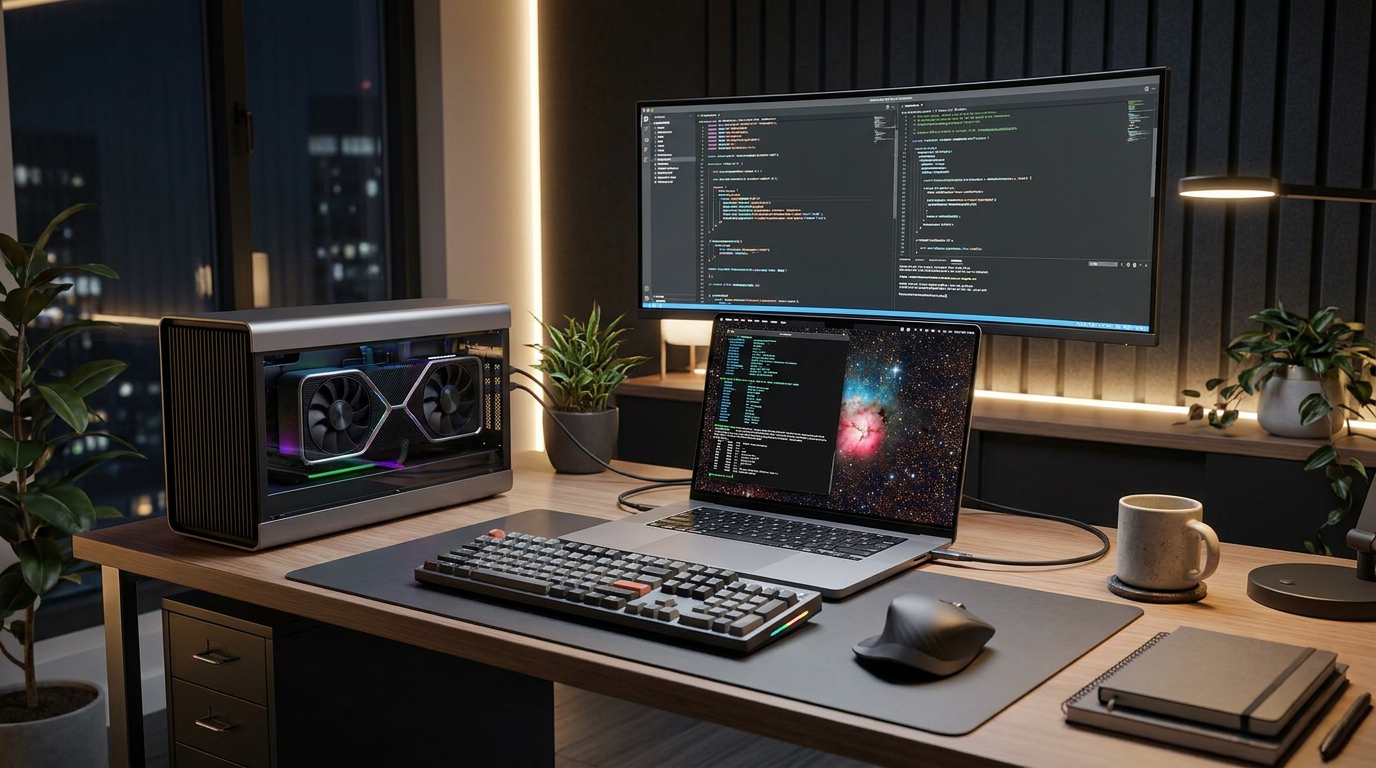
The artificial intelligence landscape has fundamentally shifted. Two years ago, running a highly capable large language model required massive cloud infrastructure, expensive enterprise API subscriptions, and a constant internet connection. The power to generate complex code, analyze vast datasets, and automate workflows was concentrated in the hands of a few centralized tech monopolies. Today, that dynamic has been upended. Developers, researchers, and small businesses are now running frontier-class AI entirely offline on consumer laptops and desktop workstations. This decentralization marks a new era in computing, shifting the locus of control from remote server farms directly to the user's local machine.[7]
The catalyst for this shift is the rapid maturation of "open-weight" models. Tech giants and independent research labs alike have released highly optimized architectures that rival, and in some cases exceed, the performance of proprietary cloud systems. By democratizing access to the underlying neural networks, these organizations have sparked a grassroots explosion of local AI development, allowing anyone with a modern computer to harness enterprise-grade reasoning capabilities without paying a per-token fee.[1][4]
Models like Meta's Llama 4 Scout, Alibaba's Qwen 3, and Mistral Small 3.1 have proven that smaller, efficient architectures can punch well above their weight class. These models are specifically designed to operate within the memory constraints of standard consumer hardware while maintaining deep multilingual support and advanced coding proficiency. Rather than relying on brute-force parameter counts, they utilize refined training data and mixture-of-experts architectures to deliver rapid inference speeds on local devices.[1][6]
But what exactly makes a model "open-weight" rather than "open-source"? The distinction is crucial for developers and enterprise legal teams navigating this new ecosystem. While the terms are often used interchangeably in casual conversation, they carry vastly different implications for commercialization, transparency, and vendor lock-in.[3]

Truly open-source software provides the underlying code, the exact training datasets, and the final product under a permissive license like Apache 2.0 or MIT. Open-weight models, however, typically release only the trained neural network parameters—the "weights"—but keep the proprietary training data and the specific training code hidden. This allows users to run and fine-tune the model, but prevents them from fully reverse-engineering the original training process.[1][3]
For the average user or hobbyist, this distinction is largely academic. You can download the model, run it locally, and own the inference process entirely. But for enterprise legal teams, the specific license terms dictate how the AI can be commercialized. Some open-weight models include clauses that require separate licensing agreements if a product exceeds a certain number of monthly active users, meaning companies must carefully audit their AI supply chain before deployment.[1][7]
The technical breakthrough enabling this local revolution is a process known as "quantization." Without quantization, the hardware requirements for modern AI would remain insurmountable for the average consumer, keeping the technology locked behind enterprise paywalls and cloud computing clusters.[4][5]
Large language models are essentially massive mathematical matrices. In their raw, uncompressed state, a model with 70 billion parameters requires immense amounts of Video RAM (VRAM) to function—often upwards of 140 gigabytes. This is far more memory than a standard computer or even a high-end gaming desktop possesses, making raw inference impossible outside of a dedicated data center.[5]
Quantization compresses these models by reducing the precision of their mathematical weights. By shrinking the data footprint from 16-bit floating-point numbers down to 4-bit or even 3-bit precision, a massive model can be squeezed into the 8GB to 16GB of VRAM found on modern consumer graphics cards or Apple Silicon Macs. This mathematical compression acts like a highly efficient zip file for neural networks.[4][5]

Quantization compresses these models by reducing the precision of their mathematical weights.
Remarkably, this compression results in a negligible drop in reasoning quality, but a massive gain in accessibility. What once required a dedicated server rack costing tens of thousands of dollars can now run quietly on a desk. Developers can interact with a quantized model in real-time, experiencing rapid token generation speeds that rival cloud-based APIs.[5]
The software ecosystem has evolved in tandem to make local deployment entirely frictionless. Just a few years ago, running a local model required navigating complex Python environments, managing dependencies, and writing custom inference scripts. Today, the user experience has been streamlined to mirror standard consumer applications.[4]
Tools like Ollama and LM Studio operate as the "Docker Hub" for local AI. Instead of writing code, users can now download and run an AI assistant with a single terminal command or through an intuitive graphical interface. These platforms automatically detect the host machine's hardware limits, allocate VRAM efficiently, and optimize the model's performance without requiring any manual configuration.[4][5]
The primary driver for adopting local LLMs in the enterprise sector is data privacy. When using cloud-based APIs, sensitive corporate data, proprietary source code, and personal customer information are inevitably transmitted to third-party servers. For highly regulated industries, this transmission represents an unacceptable security risk.[3][4]
Local models guarantee absolute data residency. Because the inference happens entirely on the user's device, the data never traverses the internet. A hospital can summarize patient records, a law firm can analyze confidential contracts, and a defense contractor can debug proprietary software—all with the mathematical certainty that their data cannot be intercepted, logged, or used to train future commercial models.[3][5]

Cost is the second major factor driving the migration away from the cloud. Cloud AI spending has skyrocketed in recent years, with companies paying per-token for every query, summarization, and code generation task. For high-volume applications, these recurring API costs can quickly cripple a project's budget.[1][3]
Open-weight models eliminate these recurring API costs entirely. Once the initial hardware is purchased, the marginal cost of generating text, analyzing documents, or writing code drops to the cost of electricity. This predictable cost structure allows startups and independent developers to experiment freely without watching a meter tick upward with every prompt.[1][4]
However, local deployment is not without its limitations. Consumer hardware still imposes a hard ceiling on context windows—the amount of text a model can remember and process in a single session. While cloud models can process entire books simultaneously, local models running on constrained VRAM must often limit their context to a few dozen pages before performance degrades or the system crashes.[3][5]
Furthermore, the democratization of powerful AI models removes the centralized safety guardrails that cloud providers enforce. When an AI is accessed via an API, the provider can monitor prompts, filter toxic output, and block malicious use cases. Once a model is downloaded locally, the developer loses all control over how it is utilized.[2]

Safety researchers warn that malicious actors can easily strip away safety fine-tuning from open-weight models. This raises concerns among policymakers about the potential for local AI to be misused for generating phishing campaigns, discovering software vulnerabilities, or facilitating cyberattacks without any oversight or moderation.[2]
Despite these challenges, the trajectory of the industry is clear. The future of artificial intelligence is increasingly hybrid. Massive cloud models will continue to handle heavy, complex workloads that require vast context windows, while fast, private, open-weight models running locally will become the default for daily coding, writing, and data analysis tasks.[3][7]
How we got here
Late 2023
Early open-source models like Llama 2 prove that capable AI can be run outside of proprietary cloud environments.
Mid 2024
Quantization techniques and tools like Ollama make local deployment accessible to non-technical users.
Early 2025
The release of highly efficient models like DeepSeek R1 and Mistral Small bridge the reasoning gap with cloud APIs.
May 2026
A new generation of models, including Llama 4 Scout and Qwen 3, establish local AI as a standard enterprise alternative for privacy-sensitive workloads.
Viewpoints in depth
Open-Source Advocates
Developers and privacy advocates pushing for decentralized AI.
This camp views local, open-weight models as a necessary bulwark against corporate monopolies. They argue that relying entirely on cloud APIs creates dangerous vendor lock-in and exposes sensitive data to third parties. By democratizing access to the underlying weights, they believe innovation will accelerate at the grassroots level, allowing small businesses to build bespoke tools without paying exorbitant per-token fees.
Enterprise IT Leaders
Corporate strategists balancing cost, security, and performance.
For enterprise decision-makers, the appeal of local LLMs is strictly pragmatic. They prioritize data residency and compliance, noting that highly regulated industries like healthcare and finance cannot legally send customer data to external AI providers. However, they also acknowledge the hidden costs of local deployment, pointing out that managing on-premise infrastructure, updating models, and ensuring hardware compatibility requires significant internal engineering resources.
AI Safety Researchers
Policy experts concerned about the proliferation of unregulated models.
Safety advocates warn that open-weight models remove the centralized kill-switches and moderation filters present in cloud APIs. Once a model is downloaded locally, malicious actors can easily strip away safety fine-tuning to generate phishing campaigns, exploit code, or harmful content. They argue that as local models reach frontier-level capabilities, the lack of deployment oversight poses a significant security risk that current regulations are ill-equipped to handle.
What we don't know
- Whether future open-weight models will face stricter government export or deployment regulations.
- How quickly consumer hardware memory bandwidth will scale to support unquantized frontier models.
- If the open-source community can maintain pace with the massive training budgets of closed-source labs.
Key terms
- Open-weight model
- An AI model where the trained parameters are publicly available to download and run, even if the original training data is kept private.
- Quantization
- A compression technique that reduces the memory footprint of an AI model by lowering the mathematical precision of its weights, allowing it to run on consumer hardware.
- VRAM (Video RAM)
- The dedicated memory on a graphics card, which is the primary bottleneck for loading and running large language models locally.
- Inference
- The process of a trained AI model generating a response or prediction based on a user's prompt.
Frequently asked
Can I run a local LLM on my laptop?
Yes. With tools like Ollama and quantization techniques, many modern laptops with at least 8GB of RAM can run smaller models like Mistral or Llama 4 Scout.
Are local AI models completely private?
Yes. Because the model runs entirely on your device's hardware, your prompts and data are never sent over the internet to a third-party server.
How do open-weight models compare to ChatGPT?
While the largest cloud models still hold an edge in complex reasoning, optimized local models now match or exceed the performance of GPT-4 class models from just a year ago.
What is the difference between open-source and open-weight?
True open-source includes the training data and code. Open-weight models only release the final trained model parameters, often with specific commercial use licenses.
Sources
Source coverage
7 outlets
4 viewpoints surfaced







[1]MediumOpen-Source Advocates
5 Open-Source AI Models You Can Run Locally (and Never Pay for Again)
Read on Medium →[2]Simon Institute for Longterm GovernanceAI Safety Researchers
Open AI Models: An Introduction
Read on Simon Institute for Longterm Governance →[3]MonterailEnterprise IT Leaders
Non-Technical Guide To Open-Source LLMs
Read on Monterail →[4]AIML InsightsEnterprise IT Leaders
Best Open Source LLMs for Local Use in 2026 Compared
Read on AIML Insights →[5]Sigma BrowserEnterprise IT Leaders
What Local LLMs Really Are and How They Work
Read on Sigma Browser →[6]Kilo CodeOpen-Source Advocates
Best Open-Source & Open-Weight Coding Models (2026)
Read on Kilo Code →[7]Factlen Editorial TeamNeutral Analysts
Synthesis by Factlen editorial team
Read on Factlen Editorial Team →

More in ai
See all 5 stories →

Every angle. Every day.
Get ai stories with full source coverage and perspective breakdowns delivered to your inbox.